
I would like to thank you all for the warm welcoming you gave me last week. It was very much appreciated and I’m sorry if I’ve worried you. My WordPress family is the best! And now that I have your attention, I’ll take the opportunity to tell you that I’ll be leaving again but this time for far different reasons. I’ve got a couple of things I had planned on doing as the New Year began but that flu bug caused a major change of plans. As a result, I had thought that I’d start a hiatus in a couple of weeks from now but then I received an email. My Zia and cousin from San Marino are coming to the States for a visit! I don’t know much more than that they will be arriving in Michigan sometime Friday. Whether I go to visit them, or, they come to Chicago to visit me has yet to be determined. Either way, though, I cannot wait to see them. So, rather than take time off for their visit, post a recipe or two, and then leave again, I think it best to just start my break a little earlier than planned. As always, thank you for your understanding and, again, for your thoughtfulness last week. I look forward to seeing you again very soon, and, with a little luck, bearing new family recipes.
* * *

* * *
Ah! Finally, the long-awaited agnolotti recipe featuring the filling that was first described to me by a sous chef in Bologna. You may recall that I experimented with another filling when I made Agnolotti del Plin last December. That filling was much softer and, consequently, I used a pastry bag in the process. That wasn’t possible with this filling.
From what I learned from that generous sous chef — I really wish I could remember her name — agnolotti, unlike stuffed pastas from other regions of Italy, are primarily meat filled. That’s definitely the case when you compare this 4-meat recipe to my family’s traditional ravioli filling. As I mentioned in the December post, fillings like this one were considered so rich that in Piemonte, where agnolotti originated, they were once served in a pile atop clean table linens, with no sauce or condiment at all. Now this is my kind of finger food!
Once you’ve determined a worthy filling — or located a hard-working sous chef willing to divulge family recipes — all that’s left to do is to make the pasta pillows. This is not as simple as one might think. When talking about the various stuffed pastas, aside from the fillings, very often the only other differences are in the shape of the pasta. Tortellini and ravioli, for example, are easy to differentiate. The first looks like a Bishop’s mitre and the second a square pillow, typically cut on all 4 sides. Agnolotti are almost exclusively hand-made and, as you’ll soon see, each is typically cut on 3 sides, the fourth being a fold. What’s this? You’ve seen ravioli made this way? Me, too. Some say all agnolotti are rectangular shaped. There are those that feel square-shaped is preferable. While still others claim that all agnolotti must be half-moon shaped. What? You’ve also seen ravioli made similar to each of these? Same here and that’s perfectly fine in my book. If you place a dish of home-made stuffed pasta before me, you can call them ravioli, tortellini, agnolotti, cappelletti, or pansôtti and you’ll have no argument with me. Deny me a second helping, however, and we’re sure to have a problem.
As I’ve mentioned, the filling for agnolotti is traditionally made using roasted meats. Traditionally, yes, but I cheated. I thought it wasteful to roast both beef and veal just to make agnolotti, particularly since I live alone. So, I bought some beef and veal, cut them into medium-sized cubes, and sautéed them in a little butter rather than roast them. This is the same method that we Bartolini use when preparing meats for our ravioli and cappelletti. The rest of the agnolotti recipe that I’ve shared is just as I was told by my Bologna sous chef. Gotta love that woman!
* * *

Caveat Canis
* * *
Agnolotti Recipe
Ingredients
- 8 oz (228 g) mortadella (see Notes)
- 8 oz (228 g) veal (See Notes)
- 2 tbs butter
- 8 oz (228 g) prosciutto crudo (See Notes)
- 8 oz (228 g) prosciutto cotto
- 4 oz (110 g) grated Parmigiano Reggiano (Pecorino Romano may be substituted)
- 1 egg, slightly beaten
- nutmeg, to taste
- salt and pepper, to taste
Make the Filling
- In a frypan over med-high heat, melt the butter before adding the beef chunks. Season lightly with salt and pepper and sauté until browned on all sides. Set aside.
- Repeat Step 1 using the veal chunks in place of the beef.
- Cut both types of prosciutto into cubes.
- Grind/mince the 4 meats using the meat grinder plate with the smallest holes. (See Notes)
- Once all have been ground, add the grated cheese and nutmeg, mix well, and taste to check seasoning. Add nutmeg, salt and pepper, if needed.
- Add the egg and mix until combined.
- Cover and refrigerate for several hours or overnight to allow the flavors to meld.
Make the Agnolotti
- At all times, beware of the dog.
- Make the pasta dough and let it rest for about 30 minutes.
- Roll a portion of the dough — using a machine or by hand — until quite thin. (See Notes)
- Place the dough strip on a lightly floured work surface, Use a pastry cutter to “square off” both ends.
- Evenly space balls of filling along one side of the dough strip about a half-inch away from the strip’s edge. I used a small ice cream scoop. (See Notes)
- Use a pastry brush or your finger tip to lightly moisten the dough on the inner side of the filling,
- Carefully fold the dough flap over the filling balls. Make sure the flap touches the filling balls. This will help in the next step.
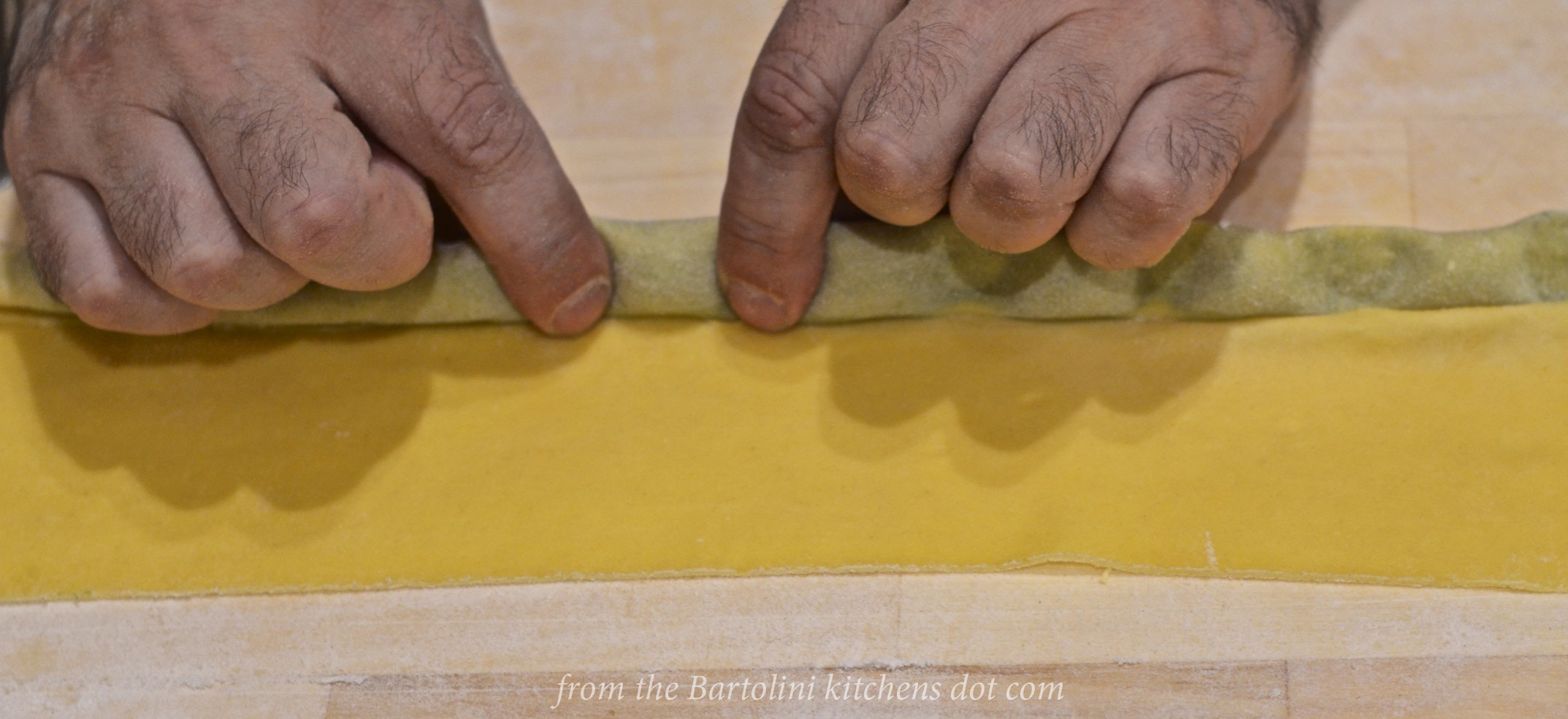
- Use your finger to press the dough between each filling ball before sealing the edge. Try to remove as much of the air as possible.
- Use a pastry cutter to cut between each agnolotto and to trim away any excess dough. Place on lightly floured linens or wax paper and use immediately or cover and refrigerate if to be used later that day. I’d recommend freezing them if cooking is to be be delayed much longer.
- To cook, bring a large pot of salted water to the boil. Add the agnolotti, lower the heat to a medium simmer, and cook for a few minutes. They will float when cooked but, if in doubt, taste one. It will take a few minutes longer to cook frozen agnolotti.
- Gently strain the agnolotti and dress with butter, olive oil, or any number of sauces. (See Serving Suggestion)
* * *


* * *
Serving Suggestion
I served these agnolotti just as the restaurant had dressed their tortellini, with a basic cream sauce. Take some heavy cream and, over medium heat in a small sauce pan, reduce until half its original volume. Add a bit of grated cheese — whichever cheese you used to make the agnolotti filling — and stir till combined. Dress the agnolotti with the cream sauce and serve garnished with more grated cheese and freshly ground pepper.
* * *
Notes
eta: When this was originally published, our friend and honorary Bartolini, Stefan of Stefan’s Gourmet Blog mentioned that he was aware of mortadella being used in the filling. I thought nothing more of it until I was adding this recipe to my upcoming cookbook and checked my original notes. He was, in fact, correct. I had misread my scrawl from that evening, interpreting “meat” to mean beef when, in reality, I had written “mort” for mortadella. I’ve changed the recipe here to reflect the correction. Thanks, Stefan. You’re the best!
If you do not wish to use veal or cannot find some that is relatively humanely raised, feel free to use only beef. Cubed chuck works fine.
When buying the prosciutto, have them cut you a slice that is about 1/4 to 1/3 inches (.6 to .8 cm) thick. That should give you an amount that will work fine with this recipe.
You’ll find that you meat grinder works better if the meat is placed in the freezer for 30 to 45 minutes before use.
If you haven’t a meat grinder, you can use your food processor instead. Place the meat into the bowl and pulse-process until ground to your satisfaction, A little texture is a good thing, so, don’t process until the meat is completely smooth.
There are 2 types of Italian prosciutto, crudo and cotto. Prosciutto crudo – raw – is the kind that most of us know and that can be found at just about any deli counter. Prosciutto cotto – cooked – is the Italian version of baked ham and is a bit harder to find. If you cannot find prosciutto cotto in your area, feel free to substitute baked ham, low-sodium is preferred.
Be careful when adding nutmeg to the filling. A little goes a long way. It’s best to add it in small increments, tasting as you go.
Unless you use pasteurized eggs, all tasting of the raw filling should be done before the raw egg is added, to eliminate the risk of salmonella poisoning.
The settings for my pasta roller attachment start at 1, the thickest setting, and run to 9, its thinnest. When making agnolotti, I roll the dough up to and including the 7th setting.
The amount of filling used will eventually determine the size of the agnolotti. Using a small ice scream scoop, I can maintain about a teaspoon-sized filling ball for all the agnolotti.
When cooking any freshly made stuffed pasta, once the pasta has been added and the water has returned to the boil, lower the heat lest the pasta becomes damaged during the remainder of the cooking process.
* * *
It’s déjà vu all over again …
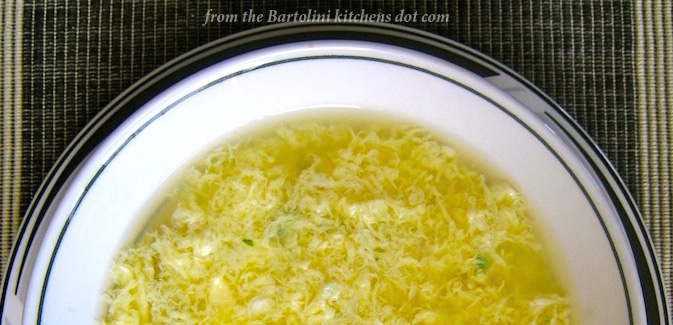
It’s still soup season in these parts and today’s look back focuses on a good one. Stracciatella soup got its name because it looks like torn rags but I guarantee there’s nothing shabby about it. Easy to make and oh, so very satisfying, you can find the recipe HERE.
* * *
Coming soon to a monitor near you …

New York Style Cheesecake
* * *
















 from the Bartolini kitchens