The Ketchup that Came Down the Mountain

I’ve mentioned it in the past and it bears repeating: blogging continues to surprise me in ways I never dreamt possible. One need look no further than my dining room table to see what I mean. There, in jars of all shapes and sizes, you’ll find preserves, jams. jellies, pickles, pickled peppers, brandied figs, apple sauce, corn relish, and ketchup. You may recall that I was the guy that swore he’d never can anything. Now it looks like I’m stocking a bunker for a nuclear holocaust. Look closely, however, and you’ll soon find the Belle of the Ball … well, Ball Jar. I’m talking about the ketchup and that’s the recipe I’ll share today.

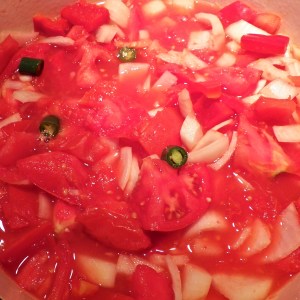
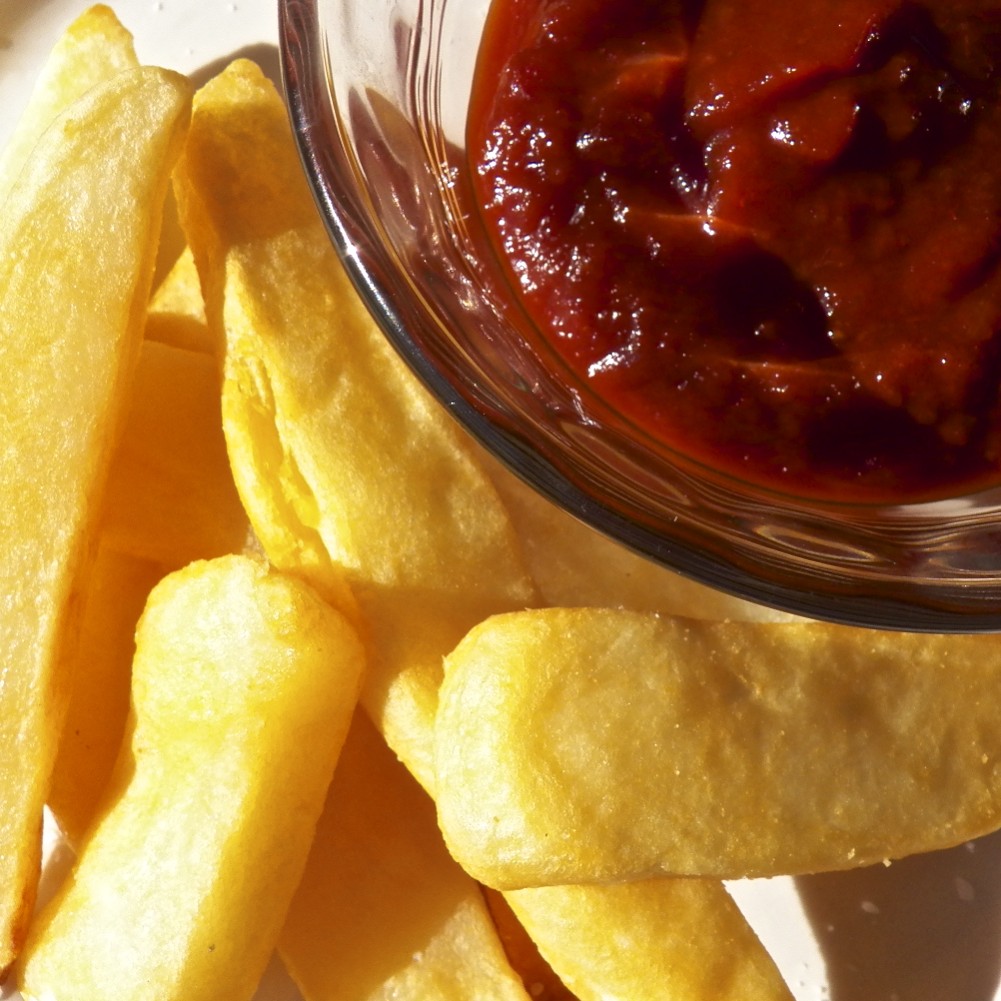
Way back in September of 2011, my blogging friend Tanya, of Chica Andaluza fame, posted a recipe for “Up The Mountain Spicy Tomato Ketchup.” With this area’s farmers markets still flush with tomatoes, I bought a couple pounds and decided to give her recipe a try. Knowing how spicy things can get up that mountain, however, I did tweak the recipe to cool it down just a bit. And the result? This is one exceptional ketchup. In fact, it hardly seems right to call it ketchup for this isn’t at all like the bottle of red stuff on your grocer’s shelf — and that goes for all 57 varieties! Tanya’s sauce is so good that I actually felt like I was wasting money the last time I was without and needed to buy ketchup. But don’t just take my word for it. I’ve given jars of Tanya’s ketchup to friends and family alike, all of whom, without exception, sing its praises. And to all of my fellow Chicagoans, this ketchup is good enough to be served on a hot dog! Yes, it’s that good!

There’s only one possible issue worth mentioning. It is best to simmer this sauce slowly and to stir it frequently. If you don’t you could end up with a splattered mess or, worse yet, a scorched pan bottom. A splatter screen may help prevent the mess but a scorched bottom can ruin the entire batch of ketchup. If you suspect that the ketchup has begun to burn, do not use a spoon to scrape the bottom of the pan. That will only foul your ketchup. Better to dump the pot’s contents into a large bowl and clean the pan’s bottom before re-filling it with the ketchup and continuing the simmer. Bear in mind, the lower the simmer, the longer the time required to get a thick, rich ketchup. For me, this job will easily last a full afternoon.

 *     *     * 

Home-Made Ketchup Recipe

Ingredients

  • 8 lbs. (approx 3.5 kg) tomatoes, roughly chopped
  • 4 large onions (yellow, sweet, red, or any combination), chopped
  • 2 red bell peppers, chopped
  • 2 Serrano peppers, chopped
  • 1 jalapeño, chopped
  • 4 garlic cloves, peeled and smashed
  • 1 cup cider vinegar
  • ¾ cup dark brown sugar
  • ½ tsp dry mustard
  • 2 cinnamon sticks
  • 2 tsp whole cloves
  • 2 tsp whole allspice
  • 2 tsp mace
  • 2 tsp celery seeds
  • 2 tsp smoked paprika
  • 2 tbsp black peppercorns
  • 2 bay leaves
  • cayenne pepper, to taste
  • nutmeg, to taste
  • salt, to taste

Directions

  1. Use a piece of cheese cloth to form a pouch into which you’ll add the cinnamon sticks, allspice, cloves, mace, celery seeds, peppercorns, and bay leaves. Use butcher string to enclose and securely tie the herbs & spices. Set aside.
  2. Place the tomatoes, onions, peppers, and garlic into a heavy bottomed saucepan over med-high heat. Bring to a boil, reduce to a simmer, and cook until the ingredients are all soft, 30 to 45 minutes.
  3. Once the tomato mixture has softened, pass it through a food strainer, food mill, or fine meshed sieve to separate peel and seeds from the pulp.
  4. Return the strained pulp to the saucepan, along with the brown sugar, mustard, paprika, cider vinegar, and spice pouch. Stir to combine over med-high heat. Bring to a boil, reduce to a simmer, and continue for 45 minutes, stirring occasionally to prevent scorching. Remove the pouch.
  5. At this point, continue to simmer until the ketchup has reached the consistency you prefer. This could take anywhere from 30 minutes to several hours.
  6. Once it has reached the desired thickness, add cayenne pepper, ground nutmeg, and salt, to taste.
  7. Once the seasonings have been adjusted, you can either bottle it for storage in the refrigerator where it will keep for about a month, freeze it, or, you can process it in a boiling water bath for 35 minutes if using pint jars and 40 minutes if using quart-sized canning jars.

With thanks to: Chica Andaluza, “Up The Mountain Spicy Tomato Ketchup

 *     *     * 

Notes

You may have noticed that the spice pouch was removed after simmering for 45 minutes. That’s because the tomatoes will continue to reduce for some time afterward and that will serve to concentrate all the flavors in that pot. To leave the spice pouch in the tomato mixture for too long could render the ketchup inedible. You can always adjust the seasoning at the end of the cooking, just as one does with the cayenne, salt, and pepper.

Living as far North as I do, finding good tasting tomatoes from now until Spring is pretty much impossible. Even so, I’ll still use off-season, or even canned, tomatoes to make ketchup during the Winter and Spring months, adding tomato paste to boost the tomato flavor. Although this version may not quite equal the taste of ketchup made from Summer’s best, it is still leagues ahead of any ketchup you might buy at a store.

 *     *     *
Grilled Chicken with Tomato Jam Glaze

*     *     *

One last word about tomatoes …

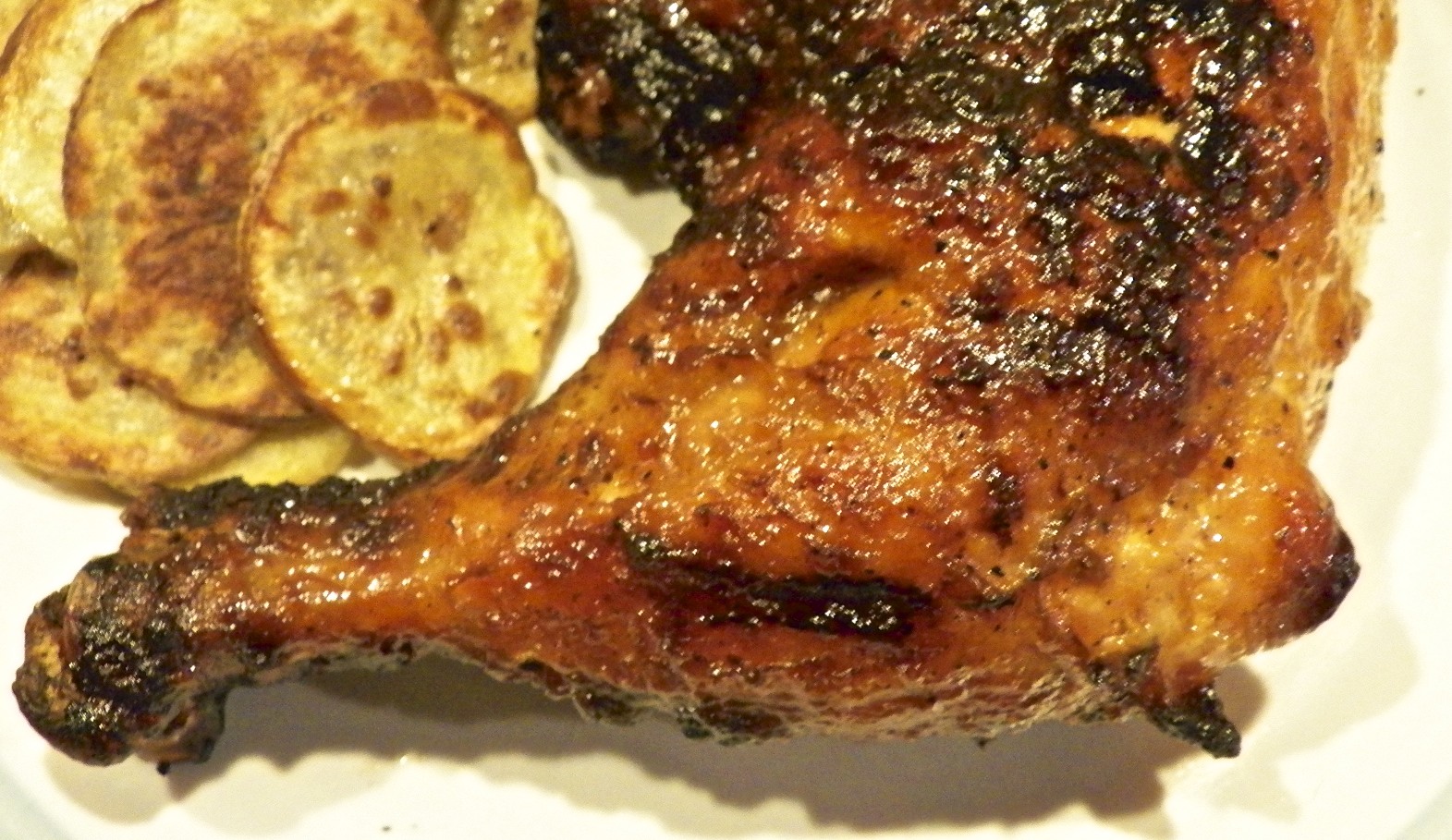
In September, Marie posted a link to a recipe for tomato jam that used yellow heirloom tomatoes and basil. I spoke to Zia about my intention to try my hand at making the jam and that triggered a memory of Grandma making tomato jam when Mom & Zia were little girls. Grandma’s version didn’t use basil and, though the tomatoes she used would be considered “heirloom” by today’s standards, back then they were just “tomatoes.” Well, in an effort to bridge the gap between New and Old, I made tomato jam that weekend with yellow heirloom tomatoes but without the basil.  And the result? Like almost all the jams I’ve made, it goes very well with goat cheese. (Is there a jam or preserve that doesn’t go well with goat cheese?) Not only that but I was surprised to find out just how good it worked as a glaze for barbecued chicken. Next time, though, I’m adding a few red pepper flakes and a dash of hot sauce to the glaze. Of course, you can always serve it like my Grandma did for her girls: on a chunk of Italian bread.

*     *     *

It’s déjà vu all over again …

As a boy, vegetables were very much a part of my family’s diet. Whether picked fresh from Grandpa’s garden or selected at a grocery or market, you could count on a salad of fresh greens and at least one vegetable being served at every dinner.  Mom’s favorite, and frequent star at our supper table, was Swiss chard. Mom enjoyed it enough to commandeer a small patch of Grandpa’s garden so that she could grow her own.  Now that’s some serious chard love!  Very often, Mom would use a combination of chard & spinach to fill small pies, cacioni, from a recipe that came from Dad’s homeland, San Marino. Click HERE to check out the recipe for this family favorite.

*     *     *

Coming soon to a monitor near you … 

Sausage Ravioli

Sausage Ravioli

*     *     *
Crostini e Bruschette

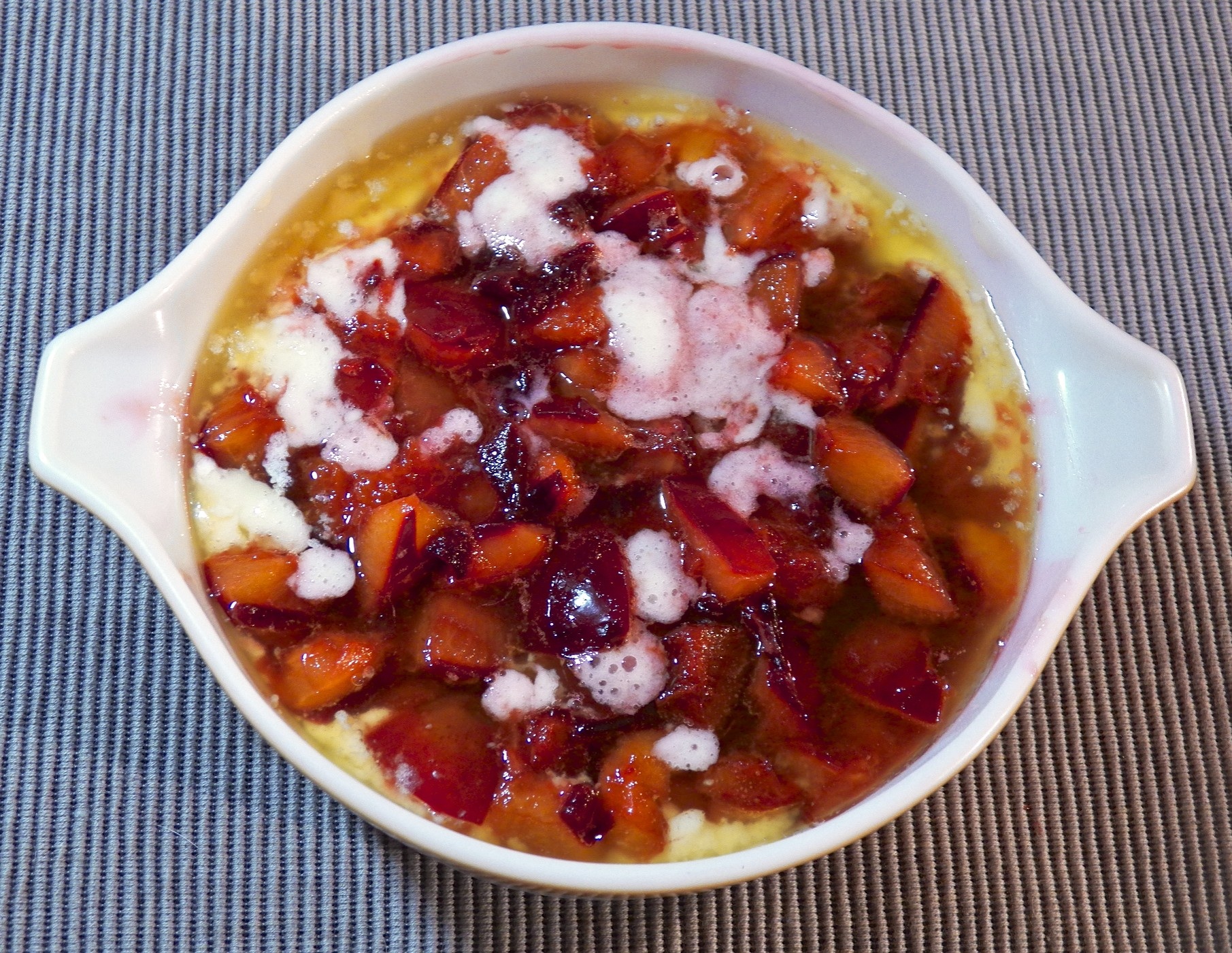
A few weeks ago I posted my last recipe in the series of making cheese at home, Italian Mozzarella. Within that post were photos of crostini & bruschette and, with the holidays quickly approaching, I thought this the perfect time to share both recipes. Besides, if you were successful and made a couple of pounds of mozzarella, eventually you’re going to tire of eating it “by the chunk” — and that’s when these recipes will come into play.

First a definition of terms. The word crostini means little toasts, whereas bruschetta has as its origin bruscare, to char or roast. They sound pretty similar to me. I’ve always thought the difference to be in the bread used. When I make crostini, I use a baguette, thinly sliced on the diagonal. For bruschette, I use a thicker slice taken from a loaf of Italian bread. I toast both before piling on the fixin’s and sometimes pop them back into the oven afterward. It really does depend on what’s being used to top each off. And speaking of the fixin’s, you can use pretty much anything you like.  Just stick with fresh ingredients and you won’t go wrong.

About a year ago, I posted a recipe for Gorgonzola and Honey Bruschette. At the time, I mentioned that I often use my toaster to toast the bread beforehand and store it in airtight containers until needed later that day. This is particularly helpful when entertaining. It’s just one less thing to worry about.  No matter when you toast the bread, though, try to serve these bruschette directly after preparation or they may become sodden.

 *     *     *

 *     *     *

Mozzarella and Tomato Bruschette Recipe

Ingredients

  • ⅔ inch (1.7 cm) slices of Italian bread
  • plum tomatoes, seeded and chopped
  • garlic, minced
  • a few tbsp of sweet onion, diced
  • fresh mozzarella, cut in 1/2 inch cubes
  • fresh basil leaves, hand torn
  • Italian seasoning
  • olive oil
  • Balsamic vinegar
  • dried oregano
  • salt & pepper

Directions

  1. Slice bread, brush with olive oil, and toast lightly
  2. Add a couple of tablespoons of olive oil to a frying pan over medium heat. Add the onion and garlic, sautéing for about a minute. Do not let the garlic burn.
  3. Add the tomatoes, season with salt and pepper, and cook until heated through.
  4. Remove from heat, add the basil, Italian seasoning, balsamic, and olive oil. Mix well and taste before seasoning with salt and pepper. Set aside.
  5. Add the cubed mozzarella once the tomato mixture has cooled to room temperature.
  6. When ready to serve, spoon some of the tomato-mozzarella mixture on top of each toasted bread slice, season lightly with salt and cracked black pepper, and garnish with a light sprinkling of dried oregano.

 *     *     *

 *     *     *

Crostini alla Caprese Recipe

Ingredients

  • ½ inch (1.2 cm) thick slices of baguette, cut on the diagonal
  • cherry tomatoes, sliced in half
  • fresh mozzarella, cut in ¼ inch (.6 cm) slices
  • fresh basil leaves
  • olive oil
  • red wine vinegar
  • salt & pepper

Directions

  1. Slice bread, brush with olive oil, and toast lightly.
  2. Pre-heat oven to 400˚F (204˚ C).
  3. Place tomatoes in a bowl, season with salt & pepper, and drizzle with olive oil.
  4. Place tomatoes on a baking sheet and then into the oven to roast for about 15 to 20 minutes. Do not allow to roast so long that the tomatoes completely collapse.
  5. Meanwhile, place a slice of fresh mozzarella and then a few small basil leaves atop each piece of toast.
  6. Remove tomatoes from the oven and when cool enough to handle, place one tomato half, cut-side down, on each piece of the toast with mozzarella and basil. If you prefer, add a light drizzle of olive oil and a few drops of red wine vinegar.  Serve immediately.

*     *     *

Notes

These antipasti should be made using fresh mozzarella. No, you needn’t make it yourself and you can find it now in most large grocery stores. Just to be clear, I’m not talking about the pre-shredded stuff used when making pizza. Fresh mozzarella is usually ball-shaped and is often packaged in water/whey. If you’re unsure, ask a person working at your store’s deli counter for assistance.

*     *     *

It’s déjà vu all over again …

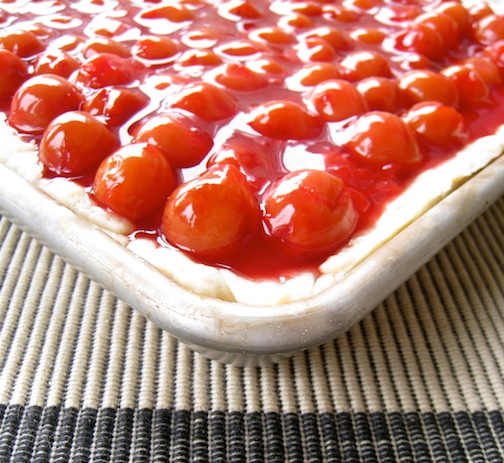
Since this post is somewhat party themed, I thought it best to resurrect a recipe that’s perfect when entertaining a large group. Cut into 3 inch squares, your guests will have no trouble munching on this bit of cheesecake while sipping on their cocktails, You can find the recipe for this Cherry Cheesecake Pizza by clicking HERE. If you need help deciding which cocktail(s) to serve, do what I do. Click HERE or HERE. While you’re there, be sure to take some time to check out both Greg’s and John’s blogs. You won’t be disappointed.

*     *     *

Coming soon to a monitor near you …

The Ketchup That Came Down The Mountain

*     *     *

The Proverbial Last Rose of Summer

“Sunset Celebration”

*     *     *

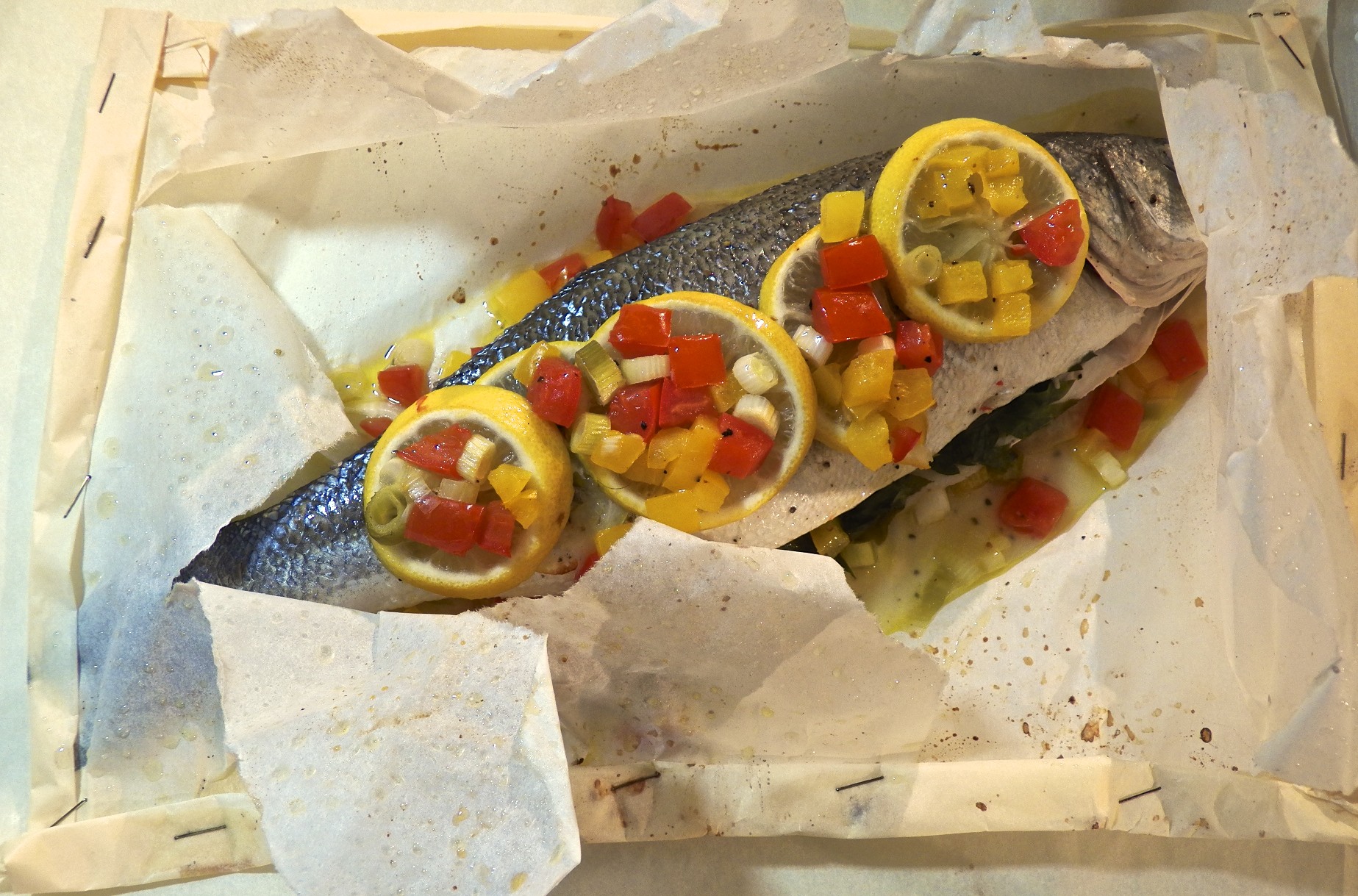
Mediterranean Sea Bass in Parchment

Branzino al Cartoccio

During the past 6 months, I’ve discovered not just an Italian market with an extensive fish counter but 2 fish mongers, as well. Their impact upon my diet has been incredible and I’ve enjoyed a far greater variety of seafood than ever before.  I’ve not seen some — whiting (merluzzo), eels (anguille), octopus (polipo) — since I was a boy. Others — clams (vongole), squid (calamari), red snapper, and the like — may have been more readily available but the fish and calamari were often frozen and finding clams was a hit-or-miss affair. So, suddenly having 3 sources for fresh (affordable) seafood is mind-boggling and I’ve taken full advantage of them. Mediterranean sea bass (branzino) is a case in point.

Up until I found the Italian market, branzino was something I only saw on the menus of restaurants. My usual sources for seafood certainly weren’t going to carry it, although I suppose I may have been able to order one. You can imagine my surprise when I looked at the market’s fish counter one day and saw no less than a dozen fresh branzini on display. I just could not pass them by — even though I was leaving for Michigan the next morning. I bought one, packed it in ice overnight, repacked it in ice in my cooler for the trip, and we arrived in Michigan, fresh as daisies, the next afternoon. After a quick run to a grocery, I fixed today’s recipe for Zia that night.  Unfortunately, the pictures from that dinner were too dark to be used in a post, so, I was forced to prepare the dish again here at home. I know. The sacrifices we bloggers must endure.

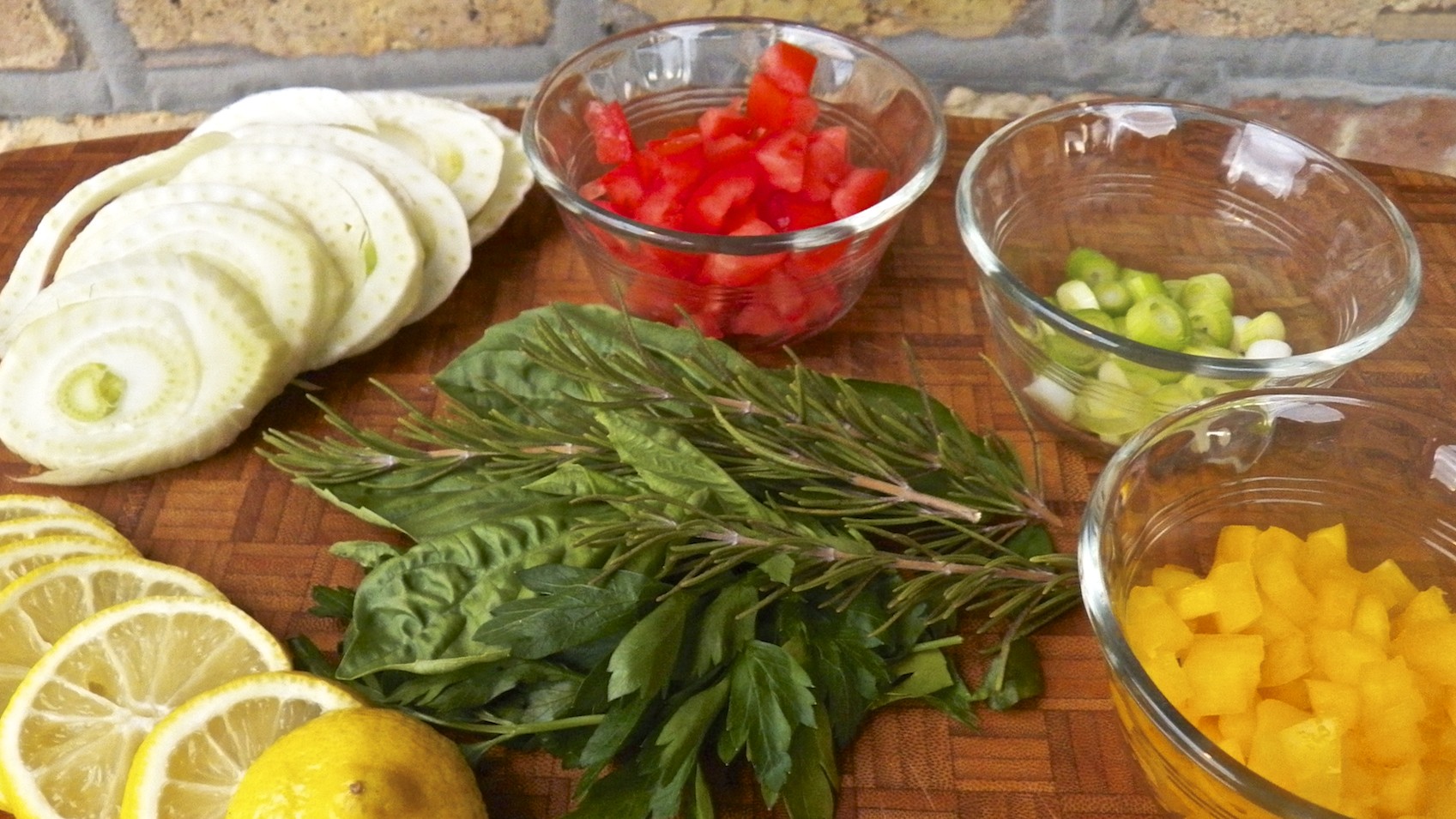
By now, you’ve probably surmised that al cartoccio is Italian for “in parchment.” For this dish, because of its length, I used 2 sheets of parchment paper to enclose the fish. With a smaller branzino, you may be able to use a single large sheet, folded in half.  Although this is a recreation of our meal that night, it’s not exactly what I had planned for us. True to form, I forgot to bring a few ingredients with me and her area’s markets did not have them in supply. The fish was nonetheless delicious but, if you’re interested, the “Mediterranean style” mentioned in Variations below is what I had originally intended for that evening.  No matter how you decide to prepare your fish, be sure to set aside a few of the diced vegetables and chopped herbs to be used as garnish before serving. They’ll add both texture and freshness to the dish.

*     *     *

Branzino al Cartoccio Recipe

Ingredients

  • 1 branzino, cleaned, scaled, fins trimmed and, if desired,  head and tail attached
  • 1 fennel bulb thinly sliced
  • thinly sliced lemon
  • diced yellow bell pepper
  • diced, cored, & seeded tomato
  • chopped scallions
  • a couple stems of fresh basil
  • 1 or 2 rosemary branches
  • a few parsley stems
  • white wine
  • olive oil
  • salt & pepper
  • 2 sheets of parchment paper
  • additional diced vegetables with hand-torn basil & parsley for garnish

*     *     *

Oven Ready

*     *     *

Directions

  1. Pre-heat oven to 400˚F (204˚C).
  2. Place a large sheet of parchment paper on a large baking sheet.
  3. Place the sliced fennel in a straight line, forming a bed for the fish.
  4. Use a sharp knife to score both sides of the fish. Do not cut through the backbone. Depending upon its length, 3 or 4 parallel cuts should be made into each side of the fish. Season the fish, inside and out, with salt & pepper.
  5. Lay the fish on top of the fennel bed. Stuff the cavity with a loose bundle made with all the herbs.
  6. Cover the top of the fish, from gill to tail, with lemon slices and cover them with the chopped vegetables.
  7. Sprinkle a little wine across the entire fish and then repeat with olive oil.
  8. Cover the baking sheet with another sheet of equally sized parchment paper.
  9. Beginning on one side, grab the edges of both sheets of paper, fold them twice together, and use a stapler to permanently attach them to each other.
  10. Repeat Step 9 on the remaining 3 sides, creating a sealed pouch for the fish.
  11. Lightly brush the pouch’s top with olive oil before placing the pouch and baking sheet in the pre-heated oven.
  12. Bake for 20 to 25 minutes, depending upon the thickness of the fish. See Notes below.
  13. Slide the pouch on to a serving platter and bring to the table. Pierce the top but be careful of the steam’s release. Peel back the paper to reveal your main course and serve, garnished with the reserved diced vegetables and chopped herbs.

*     *     *

Pronti!

*     *     *

Variations

If you prefer a more Mediterranean style, add some chopped olives to the vegetables, add some fresh oregano to the herbs within the cavity, and use a little dried oregano to season the chopped vegetables. Oregano is a strong-tasting herb. Be careful not to use too much. Feel like something from South of the  (US) Border? Swap cilantro for the parsley, add a little chopped jalapeño to the vegetables, and maybe a pinch or two of cumin. And no matter style you follow, you can’t go wrong with capers — unless you forget to add them like I did when I prepared this fish.

*     *     *

*     *     *

Notes

The cooking times may vary depending upon the size and thickness of the whole fish or even the fillets, if used. Though the pouch will protect your fish from drying out to a point, you don’t want to let it cook too long. A good rule of thumb for this or any fish roasted in parchment is to listen for the sizzle coming from inside the pouch. Most whole fish will be finished cooking from 7 to 9 minutes from that point; fillets will be finished in about 5 minutes.

You may have noticed that I used staples instead of a series of folds to seal the parchment ends. Once I saw Alton Brown do this, I abandoned the origami method of sealing the pouches. This is so much easier and reliable, especially when preparing a fish large enough to require 2 sheets of parchment paper.

*     *     *

It’s déjà vu all over again …

I’m just finishing up with this year’s canning, preserving, and pickling. One family favorite that I shared last year is the recipe for Zia’s Corn Relish. It’s a simple pickle, actually, and results in a great little condiment to serve with virtually any protein. It’s a little bit o’ sunshine on your dinner plate and who wouldn’t like that in the cold months ahead? Now, don’t worry if the “good” fresh corn is no longer available. Frozen corn can easily be used to make this relish and you can see the recipe by clicking HERE.

 *     *     *  

Coming soon to a monitor near you …

Crostini

 *     *     *

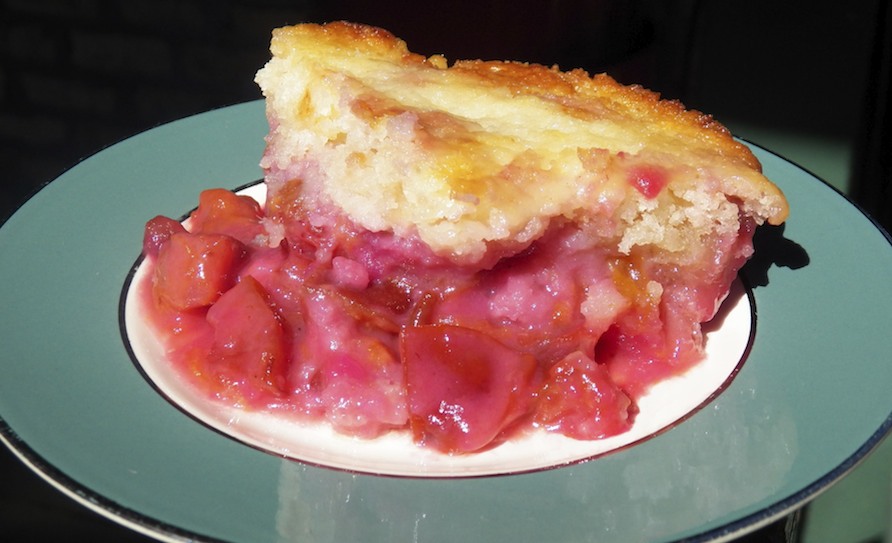
This Plum Cobbler is Magical!

You may recall that I shared a peach cobbler recipe a few weeks ago. Somewhere along the line, I mentioned having another recipe for cobbler, one where the topping starts in the bottom of the baking dish but rises to the occasion during baking, giving you a perfectly formed topping to the rich fruit/berry filling. How can this be?

**********

Do you believe in magic?

**********

I’ve made this cobbler more than a few times over the years. Peaches, plums, strawberries you name it, I’ve used them all. It’s an easy recipe, a fast recipe, and one that is sure to please everyone at your table. Just bear in mind that the topping of this cobbler, unlike the peach cobbler recipe I shared HERE, is more cake-like than biscuit. I happen to like them both and now you’ll have a choice.

The recipe is as easy as 1, 2, 3 …

*********

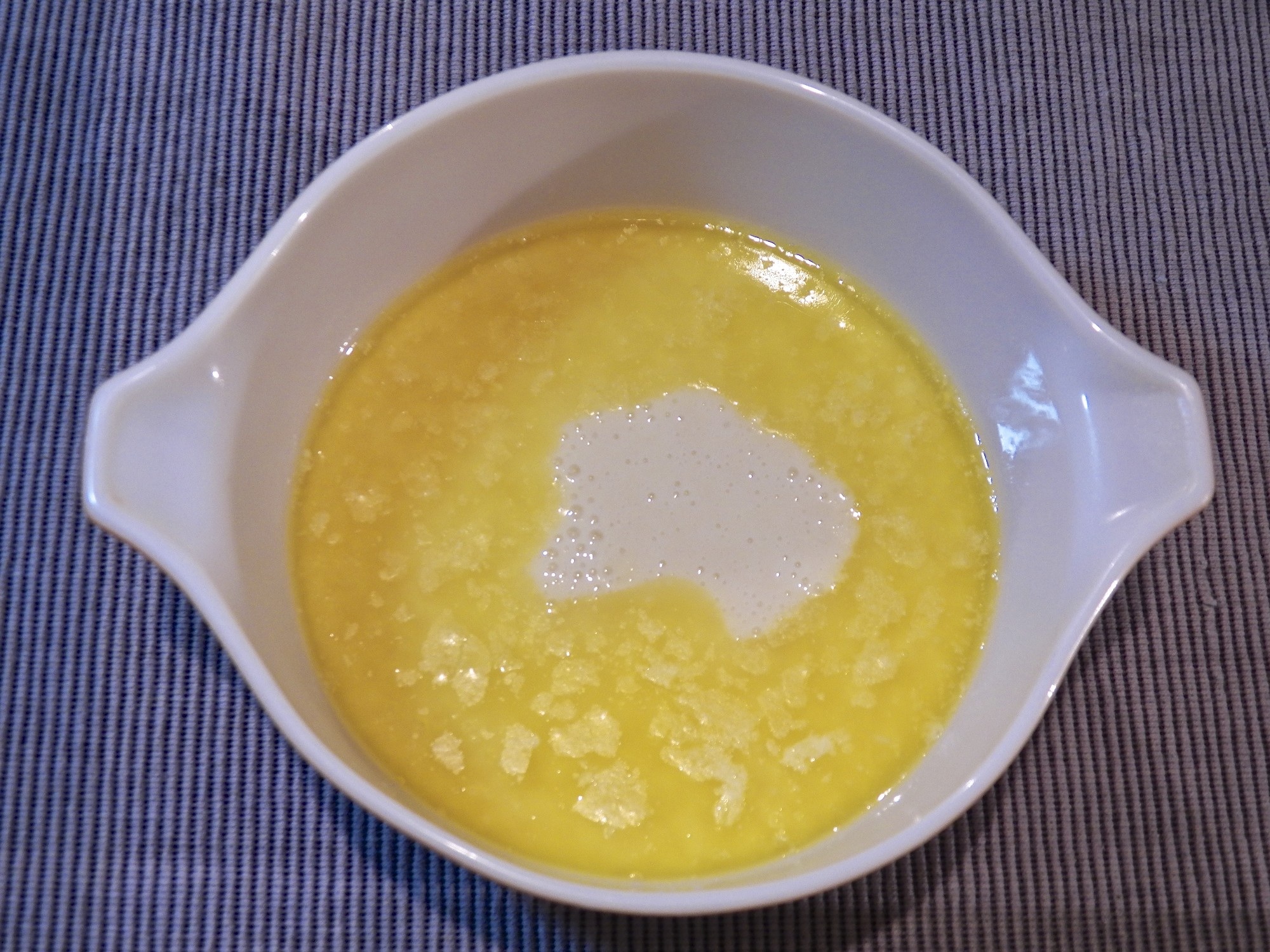
Melt Butter in Baking Dish

*********

Add Batter – Do Not Mix

*********

Add Par-Cooked Filling – Do Not Mix

**********

Bake while singing “Abracadabra!” and … Ecco!

*********

Plum Cobbler Recipe

Ingredients

  • 1/2 cup unsalted butter, melted
  • 1 cup all-purpose (AP) flour
  • 2 cups sugar – divided
  • 1 tbsp baking powder
  • pinch salt
  • 1 cup milk
  • 4 cups plums, pitted and chopped
  • 1 tbsp fresh lemon juice
  • ground cinnamon and/or nutmeg, to taste (optional)

Directions

  1. Pre-heat oven to 375 F (190 C).
  2. Pour melted butter into a 9 x 13 x 3″ baking dish.
  3. In a medium bowl, combine the flour, 1 cup sugar, baking powder, with salt and mix well.
  4. Add the milk, mixing until just combined. Pour this batter into the baking dish containing the melted butter. Do NOT mix.
  5. In a medium saucepan, combine the plums, lemon juice, with  remaining cup of sugar and bring to a boil over med-high heat. Stir constantly. Remove from heat and add optional cinnamon and/or nutmeg.
  6. Carefully pour the plum mixture into the baking dish. Do NOT mix.
  7. Bake on a baking sheet in the center of a pre-heated oven for 40 to 45 minutes or until the top is golden brown. Alternately, you can forget to set a timer and eventually find a cobbler in your oven resembling the one in the final picture above
  8. May be served warm or cold, garnished with ice cream or whipping cream.

**********

Variations

As mentioned, you can use whatever fruit or berry that you like for the filling. I’ve never used a thickening agent, like flour or cornstarch, for fear of it affecting the cake’s formation magic.

Although the recipe lists cinnamon and nutmeg as optional, I rarely use them. I find that they can easily overpower a dessert, so, I use them sparingly in my cobblers, if at all.

**********

It’s déjà vu all over again …

Today’s Blast from the Pasta, Spaghetti Aglio e Olio, is probably the most versatile of all pasta recipes. Prepared as written and you’ll be enjoying a delicious pasta dinner within minutes but that’s only part of the story. Saute some vegetables and you’ll have a great pasta primavera. Add some clams with a touch of white wine and you’ve got the classic pasta con vongole. The choices are endless and I prepare this dish, in one form or another, just about once a week. You can see the recipe by clicking HERE.

**********

Coming soon to a monitor near you …

Branzino al Cartoccio

**********

An Update

Although I’m the proud owner of some new, fancy schmancy equipment, I am still without a DSL. I have been promised, however, that service will be restored, better than ever, sometime this evening — and companies, especially very big companies, never ever lie.

Thanks for your comments and well-wishes.

*********

The long wait is over. Today we’re making Italian Mozzarella!

Yes, you’ve read that correctly. It took literally gallons of curdled milk to get us here and today I’ll show you how to make Italian Mozzarella. Prior to this, I’ve demonstrated how to make ricottagoat cheesecream cheesemascarponefeta, and American mozzarella. Hopefully, you’ve heeded my warnings and made one of these other, simpler cheeses, for this mozzarella is the trickiest cheese of them all to prepare. In fact, my success rate with ricotta is 100%; with American mozzarella the rate is about 75 – 80%; while I’m only successful making Italian mozzarella about a third of the time. So why bother? Well, Italian mozzarella is superior to the American, having a more delicate flavor and creamier consistency. It’s no Burrata but it is nonetheless a very good cheese.  It’s up to you to decide whether it is worth the effort.

NOTE: Because so much of this process is the same as that for American mozzarella, some of the following has been used in both posts. No sense re-inventing the Parmesan wheel.

As is the case with every cheese, before we get started, there are a few things to be discussed. First of all, mozzarella belongs to the pasta filata, “spun paste”, family of Italian cheese. Primarily made from buffalo or cow’s milk, provolone, scamorza, and caciocavallo are also members of this group. The curds of these cheeses are heated in water and spun before being pulled and stretched to make the cheese. If they aren’t spun or pulled properly, the cheese’s texture will not be right nor will the cheeses have that characteristic stretchy quality when melted.

Got milk?

Next, we need to look at the milk. Just like with its American cousin, when making Italian mozzarella you may not use calcium chloride (CaCl) to compensate for the effects of ultra-pasteurization upon milk. As a result, you must use raw or pasteurized milk. When choosing pasteurized, select a whole milk from a local dairy to reduce the chances of it being pasteurized at too high a temperature. Some brands will have the pasteurization temperature posted on the container’s label. Available at Whole Foods and health food stores, I use that milk because the pasteurization temperature is low compared to most and I know exactly what I am buying.

Most importantly, the curds must reach a certain level of acidity before mozzarella can be made — and herein lies the difference between American and Italian mozzarella. When we made American mozzarella, we used citric acid to create the acidity required. It enabled us to make mozzarella relatively quickly. There is no such ingredient for Italian mozzarella. These curds will acidify on their own if left undisturbed for about 10 hours or overnight. You can increase your odds of success by using pH test strips to insure that the correct acidity (5.2) has been achieved. (See Notes for more information about these strips.) Italian mozzarella’s superior flavor and texture are due to the fact that no additives are used to acidify its curds. There are no shortcuts when making this cheese.

You’ll see “Lipase” included among the list of ingredients. Lipase is an enzyme that is used to enhance the flavor of mozzarella, Asiago, provolone, feta and blue cheeses. It can be purchased from the cheese making sites listed on my Cheesy Stuff page. It is not a necessary ingredient, however, so don’t worry if you cannot find or purchase it. If you do use it, however, you’ll need to add more rennet, as indicated in the recipe below.

 *     *     *

Bruschetta

 *     *     *

Sorry about the quality of the photos to follow but this wasn’t an easy process to photograph while working alone and wearing gloves. If you have asbestos fingers, you may not need to wear gloves but I’ve found that they offer some protection from the heated curds. I’ve heard that it is customary for women in Italy to keep a bowl of ice water nearby. They dip their hands in it when the heat becomes too much to bear while they’re stretching the mozzarella. It’s not such a bad idea, even when wearing gloves.

Before beginning, please refer to my Cheesy Stuff page. Chock full of cheesy details, it provides information about ingredients, cleaning/sterilizing equipment, spices & seasonings, a few tips, and sources for supplies and information.

 *     *     *
How to Make Italian Mozzarella at Home

Ingredients

  • ½ gal (1.9 L) whole milk — NOT ultra-pasteurized
  • 1 tbsp plain yogurt, must include live cultures
  • 1 tbsp cultured buttermilk
  • ½ tablet rennet dissolved in a ¼ cup (60 ml) of cool distilled water
  • ¼ tsp Lipase dissolved in a ¼ cup (60 ml) of cool distilled water — optional but, if using Lipase, add another ¼ tablet of rennet
  • 1 tbsp table salt dissolved in 1 quart (.95 L) water

Directions

  1. In a small container, combine the yogurt, buttermilk, and a couple tbsp of milk. Stir until thoroughly mixed and set aside.
  2. Place the rest of the milk in a sterile, non-reactive pot with a lid. If using, add the dissolved Lipase and stir well. Gently heat the milk, uncovered, to 90˚F (32˚C), stirring occasionally to prevent scalding on the pan’s bottom. I’ll often fill my kitchen sink with hot water and use it, rather than my stove top, to gently heat the milk.
  3. Once the milk has reached 90˚, remove from heat and inoculate using the buttermilk/yogurt/milk mixture. Stir/whisk thoroughly.
  4. Place the pot in a warm spot (about 75˚F; 24˚C) where it will not be disturbed. Add the dissolved rennet, stir for 1 minute, and cover.
  5. Check for a clean break after 45 minutes. As was the case when we made feta and American mozzarella, you can not proceed until a clean break is achieved.  Once achieved, go to step 7.

 *     *     *

Clean break.

Bad Break

 *     *     *

6. If a clean break is not achieved, wait 30 minutes and test again. Still bad? Wait another 30 minutes before testing again. Still bad? Wait a final 30 minutes. If a clean break still eludes you, there’s nothing to be done but dump the dairy and start over. Of course, you may wish to wait longer and try again but that is up to you. I would seriously consider changing milk brands before trying again. This is why I use half-gallon quantities of milk and not the 2 or 3 gallons some suggest. If I ever make enough to become proficient, I’ll use larger quantities of milk.

*     *     *

7. Use a long knife or offset spatula, and starting at one side of the pot, cut a straight line through the curd. Once the opposite side has been reached, create another slice about ½ in front of the previous cut. Repeat until the entire curd has been cut into horizontal slices.

 *     *     *

8. Give the pot a quarter turn and, starting at one end of the pot, repeat the slicing process. When finished, the curd should be cut into ½ inch squares.

 *     *     *

9. Now take the knife or offset spatula and, with the blade on an angle, slice through the curds from side to side at ½ inch intervals. This will cut the curds beneath the surface. Repeat this step twice, turning the pot and cutting the curds on an angle each time.

*     *     *

10. Slowly re-warm the curds to 90˚F (32˚C), gently stirring the curds, and cutting any that are larger than 1/2 inch. Let sit for 15 minutes.

*     *     *

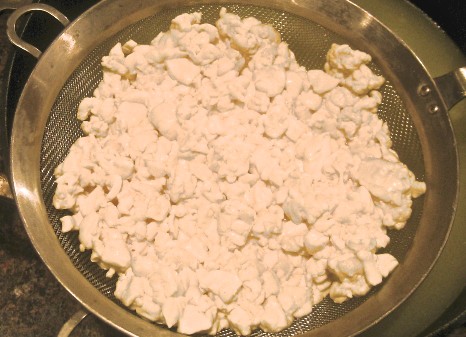
11. Gently pour the pot’s contents into a sieve, separating the curds while reserving the whey for ricotta. (See Notes below.)

*     *     *

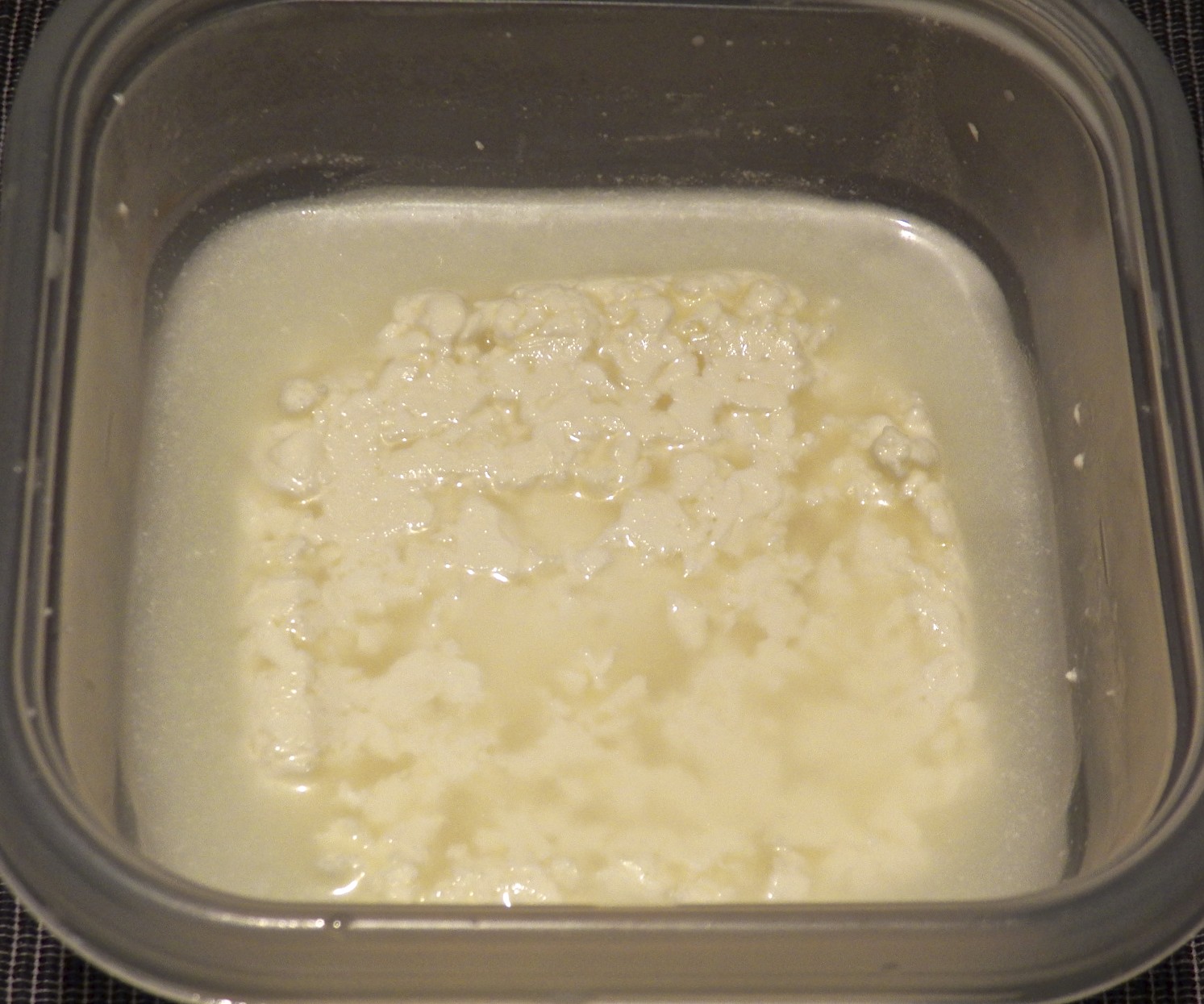
12. Place curds in a quart of cold water to rinse and then drain again. Place curds into a container, cover, and set aside, allowing the curds to reach the proper pH. It is normal for whey to continue to separate during this resting period, as shown in the image.

*     *     *

Successful pH test

13.  If using pH test strips, begin testing the curds’ acidity levels after 8 hours. Once an acidity level of at least 5.2 is achieved, continue. If not using the test strips, better to wait 10 hours before proceeding.

*     *     *

14. Heat a large pot of water to 185˚F (85˚C). Once heated, use some of it to fill a small bowl and add to it a few pieces of curd, about the size of sugar cubes.

*     *     *

15. Gently stir the bowl’s contents and, after a few minutes, the cubes will begin to show trails or filaments, spinning, as they clump together.

 *     *     *

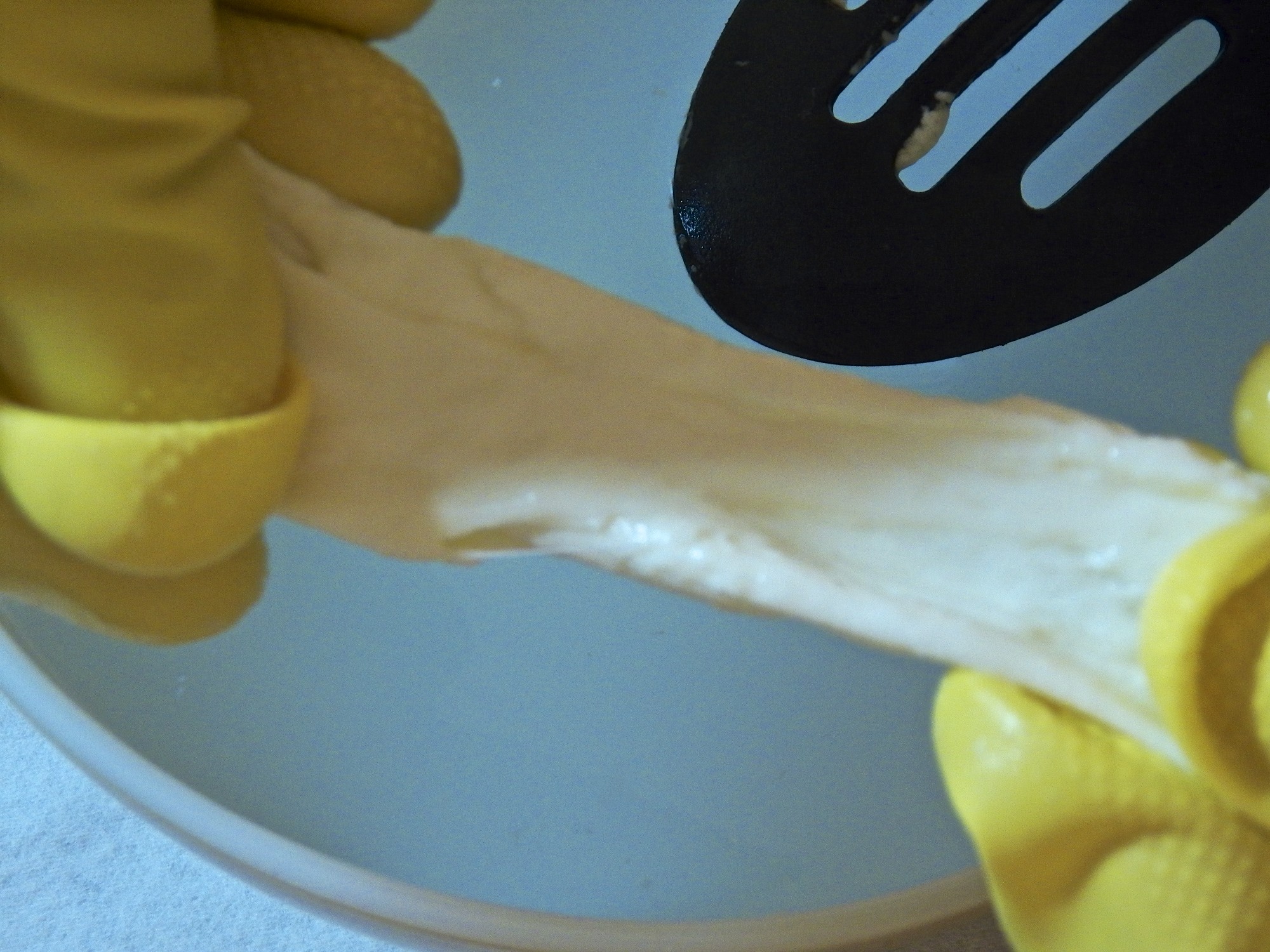
16. Use a slotted spoon to remove.

 *     *     *

17. See if the curds will stretch. If they do, without breaking, the curds are ready. To celebrate, I usually eat the test curds before continuing to Step 17. If they do not stretch, return the curds to the rest and set aside for another 2 hours before testing again. If they still do not stretch, set aside and test again. If still unsuccessful, it is up to you to decide how much longer and how many more times you’ll test the curds. It can be very frustrating.

 *     *     *

18. After a successful test, the rest of the curds need to be processed. Use a thin meshed sieve to drain off the whey. Meanwhile, begin re-heating the pot of water.

*     *     *

19. Place the now drained curds on a flat surface and slice into ½ inch cubes. Best to use a dish for this step, rather than a cutting board, since some whey may still be present.

 *     *     *

14. Separate the sliced curds into individual cubes.

 *     *     *

20. This is where the real trouble starts. If you read the books, scanned the websites, watch the videos, they will place the curds in a large bowl, pour the heated water over the curds, stir, and, voilà! Mozzarella ready to be stretched and pulled. Not for me. I’ve found I have greater success if I use smaller amounts of curd, resulting in smaller mozzarella balls. No matter which way you choose to go, you’ll need to pour the heated water (185˚F; 85˚C) over the curds and stir until they begin to spin. Do not rush this step. It should take a few minutes. Do not let the water temp fall below 135˚F (57˚C) but it should not remain higher than 140˚F (60˚C).

 *     *     *

21. (Yes, it’s the same photo as in 16 above.) Once you see evidence of spinning, use a slotted spoon to remove the curds. Begin to stretch the curds, fold on to themselves, and stretch again. Continue doing this a number of times, creating many layers, until the cheese is smooth and glossy.

 *     *     *

22. Form into a ball like you would bread dough for a dinner roll. Place in salted water. Congratulations! You’ve just made Italian mozzarella!

 *     *     *

Notes

As was mentioned, the key to making this mozzarella is the acidity of the curds. One day last Spring, I noticed pH test strips at a home brewery shop that I’d entered to purchase the calcium chloride (CaCl) needed to make feta cheese. Not all pH strips are created equal and each type is used to test specific levels of acidity/alkalinity. As luck would have it, these strips were used to test beer and were for the same range needed to test mozzarella curds. If you’re going to purchase pH strips, be sure that they are capable of testing substances with a pH of 5.2 otherwise they will be of no use whatsoever. See the image above (Step 13) for a sample of a correct pH scale and strip for testing curds. Remember that the lower the pH value, the more acidic the substance.

In Italy, only the whey from making mozzarella may be used to make ricotta. I’ve had varying levels of success trying to do so. Most recipes for making mozzarella call for at least 2 gallons of milk — sometimes 3 — to be used. When making American mozzarella, I use a gallon of milk and the resultant yield of ricotta is too little for me to use. Because of the high failure rate, I only use a half-gallon of milk when making Italian mozzarella. Once again, the ricotta yield is too far little to be of use. Now, you can add a quart of milk to Italian mozzarella’s whey to improve the yield but I’d rather use the milk to make ricotta like I’ve shown you HERE. I’ve never had a failure following that recipe and a half-gallon of milk gives me all the ricotta I need. Still, if you wish to try the more traditional approach, you can see how Dr. Fankhauser does it HERE or how our very own Miss Celi does it down on the farmy HERE. While you’re there, if you haven’t already, be sure to check out her blog. It is truly a delight to read and a great way to start your day.

No matter which mozzarella you choose to make, the cheese is best when freshest. Even so, Italian mozzarella does stay fresh longer than its American cousin. Some suggest leaving the cheese in its salt water bath until needed or transferring it to fresh water after a few hours for storage in the refrigerator. Others suggest using the brine bath for an hour before patting the cheese dry and storing in a sealed plastic bag. I’ve even heard of some freezing it for later use, something not possible with American mozzarella. I prefer to leave my Italian mozzarella in the salted water until ready for use and that’s always within 24 hours. When I remove it, I might have to rinse it to remove a soft coating that’s developed. The cheese is still very good but that coating is rather unappealing. One of these days, I’m going to make a batch, divide the cheese into thirds, and store a third in brine, a third, in fresh water, and the last third in a plastic bag. I need to feel more secure in my Italian mozzarella cheese making abilities before donating a batch to science.

And so ends our cheese making series. Now it’s your turn. Good luck!

*     *     *

Inspired by the Fankhauser Mozzarella webpage

and

“Home Cheese Making” by Ricki Carrol

*     *     *

Coming soon to a monitor near you …

Magical Plum Cobbler

*     *     *

It’s déjà vu all over again …

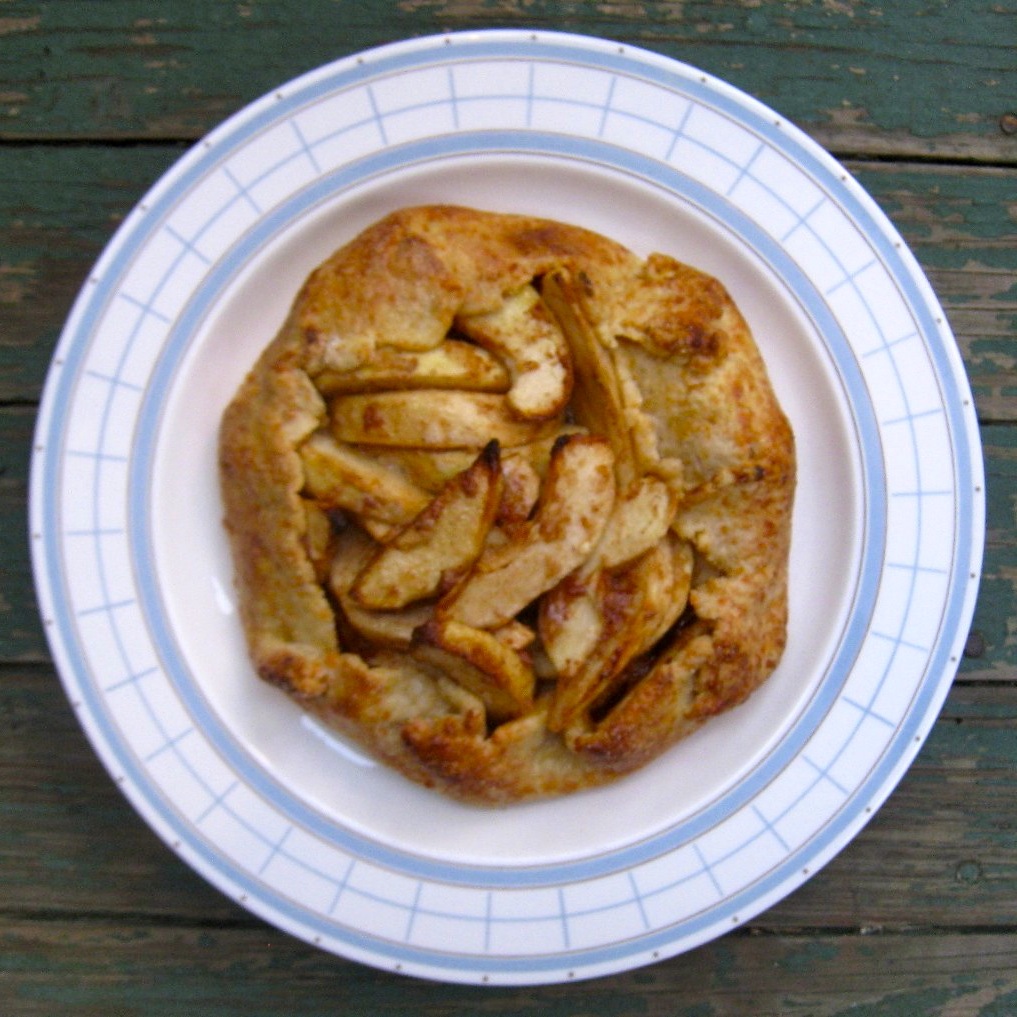
Hard to believe that it was a year ago when I introduced you all to the Apple Thingamajig. Despite your numerous attempts to (correctly) identify it as a crostata, Zia and I have continued to call them Thingamajigs and I don’t see either of us changing anytime soon. Just click HERE if you wish to see the recipe, are feeling a bit nostalgic, or want to try your hand at helping us to remember that our Thingamajig is really a crostata. (Good luck with that!)

*     *     *

It’s a Holiday!

Have a fun-filled Columbus Day!

Tomato with Bread Soup

Pappa al Pomodoro

Columbus Day is right around the corner and I can think of no better way to commemorate the day than to share a recipe that typifies traditional Italian cooking. I’ve mentioned in the past that very little goes to waste in an Italian kitchen, bread being a perfect example. Like elsewhere in Europe, bread is baked or bought daily and seldom, if ever, is it discarded because it’s stale. Day old bread is used to make everything from bread crumbs to a delicious Tuscan salad known as Panzanella. {That recipe features Michigan heirloom tomatoes (What else?) and is from Bam’s Kitchen, a wonderful blog whose author currently lives in Hong Kong and offers recipes from around the world.}  Today’s recipe, Pappa al Pomodoro, is another that takes advantage of not just day old bread but, also, the glut of home-grown tomatoes that many experience during Summer. It is a simple dish to prepare but, oh, so very satisfying.

I cannot speak for everyone but I will say that the majority of us, growing up in Italian households, at one time or another experienced the simple pleasure of eating a piece of bread that had just been dipped in Mom’s or Nonna’s simmering pot of tomato sauce. As a boy, Mom would dunk a piece of crusty bread into the pot, blow on it a few times to cool the sauce, and then hand it to me with a warning to be careful because it was still hot. As I got older, I became an expert at sneaking a piece of bread into the pot and then my mouth in one fell swoop without her noticing. (Yeah, right!). Unfortunately, the sauce was every bit as hot as it was years before and a burned mouth was very often punishment for my devious ways. Even so, the reward of a piece of sauce-soaked bread made the risks worth while. And today, far too many years later to mention, my favorite way of checking the seasonings of my tomato sauce is with a chunk of bread, though I’ve grown a little more patient and a burned palate is rare.

Understanding that bit of my personal history may help you understand why I so enjoy Pappa al Pomodoro. Often described as having the consistency of baby food, one might wonder why ever would anyone like this soup. Well, one taste and you’re once again standing next to Mom or Nonna, eagerly waiting for her to blow on a sauce drenched tidbit. Here, though, instead of just having a crust of bread, you have an entire bowl to savor. Better still, the fresh basil and grated cheese gives this dish a wonderful aroma. I’m telling you, if you liked pieces of sauce-dipped bread as a child, you’re going to really enjoy this soup as an adult.

When making this soup, be sure to use the ripest tomatoes you can find. In fact, if they’re a little over-ripe, that’s just fine. As for the bread, it’s best to use day old bread with a good crust; fresh bread just won’t do. I use a small loaf of ciabatta and it works perfectly. If you’ve no day old bread, you can use fresh if you slice it and put it into a warm oven for a few minutes. You’re not trying to toast the bread, merely dry it somewhat, mimicking the feel of bread that’s just past being fresh. This is necessary because dried bread will receive the sauce much more readily than fresh. Think back to when you were a child. The best “samples” resulted from bread that had been fully drenched in the sauce. The same is true here. Lastly, be sure to garnish each serving with olive oil, freshly grated cheese, and a hand-torn leaf or two of fresh basil, the aromas of which will add so much to the dish.

*     *     *

Pappa al Pomodoro Recipe

Ingredients

  • 3 tbsp olive ol
  • 1 onion, chopped
  • 2 garlic cloves, minced or grated
  • 2½ lbs of tomatoes, preferably plums, peeled, cored, seeded, and chopped
  • 2 cups vegetable stock – water may be substituted
  • about 9 oz of day old, crusty Italian bread, cut into cubes (I use a small ciabatta loaf.)
  • 1 cup fresh basil leaves
  • salt & pepper, to taste
  • olive oil, grated Pecorino Romano cheese, and whole basil leaves for garnish

Directions

  1. Heat oil in a saucepan over medium heat. Add onions and sauté until translucent, about 5 – 8 minutes. Add garlic and continue cooking for another minute. Season lightly with salt and pepper.
  2. Add tomatoes, bring to a boil, and then reduce to a simmer. Cook until tomatoes begin to break down, about 5 minutes.
  3. Add the bread and stock to the pot, stirring until the bread is fully coated with the tomato mixture. Continue to simmer until the soup begins to have the consistency of  baby food.
  4. Hand tear the basil leaves, add to the pot, stir, and continue a low simmer for about 10 more minutes. Add more stock or water if it becomes too dry.
  5. Serve immediately, garnished with grated Pecorino Romano cheese, a drizzle of olive oil, and a leaf or two of fresh basil.

*     *     *

Notes

What if you live here, in Chi-town, and you want a bowl of Pappa al Pomodoro but it’s January. Fear not! Although fresh, vine ripened tomatoes are always preferable, you can make this soup with canned tomatoes just as easily. Instead of using the 2½ lbs. of tomatoes listed in the recipe’s ingredients, substitute one large can of San Marzano tomatoes, crushing them by hand before you add them to the pot.

Speaking of San Marzano tomatoes, shopping for a can of the real thing can be a daunting task. Many cans will claim to be filled with San Marzano tomatoes but, after close inspection of the labels, you’ll learn that they are mere plum tomatoes and not their more famous — and expensive — cousins. How do you tell the difference? Like authentic balsamic vinegar, San Marzano tomato sales and distribution are tightly controlled. Click HERE to learn what must be on a can’s label for all San Marzano tomatoes. By the way, if the canned tomatoes are crushed, chopped, or puréed, they are not true San Marzanos. See? Click on the link.

*     *     *

Coming soon to a monitor near you …

Italian Mozzarella!

*     *     *

It’s déjà vu all over again …

With Columbus Day fast approaching, I thought it appropriate to take a look at not one but two posts from the past. The first will share my family’s recipe for a ravioli filling that consists of veal, pork, spinach, cheeses, and seasonings. The second will show you how to use a ravioli die to make the pasta pillows. Click HERE to see the ravioli filling recipe and  HERE to learn how to make the ravioli.

*     *     *

Fig Preserves with Balsamic Vinegar and Black Pepper

Argh! “The best laid schemes o’ Mice an’ Men”. It’s happened again. I have a schedule for these posts. I really do. Today’s entry, for example, was to have been an instructional post detailing how to make Italian mozzarella. The Fates, however, intervened. In the days preceding my trip to Michigan, I failed twice to make the cheese.  I thought I’d be able to try again once I returned home but soon there were peppers to pickle, figs to preserve, olives to cure, and a seemingly endless stream of posts to read and comments to write. So — and by stating my plans I’m taking a big risk with those pesky Fates —  I decided to schedule Italian mozzarella for October 10th.

Now, pushing mozzarella off into the future left me in a bind.  I had no post for today. Earlier I mentioned I had figs to preserve. Well, that recipe suddenly became today’s post, meaning I had some writing to do. As you can see, I got it done but, as for the backlog of posts & comments, I’m still working on them. Sorry for the delay.

 *     *     *

 *     *     *

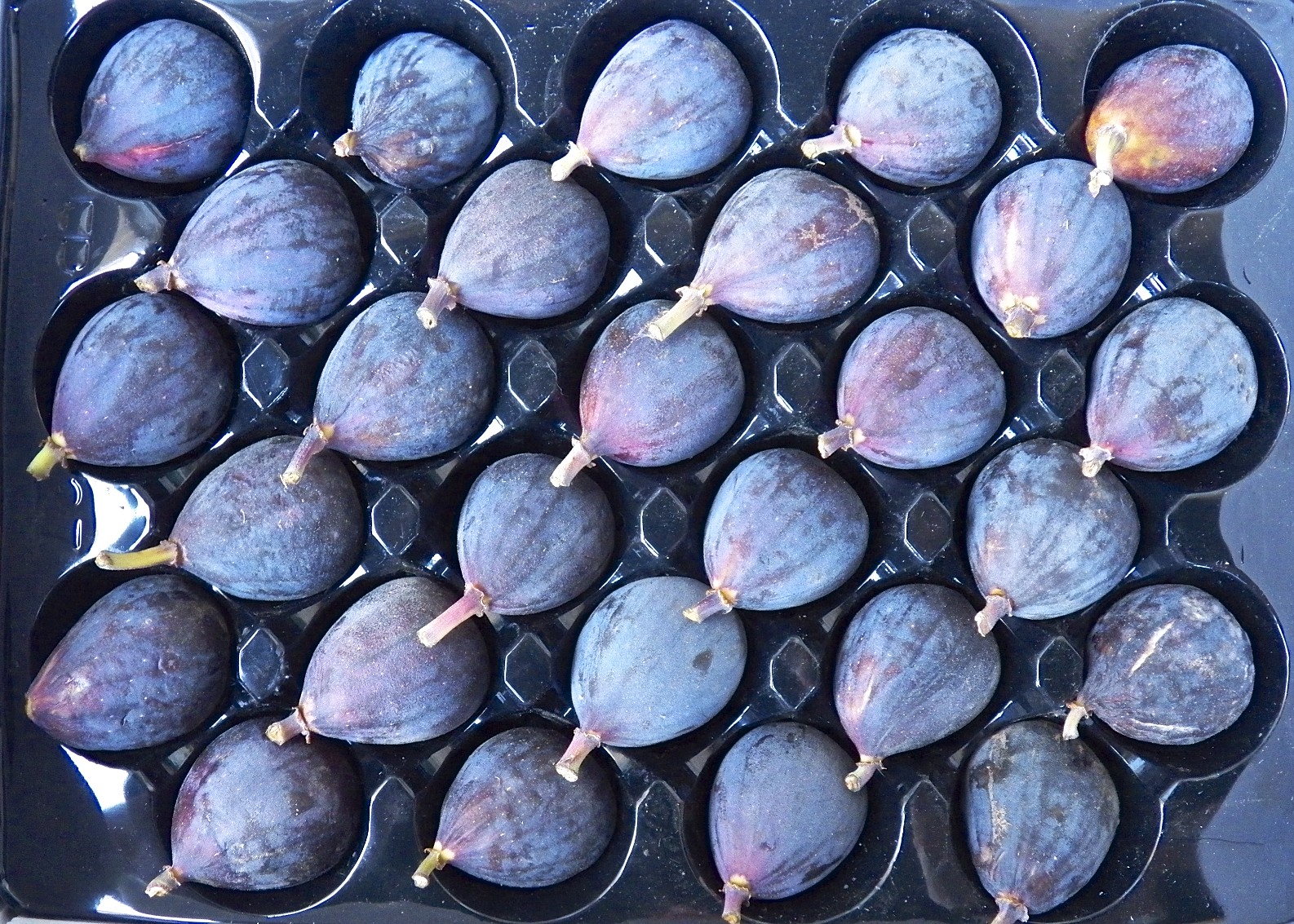
A few weeks ago, chaiselongue1 posted Jamming, an entry about making fig jam. (If you’re not familiar with this beautiful blog, olivesandartichokes, now is as good a time as any to check it out.) I thought that jam sounded delicious but that’s about as far as it went — until a market last week had crates of Mission figs for half the price I’d previously seen. Next thing you know, I’ve got 2 crates (about 3 lbs) of figs in my cart. Once I got home, I checked the Jamming post again, as well as the Pick Your Own website, as I always do before I preserve anything. Once there, a sentence caught my eye. “If you like strawberry jam, you’ll love fig jam.” That got me to thinking. I went back to the recipe I’d shared for strawberry jam with balsamic vinegar (thanks, Sarah!) and decided to use it as a guide for these preserves.

Unlike the strawberry recipe – but like Jamming — this recipe doesn’t use pectin. It takes a bit longer to prepare but if you take your time, the preserves will set as nicely as if you used pectin. Just like the strawberry jam, however, I included cracked black pepper. I really enjoyed the “bite” it brought to the strawberries. Lastly, these figs were sweet enough, allowing me to use less sugar than was used with the strawberries. Besides, I’ve got plans for these preserves that don’t involve toast. Stay tuned …

 *     *     *

*     *     *

Fig Preserves with Balsamic Vinegar and Black Pepper Recipe 

yield: 5 – 6 cups

Ingredients

  • 4 – 5 cups fresh Mission figs, prepped & chopped (about 3 lbs.)
  • 3 cups sugar
  • ½ cup water
  • 1 tsp butter (optional)
  • pinch of salt
  • ⅔ cup balsamic vinegar
  • ¼ cup lemon juice
  • 1 tbsp cracked black pepper

Directions

To Prepare

  1. Sterilize the jars and wash the jar lids and rings in hot, soapy water. Place lids and rings in a deep bowl and pour near-boiling water over them.
  2. Start bringing to boil a large, deep canning kettle of water to be used for the canning process and a second, smaller pot of water to be used to replenish water that may boil away during the canning process.
  3. Trim stem and bottom of each fig before chopping. When finished, use a potato masher to smash them.

To Make the Jam

  1. Place a small plate in the freezer. Place the figs, sugar, and water into a sauce pan over high heat and bring to a boil. Reduce heat to medium, add the salt, optional butter, and stir occasionally until a rolling boil is achieved. (A rolling boil is one that cannot be stirred away. Using a candy thermometer, that’s about 220˚F (104˚ C).)
  2. Once a rolling boil has been achieved, place a small amount of the fig mixture on the now frozen plate. Once the cooked figs have returned to room temperature, check to see if it is jam-like. If too runny, continue cooking for 10 minutes and test again. When the right consistency is achieved, remove from heat and continue to the next step.
  3. With a large spoon, carefully skim the surface to remove any foam.
  4. Add the balsamic, black pepper, and  lemon juice. Stir well to thoroughly combine.

To Preserve

  1. Using a funnel and large ladle, fill each jar to ¼ inch from the rim. Wipe the rim to make sure no jam has spilt, place a lid on each jar, and then the ring, tightening until “finger tight” but not as tight as you can make it. Act quickly, filling and capping all the jars.
  2. Jars placed directly on the kettle’s bottom might burst, so, a rack of some sort must be put into the canning kettle to cover the bottom. Many large pots have one, as do many pressure cookers.
  3. Keep each jar level as you place them, one by one, into the canning kettle filled with now boiling water. The jars should not touch each other, nor should they be allowed to tip over. Depending upon the size of the kettle and number of jars, you may need to work in batches.
  4. Once the jars are in the kettle, make sure that there is at least one inch of water over the top of the tallest jar(s). If not, add boiling water from the smaller pot mentioned in Step 2 of  To Prepare.
  5. Cover the pot and begin timing when the water returns to the boil. The jars must be boiled, “processed”, for 5 to 10 minutes, depending upon the size of jar used.
  6. Meanwhile, place a baking sheet on a level surface and line it with a clean kitchen towel.
  7. Once the time has passed, carefully remove each jar and place it on to the towel-lined baking sheet. Leave about an inch separating the jars.
  8. Once all the jars have been processed and placed on the baking sheet, remove the baking sheet & jars to a place that is draft-free and where they will remain undisturbed for 24 hours.
  9. After 24 hours have passed, check each jar to insure it’s sealed and then store on a shelf in a cool, dark place, where it will stay fresh for months.

*     *     *

Notes

Once opened, the preserves should be refrigerated and fully used within a month.

*     *     *

Coming soon to a monitor near you …

Pancetta-Topped Roast Loin of Pork with Fig Preserves

*     *     *

It’s déjà vu all over again …

It’s that time of year again. Concord grape time, that is. In our farmers markets, groceries, and vegetable/fruit stands, the grapes are on full display. Although a sure sign of Summer’s end, they do mean that it’s time to start making some jelly — and I’ve got a few pounds of the blue beauties just waiting to be transformed.  I’ll be following a recipe that I used last year. If you’re interested in doing the same or just want to check it out, you can do so by clicking HERE.

*     *     *

Peach and Bing Cherry Cobbler

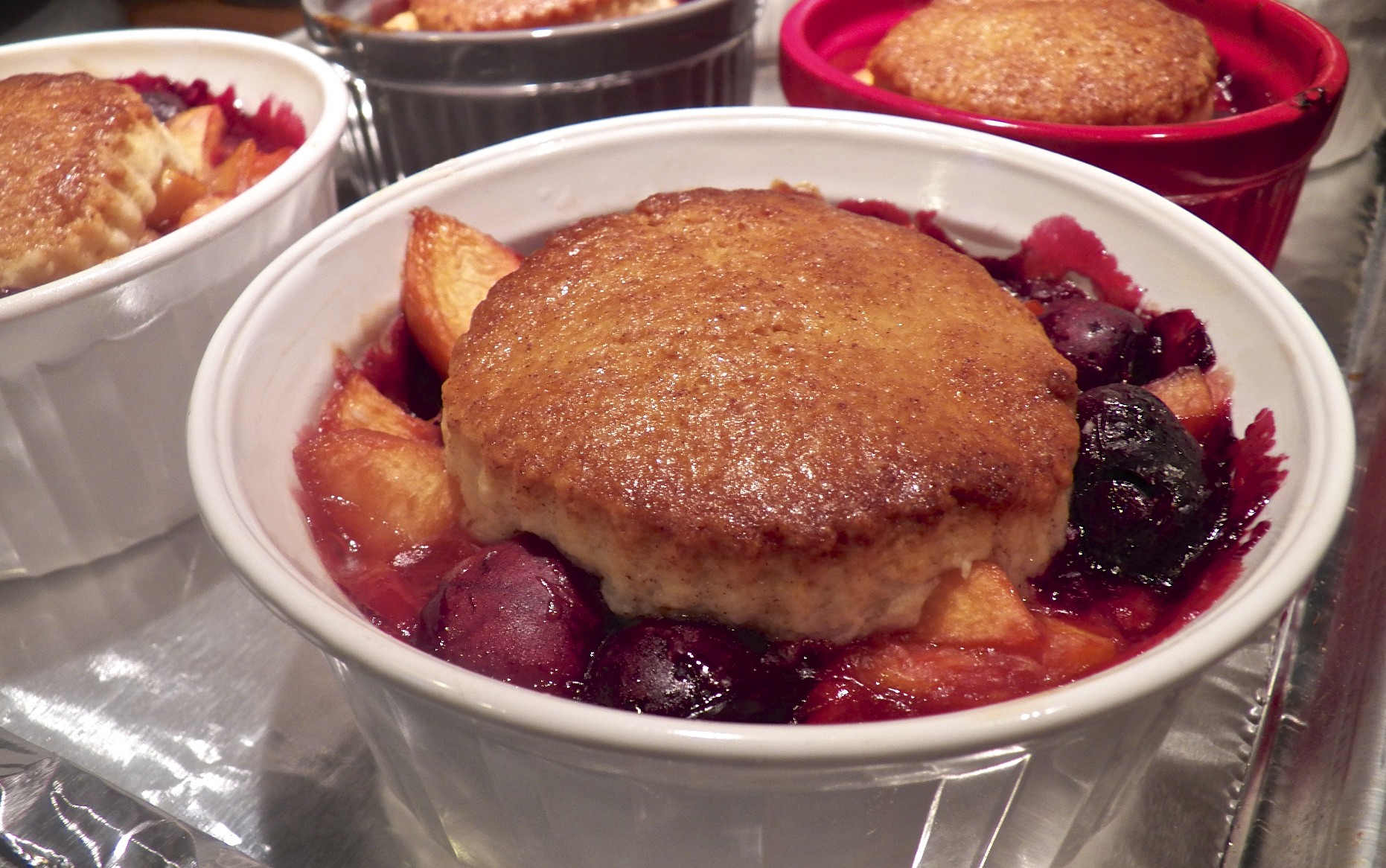
Well, it certainly took me a while to get here but this is it, the end of this year’s peach recipes. And, as far as this blogger is concerned, I saved the best for last. You see, I happen to really like peach cobbler. I make them with a batter that rises through the peaches, creating a cake-like top. I make them with a biscuit placed on top and baked.  I eat them as they are, still warm from the oven. I eat them with a scoop of vanilla ice cream or a large spoonful of whipped cream. And there lies the problem. I eat them. All of them. Every last morsel of every last one of them. There just aren’t many recipes for peach cobbler for one. So, I make a cobbler and for the next week, my snacks and desserts are all servings of peach cobbler.  I know, poor me! Well, this time around, I decided to try something different. I divided the cobbler among 6 smaller dishes and froze all but the one I tested for “quality control”. (Thank you, Tanya.)  See Variations below to see what I did.

Oh, yes. I almost forgot about the cherries. Most will recall that a few weeks ago I shared 2 recipes for a blueberry and cherry pie. The final pie was so good that I’ve been thinking of combining other fruit in other pies. Well, this being peach cobbler season, why not  experiment? Last week at the farmers market, I purchased what would turn out to be the last of the season’s Bing cherries and a plan was born. Upon my return home, Google gave me the recipe.

Today’s cobbler combines Bing cherries with fresh peaches and is crowned by a biscuit, of sorts. There’s nothing complicated about it, though pitting the cherries can be a bit tiresome. Even so, once the fruit is prepared, the rest of the recipe is a snap. And once you taste this cobbler, you won’t remember anything about pitting cherries — unless you wore a white t-shirt. When will I learn?

 *     *     *

 *     *     *

This post was written prior to my departure for Michigan and scheduled to post now. The trip went as planned, Zia’s freezer is filled, and we took turns cooking dinner. I hope to have a “vacation” post written by the weekend. Internet service was deplorable and, as a result, it will take me a while to get caught up with all of your posts and comments but I’ll get there. Thanks for your patience.

 *     *     *

Peach and Bing Cherry Cobbler Recipe

Ingredients

  • 3½ lbs peaches, peeled and sliced or chopped  (about 6 large peaches)
  • 2 lbs Bing cherries, pitted
  • ¾ cup sugar
  • ¼ cup cornstarch
  • 3 tbsp lemon juice

for the biscuit topping

  • 2 cups all-purpose (AP) flour
  • ⅓ cup plus 2 tbsp sugar, divided
  • 2½ tsp baking powder
  • ½ tsp salt
  • ½ cup unsalted butter, chilled and cubed
  • ¾ cup plus 2 tbsp whipping cream, divided
  • ¼ tsp ground cinnamon
  • ice cream for serving (optional)

Directions

  1. Liberally grease a 9 X 13″ baking dish. Pre-heat oven to 425˚ F (218˚ C)
  2. In a large saucepan over high heat, combine peaches, cherries, and sugar. Stir carefully, bring to a boil, and simmer for 1 minute.
  3. Remove filling from heat and pour into prepared baking dish.
  4. In a mixing bowl, whisk together the AP flour,  ⅓ cup of sugar, baking powder, and salt.
  5. Using knives or a pastry blender, cut the butter into the dry ingredients until a very coarse mixture results. Stir in ¾ cup whipping cream and knead only enough to create a dough. DO NOT OVER-WORK THE DOUGH.
  6. Place dough on a floured surface and roll to a ½ inch thickness. Use cookie or biscuit cutters to cut shapes in the dough. Place the shapes on the filling in any pattern you wish.
  7. Combine cinnamon with remaining sugar and whipping cream. Use a pastry brush to coat the tops of all the pasty cutouts.
  8. Bake in a 425˚ F (218˚ C) pre-heated oven for 20 to 25 minutes. Filling should be hot and bubbling.
  9. Serve warm with optional ice cream.

 *     *     * 

*     *     *

Variations

As I mentioned, I used 6 small baking dishes for this recipe rather than 1 large dish. 4 of these dishes each held 500 ml while the other 2 were a little smaller at about 400 ml. I greased and filled each one, using biscuit cutters for the topping. Once they were baked and cooled completely, I wrapped each in plastic wrap before sealing them again in aluminum foil. They were placed on a baking sheet and frozen. To serve, remove the plastic wrap and recover using the foil before placing it in an oven pre-heated to 350˚F (177˚C). After 30 minutes, remove foil and continue heating until filling is bubbly, about another 15 minutes. Cooking time will depend upon size/amount frozen.

I think next year I’m going to try this recipe using tart cherries instead of Bing and with a little almond extract in the biscuit instead of the cinnamon. It’s not that there is anything wrong with this cobbler, I just happen to prefer tart cherries and want to see if they’d be at least as good.

*     *     *

It’s déjà vu all over again …

Peaches are all but gone from our farmers markets and though a few berries, plums, and pears remain, apples have started to take over the vendors’ stalls. It’s the time of year for apple pies, muffins, crumbles, and sauce. If you choose your apples wisely, your pie will be as tart, and your apple sauce as sweet, as you like.  As proof of the latter, last year I shared a recipe for apple sauce that does not call for any sugar whatsoever. You can see the recipe by clicking HERE.

*     *     *

And another thing or three …

Aside from the recipes I’ve posted, the Kitchens have been busy trying out recipes from two great blogs. Thanks to David, The Gastronomic Gardener, I have jars of brandied figs and 2 kinds of pickled peppers on my shelf. And thanks to Richard, REMCooks, my tasters and I all have jars of  peach preserves with jalapeños and cardamom. Both guys have great blogs and I hope you take some time to check them out.

*     *     *

Peach Ice Cream – Revisited with Custard and Nectar


Yes, I know it’s getting a little late for ice cream recipes and peaches are all but gone from the farmers markets, but I just couldn’t let this one sit around until next year. My previous peach ice cream used sour cream for its base. Today’s recipe uses custard for a base but it, also, uses peach nectar for added flavor.  That peach nectar also affects the ice cream’s texture. One of my tasters said it was like a cross between sorbet and ice cream. Despite its great taste, though, you may prefer a more traditional, custard only, ice cream. Lucky for us all, Betsy has already shared her recipe for peach ice cream on her blog, Bits & Breadcrumbs. (Do take a few minutes to check out both her recipe and her blog. You won’t be disappointed.)  So, you now have 3 peach ice creams from which to choose but if you think I’m done with peaches, you’d be mistaken. Next week I’ll share a recipe for peach cobbler, with a twist.

This ice cream will have a better “mouth feel” if you fully purée the peaches.  Although you can process the peaches until merely chunky, I find it better if they are puréed until completely smooth. This recipe will make 3 quarts of ice cream. That’s quite a bit if you’ve a smaller machine like mine. The saving grace of my machine is that I purchased it on Amazon during a sale in which I received an additional freezing canister for free. That additional canister means that I can get all 3 quarts made and put away in one night. To see how it’s done, be sure to check out the Notes section below.

Now, I’m already in Michigan, where Zia and I have plans to stock her freezer with ravioli and sausage, that is if we can keep Max occupied elsewhere. So, I’ll keep the posts for today and next week on the short side. Given the sorry state of that area’s internet coverage, I hope you’ll understand if I’m not quick to respond to your comments or to leave a remark on your blogs.

 *     *     *

 *     *     *

Peach Ice Cream Recipe

Ingredients

  • 4 cups peeled and chopped peaches (about 3 lbs or 6 large peaches)
  • 1 cup nectar
  • ½ cup sugar
  • 4 egg yolks
  • 4 cups milk
  • 1 cup half-and-half
  • 1 tbsp lemon juice
  • ¼ tsp cinnamon
  • pinch of salt
  • sliced fresh peaches and toasted pecans for garnish (optional but strongly advised)

Directions

  1. In a large bowl, combine peaches, sugar, and nectar. Mix thoroughly.
  2. Working in batches, use a food processor or blender to fully purée the peach mixture until smooth. Refrigerate.
  3. In a mixing bowl, whisk together egg yolks and milk until fully blended. Add the egg mixture to a heavy-bottomed pan or double boiler (my favorite). Heat over a med-high heat, stirring constantly, until it thickens and a custard forms, about 20 to 25 minutes. DO NOT ALLOW TO BOIL.
  4. Once thick enough to coat the back of a wooden smooth, remove from heat and pour the custard through a fine mesh strainer into the reserved peach purée. Add the half-and-half, lemon juice, cinnamon, and salt, whisking until fully combined.
  5. Cover and place in the refrigerator for at least 4 hours.
  6. Make your ice cream using this peach custard and following your machine’s instructions. Place in freezer until frozen to your liking.
  7. When ready to serve, garnish with sliced peaches and toasted pecans. (See Variations)

 *     *     *

Variations

This is a good ice cream recipe but it is so much better when served with sliced fresh peaches and toasted pecans. To prepare the peaches, just peel and slice a ripe peach, putting the slices in a resealable container. Sprinkle a little sugar on top, seal the container, and place in the fridge for at least 30 minutes, giving the fruit a chance to macerate. In the meantime, toast the pecan chips in a small frying pan over medium heat. Be attentive or they’ll burn before you know it. Add a little of both to your ice cream cup for a dessert that is just about perfect.

Notes

As I’ve mentioned, this recipe will make enough peach custard to make 3 quarts of ice cream. That is 2 quarts too many for a single machine like mine and even though I’ve got a 2nd canister, that still leaves me with one quart of custard too many. Since it takes a full 24 hours to freeze my canister, this recipe could stretch out over 2 days, at least. Here’s what I do to get around the problem.

Once the custard is chilled and ready to be put into the machine, I put it into the canister and refrigerate the excess.  When it’s ready, after about 25 minutes, I quickly dump the newly formed ice cream into a container, place it in the freezer,  and quickly refill the canister with more custard. If there’s leftover ice cream in the canister, all the better. After 25 minutes, I will not have ice cream but I will have a thicker, chilled custard.  I then pour this custard into the unused frozen canister, which I’ve kept in the freezer until now. No need to let the machine process for all the 25 minutes, 15 minutes will do. Quickly remove the ice cream, use it to fill another quart container, and place it in the freezer. I then pour the remainder of the custard into the same canister and let her rip! Surprisingly, after about 30 minutes, I’ll have another quart of ice cream ready to be frozen. And what do I do with 3 quarts of ice cream? I give 2 quarts to my tasters and keep one for me.

Adapted from Southern Living, July 2005

*     *     *

It’s déjà vu all over again …

Well, with today’s recipe being an ice cream, what better recipe to pull from the past than the one for pickles, Bread & Butter Pickles? These are not preserved but are kept in the refrigerator, where they will keep for weeks. You needn’t worry about that, though. These pickles will disappear long before freshness is an issue. You can read the recipe by clicking HERE.

*     *     *

The parting shot …

For the past 13 weeks, I’ve ended each blog entry with a photo. Well, I’ve no more roses to share but I didn’t think it right to abruptly stop the practice. So, I give you this last photo and, although this may have nothing to do with roses, it is, in its own way, every bit as memorable. With thanks to Chris.

*     *     *