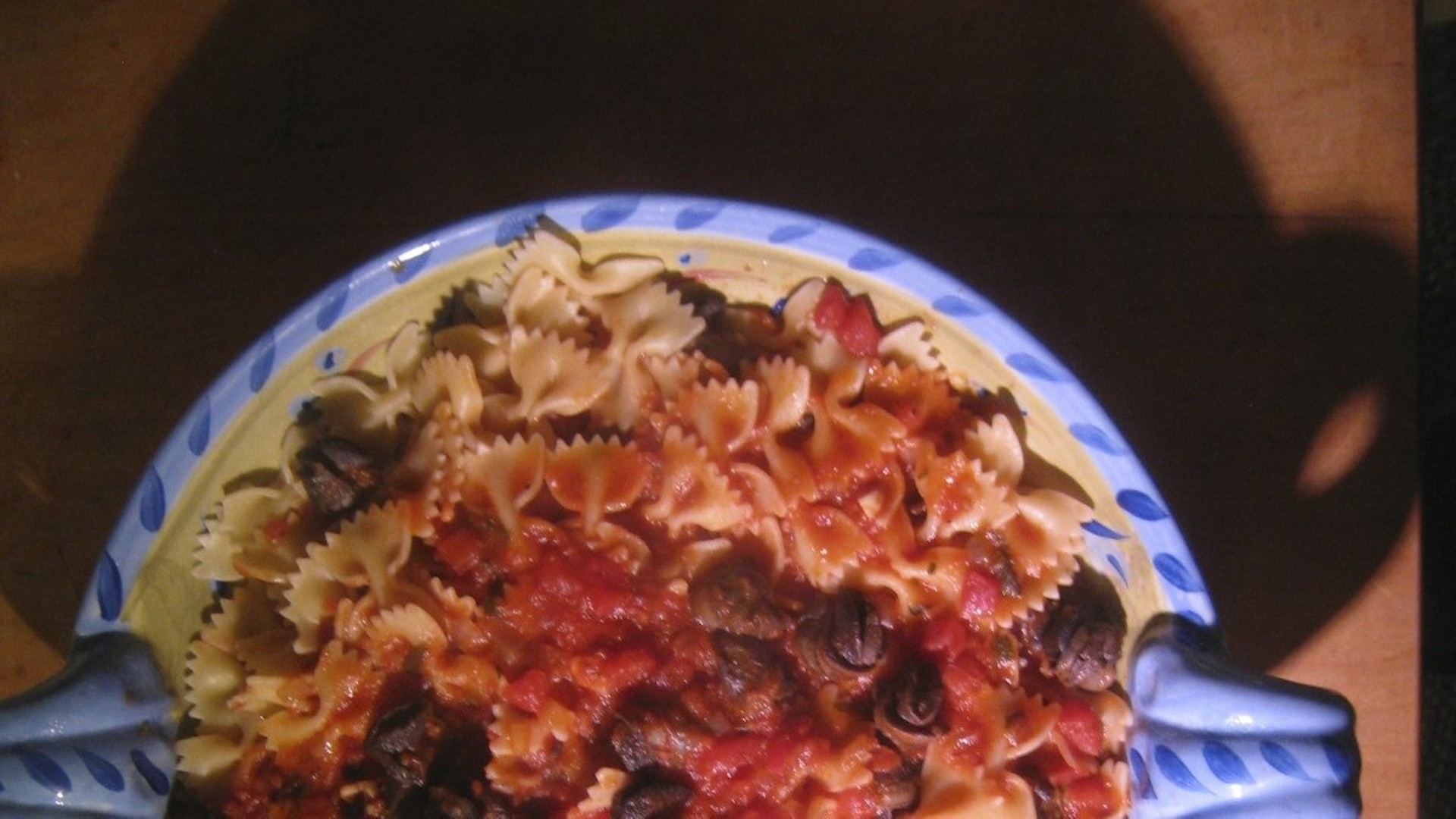
Sis’s Soup with Little Meatballs (Minestra con Polpettine)

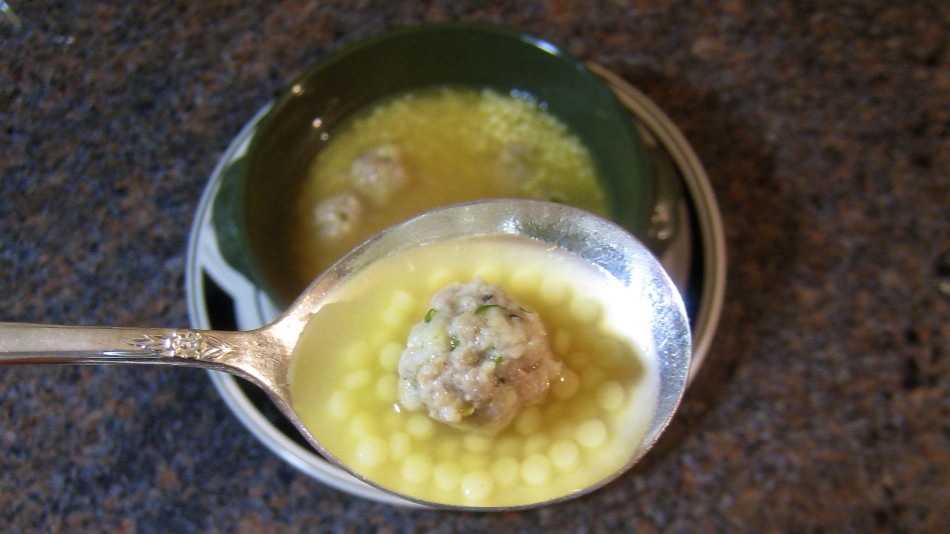
You might recall that last December, I demonstrated how to make quadretti, a small, square-shaped pasta. At some point, I mentioned Mom using this pasta in soup to nurse me back to health but that my Sister remembered differently. She recalled Mom serving broth filled with Acini di Pepe, “sick soup”, whenever she was ill. Well, since Monday was Sis’s birthday, why not share the recipe for her sick soup?

Soup made with Acini di Pepe is not a Bartolini tradition. Oh, sure, it was served plenty of times at the old two-flat but it wasn’t made from a recipe that had been handed down from one generation to the next. It came to us, oddly enough, from the Mother of my 5th grade teacher. Mr. D was from Upstate New York and my class was his first in Detroit. In fact, he arrived in my hometown barely 1 week before school started that September. Mr. D wanted to introduce himself to the parish and to our parents so, once classes started, he visited the home of each of his students. He chose the families alphabetically, making mine the second home he entered. And as was so often the case with newcomers who entered the two-flat, he hung around for a number of years — make that decades — afterwards. (There was a similar phenomenon in our backyard that involved Grandpa, our neighbors, and the Parish priests but I’ll save that for another post.) Eventually, Mr. D migrated upstairs, becoming good friends of Zia and Uncle.  At some point, and I do not recall how much time had transpired, his Mother and Aunt came to Detroit for a visit. It wasn’t long before they, too, became ensnared in the two-flat’s web of conviviality. Well, as luck would have it, both women were good cooks and during subsequent visits, recipes were traded. One of the very few recipes to survive is today’s minestra, Acini di Pepe with meatballs. (It took a while but I got us here.)

Acini di Pepe is a small, bead-like pasta that expands during the cooking process, much like couscous. Mom served it to Sis when her tummy was upset, just as she served me quadretti. As was her way, Doctor Mom started with broth only and gradually added increasing amounts of Acini di Pepe to the broth as Sis’s condition improved. The meatballs, polpettine, were never used for medicinal purposes. No, they were served when everyone was well and seated at the dinner table. And did we ever enjoy them. The lemon zest in the polpettine, when mixed with a hint of nutmeg, take this simple soup to an entirely different level. Now, if Acini di Pepe isn’t “your thing,” I strongly suggest you make the polpettine and use them with whatever pastina you prefer. Trust me. You won’t be disappointed.

Oh, yeah. Happy Birthday, Sis!

*     *     *

Acini di Pepe with Meatballs Recipe

Ingredients

For the polpettine

  • 1/2 lb ground veal
  • 1/4 cup grated cheese, pecorino romano preferred
  • 1/2 cup plain bread crumbs
  • 1 large egg, slightly beaten
  • 1/8 tsp nutmeg
  • zest from 1/2 lemon
  • 2 tbsp fresh parsley, chopped
  • salt & pepper, to taste

For the minestra

  • 2 quarts homemade chicken stock (low-sodium store-bought may be substituted)
  • 1 cup Acini di Pepe, uncooked
  • additional grated pecorino romano

*     *     *
*     *     *

Directions

To make polpettine

yield : approx. 100 polpettine, divided, half to be frozen for later use

  1. Place all the ingredients into a bowl and mix until combined. Do not over-work.
  2. Use a melon baller or small scoop to fashion small meatballs. (See Notes below.)
  3. Divide all the polpettine into 2 halves and place each on separate baking sheets.
  4. Place one baking sheet into the freezer and, once frozen, place the polpettine in a container, return to the freezer for use on a later date.
  5. Use the other half as indicated below.

To make the minestra

  1. Bring the stock to a rapid boil.
  2. Add the Acini di Pepe, stir, and then add the remaining half of the polpettine.
  3. When stock returns to the boil, reduce to a medium simmer and cook for about 10 minutes. Stir often but gently so that the polpettine remain intact.
  4. At the end of 10 minutes, taste the minestra to see if the pasta is cooked to your liking and to adjust seasoning, if necessary.
  5. Serve immediately. Have plenty of grated pecorino romano cheese available at the table.

*     *     *

Notes

Polpettine are meant to be relatively small. One polpettino should easily fit upon a soup spoon with plenty of room left for pasta and broth. Although this recipe yields about 100 meatballs, I prefer to use only about half that amount in a 2 quart pot of soup. Of course, you may use more or less depending upon your own preference.

*     *     *

And Now for the Awards Portion of  Today’s Presentation

Over the past few weeks, I’ve been lucky enough to have received a few awards from members within our blogging community. And lest anyone think that I do not appreciate these wonderful gifts, I wanted to make sure that each was acknowledged.

*     *     *

So, to Marie, of My Little Corner of Rhode Island, I say thank you for generously nominating me for the Kreative Blogger Award.

*

*

*     *     *

To Kathryn, of kiwsparks, and Eva, of Kitchen Inspirations, I say thanks for your thoughtfulness in granting me The (Red) Educational Shoe Award. (And to Greg: You’ll just have to wait before you get to see me in stilettos, be they red or some other color.)

*

*     *     *

Finally, to Roger, of Food, Photography, & France, mere words cannot express the depth of emotion that I experienced upon learning you had nominated me for the Sunshine Award.

*

*

*

*     *     *

OK, I know that I’m supposed to answer a variety of questions or volunteer some facts about myself and I must admit to enjoying reading others’ replies. The truth of the matter is, however, that I’m not all that interesting. I am no onion with many layers to be pulled back revealing inner truths. There is no art in this choke. What you see is what you get — and what you get is pretty boring, at that. Besides, what little there is to tell is fodder for my future posts. If I tell you everything about myself now, whatever will I write about next time or the time after that?  And so, to those who truly wish to learn more about me, I say “Stay tuned … “

The next part of any award acceptance is to pass the award along to deserving individuals. Well, there are 3 awards to pass along and I don’t even know how many bloggers, in total, I am to name. I do know, however, that no matter how many good people I nominate, I will surely forget one person and, in all probability, quite a few more. I have been treated kindly by everyone I’ve met here and encouraged in more ways than I could ever enumerate.  I’d sooner quit blogging than hurt or offend any of those who have treated me so graciously. So, rather than nominate many, I shall only nominate one.

A relative newcomer, this blogging friend has taught me a great deal. By her example, I’ve learned that less is more. That silence is truly golden. That to just be yourself and the World will be yours to conquer. And so it is that I nominate, for the Kreative Blogger, The (Red) Educational Shoe, and Sunshine awards, none other than …

*

*

*

*

*

*

*

*

*

*

*

*

*

*

FLAT RUTHIE !!!!!

As soon as word of the awards became known, her friends carried her off to an impromptu party at Chicago’s Fondue Stube. Pictured above, Flat Ruthie is seen with one of her dearest of friends, Thing, as they await the arrival of the fondue pots. Oh, what a night!

So, congratulations Flat Ruthie! I for one, cannot wait to read your acceptance speech. (No fair helping her, 3D Ruth.)

And to Marie, Kathryn, Eva, and Roger, all joking aside, I am both honored and grateful for the awards you’ve sent my way. Mille grazie!

*     *     *

You Milk The Goat, I Make The Cheese

I came to making my own cheeses by a rather indirect path. Almost 4 years ago, on some cooking show, I watched as labneh was made by straining plain yogurt using coffee filters. I tried it, liked the result and then, following their lead, seasoned it with some herbs. I was so pleased with the end-result that I served it that Thanksgiving and it was well-received. Shortly thereafter, on another sleepless night, I was searching the web looking for more things to do with labneh when I stumbled upon one of the many cheese making websites. Soon I was jumping from site to site, surprised to learn how relatively simple cheese is to create depending, of course, upon the type you’re making — and I’ve been making a few select cheeses ever since.

With the right equipment, supplies, and environment, you can make almost any cheese. Living in the city, however, I cannot get many of the dairy products needed to make some cheeses. Neither do I have, nor am I going to build, a temperature-controlled room to age the hard cheeses that require it. So, right off the bat, I’ve eliminated most types of cheese — and that’s just fine. I’m very satisfied making just goat cheese, cream cheese, ricotta, mascarpone, and mozzarella. Besides, no matter how good the home-made parmesan, I don’t use nearly enough to make it worth my while to make some. (The Bartolini kitchens prefer Pecorino Romano, anyway, but try to find lactating sheep in Chicago.)

*     *     *

Goat Cheese Prepared with Herbes des Provence

*     *     *

Recently, when I decided to share my cheese making experiences, I mapped out a game plan starting with the easiest cheese to make. In my opinion, ricotta is that cheese, especially since my recipe is non-traditional, meaning not made from the whey created when mozzarella is made.  (Having made ricotta both ways, I’ll stick with the recipe I posted for reasons of both taste and ease of preparation.) Somewhere along the way I had planned to talk about making butter at home but Celi did such a good job with it that I’ll just send you to her kitchen’s garden for a look-see. So, having already shared the ricotta recipe and with the butter instructions out-of-the-way, that brings us to the next cheese in the schedule: goat cheese.

To make goat cheese, you begin by adding a little rennet to a combination of goat’s milk and cultured buttermilk. That mixture is gently warmed and then set aside to allow the formation of curds. Once formed, the curds are separated from the whey and the resulting goat cheese is ready for use in your favorite recipe, or, once salted and possibly herbed, can be used as a tasty spread. It really is that easy, as you’ll soon see.

Before attempting to make this cheese or any within my recipe collection, please refer to my Cheesy Stuff page. Chock full of cheesy details, it provides information about ingredients, cleaning/sterilizing equipment, spices & seasonings, a few tips, and sources for supplies and information.

*     *     *

Home-Made Goat Cheese Recipe

yield: about 20 oz. of cheese

Ingredients

  • 1/2 gallon goat’s milk (never ultra-pasteurized)
  • 1 pint (2 cups) cultured buttermilk (no substitutions)
  • 1/2 tablet rennet, dissolved in 1/4 cup distilled water
  • salt (optional, though strongly recommended)
  • herbs (optional)
  • olive oil (optional)

Directions

  1. Place the goat’s milk, buttermilk, and rennet into a large, non-reactive pot. Over med-low heat, slowly raise the mixture’s temperature to 180˚, stirring occasionally to prevent its scorching on the pot’s bottom.
  2. Once it has reached 180˚, remove the mixture from the heat, pour it into a large glass bowl, cover it, and set it aside, undisturbed, for about 12 hours. If the curds have not yet formed, leave it undisturbed until they do. It could take as long as another 12 hours (although it has never taken that long for me).
  3. Take some sterilized cheesecloth or a handkerchief and use it to cover the inside of a strainer. Slowly pour the mixture into the cloth-lined strainer. Once most, if not all the liquid (whey) has passed through the strainer, gather the corners of the cloth and tie them together, forming a sack, of sorts, with the curds inside. Hang this sack over a bowl and refrigerate at least overnight.
  4. Remove the goat cheese from the cloth and season with salt, to taste, and whatever herbs and olive oil you prefer.

*     *     *

Goat Cheese Stuffed Shells

*     *     *

Variations

You can do many things with goat cheese and much depends upon how well it is drained. If you intend to use it as a spread, do not drain it fully and leave it a little on the moist side or, if you like, add a little olive oil. Season it with your favorite herbs and spices and you’ll have a delicious spread for crostini and crudités, or you may crumble it and use it in salads. Drain it more thoroughly and although you can still season it and use it as was already mentioned, you’ll find that you can, also, use it as you would ricotta in lasagna, cheesecake, or stuffed shells, or on top of pizza or bruschette.

Notes

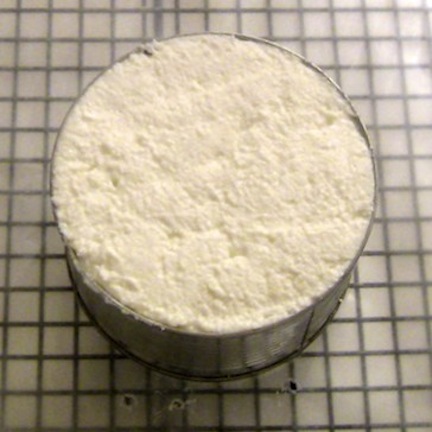
There are any number of places where you can purchase molds used to press various cheeses into recognizable shapes. If I were to make more kinds of cheese, I would probably buy a few of them. Since I really don’t make enough cheese to warrant purchasing molds, I made do. Using a large can that had been used for pineapple rings, I removed the can’s top & bottom, saving one of the lids, and filled it with goat cheese. I placed a cooling rack on top of a baking sheet and covered it with a piece of waxed paper in which I’d punctured some holes in an area a little larger than the size of the can. I placed the cheese-filled can over the holes, replaced the lid, and placed a heavy can on top of the lid, thus applying pressure to force more whey out of the cheese. Everything was refrigerated overnight and the cheese was used later that day to make the stuffed shells pictured above.

*     *     *

Coming Soon

In the weeks ahead, look for my posts detailing the making of cream cheese, mascarpone, and mozzarella. Speaking of mozzarella, please let me know if you are aware of a nearby water buffalo herd.

*     *     *

Inspired by Fankhauser’s How to Make Farmer’s Cheese web page.

*     *     *

Here’s Flat Ruthie Now …

Flat Ruthie visited Chicago and stayed long enough to take part in my 2 day birthday celebration. Click on Day One to join us as we get the party started and to learn the story behind the picture below. The celebration continues on Day Two with a mini-tour of Chi-town and concludes that evening with my birthday dinner.

*     *     *

Trippa alla Stefanina

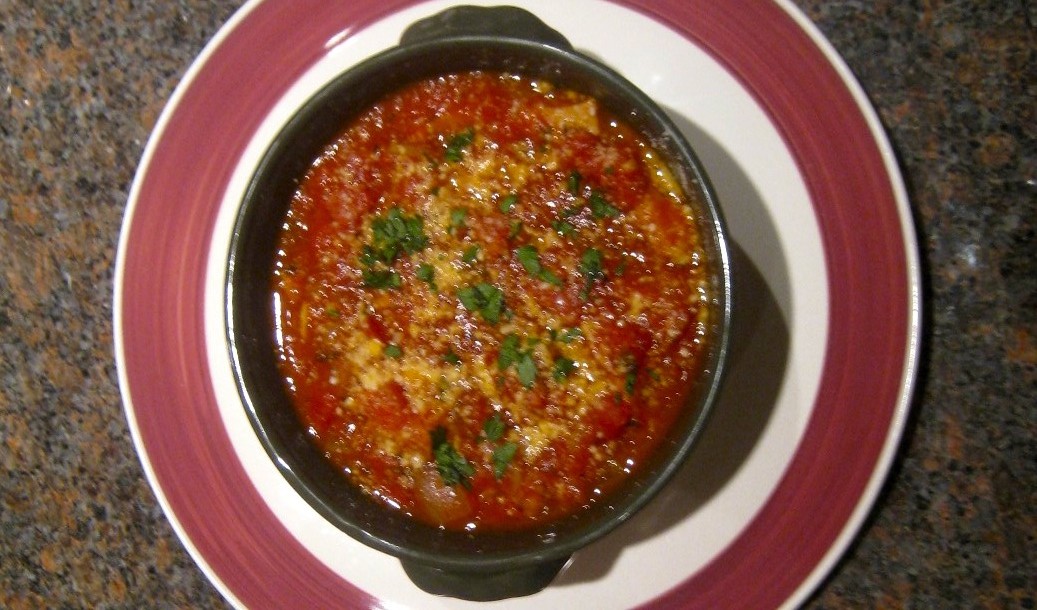
There’s no way around it. Today’s recipe is tripe, another within the series of posts which many will find less than appealing, to put it mildly. And, once again, the overwhelming majority of my generation of the Bartolini Clan would agree.  I, myself, being the only exception. Yet, tripe is an ingredient found in most of the World’s cuisines and, when cooked properly, is really quite tasty. Still, many of you may be looking for the nearest exit and, if that’s the case, you may depart HERE. All right then …

Nonna

Trippa wasn’t something Mom ever prepared while I was growing up but it was a dish that the “People Upstairs” made and one that I absolutely loved. Even then, since Zia’s boys would have nothing to do with it, I believe it was usually Grandpa who requested trippa be on that day’s menu. Being that Zia had her own family’s dinner to prepare, the trippa was often made by her Mother-in-law, a woman we kids all called “Nonna”  and whose name was Stefanina. She was a sweet woman and, for my siblings and I, the only Nonna we would ever really know. Since tomorrow would have been her birthday, and yesterday was mine, what better way to celebrate both than by sharing this special recipe? And it is special, as you’ll soon see.

Now, before going further, we need to revisit the 2 flat’s floor plans. You may recall that a stairwell separated my bedroom from our kitchen and the rest of our home. Directly above my room, was my cousins’ bedroom and the stairwell, also, separated their room from Zia’s kitchen and the rest of their home. So, forgetting the stairwell for a moment, my bed was about a 10 feet, in a straight line, from Mom’s stovetop and certainly less than 20 feet away from Zia’s. (Remind me again. Why did I move away from home?)

On those occasions when Grandpa prevailed upon Nonna to make a batch of trippa, the aroma of some as yet unknown delicacy, wafting down the stairs, was my siren call. A quick run up the stairs and a stealth bomber-like cruise through their kitchen was all I needed to check things out. Trippa was on the menu! I returned home via the “front stairs” and the wait began in my room. After what seemed like an eternity, I would hear Nonna’s voice calling, “Johnny! Johnny, are you there? I’ve got surprise for you.” My feet couldn’t get me up those stairs fast enough. When I burst into the kitchen, she’d be standing there, smiling broadly, holding a dinner plate. “Would you like some polenta?” Trying not to appear too eager, I’d reply with something like, “Sure.” And so the lesson began. “This is how you make polenta, Johnny.” Holding the plate in one hand, she would use the other hand’s fingers to dot the plate’s surface with dabs of butter. Then she would sprinkle the plate with freshly ground Pecorino Romano cheese. Next, using a large spoon, Nonna would slowly and carefully cover the plate with a nice layer of freshly made polenta. By now, I was about ready to drool. “Pazienza, Johnny,” and she would dot the surface of the polenta with more butter, to be followed with another sprinkle of grated cheese. And then came the trippa. Da Vinci didn’t take such care painting the Mona Lisa as did this dear woman when she layered the trippa upon that polenta. Then came another sprinkle of cheese. And every time, when she was done, with a twinkle in her eye, she would hand me the plate and say, “This is how you make polenta with trippa.”

Many years later, I cooked a polenta dinner for Mom and Zia. They were dumbstruck when I prepared their plates just as Nonna had showed me all those years before. Although both were fully aware that she often made me a plate when she cooked trippa for Grandpa, they’d no idea how that plate was created. And today, some 40+ years after my last serving of Nonna’s cooking, I cannot prepare a dish of polenta with trippa without hearing her say, “Pazienza,” and, minutes later, when my plate is ready to eat, I just have to echo, “This is how you make polenta with trippa.”

The preparation and serving of trippa that I am about to present is in the style of Le Marche (alla Marchigiani). (For tripe prepared with a distinctly Spanish flair, check out Tanya’s fantastic Chica Andaluza blog.) Today’s recipe is pretty much the same as Nonna prepared, save 2 exceptions. The first, and easiest to explain, is that I use instant polenta and I don’t know if the product was even available when Nonna was fixing me a plate. I first brought instant polenta to Mom and Zia some 20 years ago and they never served me “regular” polenta again. In fact, during his last visit to Italy in the early ’60s, Grandpa brought back a copper “polenta pot.” Each time Nonna prepared my plate, she served me polenta that she had spent 45 minutes stirring in that very pot. With the arrival of instant polenta, there was no real need for it any longer and I was given the pot several years ago. And, as “payment,” when I return home for a visit, I always bring a container or 2 of instant polenta.

*     *     *

*     *     *

The second exception has to deal with a basic of Italian cooking. Most, if not all, of the Mediterranean countries begin many of their sauces, stews, and, well, just about anything, with a mixture of diced green pepper, celery, and onion. In Italy, this is called a soffrito and it is sautéed in olive oil at the very start of many dishes, just as is done in France (mirepoix) or in Spain, Latin America, and the Caribbean (sofrito) where the ingredients may vary a bit. Even New Orléans has its “holy trinity” of onion, carrot, and green bell pepper. My family often began dishes with a different kind of soffrito called “battuto.” To make a good “battut,” you need fine quality salt pork, onion, garlic, and parsley. Exact quantities are nearly impossible to gauge. This is something that must be learned by doing. I can say that the onion makes up the majority of a battuto and a small to medium size onion will do. You will, also, need 2 to 3 oz of salt pork sliced about 1/4 inch thick, 2 to 3 garlic cloves, and about 4 tbsp of fresh parsley. That should give you about 1 to 1 1/4 cups of battut, just perfect for today’s recipe. Begin by heating your knife’s blade over a stove’s burner. Once hot, use it to roughly chop the salt pork. Next, in no specific order, roughly chop the garlic, parsley, and onion. Combine the 3 ingredients on top of the salt pork and continue to chop them all. Do not create a paste but continue chopping until the ingredients are of uniform size and well-blended. Once chopped, sauté the battut in a sauce pan with olive oil over medium heat until it develops a little color. Do not rush it nor let it burn. Once done to your satisfaction, go ahead with your recipe. For today’s recipe, if you’d started with a battut, there would be no need for the pancetta, onion,  nor garlic, and the only parsley required would be added at the very end of cooking. You’ll be amazed at the flavor this simple mixture brings to a dish and your kitchen will be filled with an aroma that is just too good to be true.

My family used battuto as the base for sauces, braises, risotto, some soups, and even some vegetables. During the worst of the Great Depression, dinner often consisted of a large amount of polenta served on a large “polenta board” that had been placed in the middle of the dining table. At its very center, Grandma placed a little battuto and you had to eat your way through the polenta to get to it. Grandma, also, used battuto to dress pasta, her own version of aglio e olio. Mom and Zia stopped making battuto a number of years ago, about the time they stopped making sausage. They just couldn’t find good quality salt pork anymore. In its place, like in today’s recipe, they made a soffrito, of sorts. Not willing to give up, I keep searching for salt pork that will pass Zia’s inspection. To that end, I’ve recently learned of a Polish butcher on the West Side that reportedly has the best salt pork in town. We’ll see soon enough.

*     *     *

Trippa alla Stefanina Recipe 

Ingredients

  • 5 lbs honeycomb tripe
  • 3 tbsp extra virgin olive oil
  • 1/4 lb pancetta, chopped
  • 1 large onion, chopped
  • 4 tbsp fresh parsley, chopped, separated
  • 4 garlic cloves, diced
  • 1/2 cup dry white wine
  • 3 tbsp tomato paste
  • 1 large can (28 oz) crushed tomatoes
  • 1 large can (28 oz) diced tomatoes
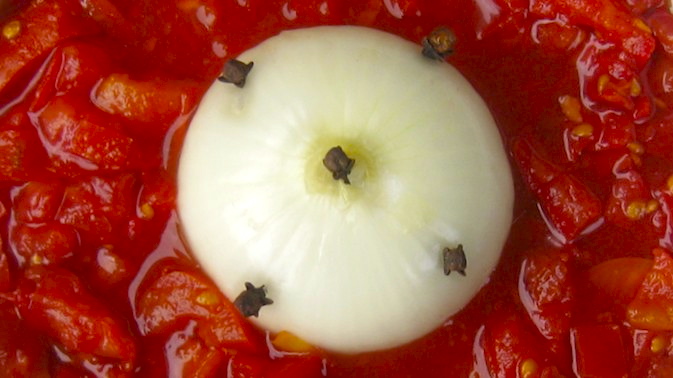
  • 1 small onion, whole & studded with 5 – 6 whole cloves
  • 1 tbsp marjoram
  • salt & pepper, to taste
  • grated Pecorino Romano cheese for serving

*     *     *

*     *     *

Directions

  1. Rinse trippa under cold water and trim off unusable parts. Place in a large pot, cover with water, and bring to a boil. Reduce heat and simmer, uncovered, for 1 hour.
  2. Remove trippa from water and, when cool enough to handle, cut into strips 1 to 2 inches in length and 1/4 to 1/3 inch wide.
  3. While the trippa cools, heat olive oil in medium-sized sauce pan over med-high heat. Add pancetta and sauté until cooked but not crisp, about 8 minutes.
  4. Add the chopped onion, half of the parsley, and sauté until onion is translucent, about 5 minutes.  Season lightly with salt & pepper.
  5. Add garlic and sauté for another minute before adding the wine. Continue cooking until the wine is reduced and almost gone.
  6. Add the tomato paste and continue to sauté for 2 minutes before adding the tomatoes, marjoram, and trippa. Season with salt & pepper, stir well, and then add the clove-studded onion.
  7. Bring to a boil, reduce to a soft simmer, and continue cooking for at least 2 hours. Sauce should be dark and thick; the trippa should be quite tender.
  8. Remove studded onion and discard. Add most of the remaining parsley to the pot, taste to see if additional salt or pepper is needed, and stir well.
  9. Serve immediately, garnished with the remaining parsley and a sprinkling of cheese. Be sure to have grated cheese available at the table.

*     *     *

Serving Suggestions

Traditionally, trippa is served in deep soup bowls with a healthy chunk of crusty bread on the side. As mentioned above, our family usually served it atop polenta. Pasta fanatic that I am, I’ve even used it to dress pastas like farfalle or rotini.

Notes

Making instant polenta is quite an easy process. So much so that there’s little need to devote an entire post to it, especially since my family’s recipe is so simple. Following package directions (most require, per serving, 4 tbsp of polenta for each cup of water), bring the water to boil, add a pinch of salt, and pour the polenta into the water, whisking all the while until fully blended. Over a medium to med-low heat, stirring frequently, cook the polenta for 5 minutes. At the end, add a tablespoon of butter and grated cheese to taste. (The latter would depend upon the dish(es) that will accompany the polenta.) Mix well and serve. It couldn’t be more simple. Of course, if you want to serve polenta like Nonna, dabs of butter and all, then go for it. You won’t be disappointed.

*     *     *

About the Matter of Provenance

I’ve been asked, more than once, if these are really my family’s recipes. Certainly, not all of them are but, I can assure you, those that I say came from Mom, Zia, Nonna, etc., are, in fact, theirs. As further proof, below is an image of the Zia’s “polanta” recipe that can be found in the recipe book that she gave me.

*     *     *

*     *     *

Where’s Flat Ruthie Now?

Any guesses?  Stay tuned …

*     *     *

A Slightly Wilted, Very Tasty, Surprisingly Filling, Spinach Salad

I hadn’t intended to share this recipe yet but, over the weekend, my vegetarian friend and fellow Wrigley Field denizen, Cynthia, convinced me to write it up and post it now. So, my dear Cubs Fan, this one’s for you …

*     *     *

*     *     *

I first saw this salad prepared a few weeks ago, just prior to Christmas, but my mind was too occupied with thoughts of the holiday dinners-to-come to give it any real consideration. I’ve always enjoyed a spinach salad, a trait Mom & I shared, but the thought of having a salad as a meal around the holidays is so not me. And then came the New Year’s Day porchetta (roasted pork).

Now, I thoroughly enjoyed that roast. It was everything I had hoped it would be and certainly lived up to my recollections of the porchette of my childhood. I, also, enjoyed the pork sandwiches and panini that followed but there came a point, much to my surprise, where the idea of another sandwich, porchetta or otherwise, was not the least bit enticing. Worse yet, and most unbelievably, I’d had my fill of pasta, too! One afternoon, I found myself walking around a grocery and nothing was the least bit appealing. You hear about this  happening to others but never in a million years do you think it will happen to you.

Dazed and confused, I pushed my cart passed the meat counter, beyond the seafood, through the dairy aisle, and into the produce section. What to do, what to do? That’s where it hit me. Spinach salad! As my anxiety waned, I began to remember the ingredients required. Luckily, I already had everything I needed at home, save the spinach. Moments later, with renewed vigor and a bag of baby spinach, I was out the door and on my way home. That evening, I dined on a spinach salad so good that I’ve prepared it twice again since that first meal. That’s right. Me. Eating salads for dinner! (Just how many Signs of the Apocalypse are there?)

*     *     *

A Slightly Wilted, Very Tasty, Surprisingly Filling, Spinach Salad Recipe

serves 4

Ingredients

  • 2 tbsp extra virgin olive oil, separated
  • 1/2 lb bacon cut into 1/2 inch strips (lardons)
  • 1 shallot, sliced
  • 1/2 lb crimini mushrooms, sliced or quartered
  • 1/2 cup chicken stock (water may be substituted)
  • 4 whole eggs
  • 1 bag (8 oz) pre-washed baby spinach
  • 6 tbsp balsamic vinegar, more or less to taste
  • salt & pepper, to taste

Directions

  1. Add 1 tbsp of olive oil to a sauté pan over med-high heat. Add bacon and sauté until cooked and crispy along the edges.
  2. Add the shallots and continue sautéing until translucent. Add the mushrooms and cook for a couple of minutes until soft.
  3. Use the chicken stock to deglaze the pan, then bring to a boil, reduce heat, and simmer until the liquid is reduced by half.
  4. Add all but 1 tbsp of the balsamic vinegar and stir. Taste the dressing and adjust, using more balsamic or olive oil, depending upon your preference. Remove from heat.
  5. In another, non-stick, skillet, heat 1 tbsp of olive oil over med-low heat.
  6. Gently add each of the 4 eggs to the pan, being careful to keep the yolks whole. Season with salt & pepper.
  7. Fry the eggs until the whites are thoroughly cooked but the yolks remain soft.
  8. Dress the spinach with the warm dressing in a large bowl. Mix well to allow the spinach to wilt evenly.
  9. Apportion the salad across 4 plates. Place a fried egg atop each salad and serve.

*     *     *

Notes

The ingredients can be easily adjusted to suit your tastes and/or the number of servings required. If you prefer your salad heavily wilted, dress the spinach with the warm dressing while the eggs are frying. If you prefer your spinach more firm, dress the spinach just prior to placing the eggs on top.

For you, Cynthia, and your fellow vegetarians: just skip the bacon, increase the olive oil to make up for the lack of bacon fat, and use water in place of the chicken stock. And, as always, Go Cubs!

*     *     *
Inspired by Michael Symon

*     *     *
Strozzapreti Pasta

Throughout much of modern history, the Italian language has had fewer words in its lexicon than most other languages, and that includes its cousins, the Romance languages. Granted, the gap has lessened over the last century but the fact that it existed at all is because Italian, being an ancient language, was so closely descended from Latin, an even more ancient language of even fewer words. So, when it came to identifying their pasta, Italians didn’t create new words but named each after the familiar object it resembled, both real and imagined. We Americans know some of their names but that’s just the tip of the meatball. There are pastas named after just about anything, from little tongues (linguine) to little ears (orecchiette) to the hair of an angel (capelli d’angelo). Some look like shoelaces (stringozzi), others like twine (spaghetti), and still others like ribbons (fettuccine). And then there are the shells, be they from the sea (conchiglie) or the land (lumache). There are the twins (gemelli), flowers (fiori), little bells (campanelle), and little radiators (radiatori). And we mustn’t overlook tortellini, which are said to resemble the navel of Venus. The list goes on and on, far too long to fully explore here. Instead, every now and again I’ll share one that I find interesting and, most importantly, easy to make by hand. To that end, I shared a recipe last May for one obscure pasta called fazzoletti, little handkerchiefs and, in December, Mom’s quadretti, little squares. Today, I thought that I’d share another, the name of which is sure to give you pause. It is strozzapreti, priest choker pasta.

I first learned of strozzapreti when Zia and I were in Florence in 2002. We had a good laugh when the waiter told us the legend behind the pasta’s name, although at the time, I mistakenly thought that he was merely giving us a sales pitch. According to the waiter, strozzapreti is so good that when it was invented and first served to priests, they devoured it so quickly that they choked. You must admit, if you’re trying to sell pasta, that’s a pretty good story to have up your sleeve. Move forward a few years. I’d forgotten all about the pasta until I heard some chef on television mention priests choking. After some web searching, I saw how the pasta was made and strozzapreti became a part of my pasta arsenal. There are, by the way, other legends involving the naming of this pasta but I’m sticking with the one I first learned. (Ya leave the dance with the one that brung ya.)

Strozzapreti are a twisted pasta, about 3 inches in length, vaguely reminiscent of cavatelli. Of course, cavatelli, being machine-made, are consistent in shape and length, while home-made strozzapreti are anything but — and therein lies its charm. Few would ever mistake a dish of home-made strozzapreti for a mass-produced pasta and no mass-produced pasta will ever taste nearly as good as home-made strozzapreti. The latter part of that statement is as good a reason as any for taking the time to make this pasta.

*     *     *

How to Make Strozzapreti

To start, you’re going to need some dough. I’ve always used Mom’s Pasta Dough here and am perfectly happy with the results. Once you’ve made your dough and rolled it out, the rest is pretty easy, albeit repetitive. Take a dough sheet of about 12 inches long, fold in half, and in half again, until it is no more than 3 inches wide. With a sharp knife, cut tagliatelle-sized noodles and unfold each noodle, as needed. Once unfolded, start at one end and roll the noodle between your palms to create a twisted piece of pasta. Tear off a 3 inch piece and roll the remaining noodle, again and again, tearing off pieces as you go. You’ll find that your pasta will have a tighter spiral if you only roll them in one direction. Going back-and-forth will only wind and unwind the coil. Once you get the hang of it, you’ll manage to make each piece with a single pass between your palms.

One last thing worth mentioning involves the pasta dough. Usually, when you cut pasta, whether by hand or machine, the dough should be dry-ish to prevent the strands from sticking together while being cut. That’s not the case here. If the dough is too dry, the lower, dangling, part will break as you try to roll the upper part to form the strozzapreti. Not only that, you may find it nearly impossible to get enough traction between your palms and the noodle to get it to twist. If you find that you cannot roll the pasta between your palms, try moistening your hands just a bit. Bear in mind, however, that too much water will ruin the pasta. A scant drop of water spread between your palms should do the trick.

*     *     *
Cut the dough into a strip about 12 inches long.

 *     *     *

Fold the strip in half

*     *     *

Repeat at least one more time to create a sfoglia

*     *     *

Cut the sfoglia into tagliatelle-sized pasta

*     *     *

Unfold 1 noodle

*     *     *

Place tip at the base of one palm and with other hand's fingertips ...

*     *     *

... Begin to roll the noodle between your palms

*     *     *

Tear off a 3 inch piece of the twisted pasta

*     *     *

Repeat until the entire noodle has been twisted and cut into pieces

*     *     *

Unfold another noodle and repeat the process until finished

*     *     *

Tutto fatto!

*     *     *

Cooked fresh in salted water, strozzapreti will be ready in minutes. If dried or frozen it will take a few minutes more. The pasta’s shape, in my opinion, lends itself to being served with pesto or a tomato sauce, with or without meat. Serve it garnished with grated cheese, while you tell the tale of choking priests, and you’re sure to have satisfied, as well as entertained, dinner companions.

Variations

Although I formed the strozzapreti by rolling the dough between my palms, you can make them using a slender rod or barbecue skewer. Once you’ve unfolded the tagliatelle-like noodle, cut it into 3 inch pieces. Place the rod atop each individual dough piece and roll the two, creating a spiral pasta. Remove the rod and repeat the process with another piece of dough.

Lidia Bastianich makes a version of strozzapreti that is a gnocchi-like dish. I have no doubt that her dish is called strozzapreti, just as I’ve no doubt that we were served the pasta that I’ve described above and it, too, was called strozzapreti. How can this be? Well, obviously, there’s more than one way to choke a priest.

*     *     *

Roast Pork with Fennel

Porchetta

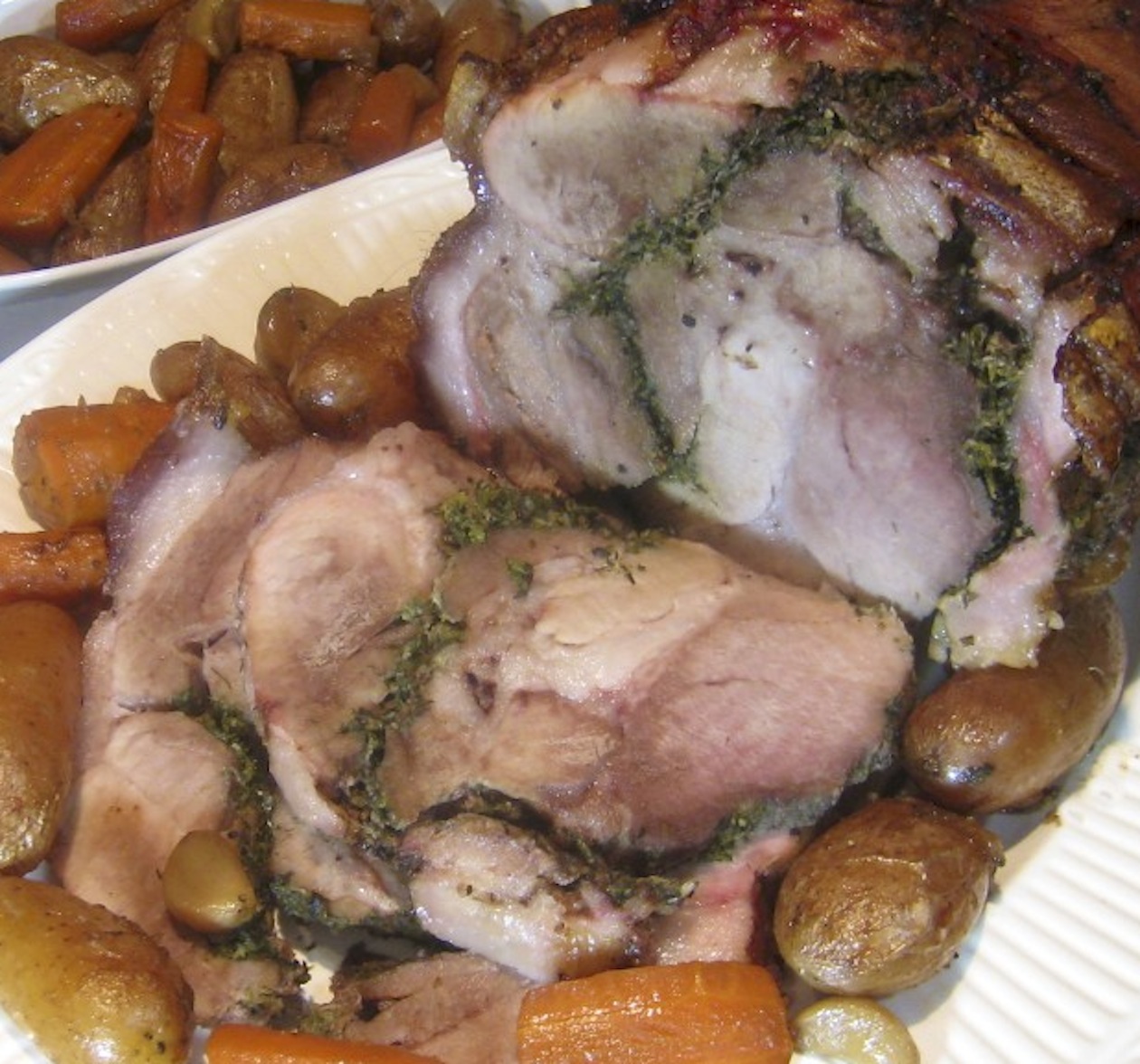
My last few posts have been pretty much dedicated to dishes served over the Holidays. Today’s recipe, Porchetta con Finnocchio, is yet another of those dishes and was served not just around Christmas but whenever there was reason to celebrate. Similar in preparation to most pork roasts, this roast differs because of the cut of meat used and for the use of fennel, finnocchio, as seasoning.

Traditionally, porchetta meant the roasting of an entire pig. In fact, one such pig was roasted at a neighborhood bakery and served at the wedding reception of Zia & Uncle. (Imagine a time when “A”, there were neighborhood bakeries and, “B”, you could use their oven to roast a pig!) Now, that may be fine when feeding large groups but, for most families, a pig roast is out of the question. My family, like many, used the pig’s foreleg, the picnic ham, for the roast.  The meat was butterflied, removing the bone in the process, and then heavily seasoned with, among other things, fennel fronds which are similar to dill in both appearance and taste. The result was a juicy roast, with herbal flavoring throughout. Times have changed and picnic hams aren’t as readily available as they once were. My family switched to roasting bone-in pork loins initially but, as time passed, they, too, became less available and we began roasting boneless pork loins. Although still very good, the loin is a lean cut of meat and some will forever favor a porchetta made using  picnic ham over one made with pork loin.  In a future post, I’ll share a recipe for porchetta using a pork loin but, for today, we’re once again turning back the clock to roast a leg of pork.

This recipe differs from that used by my family in a couple of ways. First off, I wanted to make sure that I had a sauce to serve with my porchetta. To that end, I include roasting vegetables in the pan, adding stock & wine as a basting liquid. I, also, love roasted vegetables and add potatoes and carrots to the roasting pan about an hour after the roasting has begun. In contrast, the most my family put in the roasting pan was a few potatoes, and even that was a rarity. As a result, I don’t remember Mom ever serving a sauce with her porchetta. Lastly, and this is a big one, relatively speaking, I include sliced finnocchio as a roasting vegetable. This would never have been done back home, for fennel was always served raw, the fronds and smaller stems being frozen for later use in a porchetta. Whether served alone or among crudités, fennel was either served plain or with a small, ramekin-sized dish containing a simple dipping sauce of extra virgin olive oil, salt, pepper, and maybe a little red wine vinegar. (There is a name for this sauce but neither Zia nor I can remember it.) I broke with tradition when, about 15 years ago while they were visiting Chicago, I served Mom & Zia a whole sea bass that had been stuffed with, and roasted upon a bed of, fennel. That was the first time either had been served cooked fennel. So, for me to add fennel to the roasting pan is somewhat of a big deal. The flavor it brings to the sauce, however, is well worth the change. Still, should you wish to roast your porchetta in true Bartolini fashion, prepare the roast as indicated below, omitting all the roasting vegetables, and place the porchetta on a roasting rack centered in a roasting pan. No matter how you roast your porchetta, bear in mind you may need to adjust the amount of herbs needed depending upon the size of your roast.

*     *     *

Porchetta Recipe

Ingredients

    • 1 raw picnic shoulder ham, skin on, bone removed, butterflied
    • 4 tbsp fennel fronds, chopped
    • 4 tbsp fresh parsley, chopped
    • 8 – 10 garlic cloves, diced
    • 3 – 4 tbsp fresh rosemary, chopped
    • olive oil
    • 1 tbsp marjoram
    • 12 whole garlic cloves
    • 1 fennel bulb, thinly sliced
    • 1 onion, thinly sliced
    • 3 celery stalks, chopped
    • 3 carrots, cut into large pieces
    • fingerlings or new potatoes
    • 3 rosemary sprigs
    • 6 cups chicken stock, divided
    • 3 cups dry white wine, divided
    • 3 tbsp AP flour
    • butter
    • water

Directions

    1. About an hour before the porchetta is to go into the oven, combine the fennel fronds, parsley, chopped garlic, and rosemary. Add enough olive oil to make a paste, stir,  and set aside.
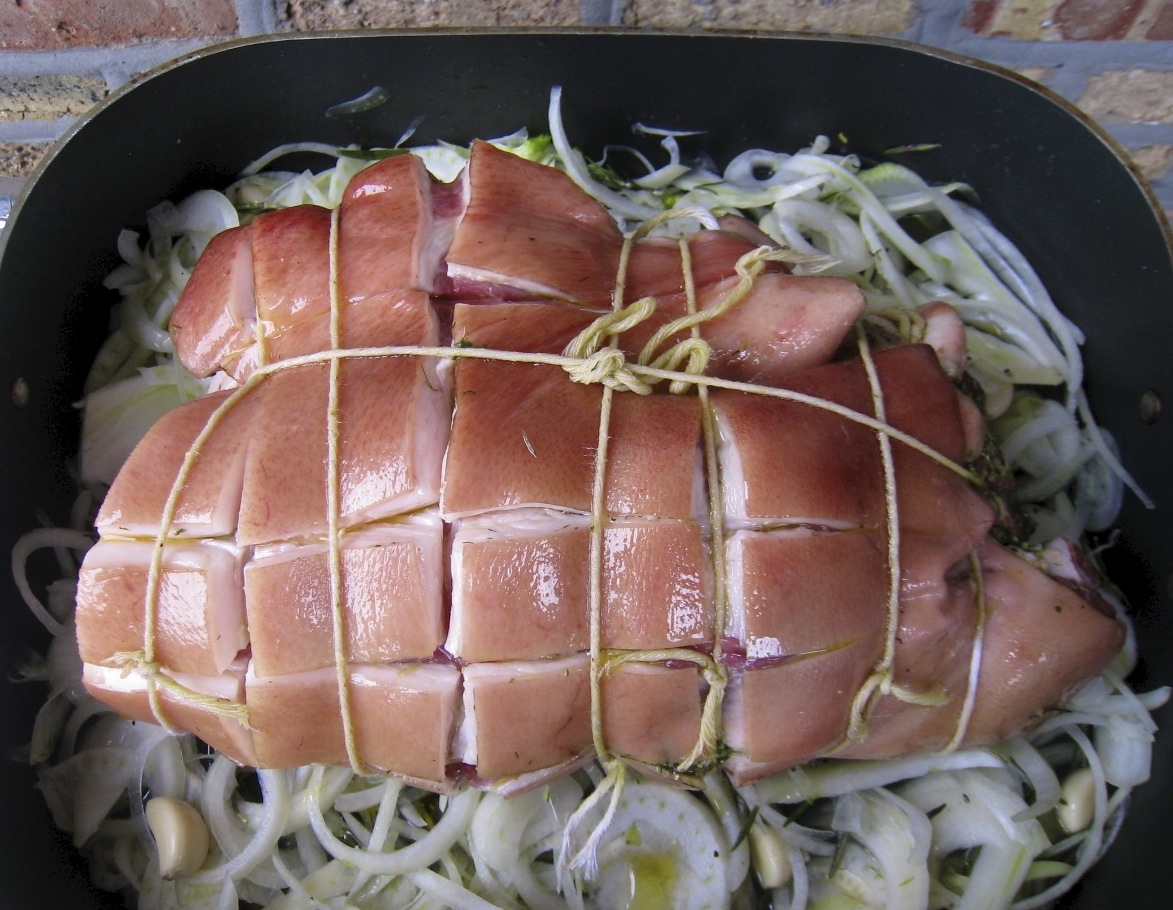
    2. Use a sharp knife to score the pork skin, making a checkerboard or diamond pattern. Try to avoid cutting deeply into the pork meat, if at all.
    3. Place the roast, skin-side down, and “open it,” revealing as much surface area inside the roast as possible.
    4. Evenly coat the exposed flesh with the herbal paste created in Step 1. Season with marjoram before liberally seasoning with salt & pepper.
    5. Use twine to tie the roast securely. Set roast aside while it loses its chill.
    6. In a roasting pan, add the sliced onions, fennel, celery, and whole garlic cloves. Season liberally with salt & pepper.
    7. Place the roast atop the bed of roasting vegetables. Pre-heat oven to 450˚.
    8. Coat the roast with olive oil, add 2 cups stock plus 1 cup wine to the roasting pan.
    9. Place roasting pan in pre-heated oven. Every 20 minutes, baste the roast with the pan juices, add more stock and wine to the pan, if needed.  (Be sure to reserve 2 cups of stock and 1/2 cup of wine for use later.)
    10. Meanwhile, place potatoes and carrots into a large bowl, season with salt and pepper, some rosemary, and enough olive oil to coat. Mix well.
    11. After 60 minutes total time, reduce oven temperature to 325˚, baste the roast adding more liquid to the pan if needed, and place the seasoned carrots and potatoes into the roasting pan.
    12. From this point forward, continue to baste the roast every 30 minutes or so, replenishing the pan juices when necessary.
    13. If outer skin grows too brown, use aluminum foil to tent the porchetta.
    14. Roast will be finished when the internal temperature reaches 165˚. When ready, remove roast to a cutting board and tent with aluminum foil to rest for at least 15 minutes. Remove the carrots and potatoes to a covered bowl. Strain the pan juices from remaining stewing vegetables.
    15. Use the reserved 1/2 cup of wine to deglaze the roasting pan over high heat.
    16. Use a grease separator to remove all but 3 tbsp of grease from the strained liquid.
    17. Reduce heat to medium, add the 3 tbsp of grease to the roasting pan, and add 3 tbsp AP flour. Mix thoroughly and cook for a minute or so to create a roux.
    18. Add the remaining pan juice liquids and stir until the sauce begins to thicken.
    19. Begin adding the reserved of stock to the pan, stirring constantly, over medium heat.
    20. Once all the stock has been added and the sauce thickened, taste for seasoning, remove from heat, and add a tab of butter to finish the sauce.
    21. Before carving the roast, use a small knife to remove the skin (crackling), which may be served with the roast or left in the kitchen as the Cook’s reward.
    22. Slice and serve the roast, accompanied by the sauce and reserved roasted vegetables.

*     *     *

Notes

You’ll note the recipe calls for fennel fronds when, in reality, Mom also used the small, thin stems along with the fronds. I believe these stems bring  much flavor to the roast but no one wants to find a stem in their food. To get around this, I make sure any stems used are chopped as finely as possible.

*     *     *

Zuppa Inglese

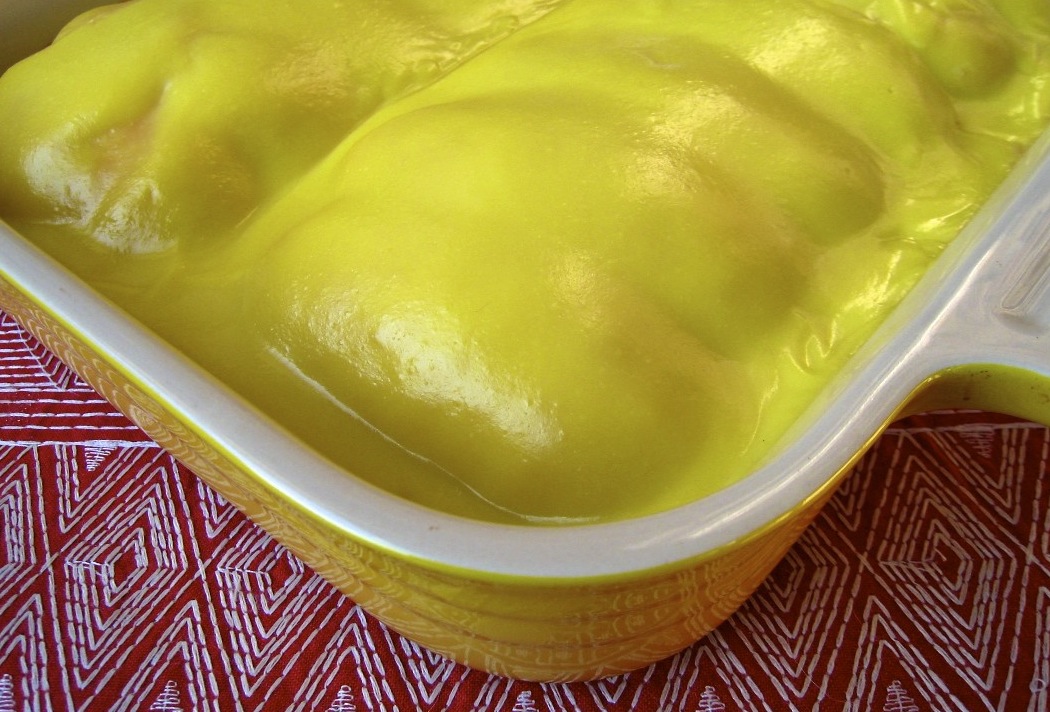
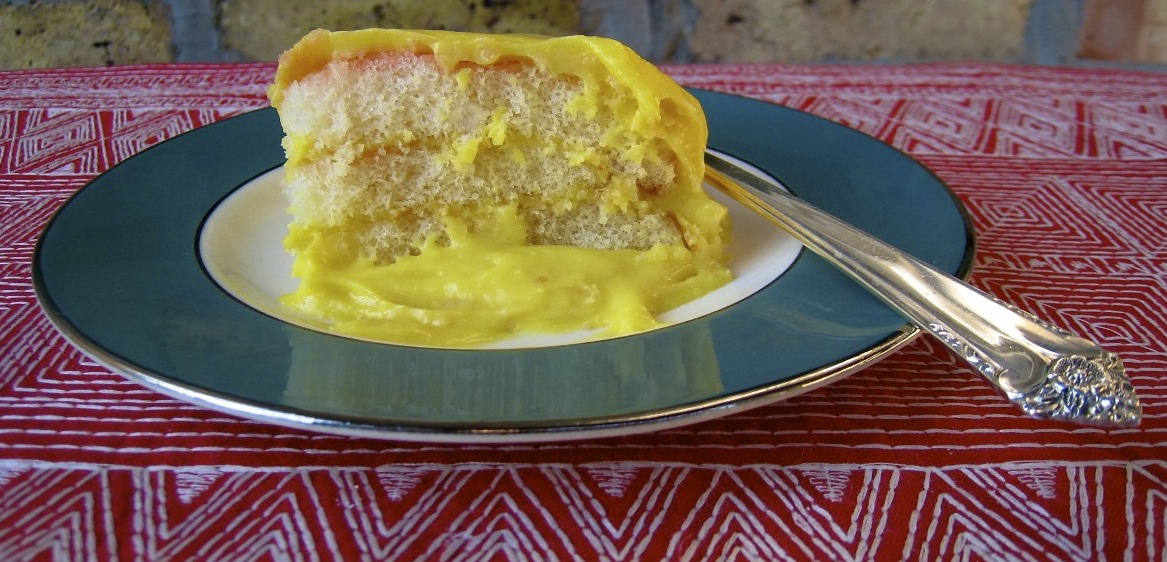
Say the words “Zuppa Inglese” to my siblings and immediately their thoughts will turn to Christmas. Consisting of liquor “enhanced” lady fingers swimming in a lemon-flavored custard, this “English Pudding” was as much a part of my family’s Christmas Dinner tradition as was the platter of ravioli and the roasted chestnuts. To be sure, this is a dessert intended for adults but Mom didn’t forget us kids. She, also, made a non-alcoholic version which you can find in Variations below. (Even so, Dad always managed to sneak us a taste of his dessert when Mom wasn’t looking.)

The recipe I’m sharing is a version Mom gave me that calls for only 12 egg yolks. Before you think, “Only 12 egg yolks!?!?!” understand that the original recipe, a copy of which I also have, calls for 36 egg yolks. That’s a whole lotta Zuppa Inglese! In fact, making a batch of custard that large became a team sport, so to speak, with Mom, Zia, and Nonna suiting up against 3 dozen taunting yolks gathered menacingly in the bottom of an enamel pan. You see, when making so much custard on top of the stove — without a double boiler, mind you — it must be given constant attention and stirred non-stop for about 45 minutes. Leave it for a minute, unattended, and you’ll return to a lumpy mess. So, the Ladies of the 2-flat banded together on Christmas Eve, each taking a 10 to 15 minute turn stirring the pot, while her teammates played Briscola. I remember them moving the kitchen table close to the stove so that the “stirrer” could sit on the table’s edge while the other 2 Ladies kept the card game going at the other end of the table. Sipping a glass of wine all the while, the 3 chatted, laughed, played, and stirred until all agreed that the custard was done.  A few minutes later and there was enough Zuppa Inglese, both with and without alcohol, to serve anyone seated at the Christmas Dinner table.

As always, there are a couple of things to consider when preparing this dish. First off, I cannot stress enough that the custard must be stirred constantly, especially if you do not have a double boiler. Failure to do so and you may find yourself buying more eggs when you should be wrapping presents. (No need to run out and buy a double boiler. Place a couple of inches of water in a saucepan over low to med-low heat. Put the ingredients in a bowl large enough to lay on top of the saucepan without falling in. The boiling water should never touch the bottom of the bowl.) Make sure to keep clean the sides and bottom of the bowl as you stir. You’ll know the custard is ready (20 – 25 minutes for 12 eggs; about 45 minutes for 36 eggs) when it is noticeably thick and coats the back of a wooden spoon.

Custard aside, you can control how “spirited” you want your dessert to be. The recipe calls for equal parts whiskey, sweet vermouth, and grenadine. How much you use to “enhance” the lady fingers is your choice. Dip the lady fingers into a booze bath and you’ll have one very strong cocktail dessert. Use a pastry brush to “paint” the fingers and, depending on how thorough a painter you are, you may still have a pretty potent pudding. On the other hand, using your fingers to lightly sprinkle spirits across the lady fingers will result in a relatively zing-free zuppa. No matter which method you use, remember Italians waste nothing. So, use the left over liquor as the base of a nice cocktail, rewarding yourself for a job well-done.

*     *     *

This is the last of only 2 edible servings of Zuppa Inglese from the entire batch. While this very photo was being arranged, Max was busy “sampling” the rest.

*     *     *

Zuppa Inglese Recipe

yield:  one 9 x 9 x 2″ dish, filled with 3 layers of lady fingers in custard

Ingredients 

  • 12 egg yolks
  • zest of 1 lemon
  • 3/4 cup sugar
  • 1 cup heavy whipping cream
  • 1 cup half-and-half
  • lady fingers (thinly sliced pound cake may be substituted)

Directions

  1. Place all ingredients, except the lady fingers, in the top-half of a double boiler or in a mixing bowl as indicated above. Use a whisk to thoroughly combine.
  2. Place a couple of inches of water in the bottom-half of the boiler, reassemble the double boiler, and heat over a low to med-low heat.
  3. Stir constantly, making sure to scrape the bowl’s sides & bottom in the process.
  4. After 20 to 25 minutes, the custard should be thick enough to coat the back of a spoon.
  5. Remove from heat and pour the custard through a sieve to remove any bits of zest.
  6. Ladle enough custard to coat the bottom of a serving dish. Place on layer of lady fingers into the dish and dress with as much liquor as you prefer.
  7. Repeat the process, at least twice. Make sure to reserve enough custard to apply a final coating of custard to “top off” the dish.
  8. Refrigerate, covered, for several hours or overnight.

*     *     *

Variations

As noted earlier, Mom made a non-alcoholic dish of Zuppa Inglese for us kids and any adults who didn’t want to imbibe. To do so, she prepared a 2nd dish only this time she substituted grenadine for the spirits. Feel free to use some other flavoring, or nothing at all, to create an alcohol-free dessert for your table.

Up to this point, we’ve prepared the zuppa in a square baking dish. You can easily create a trifle, though depending on the size of the trifle dish, you may need to make a large batch (36 yolks) of custard. Just as was done in the baking dish, alternate layers of custard and “enhanced” lady fingers until near the top of the dish. Be sure to top-off the dish with a coating of custard. If you wish, you may encircle the stack with “treated” lady fingers that are standing on end, side by side, and pressed up against the trifle dish wall. And if you didn’t make enough custard or just want something a little different, you can alternate layers with one or 2 of whipping cream in place of the pudding. In fact, using whipping cream for the top-off will allow you to fill in any low spots that may result when the trifle settles. (Tip: Add a tbsp of (non-fat) powdered milk to the heavy cream as it is being whipped. The resulting whipped cream will have additional “staying power.”)

*     *     *

Sorry, Mom!

Mom would be disappointed if she found out that I posted today’s recipe AFTER Christmas! Zuppa Inglese, after all, was her Christmas Dinner dessert. Well, in my defense, I had intended to publish it last week, in plenty of time for the holiday. Unfortunately, my small kitchen appliances had other plans and a couple of them balked at the slightest of tasks. (One is now gone and I repaired the other. A Christmas miracle, to be sure!) My to-do list was thrown upside-down and, unfortunately, today’s post “took the hit.” Rest assured. Zuppa Inglese is every bit as tasty on New Year’s Day or “Little Christmas,” as it is on December 25th.

*     *     *

Zuppa Inglese

*     *     *

Baccalà alla Marchigiana

Wind drying and salting are among the oldest methods of preserving food known to Man. One application of these techniques, dried and salted cod, has been around for hundreds of years and is common throughout much of Europe. In Italy, it is called baccalà; in Portugal, bacalhau; and  you may have seen it in Spanish markets as bacalao. No matter what name is used, if you’ve ever seen it in its dried state, you certainly won’t forget it. Off-white and heavily salted, the preserved fish is sold in pieces about 18 inches long, 4 to 8 inches wide, as much as a half-inch thick, and stiff as a board. Well, except this last piece I bought, which required refrigeration and was actually soft, relatively speaking. (Who knew?) Dried stiff or soft-ish, the cod must be rinsed, again and again, before it can be cooked. (See Notes below.) Once re-hydrated and “de-salted”, you can treat it like you would any fresh fish.

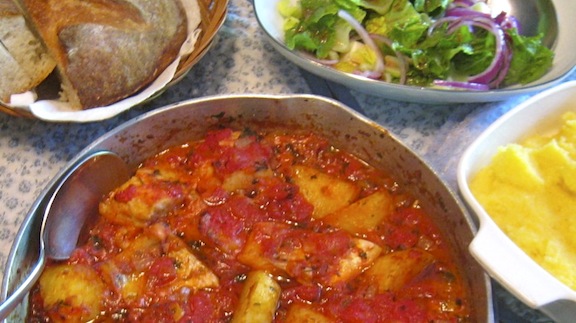
Last week, I spoke of my family’s tradition of serving a seafood feast on Christmas Eve, made possible by Dad’s employment at the restaurant, and mentioned that baccalà was often one of the famed 7 Fishes in many Italian homes. Well, not in our home, much to my dismay. Whether it was because Mom or Dad didn’t like it, or, Mom wasn’t a fan of the prep work, baccalà was a dish served only in Zia’s home. Good thing, too, because although it wasn’t as convenient as having it served at my own dinner table, Zia and her Mother-in-law, Nonna, were masters of its preparation. As a result, as Zia recalls, I was forever trying to snag whatever leftovers I could from their meal. Although both women used the same ingredients, Nonna preferred to bake her baccalà, while Zia cooked hers atop the stove.  As one who “sampled” both preparations, I can attest that each method produced a delicious dish. As for our recipe today, Zia and I combined both methods, partially cooking the dish atop the stove before finishing it off in the oven. Although I wanted to name the dish Baccalà alla Zia, my ever-so-modest Aunt would have none of it. So, to honor both her and Nonna, the recipe is called Baccalà alla Marchigiana — but you and I know its real name.

*     *     *

Baccalà alla Marchigiana Recipe

Ingredients

  • 3 to 4 medium-sized potatoes, peeled and quartered
  • olive oil
  • salt & pepper, to taste
  • 3 tbsp olive oil
  • 1 medium onion, chopped
  • 2 cloves garlic, minced
  • 2 tsp marjoram
  • 3 tbsp fresh parsley, chopped
  • 1 large can (28 oz) tomatoes (whole or diced)
  • 1 lb baccalà, soaked, and cut into 3 inch chunks (See Notes below)
  • salt & pepper, to taste

Directions

  1. Pre-heat oven to 400˚.
  2. Season potatoes with salt & pepper, toss with a splash of olive oil, and roast on a baking sheet for 20 minutes at 400˚.
  3. Meanwhile, in a large frying pan, heat olive oil over med-high heat. Add the onion and sauté until translucent, about 5 minutes
  4. Add garlic & parsley and continue to sauté for another minute.
  5. Add tomatoes & marjoram, bring to boil, reduce to simmer, and cook, uncovered,  for 30 minutes. If sauce is “tight”, meaning too dry, add water.
  6. Add roasted potatoes and continue simmering for another 20 minutes. Add water if necessary.
  7. Add baccalà to the tomato sauce and place pan into the 400˚ oven. Bake for 20 minutes. Taste before seasoning with salt & pepper, if necessary.
  8. Serve immediately.

*     *     *

Variations

Whereas baccalà is cod that has been salted and dried, stoccafisso is cod that has been dried but not salted. Once properly prepared, both forms can be cooked in a variety of ways. The portions can be baked in a sauce as above, pan-fried, baked, grilled, or poached and served in a salad. Recently, I watched a re-broadcast of Molto Mario as he used baccalà to make “fish balls,” which he deep-fried. In other words, the only thing limiting how baccalà might be prepared is your own imagination. And for those who believe that fresh or frozen cod is just as good as baccalà, I caution against mouthing such heresy in the presence of Zia’s Youngest Son. A word to the wise is sufficient.

Notes

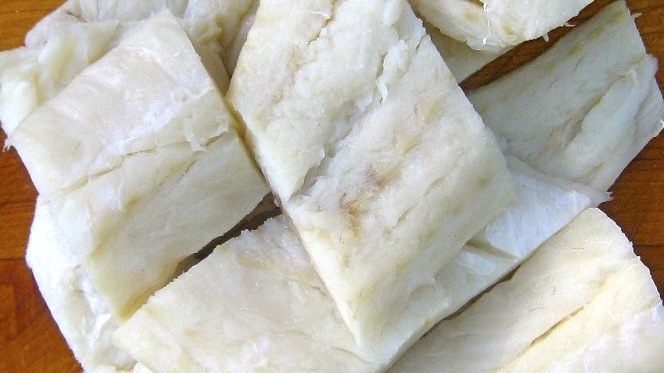
Baccalà must be thoroughly rinsed and soaked before you can cook it. If it is salted and fully dried (pic on left), it will take 2 days to get it re-hydrated and de-salted  (pic on right). This is readily  accomplished by placing it in a large baking  dish filled with cold water and changing the water occasionally over the course of the 2 days. I find it helps to let the water run gently into the dish a few times, as well. If, as was the case with my most recent purchase, your baccalà is not fully dried but refrigerated, you may be able to get away with a 1 day soak. You will know when the fish is ready by its appearance, feel, and, yes, its smell. Be careful, however, not to let it soak for too long or to run the water too forcefully. The fish could lose its firm texture and might even disintegrate.

No post about baccalà would be complete without mention of its “aroma.”  Certainly not as strong as stoccafisso, when first you begin to soak the cod, you will notice it that it smells like, well, dried fish. The smell quickly dissipates in the rinse water and soon its scent compares favorably with any other fish product. Stoccafisso, however, is not so easily rendered scentless and should only be attempted outdoors or in a well-ventilated room. To illustrate my point …

I was about 5 or 6 years old and shared a bedroom with my brother, who was about 10 or 11 years old at the time. Our bedroom, as well as the bedroom of my cousins’ directly above ours, was separated from the rest of the house by a stairwell that ran from the 2nd floor to the basement. One morning, Mom entered our bedroom in a cleaning frenzy, convinced that my brother or I had done, or left, something disgusting in the room. Angels that we were and despite our claims of Godliness, a foul stench had reached her kitchen, which was located on the other side of the stairwell, and our room declared a crime scene — ground zero, in today’s parlance. Lucky for the two of us, Mom found nothing untoward in our room and now, more determined than ever, she set out to find the source of the stench. It wasn’t long before her nose led her to the basement where, under the stairs, she found Grandpa’s stoccafisso, bathing innocently in a tub of water. Well, revenge is a dish best served cold, so Mom patiently bided her time. It wasn’t long before Grandpa left the house, as he did every morning like clockwork. Seizing the opportunity, Mom placed the tub of stoccafisso under his bed and closed his bedroom door as she left. Even Grandpa’s Old Spice, the scent of which permeated that room, proved to be no match for stoccafisso, as Grandpa learned when he opened that door a few hours later. To be sure, Mom and her Father “discussed” the matter but, being so young, I wasn’t privy to that conversation. I do know, however, that Grandpa never soaked stoccafisso under those stairs again.

*     *     *

Mom’s Calamari Salad


Insalata dei Calamari

Prior to the changes brought by Vatican Council II in the 1960′s, Christmas Eve was a “fast & abstain” day, meaning only 1 main meal could be consumed and no meat was to be eaten all day. For most Catholics around the World, it was a day of contemplation and that one meal was nothing special. With Christmas coming within 24 hours, all eyes — and appetites — were focused on the big day — and dinner — soon to come. Not so the Italians. If tomorrow’s a big holiday and today you can only have one meal, why not make that meal special? And so they did.  Can’t have any meat? No problem. With Italy being both peninsula and island, fish was very often more readily available than many meat products. And so it became a seafood banquet. Wait a minute! The Church may frown upon so grand a celebration on the eve of the birth of the Christ Child. Again, no problem. They made a point of serving seven fish, each one representing one of the Seven Sacraments of the Christian Faith. In one masterstroke, their seafood feast became an Act of Faith. What priest, bishop, or even Pope would dare interfere with these devout Catholics as they used the day’s only meal to commemorate the Seven Sacraments? (The fact that the clergy themselves were probably dining on an even more spectacular seafood supper didn’t hurt “the cause” either.) And so the Feast of the Seven Fishes was born and survives to this day wherever Italians call home.

It’s funny but I don’t recall hearing anything about the Feast of the 7 Fishes when I was growing up. This, despite our having a large seafood meal every Christmas Eve. Dad, working in a restaurant, would come home early in the evening of Christmas Eve, bearing gifts of clams, oysters, and red snapper, at the very least. This would be added to the shrimp and crabmeat that Mom was preparing as appetizers and the calamari she was using to make a salad. As Dad shucked, he helped Mom with the recipes for clams casino and oysters Rockefeller. (Yes, Dad could cook but it was a skill he successfully kept under wraps except on the most rare of occasions.) There was, of course, a big platter of home-made linguine with tuna — or possibly clams — to be served along with the red snapper that Mom had broiled. It was, by any measure, quite a feast of seafood — we just never counted the “participants”.

Although today I do not maintain this family tradition, I do, however, make sure that my plans for Christmas Eve include a meal of seafood, no matter what. Since I’ve posted a number of seafood recipes over the past several months, I thought I’d post links to them all for anyone planning a Feast of the 7 Fishes but who may be missing a fish or two. Before doing that, however, I’ll share Mom’s recipe for Calamari Salad because, well, you should have it; she said so. And, next week, I’ll share the Bartolini recipe for what is the traditional main course in many Italian homes on Christmas Eve, Baccalà (salted cod), which, by the way, is also one of the 7 Fishes.

*     *     *

The Real McCoy

*     *     *

Now, there are a few things to consider with the recipe I’m about to share. First off, when cooking calamari, it’s been said to either cook it for 1 minute or 45. Anything in between and you’ll be eating something akin to rubber. So, use a big pot, bring it to a rolling boil, and get those squid into, and out of, the pot quickly. Beyond that, this recipe is typical of most of my family’s in that it features a few ingredients with relatively few spices. It is all about balance, that’s why there are no amounts given. Yes, Mom listed 1 green and 1 red pepper but I omitted the quantities. It all depends upon how much calamari you use and you’ll note that Mom didn’t list the amount of calamari needed in her recipe. Chop and mix as much bell pepper, red and green, as your eye tells you. (For 1 1/2 lbs calamari, I used about 2/3 each green & red bell pepper.) Taste the onion and let that determine how much to use. If you feel it’s too strong, feel free to give it a quick rinse under cold water after you’ve chopped it. Still not liking the onion? Try a shallot or 2 instead. Lastly, if you’re not comfortable adding the dressing ingredients directly onto the calamari & peppers, then mix it first in a small bowl, taste it, adjust if necessary, and then dress your calamari with it. Bear in mind that most homemade vinaigrettes call for 3 parts oil (olive) for every one part acid (vinegar or, in this case, lemon juice).

*     *     *

Mom’s Calamari Salad Recipe

Ingredients

  • squid, cleaned and cut into rings (halve tentacles, if using)
  • green bell pepper, diced
  • red bell pepper, diced
  • red onion, diced
  • extra virgin olive oil
  • lemon juice
  • fresh parsley
  • salt & pepper, to taste

Directions

  1. Fill a large saucepan with water and bring to a rolling boil over high heat.
  2. Add the calamari, stir, and turn off the heat.
  3. After one minute remove from water and place in an ice bath to chill. (Calamari may be “held” here for a couple of hours until ready to be served.)
  4. Once fully chilled, drain, place calamari on paper towels, and pat dry before dressing immediately with lemon juice, olive oil, parsley, salt and pepper.
  5. Toss and serve.

*     *     *

This couldn’t be easier to prepare and, best of all, you can cook the calamari, make the dressing, and chop the peppers, onion, & parsley ahead of time and store it all separately in the fridge. Just before serving, mix the ingredients, season with salt & pepper, and bring it to the table. Who wants to be stuck in the kitchen when there are unattended gifts to shake?

*     *     *

All righty! That’s 1 recipe down and 11 more to go. As promised, here are the seafood recipes that I’ve shared during the past year.

Tomato Sauce with Tuna

*

Fried Calamari

*

Pasta with Clams (“White Sauce”)

*

Pasta al Salmone

*

Grandpa’s Barbecued Shrimp

*

 Pasta with Clams (“Red Sauce”)

*

Salmon en Papillote — on the grill

*

Pasta with Shrimp

*

Brodetto

*

Lumache alla Bartolini

*

Puttanesca Sauce

*

*

*     *     *

As you can see, of the 11 dishes presented, 7 involve pasta. I’m afraid that’s a bit too much pasta for a Feast of the 7 Fishes, even for me. So, I’ve got a plan. For your primo piatto, prepare my Brodetto. That’s 5 fish in one dish! Clear the table and serve today’s calamari salad alongside next week’s Baccalà and you’ll have all 7 fishes, present and accounted for, in only 2 courses. That wasn’t so hard, was it?

Oh! About dessert. Yes, you may have dessert but, keeping in mind that it is a day of fasting and in the spirit of the Feast of the 7 Fishes, go easy on the whipped cream and chocolate sauce. Besides, you’ll need room for the fruit & cheese platter that you’ll be  serving while the chestnuts are roasted.

*     *     *

Quadretti Pasta

Most of us have warm and fuzzy memories of being nursed back to health by a loving caregiver, usually Mom, who served us a cup or bowl of soup. And you parents reading this are sure to have equally warm memories — some pretty recent — but from the other side of the covers. I’d be willing to bet that most of us were served soup made with a chicken-based stock or broth. What went into that broth, however, varied widely from house to house. In ours, Mom used either of 2 pastas, one of which is today’s recipe, quadretti.

Generally speaking, Mom relied upon 3 dishes to get me up-and-about. Breakfast would be a 3-minute egg, with or without buttered toast depending upon my stomach’s attitude.  My meals would be pasta in bianco. Aside from it being a traditional cure served to bambini with stomach ailments, Mom knew that I could’ve been at Death’s door and I would have agreed to at least try a little pasta in bianco. Between meals, though, there was a constant supply of broth which, as the recovery progressed, contained more and more pastina. Ask my Sister what Mom served her when ill and she’ll mention, without hesitation, Acini de Pepe, a tiny bead-like pasta. As for my Brother and me, it was quadretti all the way.

“Feeling better?”

Quadretti are square-shaped pastina that, as you’ll soon see, are quite easy to make. Whenever Mom made pasta of any kind, she would roll out the left-over dough and use it to make quadretti. (In true Italian tradition, absolutely nothing was wasted.) This she stored in a container, adding to it with each new batch of home-made pasta. Because she was always adding to her stash, she rarely had to devote a batch of pasta dough to making quadretti. When combined with the quart or 2 of chicken stock she was sure to have on-hand for risotto,  Mom was always prepared when one of us was feeling under the weather.

One more thing before getting to the directions and this is for soup novices. You will get better results if you only make enough soup with quadretti for as many bowls as will be served in 1 meal. If you make a large batch of soup with quadretti and store it in the fridge, when you bring it out of the fridge, you may be surprised to find that the noodles have absorbed a great deal of the broth. Not only that but, depending upon how much quadretti you put into the soup, you my have very little broth left at all. So, before you add the quadretti to your soup, take into consideration that the noodles will swell a bit during cooking and later in storage. Better to make just enough soup for one meal and store the raw quadretti separately from the broth/stock.

Don’t let any of this deter you from making this pasta. Just as you cannot compare a dish of home-made linguine with store-bought, you will not find a mass-produced pasta that comes close to the taste of home-made quadretti. It just ain’t gonna happen!

*     *     *

How To Make Quadretti

A half batch of Mom’s Pasta Dough will give you about 2/3 to 3/4 lb of fresh pasta dough. That should be more than enough for most soup recipes. Once the dough has rested, you must roll it out, either manually or by machine. If doing it by hand, roll it until it is as thin as you would when making ravioli. If using a machine that, like mine is at its widest when the setting is number “1,” then pass the dough through the rollers, repeatedly, advancing the setting with each pass, up-to-and-including the number “6” setting. If your rollers, like Zia’s, work the opposite of mine and their widest setting is number “10,” then pass the dough repeatedly through the rollers, decreasing the setting with each pass, down-to-and-including the number “5” setting. Once you’ve attained the proper thickness, cut the dough strip into sheets 2 to 3 feet long, and follow the steps outlined in the images below. Be sure to allow the dough sheets to dry sufficiently. If the sheets are too moist, the quadretti will stick together when you cut them. If too dry, the dough sheet will crack and break as you try to fold it to create the sfoglia.

*     *     *

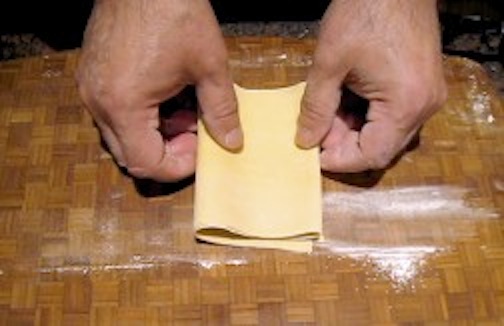
Fold dough sheet in half,

*     *     *

Continue to fold in half repeatedly until a sfoglia of about 2 to 4 inches wide is created.

*     *     *

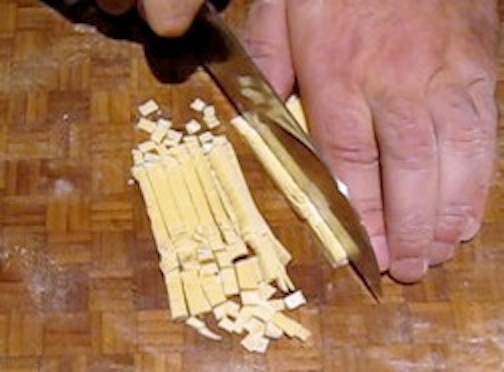
Starting at one end, begin cutting sfoglia into strips, no thicker than the width of linguine.

*     *     *

Carefully turn a number of the noodles 90* and begin cutting, again as if cutting linguine.

*     *     *

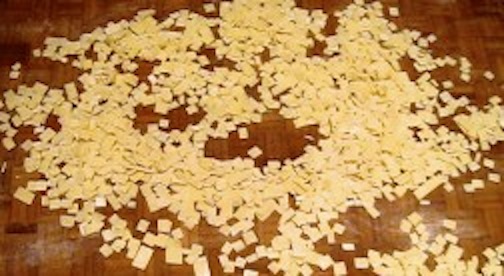
Gently separate the freshly cut quadretti.

*     *     *

Spread out to dry before freezing or refrigerating in an airtight container until use.

*     *     *

See? A pasta cannot be easier to make by hand and, if you’ve never enjoyed home-made pasta in your broth, you’re in for a real treat. Keep a container of quadretti in the back of your freezer and if, heaven forbid, you’re feeling under the weather, a mug of your home-made broth with a sprinkling of quadretti is just what my “Doctor Mom” would have ordered.

*     *     *