Grilled Salted Cod

Baccalà alla Griglia

Grilled Salted Cod

Today’s post is the 3rd straight recipe involving seafood of some sort — and we’ve 4 more to go. For today’s dish, we return to the grill but this time, after some discussion, a grill basket is used.   You see, fresh from my success with the grilled sturgeon, I wanted to try grilling salted cod, baccalà, directly on the grill plates. What could go wrong? Well, when I spoke with Zia about my plan, not only did she mention what could go wrong but she also pointed out that we Bartolini always grilled baccalà lightly breaded and in a basket.  How could I fight that kind of logic? This is, after all, a place for documenting our family’s recipes. So, moments later, she was explaining how baccalà was grilled in the Old Days and I was wondering where I’d put my grill basket. You needn’t worry, however, if you’re a fan of grill marks on you fish. We’ll return to the grill next week, when swordfish is on the menu.

With the grilling method out-of-the-way, let’s briefly recap baccalà and its preparation. For centuries, cod was caught, cleaned, and dried primarily in Scandinavia before distribution across Europe. If the cod is salted and then air-dried, it’s called salted cod, baccalà in Italy. If the cod is hung and air-dried, it is called stock fish, stoccafisso in Italy. (In Italy, all stoccafisso is cod but that’s not necessarily the case elsewhere.) Before either form of cod can be prepared, each must be re-hydrated and, if necessary, rinsed free of salt. To do so, place the cod in a flat baking dish, deep enough to hold enough water to completely submerge the entire fish. Keep the cod in the water for at least 12 hours but no more than 2 days. Replace the water 3 times daily. You can speed up the process a bit by letting a slow, steady stream of water flow into the dish but not on to the cod or you might damage the fillet. You’ll know the fish is ready by the way it looks, feels, and smells.

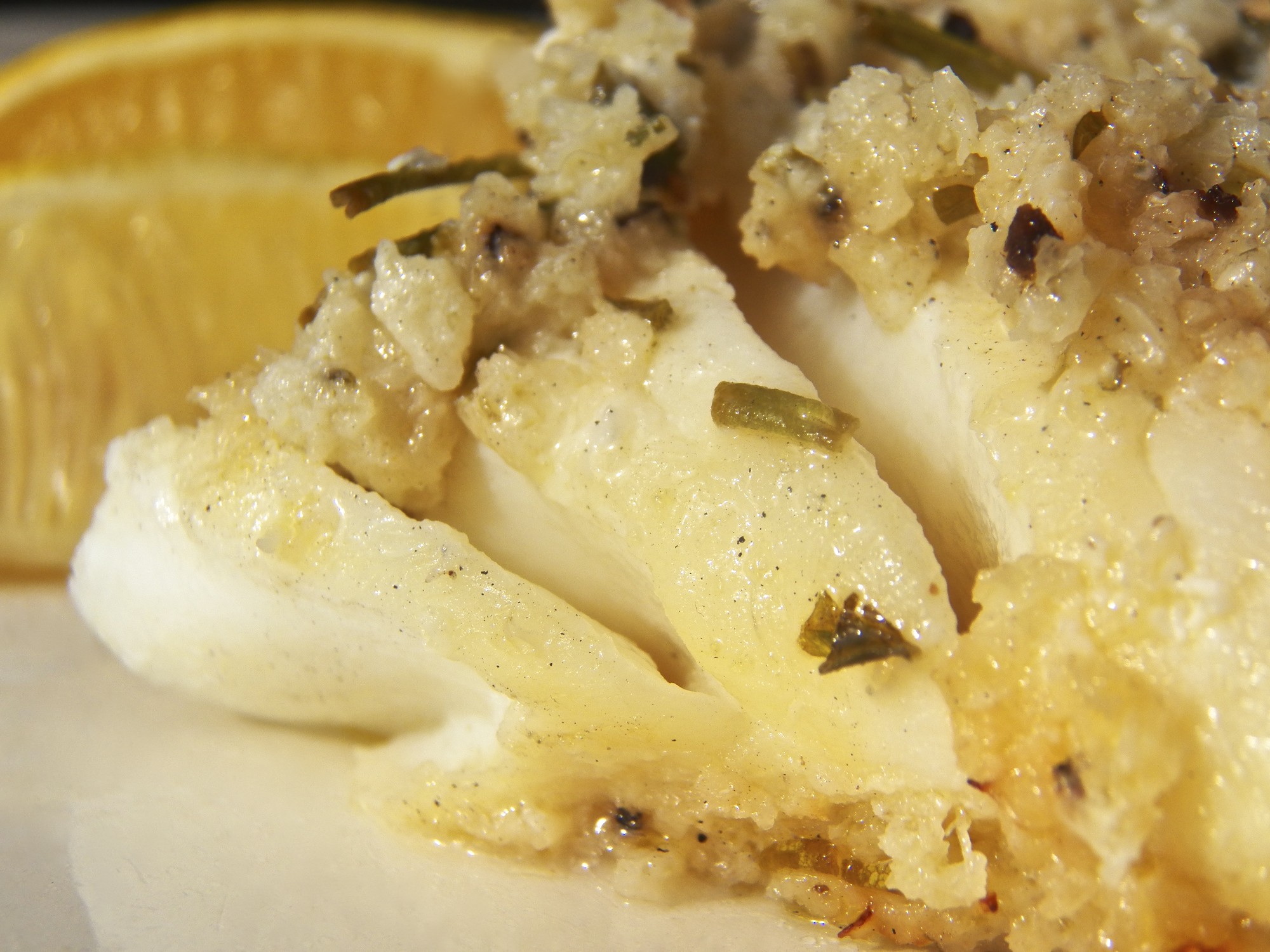
Once the cod is ready, remove it from the water and place it on (paper) towels while you make the marinade. You do not want to allow the cod to completely dry out but do remove the surface moisture. In a small mixing bowl, add about 1/3 cup Panko bread crumbs; 3 tbsp chopped fresh parsley; 1 tbsp chopped fresh rosemary; 1 or 2 cloves of garlic (grated or diced); 1/2 cup extra virgin olive oil; and pepper to taste. (Salt should not be needed and ingredient amounts may vary depending upon the size of the fillet.) Return the cod to the now-dry baking dish and cover with the marinade, coating it evenly on all sides. This is not a “true” breading, so, there’s no need to completely cover the fish. Use plastic wrap to cover the dish and set aside for a couple of hours. It may be necessary to refrigerate the cod, depending upon your kitchen’s temperature.

Pre-heat the grill when you’re ready to cook your cod. Clean the grilling basket and oil it liberally just prior to placing the cod in its center. Once secured, lay the basket on the grill and sprinkle a bit of olive oil over the fillet’s top side and close the grill’s lid. Lower the heat to med-high. Depending upon your grill’s temperature, how the basket rests on the grill plates, and the thickness of the fillet(s), baccalà will take from 8 to 11 minutes per side. Be sure to check it midway through the cooking of each side and be prepared to adjust cooking times, as required. Once you’ve flipped the basket over, sprinkle the fish’s “new” top side with the juice of a half-lemon. Continue grilling until done.

When cooked properly, cod will easily flake. Keep this is mind as you carefully remove the cod from the grilling basket.  Place on a serving platter and serve immediately with lemon wedges.

*     *     *
*     *     *

Notes

As mentioned earlier, the marinade is not meant to be a breading that completely covers the fillet. Though it contains bread crumbs, there is no way that all of it will remain on the fish as it is grilled. Once the marinade has done its job, the bread crumbs will offer some protection for the fish, helping it to remain moist as it’s grilled.

Depending upon where you live, you may be able to purchase a piece of baccalà that is just about equal in size to the fillet I used in this recipe.  I have no such luck and must purchase a large piece of baccalà, probably around 18 inches (46 cm) long, that is the entire side of the fish, from the gill opening to its tail. On Christmas Eve, the entire piece can be cut up and cooked, as I showed you HERE. Any other time of the year, that piece of cod is far too big for me and I divvy it up for 3 different dishes. First of all, do not re-hydrate the cod until you’re ready to use that particular piece of fish. Even though dried, you’ll notice one side, the fillet section, that is thicker than any other part of the fish (shown in RED on the right). Use a sharp knife or kitchen shears to remove that piece. This is the piece I used in today’s recipe. On the other side of the fish, is another, equally sized portion, though not as thick (GREEN). Remove that section and return it to the packaging. This piece will be used to make a salad and I’ll show you how in a future post. The remaining section BLUE), about a 10 inch (25 cm) “tail”, should be returned to the packaging and, once re-hydrated, can be baked or broiled. I’ll be showing you how to do that, too, at a later date. Properly sealed and kept dry, these 2 remaining pieces will keep for months although, if you enjoy baccalà like we do, you needn’t worry about it being around for weeks, much less months.

And for those of you keeping track, this is pretty much the same bread crumb mixture that was used in last week’s recipe, as well as a number of other Bartolini recipes. Guaranteed, it will be making at least one more appearance in the weeks ahead.

*     *     *

In my rush to get last week’s entry posted, I failed to include anything about my visitors. For those not in the know, that previous Friday, Miss C and The Matriarch, of The Kitchen’s Garden fame, rode into town on a brisk, but sunny, Friday morning and left the very next morning, heavily laden with packages of every kind. It was a whirlwind tour of some of my favorite food haunts, topped off with a late lunch at a favorite Thai restaurant. They were, without a doubt, perfect guests, as we ran from store to store, aisle to aisle, letting me prattle on as if I was personally responsible for the contents of each. By any measure, it was a very good day, one that I hope we can repeat, weather and Farmy permitting.

*     *     *

It’s déjà vu all over again … 

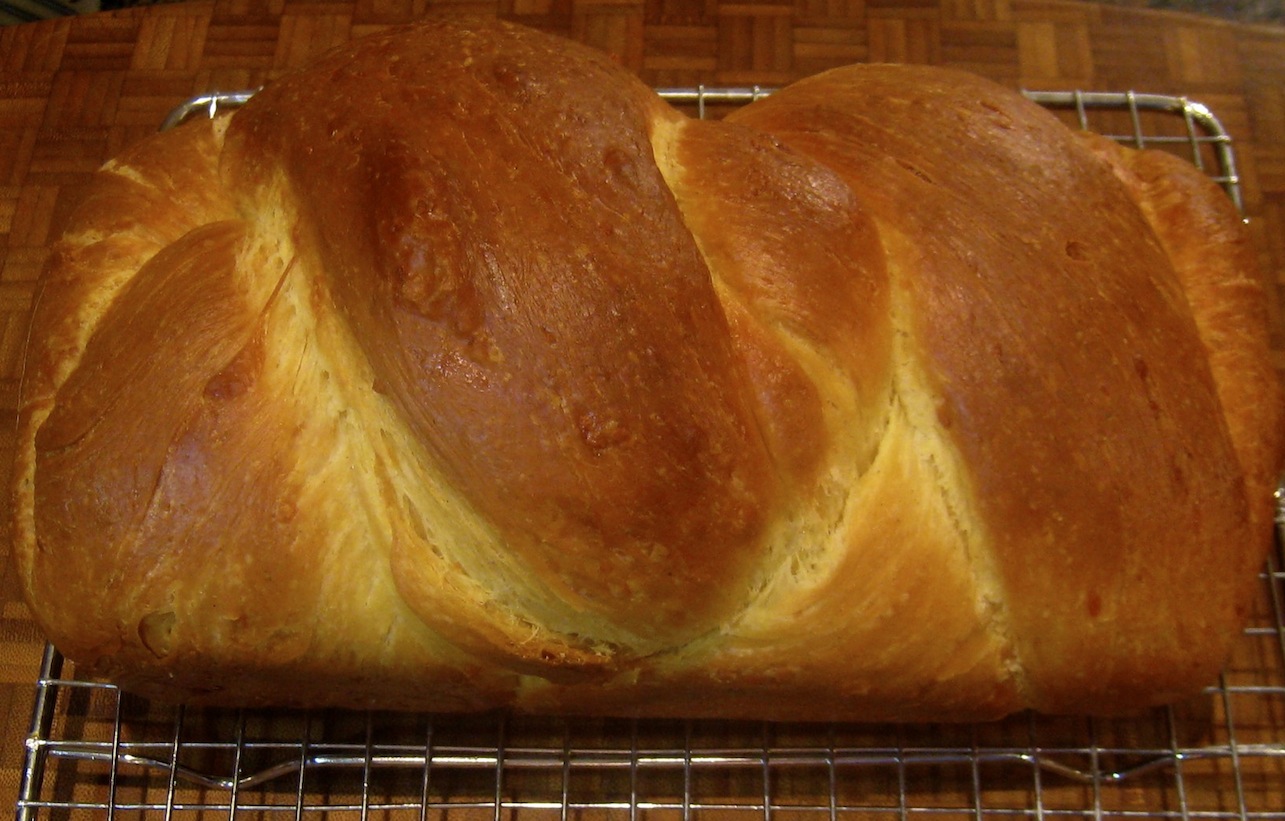
Easter is still several weeks away but it’s never too late to plan. Besides, if you like this bread as much as all who’ve baked it, you’ll need time to bake another loaf for the Holiday. Crescia al Formaggio is baked in the Bartolini homeland, Le Marche, every year at Easter. With over a cup of grated cheese in its dough, this bread not only tastes good but it fills your kitchen with a fantastic aroma while it’s in the oven. Believe me. This is one bread that is sure to please everyone seated at your dinner table. You can read my post by clicking HERE.
*     *     *

Coming soon to a monitor near you …

Grilled Swordfish with Salsa Verde

 *     *     *
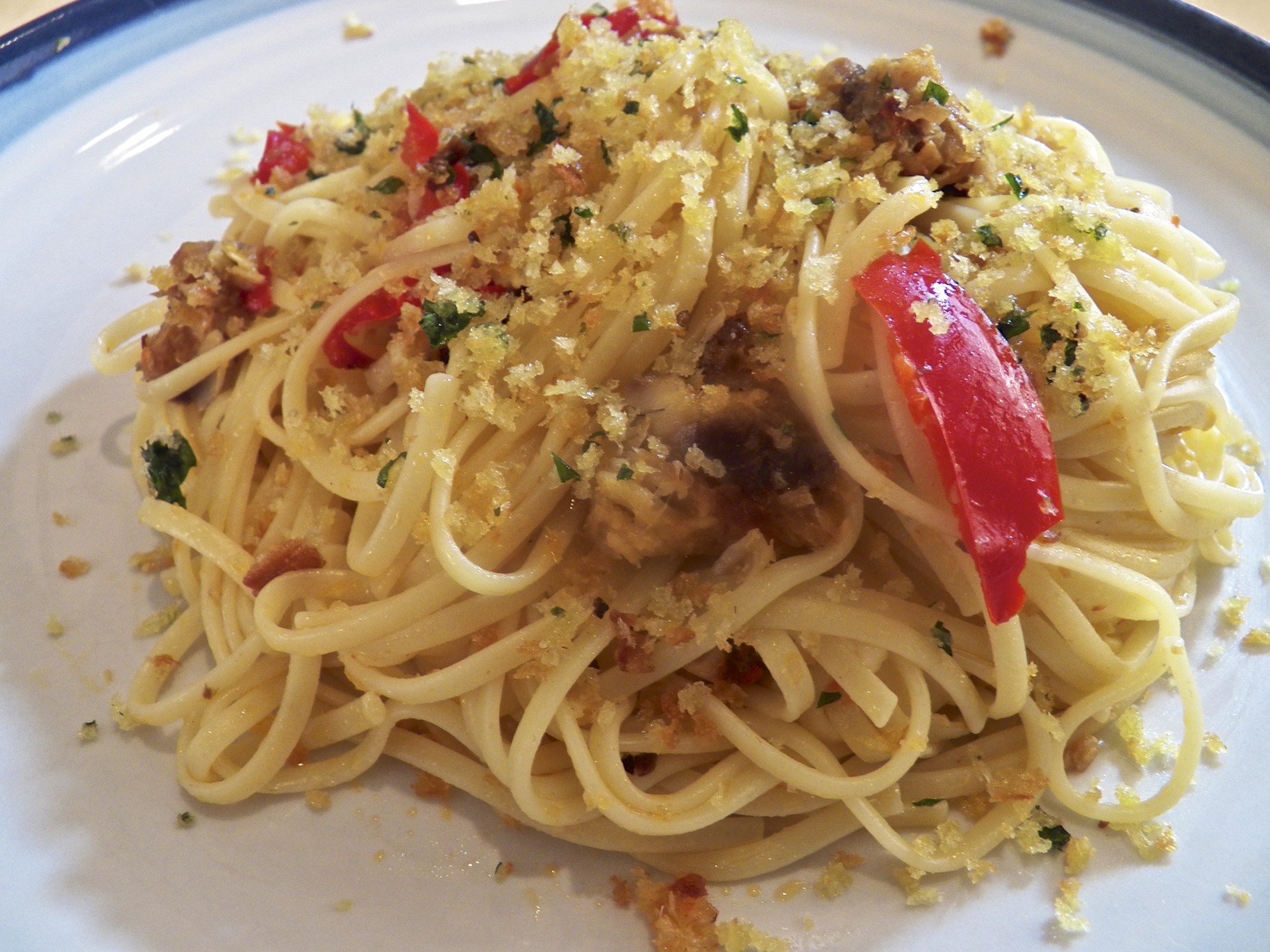
Linguini Fini with Sardines & Pickled Cherry Peppers

I continue to be amazed by the talent and creativity I see in the blogs I visit. Often, having spent the day in an assortment of unplanned, often unnerving, activities, the dinner hour is approaching and the blogger has absolutely no idea of what to prepare. A look in the pantry, a scan of the fridge, and within minutes a delicious dinner is on the table while a tasty dessert awaits on a countertop. OK, that may be a bit of an exaggeration but the point remains. Many of you can create fabulous dinners on a moment’s notice, using only what you find in your kitchen and pantry. This is so not me. If caught with nothing planned for dinner, I can scan my cupboards or stare into the fridge for hours and I’ll end up with the same 2 dishes: a sandwich from a previous night’s roast and, when there’s no roast, some sort of pasta. Today’s recipe is a case in point.

You see, this is not the recipe I had planned to share today but before I get into that, please take a look at the image to the right. Examine that box very closely. Everybody done? Good. Now, do you see anything that would lead you to believe that there are anchovies in that box? Anything at all. Of course not. So, why did I buy it, mistakenly believing it contained white anchovies — the ingredient that was supposed to be featured in today’s recipe? Worse yet, that box sat in my cupboard for 2 weeks, visible to me countless times during that period. Yet, incredibly, it wasn’t until I opened the tin late last week that I realized my mistake — and then I had an open tin of sardines to deal with and nothing for dinner or today’s post.

Now, I could have taken the easy route and just substituted the sardines for the anchovies but that would have cost me a perfectly good pasta recipe that uses white anchovies, as you’ll see in the weeks ahead. No, I had to think of something else and, thankfully, I remembered an ingredient Mario Batali had used recently. So, I went to my stash of canned goods, specifically the hot cherry peppers I pickled last September, and the result was today’s dish, a pasta much like an Aglio e Olio.

To recap, a typical aglio e olio uses olive oil, garlic, and red pepper flakes to dress a spaghetti-like pasta that’s topped with grated cheese and freshly cracked black pepper. The red pepper flakes give the dish a nice even heat that can be as bold as you like, unlike today’s dish, where the chopped pickled peppers give bursts of heat, as well a touch of acid from the pickling liquid. Of course the sardines give this dish an entirely different flavor profile from your everyday aglio e olio and, because of them, grated cheese should not be served with this dish. So, to top the dish off, I used the Bartolini breading mixture that was lightly toasted beforehand. And the result? Well, it was so good that I’ve promised Zia I’d prepare it for her when I visit next.

*     *     *

*     *     * 

 Linguine Fini with Sardines & Pickled Cherry Peppers Recipe 

Ingredients

  • 1 lb linguine fini (cappellini, spaghetti, linguine, or trenette may be used)
  • 1/2 cup + 2 tbsp extra virgin olive oil, divided
  • 1 pkg. {3.75 oz (105 g)} of skinless & boneless sardines, drained & roughly chopped
  • 5 cloves of garlic, diced or grated – divided
  • 4 pickled cherry peppers, cored, seeded, and roughly chopped
  • 1/2 cup Panko bread crumbs
  • 3 tbsp fresh parsley, chopped
  • salt & pepper
  • reserved pasta water

Directions

  1. Make the bread crumb topping:
    1. In a small mixing bowl, combine 1 diced/grated garlic clove, bread crumbs, and 2 tbsp of olive oil. Season lightly with salt & pepper. Mix thoroughly.
    2. In a small frying pan over med-high heat, lightly toast the bread crumb mixture. Do not allow to get too dark or it will ruin the dish. Remove from heat and set aside.
  2. Bring a large pot of heavily salted water to boil. Add the pasta and stir.
  3. In a large frying pan over med heat, add the remaining olive oil. Once hot, add remaining garlic and sauté for 1 minute.
  4. Add the pickled peppers to the pan and continue sautéing for another minute before adding the sardines. Continue sautéing until the pasta has cooked 2 minutes less than the package’s cooking instructions indicate for al dente. If you’ve timed everything correctly, you should sauté the sardines for no more than 5 minutes before the pasta is ready.
  5. Drain the pasta, reserving 1 cup of the pasta water.
  6. Add pasta to the pan containing the sardines and peppers. Gently toss to evenly coat the pasta. If too dry, add enough pasta water to create a sauce. Continue to sauté until the pasta is al dente, 1 to 2 minutes more.
  7. Remove from heat, add 2/3 of the bread crumb mixture, and toss.
  8. Place on a serving platter and garnish with remaining 1/3 of the bread crumb mixture.
  9. Serve immediately.

*     *     *

Variations

If you’re one who enjoys cooking Italian dishes, preparing aglio e olio is a dish you really should learn. The basic recipe involves using garlic-infused oil and red pepper flakes to dress pasta but that’s just the start. Today’s dish swapped out the red pepper flakes for hot cherry peppers and added sardines to the mix. You may wish to keep the pepper flakes and use some vegetable(s) instead of the sardines. No? How about some shrimp? What you choose to add or subtract from the garlic-flavored oil is totally up to you but the result is sure to be a flavorful dish of pasta. Best of all, you can go from staring into your refrigerator to dining at your table in under 20 minutes.

Notes

To be sure, not everyone has pickled cherry peppers in the pantry. Most groceries do carry them, however, but you could use peperoncini instead. Still, no matter which pepper you use, I suggest tasting one beforehand to see if its level of heat is to your liking.

*     *     *

It’s déjà vu all over again … 

Having referred to it a number of times, I’ve little choice but to feature our Aglio e Olio recipe as this week’s Blast from the Past. The dish couldn’t be easier to prepare and the post contains a favorite memory of my Uncle. You can read both by clicking HERE.

*     *     *

Coming soon to a monitor near you …

Grilled Salted Cod

Grilled Salted Cod

 *     *     *

Grilled Sturgeon — Storione alla Griglia

Today, Ash Wednesday, marks the beginning of Lent for Western Rite Christians. In Catholic homes, it is a day of abstaining from meat, as are all the Fridays leading up to Easter Sunday. Although I consider myself a Recovering Catholic, I do think it a good idea to go meatless, for a number of reasons, and am trying to do so one day a week. So, whether you’re a practicing Catholic or just want to cut down on the amount of meat you eat, the Kitchens are here to help. Over the next several weeks, I’ll post a series of meatless recipes where fish is the primary protein. Well, that’s the plan anyway …

*     *     *

*     *     *

Today’s recipe is not one from the Bartolini playbook. I don’t recall sturgeon ever being on the menu when I was a boy. I do enjoy sturgeon, though, having ordered it at restaurants several times as an adult. Recently, when my fishmonger ran a sale on the fish, I couldn’t resist purchasing some. While wrapping my purchase, he suggested I grill it. Now, those of you who have written posts featuring grilled fish have read my comments in which I confess an utter lack of grilling skills, especially when it comes to seafood. Fearing another disaster, I nevertheless took the fish monger’s suggestion as a challenge and fired up the grill that evening. Well, what can I say? Not only did the fish cook perfectly, it actually bore grill marks instead of sticking firmly to the grill plates. I have since returned to the grill and had equally good results, as you’ll see in the weeks ahead.

Once grilled, you’ll need some sort of sauce to compliment the fish. I’ve been served this sauce, or something closely resembling it, in restaurants several times. It couldn’t be easier to prepare and the amount of each ingredient may be modified to suit your own preferences. It’s, also, tasty enough that you can use it for just about any fish that makes its way to your dinner table.

And by the way,  Happy Birthday, Sis!

*     *     *

Grilled Sturgeon with Lemon-Caper Sauce Recipes

Ingredients

  • sturgeon fillets, about ½ pound each, skin removed 100_1696
  • salt
  • pepper
  • extra virgin olive oil

Lemon-Caper Sauce

  • 4 tbsp butter
  • 2 tbsp lemon juice
  • zest from ½ lemon
  • 1 tbsp capers
  • 1 small clove garlic, grated or minced
  • 1 tbsp fresh parsley, chopped

Directions

  1. Start grill. Will require a med-high heat.
  2. When grill is ready, thoroughly clean the grilling surface before using a towel soaked in vegetable oil to coat the grill plates.
  3. Lightly coat fish with vegetable oil, season with salt & pepper, and place on grilling surface. Do not move or disturb once placed on the grill.
  4. Grill for 3 to 4 minutes per side. Remove from heat, cover, and let rest.
  5. While the fish rests, melt butter in a small fry pan over med-high heat. Add garlic and sauté for about a minute. Add the lemon juice, zest, and capers, continuing to sauté for another minute. Remove from heat, add parsley and gently stir.
  6. Place sturgeon fillets on a serving platter, spoon lemon-caper sauce over the fillets, and serve.

 *     *     *

Notes 

Sturgeon is a meaty, delicate tasting fish. It can be served baked, fried, smoked, or grilled. It’s flesh is more dense than say, cod, so it won’t flake as one might expect. Keep this in mind when you prepare sturgeon because it may become a bit tough with a more pronounced fish flavor when overcooked.

It really does pay to heed the experts and ensure that your grill plates are as clean as possible and well-oiled before you begin grilling any type of fish. Believe me, a light cleaning and oiling just won’t do. And be sure those grill plates are good and hot. Meet these 3 basic requirements and you’ll notice a marked improvement in your grilling.

One of the reasons I’ve chosen to go meatless one day a week is to reduce the impact on Mother Earth of raising meat, no matter the kind. I’d be robbing Peter to pay Paul, however, if I chose endangered seafood to eat instead of meat for that day. There are now a number of seafood apps available for your smartphone or tablet that will let you know whether a particular sea dweller is endangered and offer substitutions when possible. Just go to your virtual app store and do a search for “seafood”. The rest is up to you.

*     *     *

It’s déjà vu all over again … 

Since we’re going meatless, we might as well take a look at some of the Kitchens’ previously posted meatless recipes, too. This week’s Blast from the Past will send you to my Pasta Puttanesca recipe. Originating in Naples, this flavorful pasta features anchovies, olives, and capers, all simmered in a rich tomato sauce. Not only that, its aroma is certainly one of a kind. You can find the recipe by clicking HERE.

 *     *     *

Coming soon to a monitor near you …

Pasta with Sardines and Pickled Cherry Peppers

*     *     *

Cappelletti in Brodo, The Super Bowl of the Bartolini

When I shared the recipe for Mom’s Brodo several weeks ago, it was with today’s post in mind. While it may be true that her broth was used in a number of recipes, from chicken cacciatore to risotto, for many of us, it was at its best when served with Cappelletti, yet another jewel in the Bartolini Crown of Recipes. Traditionally served at Christmastime, cappelletti are a type of stuffed pasta said to resemble small hats. Search the internet and you’ll see them made much like the making of tortellini. I’ve watched cooking shows touring Bologna and have been mesmerized at the sight of women quickly fashioning cappelletti by hand. As the camera moves back offering a wider shot, it is really quite impressive to see all the freshly made little hats prepared that morning. That is not what you’re going to see here today.

*     *     *

*     *     *

Forming those little hats is a most time-consuming practice unless you’ve enough experience to become proficient. The women I’ve watched will make more cappelletti in one day than a Bartolini would have made all year — and then some. There is just no way Mom or Zia could devote the time to make enough little hats to serve their families later that day. You read that right, later that day.

When I was a boy, few families, if any, owned freezers other than the small compartment atop their refrigerator. As a result, there simply was no place to store freshly made ravioli or cappelletti. This meant that Mom and Zia got to work making pasta at 5:00 AM on every holiday. As such, either ravioli or cappelletti were made on any given holiday and never both. So, in our home, Mom served ravioli for our Christmas Day dinner, while cappelletti was served for lunch on New Year’s Day. There were days, however, when the cappelletti lunch was nixed in favor ravioli that night. It wasn’t until a large freezer was bought and placed in the basement that it became possible for ravioli and cappelletti to be made ahead of the actual holiday — allowing Mom and Zia to get some much-needed rest on those holiday mornings. Not only that, but it, also, became possible to have cappelletti for lunch AND ravioli for dinner on the same holiday. What joy!

Yet, even though they could now prepare their pasta in advance, there was still no way that either Sister could afford the time to make little hats. Initially, they made cappelletti as they did ravioli, rolling out large sheets of dough, covering half will little balls of filling, and then covering them with the “free” half of the dough sheet. Using a spoon handle, the mound in the dough were sealed and then cut using a pastry wheel. Remember that cappelletti are served in soup and shouldn’t need to be cut before being eaten. Each must be small enough to fit comfortably on a soup spoon, making this a time-consuming process in its own right. There was — and is — no need for hats. Speaking of which and just to be clear, although we call our pasta cappelletti, they actually are small ravioli, raviolini.

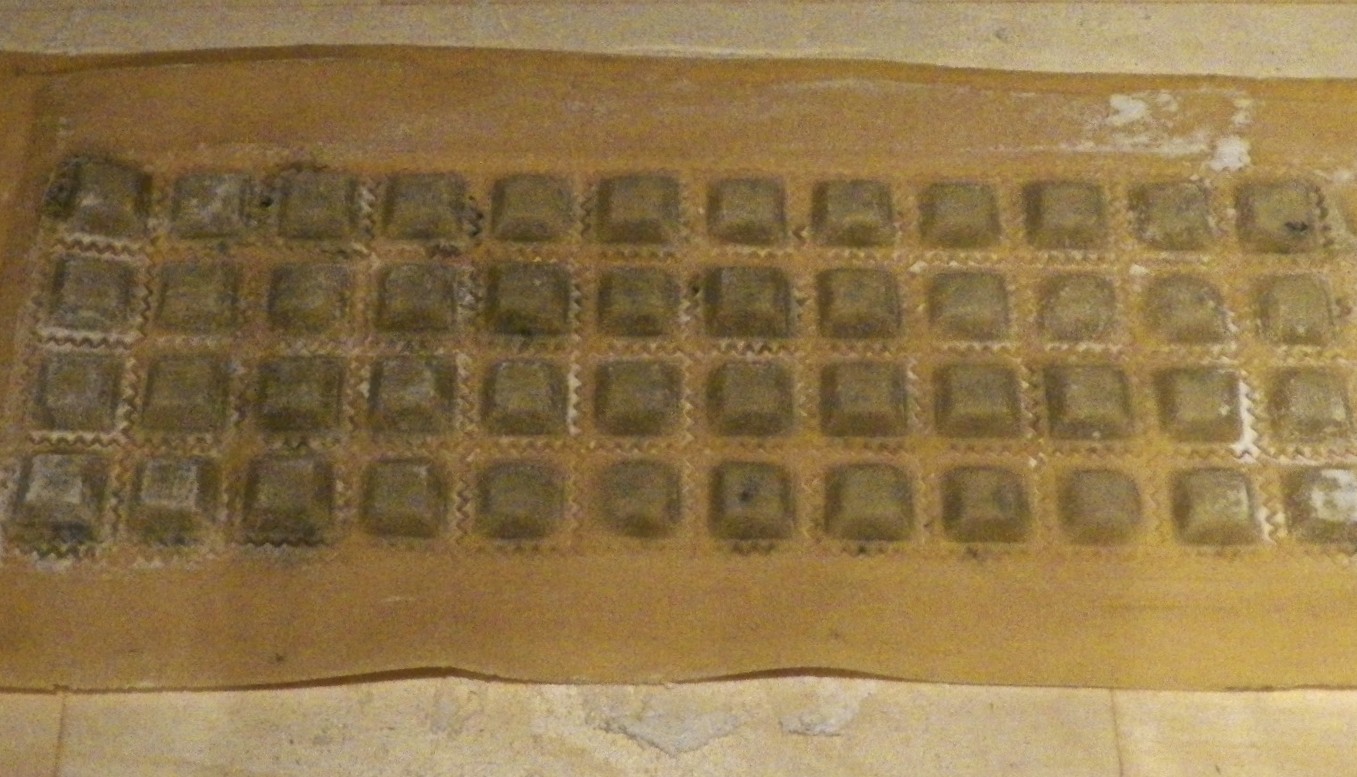
Everything changed again when Mom started using dies (moulds) to make her ravioli and cappelletti. Her cappelletti became miniaturized, smaller than any she’d made before. I have that die and, unfortunately, I’ve yet to be able to master it. The compartments for the filling are far too small for my hands to fill. I never saw Mom use the die and I must be missing some secret trick to its use. Now, Mom’s die made 40 cappelletti, each ¾ inch (1.9 cm) square, while my die will make 48 cappelletti, each 1 inch (2.5 cm) square. That ¼ inch may not seem like a lot but it’s enough to separate success from failure on my pasta board. Even so, I know that I’m not done trying to learn how to use that die if for no other reason than self-satisfaction.

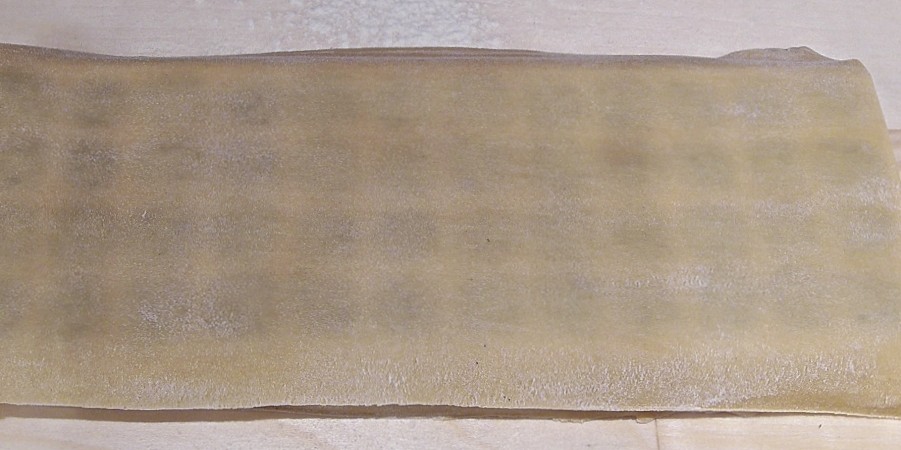
This post will not be as detailed as previous posts when depicting the use of a ravioli die. You can find more complete instructions in my Ravioli dei Bartolini post. No matter the size of the die or the resulting pasta, the steps required are the same. Cover the die with a sheet of dough; place a small amount of filling in each indentation; lightly moisten another dough sheet before placing it atop the first; use a rolling-pin to seal the 2 sheets; remove the now-joined sheets from the die; and, separate the individual raviolo. Sometimes, a pastry wheel will be required to cut and separate them.

When using any die, the most important thing to remember is not to overstuff each compartment. Look again at the 2 dies in the photo above. One has compartments that are open while the other’s compartments have a back and are closed. When using a die that is open, the dough sheet will stretch a little to compensate if you’ve used too much filling. Even so, use too much filling and the dough sheet will stretch to the point of tearing, a very disheartening sight. If you place too much filling on to a die that is closed, that has a back, the excess filling has nowhere to go other than out that compartment’s sides, possibly affecting the seal of not just that one raviolo but all of its neighbors, as well. All is not lost, though, for some of these poorly sealed ravioli.

Ravioli are first boiled in water before being drained and dressed with your favorite sauce. Poorly sealed ravioli will dump their contents during the boiling or draining stage. Little can be done to save them and their tasty filling. Cappelletti, though, are a different matter altogether. As you’ll soon see, these are cooked in brodo and should any split during cooking, the contents aren’t lost but will serve to flavor the soup. It may not be pretty but it will be one tasty bowl of soup.

The recipe for the cappelletti filling is easy to follow and lacks exotic ingredients, a hallmark of Bartolini recipes. It can be made as much as 2 days in advance so long as it is kept covered and refrigerated. Longer than that, it may be frozen and used within a few weeks. In preparation for this post, I made about 500 cappelletti with one batch of filling — and still had enough filling left over to use in another recipe. That dish will be shared sometime in the weeks ahead.

*     *     *

*     *     *

Filling Recipe for Bartolini Cappelletti

Yield: Enough filling to be used with 8 eggs of pasta dough. Recipe found here.

Ingredients

  • 1 1/2 lbs. ground pork
  • 1 1/2 lbs. ground veal (chicken or turkey may be substituted)
  • 2 – 3 tbsp butter
  • 1 pkg (8 oz) cream cheese
  • 1 cup grated Pecorino Romano — Parmigiano may be substituted
  • 2 or 3 eggs slightly beaten — depending on size
  • ¼ tsp ground nutmeg
  • zest of 1 lemon, more if you like

Directions

  1. Sauté meat in butter. Season lightly with salt.
  2. Use meat grinder to process the meats. Add all the ingredients into a mixing bowl and mix until well-combined.
  3. Cover the filling and refrigerate for a few hours or overnight.
  4. Once the filling has rested, you can begin making your cappelletti.

*     *     *

Variations

Our cappelletti are served alone in brodo. Adding other ingredients, aside from a garnish of grated cheese, might serve to overpower the hint of nutmeg or touch of lemon zest flavors within the cappelletti.  My blogging buddy, Stefan, serves his tasty Tortellini in Brodo the same way. Ours is not the only way, however.

Recipes abound that feature tortellini served in brodo with a variety of ingredients. Last October, my friend Linda, of Savoring Every Bite, shared her tasty recipe for one such preparation, a hearty Tortellini Soup. And, not to be outdone, my friend Tanya, over at Chica Andaluza, just last week posted her delicious recipe featuring Tortellini with Leeks and Bacon Broth.  You certainly cannot go wrong with any of these recipes.

*     *     *

*     *     *

Notes

As mentioned earlier, cappelletti are cooked in the broth in which they are served. Bring your broth to the boil over med-high heat before adding the cappelletti. Once the boil returns, reduce the heat to a soft simmer. Too hard a boil may damage the cappelletti. Actual cooking times will vary, depending upon the cappelletti’s size and whether they’re freshly made or frozen. Once the cappelletti begin to float in the broth, they are usually just about ready for serving. I’ll wait another 1 or 2 minutes before tasting one for doneness. Serve immediately with plenty of grated cheese at the table.

Not everyone has the time to make homemade brodo and most of us will turn to store-bought stock occasionally.  Whether you use your own broth or buy one at your local market, make sure it is low sodium. The cheeses within the cappelletti both contain salt and, if you’re not careful when preparing/selecting your brodo, your bowl of cappelletti may be too salty to enjoy. You can always add salt, should the soup need it, just prior to serving.

*     *     *

It’s déjà vu all over again … 

I shared the recipe for Steak Pizzaiola about 2 years ago and, since that time, it has become one of the most popular recipes on my site. Easy to prepare, this is one dish sure to please all members of your family — well, except for the vegetarians. Not to worry. We’ll be sharing recipes for our non-carnivore friends in the weeks to come. In the meantime, you can check out the recipe for steak pizzaiola by clicking HERE.

*     *     *

Coming soon to a monitor near you …

Grilled Sturgeon with Lemon-Caper Sauce

*     *     *

Gnocchi with Lemon, Spinach, and Burrata

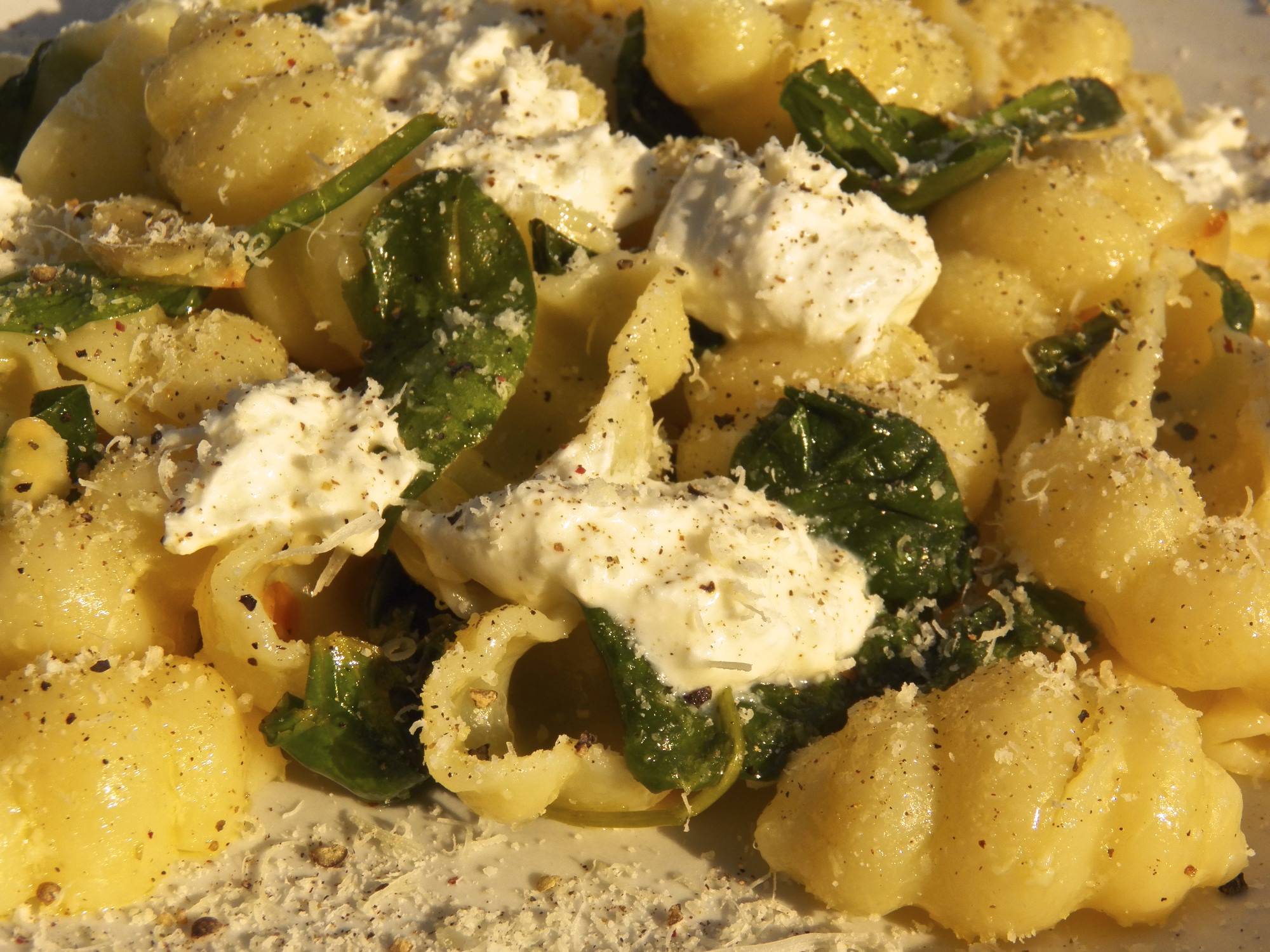
If you came here expecting to find a recipe for those tasty little Italian potato dumplings, well, SURPRISE!  The gnocchi of today’s post are a type of pasta and have nothing to do with their namesake other than a similar shape. Now, I wish I could say that my family has prepared these for years but, the fact is, I stumbled upon these gnocchi during one of my voyages of discovery down the pasta aisle of the Italian market. Since I had already planned to share this recipe, I merely substituted one pasta for another.

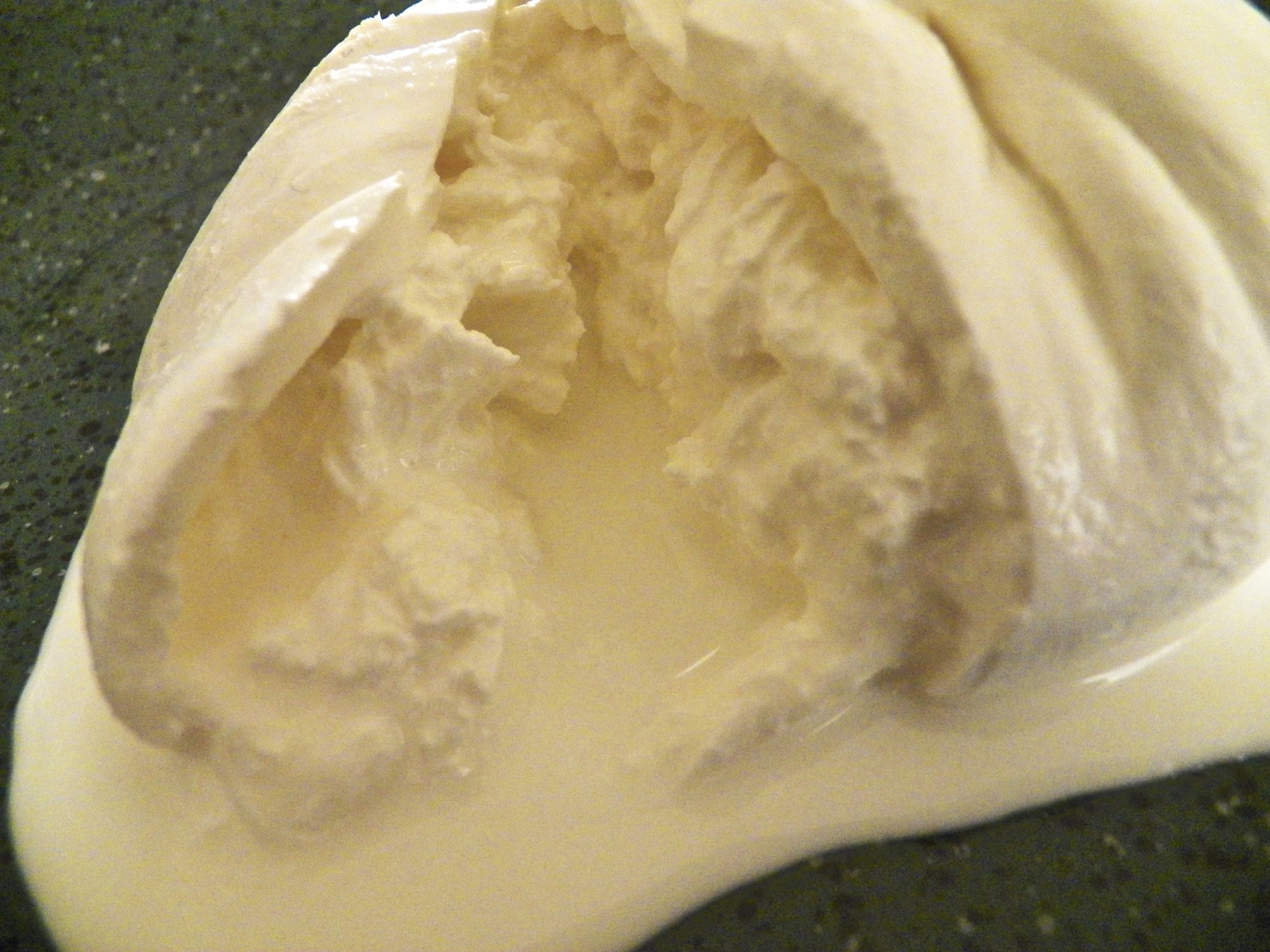
The pasta aside, the reason I wanted to share today’s recipe was to introduce burrata. If you’ve never tried nor heard of burrata, you’re in for a treat. Originating in Puglia, burrata is a fresh cheese that is closely related to mozzarella. To make it, a piece of newly formed mozzarella is stretched into a flat sheet and used to form a pouch. It is then filled with fresh cheese curds, “topped off” with heavy cream, and sealed.  (See photo below.) The result is about as rich a cheese as one could ever expect.

*     *     *

*     *     *

There are many recipes that feature burrata but the use of lemon is what drew me to this one. None of its flavors are so bold as to hide or overpower burrata’s creamy taste while the pasta shape lends itself to providing spots to capture bits of cheese and drops of cream.  Add some toasted slivered almonds for texture and you’ve a great dish of pasta, whether you serve it as a primo piatto or secondo.

Today’s recipe is straight-forward with little need for clarification. Just be sure to slice burrata on a rimmed dish or cutting board. You do not want to let any of the cream go anywhere but into your pasta. Beyond that, you’ll need to work fast. The pasta and olive oil mixture must be hot enough to wilt the spinach and, soon thereafter, melt the burrata.  A little reserved hot pasta water will help, as will bringing the burrata out of the refrigerator an hour earlier than needed to remove its chill. See? Nothing at all difficult and an incredible pasta is your reward.

*     *     *

*     *     *

Gnocchi Pasta with Lemon, Spinach, and Burrata Recipe

Ingredients

yield: 6 servings

  • 1 lb gnocchi pasta
  • ⅓ cup extra virgin olive oil
  • 2 tbsp butter
  • 2 cloves garlic, minced or grated
  • juice and zest of 1 Meyer lemon
  • 1 pkg (6 oz) fresh baby spinach
  • ¾ cup slivered almonds
  • grated nutmeg, to taste
  • 1 lb. burrata cheese, sliced and cut into 1 inch cubes
  • grated Pecorino Romano cheese
  • freshly cracked black pepper

Directions

  1. Place almonds in a small skillet over med-high heat and toast until lightly browned.  Remove from heat and set aside.
  2. Bring a large pot of salted water to boil and cook gnocchi per package directions or to taste.
  3. When pasta is approximately 4 minutes before being al dente, heat a large skillet over medium heat. Add butter and olive oil.
  4. Add the garlic to the hot oil/butter mixture and sauté until soft, about 1 minute. Do not allow to brown.
  5. Add the lemon juice and zest to the skillet and stir to combine. Keep hot until pasta is ready. If it reduces too much, replenish with pasta water.
  6. Drain the pasta and put it into a large bowl.
  7. Add the spinach, in thirds, to the gnocchi and mix well. Continue until all the spinach has been added to the bowl of gnocchi. (Adding it in batches will help to prevent clumping.)
  8. Add the almonds and a dash of nutmeg. Mix well.
  9. Add the hot butter/oil/lemon mixture to the pasta and toss, wilting the spinach as you do.
  10. Work quickly and once the spinach is lightly wilted, apportion 6 servings.
  11. Place an equal amount of burrata on top of each serving.
  12. Finish each serving with a sprinkle of Pecorino Romano cheese and freshly cracked black pepper, to taste.
  13. Serve immediately.

Inspired by Bon Appetit, December 2004

*     *     *

Variations

Not all of us have ready access to Meyer lemons, and, gnocchi pasta probably won’t be found in your neighborhood grocery. Don’t let a lack of either stop you from making this delicious pasta. If missing Meyer lemons, use the juice and zest of 1/2 “normal” lemon. If unable to find gnocchi pasta, try using campanelle (little bells), gigli (lilies), or, as pictured on the right, conchiglie (shells).

*     *     *

Notes

It cannot be stressed enough, the key to this dish is to work fast to insure that the spinach wilts and the burrata melts. Success means a great pasta for dinner.

Burrata’s creaminess makes it a natural for crostini and you may wish to reserve a bit just for that purpose. Use it in place of mozzarella to make the crostini described HERE and pictured on the left.

*     *     *

It’s déjà vu all over again …

Kale-filled Pieda

Kale-filled Pieda

Flatbread are common to many cuisines and Italian is no different. Originating in Emilia-Romagna, this flatbread is called piedina but in my Dad’s area within Italy, the Republic of San Marino, it’s called pieda. Easy to prepare, Mom served pieda with sautéed Swiss chard but you can serve it with cheeses, lunch meats, salad greens, or any combination of those. You can find the recipe by clicking HERE.

*     *     *

Coming soon to a monitor near you …

Last week I shared the recipe for Bartolini Lasagna. At the time, I called it “one of the jewels in the Bartolini Crown of Recipes.” Well, next week I’ll present another of our Crown’s jewels: Mom’s recipe for Cappelletti. Although not made in the traditional shape, these raviolini will turn an ordinary bowl of brodo into something really quite special.

*     *     *

The Lasagna of My People — Lasagna dei Bartolini

The third week of January is another birthday week for the Bartolini Clan. Nonna’s birthday was January 26th, a date my Cousin shares with her. Not to be outdone, tomorrow, the 24th, is my birthday. It’s not a significant one but, boy, am I getting close! In the past, I’ve tried to pick a dish as a means of celebrating the person and birthday. Well, with that in mind, today I’m going to share what I consider to be one of the jewels in the Bartolini Crown of Recipes: Bartolini Lasagna.

*     *     *

*     *     *

As I’ve mentioned in prior posts, ours is not a ricotta-filled lasagna. In fact, ricotta isn’t even among the three cheeses used. (I’ve a recipe for a ricotta lasagna and I’ll share it sometime in the future.) This lasagna’s cheese filling is entirely a Bartolini invention, although not the way I had always believed. For years, I assumed that this was one of the recipes that my Grandma had taught her girls. I told my friends that, as well. You can imagine my surprise when, a short while ago, Zia corrected me and explained how this recipe came about.  Years ago — certainly before my memories begin — she & Mom had grown tired of ricotta-filled lasagne and were dissatisfied with those that called for a besciamella sauce. They decided to try something different and, Ecco! Bartolini Lasagna was born. This is a lasagna that is unlike most others and one that family and friends alike thoroughly enjoy.

Speaking of friends, did I mention that this lasagna has therapeutic qualities? Yes, there is that. You see, one of the unfortunate consequences of maturing is that the good health one took for granted before reaching the age of 40 may not be as apparent beyond that age. Things happen and, when they do, oftentimes friends and family will respond with a variety of foods and baked goods to assist in the recuperation. Well, when illness strikes a friend, I hit back with lasagna. That’s right. Bartolini Lasagna. I know that when I’ve been in a similar situation, there were times when eating was, shall we say, problematic. On those occasions when my appetite did return, it often vanished — or worse — by the time I got my meal on the stove. A casserole, however, solves that problem. A serving can be placed in the microwave and served within a few minutes, ensuring the patient receives much-needed calories to fuel the recovery. And what better casserole-type dish is there than lasagna? It certainly has the calories and, by any standard of measurement, Bartolini Lasagna has proved beneficial to each friend’s convalescence. OK, to be fair, our lasagna isn’t comparable to the waters of Lourdes and you certainly won’t find any crutches hanging from my kitchen’s ceiling. Follow our recipe, though, and you’ll have one tasty lasagna. Even Lourdes can’t do that.

*     *     *

*     *     *

This is normally where I would mention points of concern for the day’s recipe. I really have none for our lasagna recipe other than to mention the noodles used. Today, you can purchase noodles that need to be cooked before use, “boil”, or those that need no prior cooking, “no boil.” Of course, if you prefer, you can make you own — which I would highly recommend.  No matter whose lasagna recipe you follow, using homemade noodles will transform your dish. (A friend once compared my lasagna noodles to pastry.) If you do make your own (see Notes), remember that they only need to be boiled for a few minutes and they’ll be ready for use in your lasagna. If you use “boil” noodles, follow the package directions. Once boiled, you can lay them flat on a baking tray, coating each with a little olive oil, or, lay them flat in a baking dish filled with cold water. Work quickly or they may stick to each other. If using “no boil” noodles, I’ve found that they work better if each is given a quick rinse in hot tap water before being placed in the lasagna dish/pan. Don’t fret if your noodles are a little larger that your baking dish or pan. The exposed edges will crisp during baking and many find that very enjoyable.

*     *     *

The Bartolini Lasagna Recipe

Ingredients

Tomato Sauce (click on sauce name for recipe)

Cheese Sauce (see Notes)

  • 6 tbsp (85 g) butter
  • 12 oz (1½ pkg) (339 g) cream cheese
  • 2 – 3 tbsp (29 – 44 ml) milk
  • Pecorino Romano cheese, grated

Lasagna

  • Enough cooked lasagna noodles (or “No Boil”) to make 3 or 4 pasta layers (see Notes).
  • mozzarella (sliced or grated)
  • Pecorino Romano cheese, grated

*     *     *

*     *     *

Directions

Prepare the Cheese Sauce

  1. Place butter, cream cheese, and milk in a microwave proof bowl. Place in microwave and cook, on High, for 3 to 4 minutes, depending upon the microwave’s power.
  2. Remove and whisk until smooth.
  3. Set aside

Assemble the Lasagna

  1. Pre-heat oven to 350* F (177˚ C).
  2. Generously butter a baking dish or non-reactive pan.

*     *     *

3. Coat the bottom of the dish with tomato sauce.

*     *     *

 4. Add 1 layer of noodles.

*     *     *

5. Coat the noodles with tomato sauce.

*     *     *

6. Add ½ or ⅓ of the cheese sauce, depending upon the number of layers,  and spread evenly. Sprinkle with Pecorino Romano.

Repeat Steps 4, 5, and 6 once or twice depending upon noodles used and dish/pan’s depth. (See Notes)

*     *     *

7. Add a final layer of noodles.

*     *     *

8. Cover with the rest of the tomato sauce.

*     *     *

9. Place the mozzarella on top and sprinkle with Pecorino Romano cheese.

*     *     *

10. Place in pre-heated oven and bake until heated through, 40 – 45 minutes or until top layer of cheese is cooked to your liking. If using sliced mozzarella, once the lasagna has baked for 45 minutes, raise the oven temperature to 400˚ F (205˚ C) and continue until top layer of cheese is done.

*     *     *

Let rest 15 minutes before serving.

*     *     *

Notes

I use Mom’s Pasta Dough recipe for making lasagna noodles. This will result in approximately 1½ pounds (680 g) of dough. I used about 14 oz (500 g) of dough to make my noodles for an 11 X 7″ (28 X 18 cm) pan. Now, you can cut Mom’s recipe to make less dough, or, you can do as I do. Roll out the extra dough and use it to make linguine, fettuccine, pappardelle, fazzoletti,  or quadretti.

*     *     *

Fold, Cut, & Unfurl Pappardelle

*     *     *

When making homemade lasagna noodles, I roll them by machine until they are a little thicker than what I use for making linguine or pappardelle. If your rollers are at their widest at a setting of 1, then roll your dough up to and including setting 5. If your rollers are at their widest at 10, then roll your dough up to and including setting 6.

Much depends upon the type of noodles you use and the size of the baking dish or pan. If using store-bought noodles, “boil” or “no boil,” you’ll probably only be able to have 3 layers of noodles. If using homemade noodles, you can create another layer, if you wish. This is because store-bought noodles are thicker than those you’ll make by hand.

The amount of cheese sauce prepared in the recipe is intended for use in a 9 X 13″ (23  X 33 cm) baking dish. For that size dish, I estimate about 4 oz (113 g) of cream cheese and 2 tbsp (28.3 g) of butter for every layer of cheese sauce needed. Since I used homemade lasagna noodles, there were 4 layers of noodles and 3 layers of cheese sauce.

For a smaller dish/pan of 11 X 7″ (28 X 18 cm), no matter what kind of pasta or how many layers are created, I use 8 oz of cream cheese (226 g) and 4 tbsp (56.6 g) of butter with a little milk. If you prefer, you can scale back the ingredients, following my example with the larger pan. For me, frankly, scaling back the cream cheese would result in an ounce or 2 of cream cheese left in my fridge, where it will probably spoil before I think of it again. As they say, “In for a penny, in for a pound.” Might as well use all 8 oz and be done with it.

*     *     *

Variations

While discussing this recipe with Zia this past weekend, I learned that she prepares the cheese sauce differently than Mom did. Where Mom prepared her cheese sauce using butter, cream cheese, and a little milk, Zia only uses cream cheese and milk. She does, however, use enough milk to make up for the amount of butter Mom used. In short, Zia has never used butter in her lasagna while Mom and I’ve never made lasagna without it. Who knew?

As is the case with any lasagna or homemade pasta, you can go green, verde, if you like. When making your dough, add a few tablespoons of cooked, finely chopped spinach. The effect will be to die your pasta dough green. Use as you would any regular pasta dough.

*     *     *

It’s déjà vu all over again …

Not My Mom’s Lasagna

Since today’s post shared a lasagna recipe, I thought I would end with another. Using last week’s Blast from the Past Marinara Sauce, this lasagna features a parmesan besciamella with a layer of mushrooms and another with prosciutto.  Surprisingly light, the flavors within this lasagna are equally delicate. You can check out the recipe by clicking HERE.

*     *     *

Basic Meat Sauce

Sugo di Carne Odd, isn’t it? The part of each post that will give us trouble. Last week it was the photos and labels. Just how many pictures does one need of meat & vegetables floating in water? And do I call it “broth”, “brodo”, or “stock”? In the end, I chose one photo and used all three monikers.

This week it’s the post’s title. First off, I thought using the word “Sugo” might be confusing to a few people.  In English, sugo means “gravy” but, unlike some, we never referred to tomato sauce as “gravy”. It was either “sauce” or “sugo”. “Gravy” was the stuff you put on mashed potatoes. But that’s not the only problem in the title. This sauce is not a Bolognese, although I have that recipe and will share it later. I am a Marchigiano but it would be arrogant for me to call my sauce alla Marchigiani, meaning “in the style of Le Marche”. I guess I could say it’s dei Bartolini, meaning “of the Bartolini”, but that would imply that there’s one common sauce for us all. That’s hardly the case.

Back in the old two-flat, each adult was quite capable of making a sauce for pasta. Granted, it was exceptionally rare for one of the men to make a sauce but that doesn’t mean each didn’t consider himself to be a master chef when it came to making one. Oddly enough, each of the adults’ sauces was as different from the others as the cook who prepared it. In fact, I’d be willing to bet that if it were somehow possible to recreate each individual’s sauce, I would still be able to determine who prepared each. Yes, they were that distinctive despite using almost the exact same ingredients. “Almost” because there were two minor differences: Mom had her “secret” spice (See Notes) and Nonna might use a little marjoram. It remains a mystery to me how 6 people could have used the same ingredients and achieve such different results. Today, I add a little wine to my sauce and I don’t recall anyone else having done that. The point to all of this is to make clear that there is no one sauce of the Bartolini and for me to use that title for my sauce would be mighty presumptuous. Nevertheless, the bottom line is that I still needed a title for this post, so, I took the path of least resistance. “Basic Meat Sauce” it is.

"Until the juices run clear"

“Until the juices run clear”

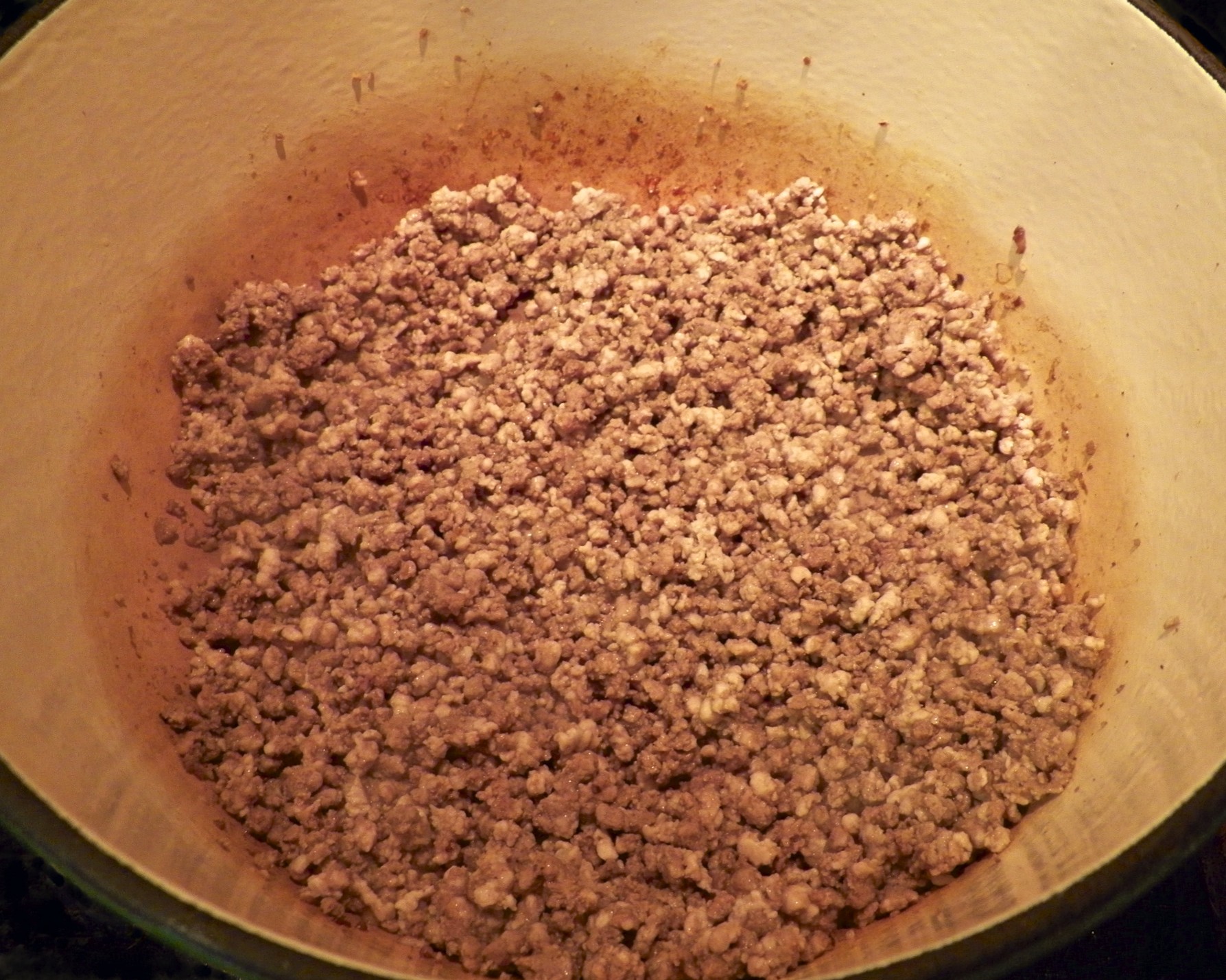
There are a few techniques that all of our tomato sauces include. In the first place, all of our sauces use onions. This is significant because the sweetness of the onion eliminates the need for the sugar that some add to their tomato sauces. When it comes to preparing a meat sauce, at one time large pieces of beef and pork were used and later served alongside of the pasta. Today those meats are ground before being added to the pot. Personally, I no longer buy ground meat and, as a result, am in better control of both the quality and fat content of my ingredients. Beyond that, the instructions for many sauces state to “Brown the meat.” Well, that’s half-right. If you only sauté the meat until the pink is gone, you’re missing an opportunity to add flavor to your sauce. As Zia says, make sure “the juices run clear” before you add anything else to the pot. This will ensure that all the liquid has evaporated, concentrating the flavor and leaving just fat behind. Only then can the meat really begin to brown and I’ll continue to sauté it for a few minutes more to do so. Lastly, I’ll add parsley and basil to the pot just like everyone else but I, also, go back and add more just after the sauce is taken off the heat. I find that doing so not only boosts the flavor of the sauce but adds to its aroma, as well.

 *     *     *

Basic Meat Sauce Recipe

yield: 2 quarts (1.9 l)

Ingredients

  • 3 tbsp extra virgin olive oil
  • 3/4 to 1 lb. (340 to 454 g) ground beef
  • 3/4 to 1 lb. (340 to 454 g) ground pork
  • 1 large onion, chopped
  • 8 cloves garlic, minced or grated
  • 4 tbsp fresh parsley, chopped – separated
  • 1 cup dry red wine
  • 10 crimini mushrooms, sliced – optional
  • 4 tbsp tomato paste
  • 2 quarts (1.9 l) tomatoes or 2 large (28 oz) cans, chopped
  • 2 tsp marjoram
  • 4 tbsp fresh basil, chopped – separated
  • salt & pepper

Directions

  1. Heat oil in large sauce pan over a medium-high heat. Once hot, add beef and pork, season lightly with salt & pepper, and sauté until the liquids run clear and the meat browns.
  2. Add onion, garlic, and half of the parsley. Stir, season lightly with salt & pepper, and continue to sauté until onion is translucent.
  3. Add the wine and sauté until all but a trace has evaporated.
  4. Optional: Add mushrooms and continue sautéing until soft, about 5 minutes.
  5. Add tomato paste, mix thoroughly, and continue to sauté another 2 minutes.
  6. Add the tomatoes, basil, marjoram, and stir to thoroughly combine.
  7. Bring to boil and reduce to a soft simmer.
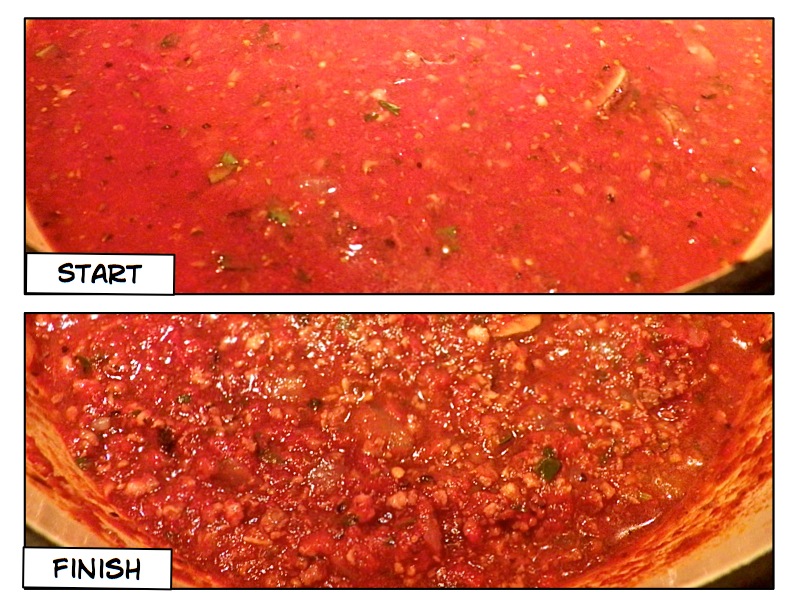
  8. Continue to simmer until the sauce deepens in color and thickens — about 2 hours. Stir occasionally.
  9. Remove from heat, add remaining parsley & basil. Stir to combine.
  10. Sauce is ready for use with your favorite pasta or, once cooled, for storage in your refrigerator or freezer.

*     *     *

*     *     *

Notes

Although this recipe makes two quarts, it can easily be halved to make one quart of sauce.

When you choose to add wine to your sauce will affect its impact on the end-result. If added early, as I did in today’s recipe, the wine will blend into the background, adding to the overall taste of the sauce. Adding it later, towards the end, the wine flavoring will be much more prominent. When preparing a meat sauce, I add the wine early on. For a marinara, I add it later, as you’ll see below. It is yours to decide which you prefer.

Mom did have a “secret” spice that she added to her sauce.  It’s not that I’ve a problem revealing the secret, it’s just that we cannot agree on what that spice was. It’s been over 10 years since I last had a taste and, speaking for myself, my memory isn’t what it used to be. Now, normally this would have meant the end of the discussion, except for one little thing. Recently, while rearranging my basement freezer’s contents, I came across a quart of Mom’s sauce that had fallen in among the ice bags that I used to create a false bottom in the freezer. (The bags were supposed to make things easier to reach and, ironically, prevent something from “getting lost” down there.) Granted, as far as discoveries go, this is not on a par with King Tut’s tomb but is it still a great find. I seriously doubt that the sauce is in any condition to be eaten but, hopefully, we’ll be able to determine just what Mom’s secret ingredient was. To that end, I plan to bring it to Zia — when I remember — and let her palate settle this matter, once and for all. Lest there be any doubt, let me assure you that Zia is a fair and impartial judge. She would never be swayed by the fact that I arranged for her to hold the hand and receive the blessing of her Patron, the soon-to-be-Saint Pope John Paul II.

*     *     *

It’s déjà vu all over again

Since I shared one tomato sauce today, I might as well take you back to an earlier post in which I shared a marinara (meatless) sauce. You can see the recipe by clicking HERE. It was one of my earliest posts, so, be kind.

And while you’re there, be sure to take the link to check out that lasagna recipe. I doubt you’ve seen one like it.

*     *     *

Mom’s Broth — Il Brodo della Mamma

Although I had planned today’s post weeks ago, it really could not have come at a better time. When that virus most vile invaded my world just before New Year’s, I was about as prepared for it as could be. In my freezer were quarts of turkey stock that had been made after Thanksgiving, as well as a nice supply of Mom’s broth, brodo, that I’d prepared for this post. As soon as I detected the contemptible contagion’s presence, I was off to the store for a few odds & ends, returning home where I would remain for the duration. The bastardly bacillus had chosen the wrong host, for the brodo that had served me so well as a child would now be called upon to see me through the dark days that loomed ahead.

I’ve mentioned in the past that we lived on the same block as the parish church which was across the street from our grammar school. Living so close to the school, we were expected to go home for lunch, for the school was relatively small and there was no cafeteria. Children who stayed for lunch sat at their desks and ate. We, on the other hand, raced home where Mom had lunch ready for us. To be sure, at the start of the school year, our lunches often consisted of sandwiches, an occasional burger or hot dog, and fish sticks, tuna salad, or some other meatless delight on Fridays. As the year progressed and the weather grew colder, soup would come to play a larger role in our noontime meals. It was no coincidence that, just as the temperatures began to dip, Mom’s old stockpot would make its first appearance on a Sunday morning, having spent weeks in hiding someplace out of sight.

Sunday was the only day that Dad didn’t work at the restaurant. That morning, Sis and I often accompanied Dad on his morning rounds, returning home just in time to sit down for lunch. Once the weather turned cold, that stock pot was atop Mom’s stove virtually every Sunday morning until Spring. Some days, our Sunday lunch was just soup, with the boiled meats served on the side. (See Notes.)  Other times sandwiches accompanied our soup and, of course, there were other Sundays where soup wasn’t served at all. Still, no matter how much, or how little, was used on Sunday, Mom had plans for that brodo.

On the coldest of school days, we could count on a bowl of steaming soup waiting for us at lunchtime. With Dad home for supper on Wednesdays, Mom often used her brodo to prepare risotto for us that night. And throughout the week, if a recipe required a cup of broth, Mom need look no further than the refrigerator. Beyond that, she always kept a quart of brodo in the freezer should one of us be visited by an ancestor of the beastly bacterium that recently called upon me. If Doctor Mom surmised that the malevolent microbe was not going anywhere for a few days, her stockpot was called back into duty so that when the quart of frozen brodo was gone, she’d be ready with a full pot of brodo to continue the battle.

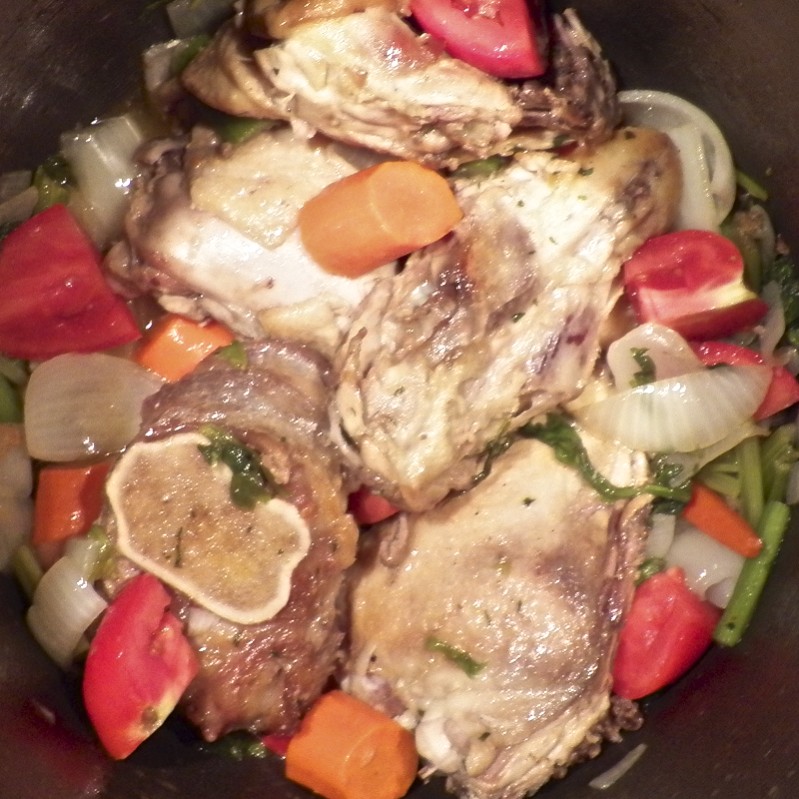
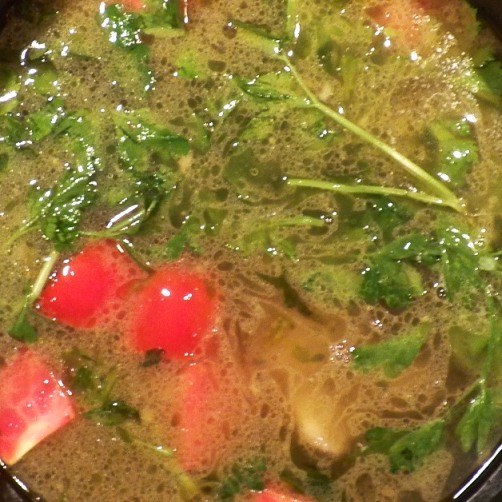
Before detailing Mom’s recipe, a few points need mentioning. None of the soups I’ve mentioned was chicken noodle soup. To be sure, she prepared that for us but it certainly wasn’t very often. We were much more likely to be fed her brodo plain or with quadretti or acini de pepe pastas when ill and, maybe, with capelli d’angelo pasta when we were feeling better. And her brodo wasn’t made with chicken only. Like most Italian broths, chicken and beef were used to create them. This isn’t to say Mom never made a purely chicken broth. It was, however, fairly rare for her to do so. Lastly, many cooks today will brown the chicken and vegetables before adding water to the pot. This will result in a flavorful broth, which some call “brown” chicken stock. I’ll make either one, depending upon how the broth will be used. If I intend to use the brodo to make risotto or chicken noodle soup, I’ll brown the meats (like Mom, I’ll include a piece of beef) and vegetables first. If, however, I’m going to use the brodo for cappelletti, stracciatella, or passatini, I’ll follow Mom’s lead and not brown anything. The meats, vegetables, herbs, and spices are put into a pot of cold water and then the heat is turned on. This results in a cleaner, less complex-tasting broth, one that will let the flavor of the pasta shine. (You’ll note that the photos accompanying this post are from the making of a pot of  “brown” chicken stock for interest’s sake. Photos of Mom’s brodo being prepared would be nothing more than beef, chicken, and vegetables floating in water.)

*     *     *

Mom’s Broth Recipe

total time: approx.  3.5 hours

Ingredients

  • 1 or 2 chicken thighs, with skin and bones
  • 1 or 2 chicken backs

or

  • 2 or 3 chicken thighs, with skin and bones

—————-

  • 1 medium-sized slice of beef shank or beef “soup bone” with meat attached.
  • (2 – 3 tbsp extra virgin olive oil, if browning meat and vegetables)
  • 1 large onion, cut into large chunks – or – 2 medium, cut into chunks
  • 2 carrots, cut into chunks
  • 2 celery stalks, leaves included, cut into chunks
  • 2 – 4  garlic cloves, smashed
  • 1 tomato, rough chopped
  • 4 – 6 parsley sprigs
  • (salt & pepper, if making soup and not broth)
  • 4 to 7 quarts of water, depending upon amount of meat used

Directions

  1. For true “brown” chicken stock, purists will omit the beef.
    1. Heat the olive oil in a large stock pot over medium-high heat. Add the onions, carrots, and celery. Stir occasionally while sautéing until the vegetables are lightly carmelized, about 10 minutes. Remove from pan and reserve.
    2. In the same pan, sear the meats. You may have to work in batches.
    3. When the last of the meat has been browned, return the vegetables to the pot, add the garlic, tomato, parsley, and enough water to cover all the pan’s contents by 3 inches, at least.
  2. For Mom’s brodo:
    1. Add all the ingredients to a large stock pot, and add enough water to cover all the pan’s contents by 3 inches, at least.
  3. Bring the ingredients to a boil, then reduce to a soft simmer. Periodically skim the film off of the surface.
  4. For a pot this large, I will continue simmering the broth for 2.5 to 3 hours. Your cook-times may vary depending upon how much brodo you’re making.
  5. When finished simmering, take the brodo off of the heat to cool somewhat. Remove the meats and reserve. Pour the broth through a fine mesh strainer, discarding the cooked vegetables and herbs. Depending upon its intended use, you can pour the broth through a clean kitchen towel, resulting in a clearer brodo. Refrigerate once strained.
  6. Once the broth is well-chilled, the fat will have risen to the top and can be removed relatively easily with a large spoon. Once the fat has been removed, store the brodo in air-tight containers in the refrigerator for a few days, or, in the freezer for several weeks.

*     *     *

Notes

More than anything, the amount of meat used will determine how much broth to make. I have a 10 quart stockpot and usually make 5 to 6 quarts of brodo. The ingredients listed reflect this and will ensure that I’ve plenty of broth my soups, risotto, or for sipping when a malicious malady attempts an invasion of my pulmonary system. Lacking a large stock pot, you should scale back the amount of meat you put into the pot. The same would hold true, for example, should you only intend to make enough brodo for that night’s risotto or soup.

You’ll note that I do not use salt and pepper in my broth unless I’m sure it will be used for soup and nothing else. Even then, I prefer not to salt it. I can always add salt to my brodo as I use it but I can do nothing, for example, to fix a risotto that’s over-salted and nothing ruins a bowl of cappelletti like a salty brodo.

Sticking with the tradition of nothing going to waste in the kitchen, Mom rescued and served whatever meat she could from the stockpot. Granted, if only chicken backs and a beef soup bone were used that morning, there’d be nothing to save. On the other hand, if there was a nice piece of beef or chicken to be found, she would shred each separately, add some of the boiled onion, and dress with a bit of olive oil and vinegar, salt & pepper. These two “salads” would be served at room temperature along with the tureen of soup.

Today, although I, too, will often make a salad with any beef that’s present, I’ll use the chicken meat in another way. After chopping the meat, I’ll sauté it in a bit of butter, seasoning it with some herb (rosemary, tarragon  or thyme) and salt & pepper. In the meantime I’ll assemble the rest of the ingredients needed for a chicken salad. When the chicken is ready, my salad gets prepared, and I’ll enjoy a chicken salad sandwich with my bowl of soup.

*     *     *

So, you’ve made brodo. Now what?

Well, you could make chicken noodle soup but, as I said, that would not have been Mom’s first choice. I’ve already shared a few of her options and all are listed below. (Click on the photo’s caption to see its recipe.) In the future, I’ll share her recipes for soup ravioli (cappelletti) and Bartolini risotto .

*     *     *

Passatini

*     *     *

Acini de Pepe with Little Meatballs

*     *     *

Stracciatella

*     *     *

Quadretti

*     *     *

It’s déjà vu all over again … 

When I wrote earlier that I needed some odds & ends, one of those was flour. Thinking ahead, I knew that at some point I would want a little something more to eat along with my soup. Bread came to mind. Spianata, to be more specific. Made with 3 of my favorite things — garlic, onion, and rosemary — this focaccia-like bread is easy to prepare and a welcome addition to any meal — like a bowl of soup. Best of all, it will fill your kitchen with a heavenly aroma like only freshly baked bread with rosemary can. You can see the recipe by clicking HERE.

*     *     *

Engineering the Standing Rib Roast

In the past, I’ve mentioned how my family traditionally cooked porchetta, a fantastic pork roast, on New Year’s Day. To be sure, that is a remarkable main course for a New Year’s Day dinner — but it’s certainly not the only one. A number of years ago, I started serving standing rib roast for my dinner on New Year’s Day. At first, not knowing any better, I prepared it like I would any beef roast and, though the results were good, I was expecting fantastic. In the years to follow, I tried different roasting temperatures and even starting on a high temperature before shutting off my oven and letting the roast sit, undisturbed in the oven for 4 hours. Yes, that roast was cooked well but all the dinner’s side dishes had to be cooked on the stove top because the oven door was not to be opened under pain of poorly roasted meat. After I cooked a second standing rib following that method, I decided I wanted to try something else. Luckily, I stumbled upon a different approach. Analytical.

*     *     *

Engineers can cook. Who knew?

Engineers can cook. Who knew?

*     *     *

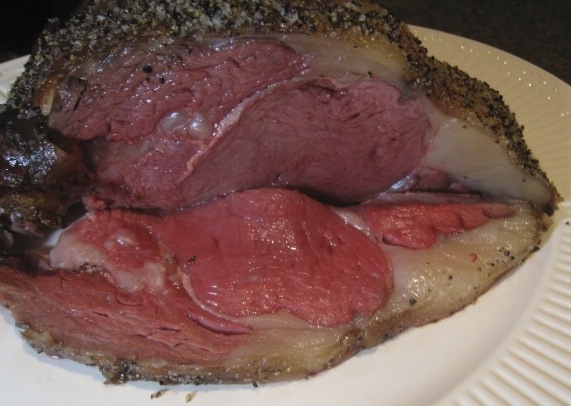
On another sleepless night — it’s 4:15 AM as I write this, by the way — I went surfing for a way to cook the perfect standing rib roast. I soon came upon a website, Cooking For Engineers, where an analytical approach is used for cooking — or so the site’s header claims. Well, I may not be aware of the analysis, if any, that lead them to this recipe but I do know a perfectly cooked roast when I see one. I have followed their instruction now 4 times and each roast has been roasted evenly throughout. There are no well-done slices at either end or gray area on the edges of each slice, with a medium-rare center.  As you can see in the photos, it is medium-rare throughout. And the best part of it all is that this is one easy roast to prepare. Incredibly so.

Day 1: Tsk. So young

Day 1: Tsk. So young.

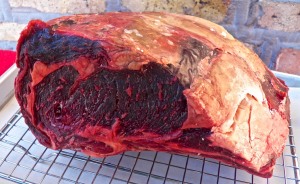
One of the keys to this dish lies in the aging of the meat. As much as one week before the dinner, you’ll want to select your roast. Once you get it home, unwrap the roast and place it on a rack, bone-side down, over a baking sheet in your refrigerator, where it will age for at least a day and no more than 7. Don’t be surprised if the aging causes changes in the roast’s appearance. It’s normal for it to darken and to lose from 10 to 15% of its weight, depending upon how long it is aged. According to our Engineer friends, aging will lend a “buttery texture” to the already richly flavored meat. Believe me. You do not want to skip this step.

Day 5: Aged & ready to go.

Day 5: Aged and better than ever.

Once you’ve aged the meat, you’ll need to prepare it for roasting. Remove the roast from the refrigerator and let it sit on the counter top for a couple of hours. For an evenly cooked roast, it must be at room temperature throughout. You may notice some unusually dark spots on the roast. These should be trimmed away. Use butcher’s twine to tie the roast lengthwise, in-between each pair of bones. This will help to ensure that the roast’s shape is maintained during the cooking process. Once the roast has been brought to room temperature, place a roasting pan on to the stove top and begin heating it. When hot, add a little olive oil to the pan. Place the roast into the now hot oil and sear it on all sides, spending about 3 minutes on each side to do so. Pre-heat your oven to 200˚ F (93˚ C). That’s right: 200˚ F (93˚ C).

Remove the seared roast from the hot pan and place a wire rack into the roasting pan. Heavily season the roast with salt & pepper on all sides. Place the roast on to the rack, insert a meat thermometer into its center, away from any bone, and place the roast & roasting pan on to the lowest rack in the oven. Set the thermometer for 125˚F (52˚C) for rare; 130˚F (55˚C) for medium rare; 145˚F (63˚C) for medium. Sorry but you’re on your own if you want to cook a fine piece of beef like this beyond medium.

For roasts under 5 pounds, it should take about 45 minutes per pound to roast. For roasts greater than 5 pounds, it will take between 4 and 5 hours to cook properly. Once your target temperature has been reached, remove the roast from the oven, place it on a cutting board, tent it with aluminum foil, and let rest for 20 minutes. In the meantime, you can deglaze the roasting pan and use the drippings to create a sauce or add flour to make a roux before adding beef stock to make a gravy. Once rested, use your carving knife to first trim the entire roast off of the rib bones. If you prefer, you can also trim off the fatty end of the roast. Once trimmed, slice the roast in however many slices as are needed to serve everyone. Serve with a little horseradish sauce on the side. (Recipe to follow.)

Now, I ask you. Could it be any easier to cook standing rib than to age, season, sear, and roast at a low temperature? Once again, look at the photos. Each time I’ve listened to the Engineers, I served a roast that was evenly — dare I say perfectly? — cooked throughout.

Oh, one more thing. Leftovers. If you’re blessed with an extra slice, it will make a delicious sandwich the next day. Just sauté it in a little butter until heated through and serve on a favorite bun with a bit of horseradish or horseradish sauce.

To make horseradish sauce: combine equal amounts of plain yogurt (Greek pref.) and sour cream. Add horseradish to taste, some brown whole grain or Dijon mustard, a dash or two of Worcestershire Sauce, and salt & pepper to taste. Mix well and set aside. Serve at room temperature.

*     *     *

Notes

The original recipe specifically mentions to leave the roast uncovered as it ages. I’ve never aged it less than 3 days and certainly not more than 7, as the Engineer states. I’ll replace the fridge’s box of baking soda a day or two before I start the aging process and have never noticed any scent in my fridge. Of course, that just as well might have been the case had I not replaced the box. I guess I’ll never know.

Roasting a piece of meat at a low temperature means that its surface may not color as it would if roasted at a higher temperature. This is why the meat is seared before going into the oven. Just be careful to only sear the meat for 3 minutes per side. Searing it for longer periods will begin to cook the meat on the roast’s inside. Later, when the roast is carved, the end pieces will be cooked more than the rest of the roast, defeating the purpose for roasting the meat this way.

*     *     *

You can see the original recipe on the Cooking For Engineers website by clicking HERE.

*     *     *

It’s déjà vu all over again …

More gravy, please.

More gravy, please.

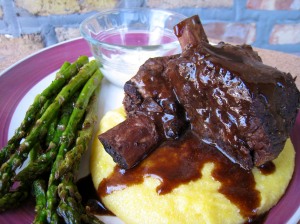
Since we’re starting the year off with a beef rib recipe, I’ll use another to end this post. With Winter here and snow having reached as far south as Texas, there are few better ways to heat up the kitchen than with a delicious braise in the oven. These beef short ribs will not only warm your kitchen, their aroma will fill your home like only good comfort food can. Be sure to serve them with mashed potatoes or polenta because you’ll want to take full advantage of that gravy. Click HERE to view the recipe.

*     *     *

Eel in the Style of Le Marche — Anguille alla Marchigiana

Our ship came in! This morning, I made what has become a daily call to the Italian market and learned that eels had been delivered late yesterday afternoon. I called a friend and within an hour, we were standing in front of the fish counter, watching the fishmonger net today’s entrée. Not but a few hours later, here I sit blogging about the dinner. Not too shabby, well, unless you happen to be an eel.

*     *     *

*     *     *

Throughout much of Italy, eel is a dish served traditionally around the holidays but is most commonly prepared in the southern portions of the country, with Naples famous for its eel. Very often one of the fishes served during Christmas Eve’s Feast of the 7 Fishes, eel is considered to be good luck for those who eat it. This is a very old custom dating back to the days when people believed snakes to be evil because of their role in the story of Adam & Eve. Because it so closely resembles a serpent, by eating eel one was symbolically triumphing over the devil and good fortune was sure to follow. I don’t know if that’s true but I’m buying a few lottery tickets, just in case.

In the old two-flat, I can’t say that eating eel was a tradition at all. In fact, I only remember seeing it one time back then. I must have been no more than 5 years old because I could barely see over the edge of the sink. Even though “barely,” I did manage to get a glimpse of a sink full of the slimy devils. Needless to say, it was a sight that left a lasting impression. Speaking with Zia, that is probably the last time eel was prepared there. So, today’s post wasn’t just a recipe. It was yet another memory test for my long-suffering Zia. I must say, though, having just finished a delicious dinner, Zia came through again. The eel flesh not only remained intact, it’s flavor wasn’t overcome by the tomatoes and, in fact, the sauce had a mild seafood taste throughout. Now I just have to figure out a way to get some eel over to Michigan so she, too, can enjoy the fruits of her memory.

*     *     *

*     *     *

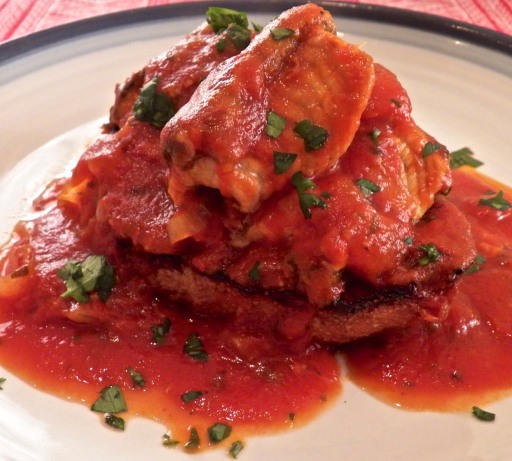
As she suggested, I prepared the anguille like we do much of our seafood, in a simple tomato sauce. In fact, this marinara is almost bland for there are no strong herbs or flavors present. Eel has a mild fish flavor and using something like organo or marjoram would definitely overpower it, leaving a tomato sauce devoid of any taste of seafood. We agreed that the eel might disintegrate if allowed to cook entirely in the sauce, so it was briefly pan-fried before being added it to the tomatoes.  Beyond that, the only change I brought to the recipe was with the basil. My family always tore by hand or chopped fresh basil before adding it to a sauce. Not long ago, I watched as Lidia added an entire stem of basil to her sauce and fished it out before serving. Well, if it’s good enough for Lidia, it is certainly good enough for me. If you, however,  don’t feel like adding a stem of fresh basil, then tear or chop away.

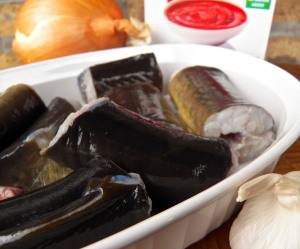
Oh! I should warn tell you one more thing about today’s protein. These eel are alive when purchased. You can bring them home and “take care of them” yourself or you can let your fishmonger do it for you. Um. No question. Let your fishmonger kill, gut, trim, and even chop the eel to your specifications. If you’re considering taking on any of the duties I’ve just mentioned, let me tell you that the term “slippery as an eel” is far more fact than fiction. I chose to chop the eel myself and it was a mistake, one that I’ll never repeat.

*     *     *

Anguille alla Marchigiana Recipe

Ingredients

  • 3 lbs. eel, cleaned with head & tail removed, chopped in 2 – 3 inch pieces.
  • 4 tbsp extra virgin olive oil, divided
  • 1 large sweet onion, sliced thin
  • 1 clove garlic, minced or grated
  • 4 tbsp fresh parsley, chopped, divided
  • 1 large can (28.5 oz) tomatoes
  • 1 stem fresh basil
  • 1 cup white wine
  • salt & pepper
  • thickly sliced, toasted Italian bread, for serving.

Directions

  1. In a large sauce pan, heat 2 tbsp of olive oil over med-high heat. Add onion and sauté for about 3 minutes before adding 3 tbsp of the chopped parsley. Continue to sauté until the onion is translucent, about 5 more minutes.
  2. Add garlic and sauté for a minute.
  3. Add tomatoes, basil, season lightly with salt & pepper, and bring pan’s contents to the boil before reducing to a simmer.
  4. After sauce has simmered for 15 minutes, heat the remaining oil in a large frying pan over med-high heat.
  5. Once the oil is hot, add the pieces of eel and sauté for about 7 minutes, being careful to insure that the pieces are evenly cooked.
  6. Carefully remove the eel and place it in the tomato sauce. Season lightly with salt & pepper.
  7. Use the white wine to deglaze the frying pan. Continue to cook the wine until it is reduced by half. Add the wine reduction to the tomato sauce and carefully stir the pan’s contents.
  8. Increase the heat to high, bring the sauce to the boil, then reduce the heat and simmer for another 15 minutes.
  9. Taste and adjust seasoning, if needed, one last time.
  10. To serve, set a piece of toasted bread on each plate and place eel pieces on top, followed by a generous amount of sauce. Garnish each serving with some of the remaining chopped parsley.

*     *     *

It’s déjà vu all over again …

Calamari SaladA little over a year ago, I gave an account of how the Feast of the 7 Fishes came about. It was part of the post in which I shared Mom’s recipe for a Calamari Salad. Follow this recipe’s guidelines and you’ll have perfectly prepared calamari, not rubber bands. That post also included a round-up of 11 additional seafood recipes for anyone needing help with gathering 7 seafood dishes for the Feast. You can see it all by simply clicking HERE.

*     *     *

What’s this? You’re still a fish short?

Here’s a round-up of this past year’s seafood posts.

So, combining both posts, you now have 18 recipes from which to choose dishes for your Feast of 7 Fishes. Still having trouble? Try this: start your meal with Mom’s Calamari Salad. Next serve a bowl brimming with Brodetto. See? You’ve got 6 Fishes out-of-the-way already. Now, finish your meal with a bang: Branzino al Cartoccio. That’s 7 Fishes and you haven’t even broken a sweat.

*     *     *

Coming soon to a monitor near you …

Mom’s Brodo

*     *     *