Baked Whiting

Merluzzo al Forno

Today’s recipe comes from a half-century ago, a time when television shows were only broadcast in black and white; when a trip to the airport was something eagerly anticipated; when all (US) phones had a dial and many of those phones, being owned by Ma Bell, were rented; when music was purchased on large, black vinyl discs; and when Catholics were forbidden to eat meat on Fridays lest they face the fires of eternal damnation. Yes, that long ago.

*     *     *

*     *     *

When I think back to those days, I’m amazed at the variety of fish that found its way to our dinner table. Aside from the usual guests — i.e., baccalà (salted cod), stoccafisso (dried cod), tuna, vongole (clams), smelt, calamari (squid), perch, sepia, lumache (snails) — there were infrequent visitors but I was far too young to remember their names. Zia, my very own Encyclopedia Italiana, can’t remember their names either. So, you can well imagine my surprise when the fishmonger at the Italian market identified a type of fish in his display case as “merluzzo.” Merluzzo! I’d not heard or seen that fish in almost 50 years. I bought a couple, rushed home, and phoned my Aunt immediately.

Zia was every bit as surprised as I was. I really enjoy these phone calls and they’re why I spend so much time investigating a market’s pasta aisle, the cheese counter, the produce department, and interrogating the fishmonger. It makes my day when I uncover some treasure from long ago and then phone her with the news. To be sure, no matter the discovery, there’ll be some in a bag, a box, or a cooler the next time I come for a visit. And that dinner will be full of memories, some of which I’ll then share with you.

*     *     *
*     *     *

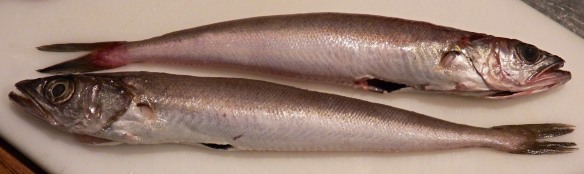
Now then, before discussing the recipe, I can no longer ignore l’elefante nella stanza. Our friends from across The Pond refer to merluzzo as “hake”, whereas here merluzzo is called “whiting.” (My sources on this “side” being my fishmongers and Fabio Trabocchi’s cookbook Cucina of Le Marche.) Although I am by no means an expert, I’ve learned that although the two fish aren’t exactly the same, the names “whiting” and “hake” are used interchangeably.  For the sake of argument, henceforth I’ll call today’s fish “merluzzo”. You, then, can translate it to mean whatever you like,  be that “whiting” or “hake”.  ChgoJohn, Peace Maker.

I’m going to dispense with my normal recipe format, for this dish doesn’t need it. Merluzz’ are small fish. Scaled and gutted, the 2 pictured were about 9 inches (23 cm) long and together weighed about 8 ounces (227 g). To stuff them, you’ll need about 1/3 of a cup of the breading mixture per fish and you may wish to make more, depending upon how you’ll cook or serve your fish.

This stuffing mixture is used in a number of the Bartolini family recipes. Grandma’s Stuffed Vegetables and Grandpa’s Barbecued Shrimp are 2 that I’ve shared so far. We, also, use it to stuff calamari and again with other baked fish, the recipes for which are forthcoming.  The only difference in its composition from one dish to the next is that, with seafood, lemon juice might be added.  It’s easy enough to make. Just combine (Panko) breadcrumbs, chopped fresh parsley, a little grated or minced garlic, salt & pepper, and olive oil. If you like, squeeze a little fresh lemon juice into the mix. Learning how much olive oil to use gave me fits. I pestered Mom with questions and was forever touching Zia’s mixture to get “the feel” of it.  You do not want a breading that is sopping wet with olive oil but neither do you want it barely moist. Too wet and you’ll have a greasy dish; not wet enough and it will dry out, and possibly burn, before the dish has finished cooking. Practice makes perfect.

Once the breading is made, salt & pepper the fish, inside and out, use the breading mixture to stuff it, and add a light drizzle of olive oil. Back in The Day, Grandpa would then secure the merluzzo in a hinged grill basket and place them on his barbecue, turning them after a few minutes. When finished, they would be removed to a serving platter and brought to the table. As you can see, that’s not what I’ve done.

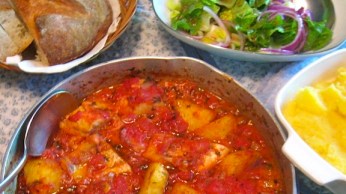
To bake, place the stuffed fish on a lightly oiled baking sheet. Place any excess breading on top of the fish before drizzling with oil, and then place in a pre-heated oven of 375˚F (190˚C). Bake for about 20 minutes or until the breadcrumbs are golden brown. Times may vary depending upon the oven and size of the merluzzo. Remove to a serving platter and serve immediately. That’s still not as is pictured but this is how my family baked and served merluzzo.

*     *     *

*     *     *

One way I like to prepare them is to roast cherry/grape tomatoes with the fish. I make extra breading and use it to cover the fish. Once roasted, the resulting flavors of roasted tomato and breading are reminiscent of Grandma’s Stuffed Vegetables.

A third way to serve them is to prepare even more breading mixture and use it to as a bed and coating for the roasting fish. Once roasted, place the breading and fish atop cooked pasta that has been lightly dressed with olive oil and chopped parsley. Roasted cherry tomatoes would work here, too.

*     *     *

Notes

Don’t let a fear of fish bones prevent you from trying merluzzo. The bones are all attached to the spine and the “top-side” fillet readily lifts off of the fish with your fork. Once exposed, the entire spine is then easily removed, making the “bottom-side” fillet accessible. Just be careful with the meat taken from around the gills and you shouldn’t encounter any bones while eating.

*     *     *

It’s déjà vu all over again …

*     *     *

As I’ve said, seafood is the protein of choice in Italian households on the night before Christmas. My Brodetto, or fisherman’s stew, uses a variety of seafood in a lightly seasoned tomato broth to create a very special dish which, coincidentally, is perfect for Christmas Eve. Click HERE to learn how to make this stew.

*     *     *

Coming soon to a monitor near you …

Next week’s recipe is a mystery dish, my memories of which predate even merluzzo. As such, I’ve no teaser photos for you. I can’t even guarantee that I’ll find it before next Wednesday. If I don’t, I may delay next week’s post a day or two, hoping that something turns up. Don’t you worry. I’ve another seafood recipe, all set to post, if I’m not successful. Stay tuned …

*     *     *

Pan-Seared Salmon with Dill Sauce

As many of you may recall, recently I’ve located 3 fishmongers in my part of town. This was quite the lucky stroke, especially considering that for years now, only previously frozen fish was available to me — unless I wished to pre-order what I wanted. Yes, that was a possibility but there was little room for spontaneity. Living by myself, I don’t mind planning a dinner when guests are involved but when dining alone, I’ll often let the market decide what I’ll be preparing. Very often that meant that good, fresh fish were off the menu. Well, not anymore.

*     *     *

*     *     *

Now that I’ve a steady supply of quality fish, I’ve certainly taken advantage. Branzino, sturgeon, merluzzo, salmon, shark, and sea bream have all found there way to my table, as have more clams than I’ve had in the past decade. I’ve prepared the fish in parchment (al cartoccio), grilled (alla griglia); baked (al forno), stewed (in umido) or, like today, pan-seared. None is difficult or complicated to prepare, nor are any so bone-riddled as to be unpalatable. Although 1 specific dish may give you pause, I guarantee that you will be able to prepare the others without so much as batting an eye. So, with Christmas Eve approaching fast, I plan to present 3 fish dishes to you in December.

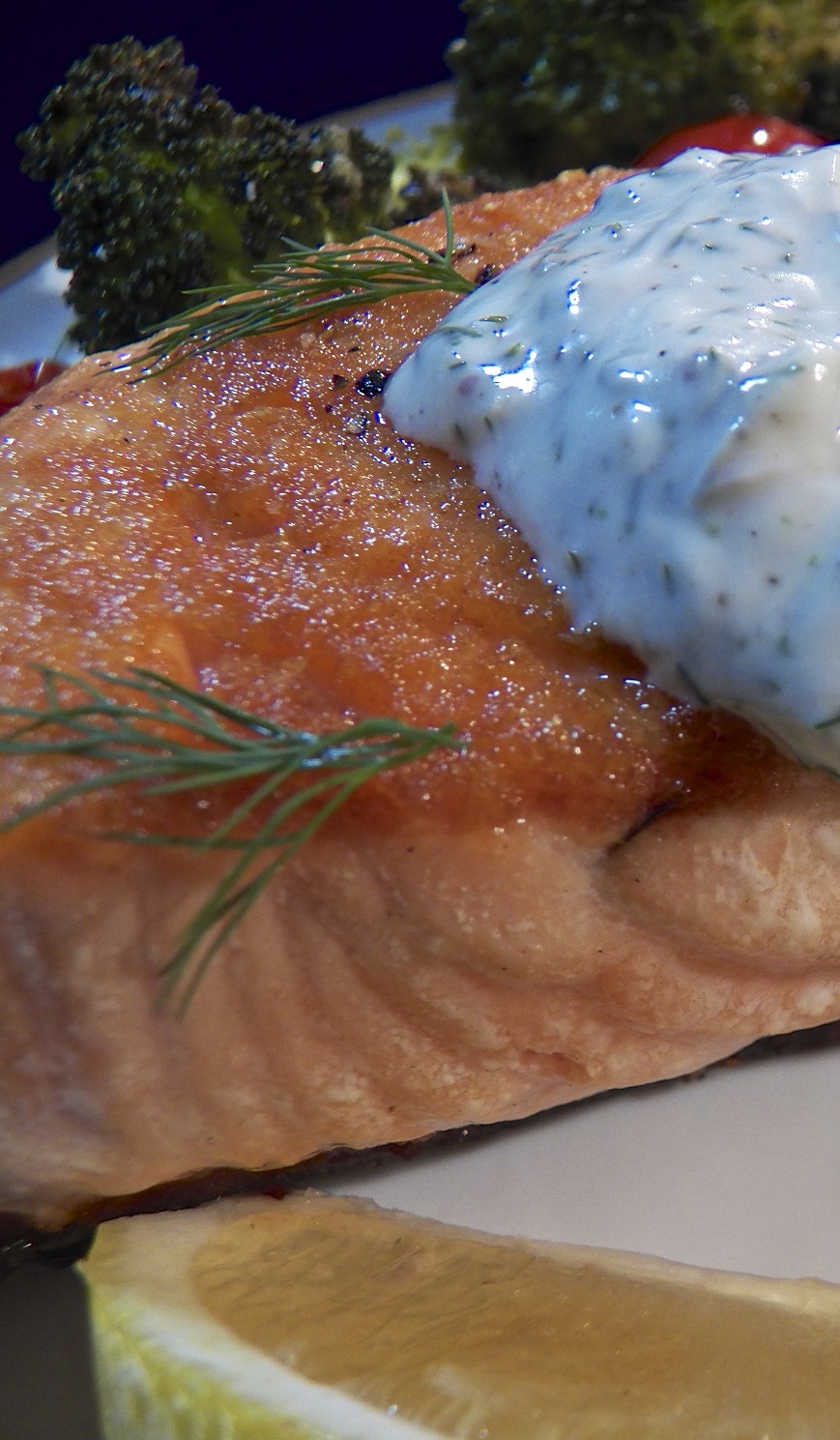
Today’s recipe is Pan-Seared Salmon Fillets. This is so easy to prepare that I debated blogging about it at all. Still, I was motivated to do so for the benefit of the younger members of my family.  Preparing fish can be a bit daunting for the inexperienced cook and a recipe like today’s is a confidence builder. With both the salmon and sauce taking less than 15 minutes to prepare, all you have to worry about is preparing a salad and whatever sides you prefer. The only way this meal could be easier is if you ordered it in a restaurant — and then it would cost you at least double.

*     *     *

Pan-Seared Salmon with Dill Sauce Recipes

Ingredients

Browned & Crispy

  • thick cut salmon fillets, skin in place
  • salt & pepper
  • extra virgin olive oil
  • lemon wedges for serving

Dill Sauce

  • 4 tbsp (low-fat) Greek yogurt
  • fresh dill, chopped + more for garnish
  • 1 small garlic clove, minced or grated
  • salt & white pepper

Directions

  1. Combine yogurt, dill, and garlic into a small bowl and mix well. Season with salt & pepper and set aside.
  2. Heat a few tablespoons of olive oil in a medium skillet over a med-high heat. Season both sides of the salmon with salt & pepper.
  3. When oil is hot, add the salmon fillets, skin side down.
  4. Turn fish over once skin is well-browned & crispy but not burnt. This should take 4 to 5 minutes.
  5. Continue to sear, flesh-side down, for about another 3 minutes. This will give you a fillet that is med-rare to medium internally. Cook more or less depending upon your own preferences.
  6. Serve immediately  garnished with chopped dill and accompanied with dill sauce and lemon wedges.

 *     *     *

Notes

To insure that the salmon cooks evenly, select yours from the thickest part of the salmon fillet. If you must use the “tapered end” of the fillet, you will need to adjust your cooking times accordingly and the salmon skin may not fully crisp.

Although the dill sauce may be prepared and served immediately, it is best when prepared a few hours in advance and allowed to sit so the flavors meld together. I prefer to serve it at room temperature and will allow it to sit on a counter for about an hour before serving.

There are definitely 2 schools of thought when it comes to eating the skin of cooked fish. This recipe specifically crisps the skin. If you enjoy eating crispy skin, serve the fillets skin-side up. If you prefer not to eat the skin, serve the fillets skin-side down. This will soften the skin and make it easier to avoid while dining.

*     *     *

It’s déjà vu all over again … 

With an eye towards Christmas Eve, I thought today’s Blast from the Past should follow this month’s fish theme. In many Italian households, baccalà (salted cod) is the centerpiece of the Christmas Eve dinner. Click HERE to learn how my family prepares this dish.

*     *     *

Coming soon to a monitor near you …

Pasta with spinach, lemon, and burrata cheese

*     *     *

What do a Zia, a Pope, and an Elf have to do with Today’s Pasta? (Part 2)

*     *     *

Ché bella Zia!

*     *     *

As was mentioned yesterday, today is the 90th anniversary of my Zia’s birth! Last Saturday, some 2 dozen Bartolini gathered at the home of one of her Grandsons for a surprise party in her honor. (Very heavy emphasis on the “surprise.”) The food was delish; the champagne chilled and plentiful (just how I like it); and the highlight of the evening was her Son’s slide show of family photographs. It was a wonderful night for this very special Lady and Matriarch of the Bartolini Clan. She deserves no less!

Now, back to our story …

*     *     *

2 Pieces of the Puzzle

*     *     *

Yesterday, I recounted my favorite story involving my Zia as a means of celebrating her birthday. What’s this? You missed it? Well, click HERE to view yesterday’s post. Once there, you’ll see how Zia and Pope John Paul II are connected. Don’t worry, we’ll wait for your return.

For the rest of you, I don’t expect you to sit idly by while the others catch up. Heavens no! Here’s a musical interlude to occupy your attention while we wait. (Thanks, Cris!)

*     *     *

(Remember this aria, Zia?)

*     *     *

Everybody here? Then let’s continue …

When we left our story, Zia and I had just experienced a close encounter of the Papal Kind and were in a taxi being ferried back to our hotel. When we arrived at the hotel, we skipped lunch, preferring to retire to our rooms. We had anticipated a memorable day and this was so much more than that, a truly once-in-a-lifetime experience. A rest was definitely in order — if for no other reason than to allow Zia to re-hydrate. Later that afternoon, as was our custom, room service delivered our caffè to Zia’s room. Normally, this is when we would have planned our dinner and evening. That night, however, we decided to “stay close to home” and made an early reservation at a restaurant just down the street from where we were staying.

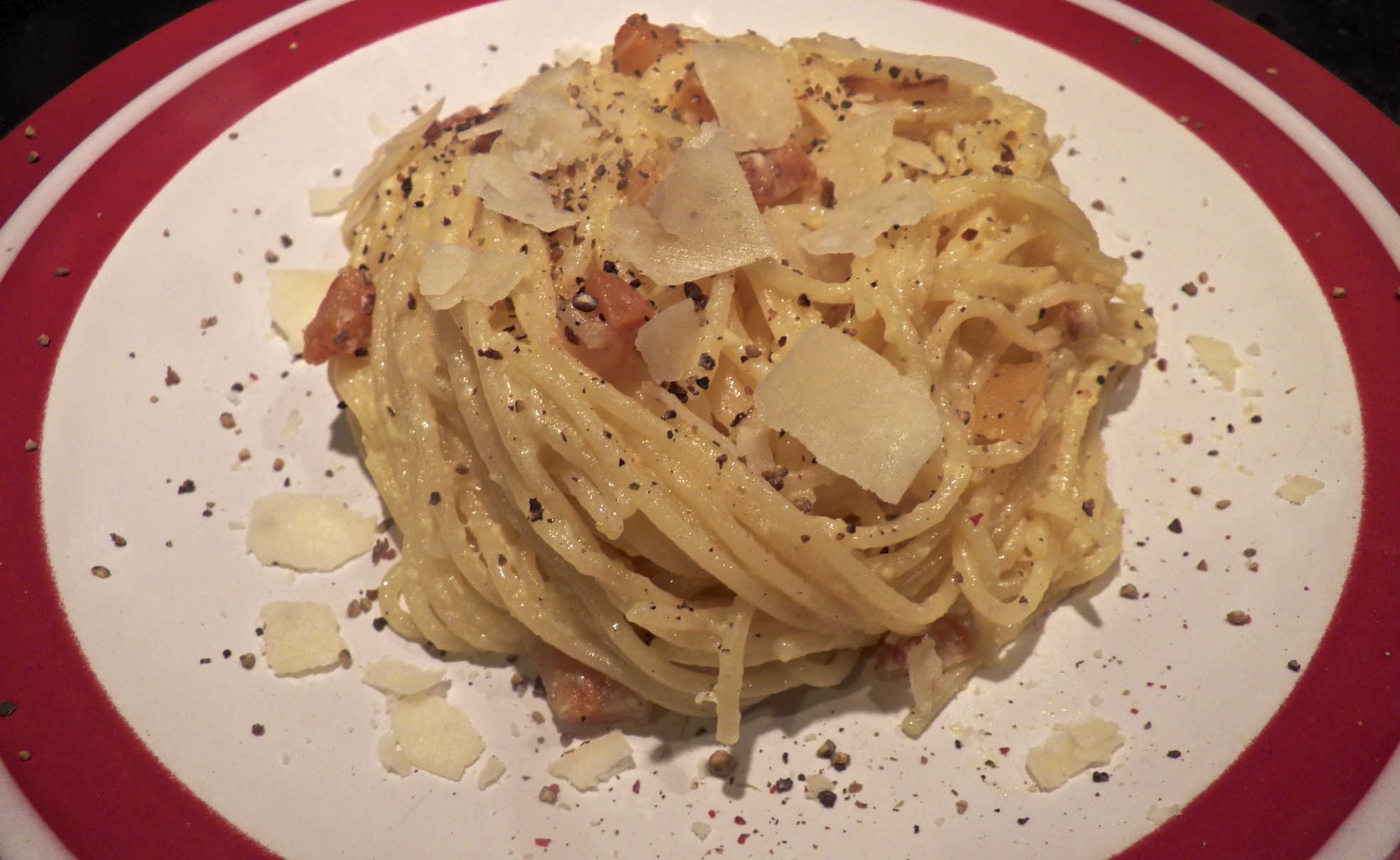
Not that much later, we were seated at the restaurant, our appetites still nowhere to be found. Now, one thing you should know about my Cara Zia is that she loves pasta every bit as much as I do. When we dined, we always enjoyed a primo piatto of pasta of some sort before ordering our secondi and contorni. So, absent an appetite, we did what came naturally: we ordered pasta.  Not so coincidentally, that pasta just happens to be today’s recipe, Spaghetti alla Carbonara.

*     *     *

Spaghetti alla Carbonara

*     *     *

Mom first prepared this dish for me when I was in my teens. She told me a legend that its name was derived from the coal miners that worked in the mines that surround Rome. As they ate their lunch, which often consisted of a plate of pasta, coal dust fell from their clothes and on to their plates. The dish’s ample use of black pepper is an homage, of sorts, to those miners and their lunches.

The version Mom served me usually contained bacon, although prosciutto was sometimes substituted, albeit rarely. Pancetta just wasn’t something that Mom and Zia used in their cooking. Remember, many of the Bartolini dishes began with a battuto of onion, garlic, parsley, and salt pork. There was no need for pancetta, too. As my experience as a cook grew, however, I began to use pancetta more frequently when I prepared this pasta.

Back in Rome, Zia and I noticed that this pasta was made with guanciale, something that was an unknown to me. Our waiter explained that guanciale comes from the pig’s jowls and, like pancetta, it’s cured but not smoked. Although now used throughout Italy, our waiter went on to explain that it is still most commonly used in Rome and its surrounding district of Lazio. Well, we needed no further urging. Zia and I ordered the Spaghetti alla Carbonara and so began my love affair with this cured meat. Unfortunately, it would take me 10 years to find a source for guanciale in my hometown but that’s a story for another day. Even so, in my mind, Spaghetti alla Carbonara will be forever linked to Zia and Pope John-Paul II.

OK. So far I’ve explained the connection between Zia and the Pope and how, on the day of their meeting, we dined on today’s pasta, Spaghetti alla Carbonara. Get ready, kids. Here comes Santa Claus!

*     *     *

No, that reindog isn’t Max.

*     *     *

In the years following that momentous day in St Peter’s Square, I’ve prepared Spaghetti alla Carbonara countless times. It is one of the few dishes I prepare using spaghetti because it’s just not my favorite form of pasta. You see, lacking the means to create this thin, round-shaped pasta, I had to rely on manufactured spaghetti. As you know, I prefer homemade pasta over pretty much all manufactured types. Still, when it came to this tasty dish, I gladly bought spaghetti and never thought twice about it. This all changed 3 years ago, almost to the day.

One afternoon, Martha Stewart was promoting a new attachment for a well-known stand mixer. This piece of equipment worked much like an extruder, forcing dough through interchangeable plates, creating macaroni, fusilli, rigatoni, bucatini, and, you guessed it, spaghetti. Later that day, I spoke with a good Friend (aka my Traveling Companion) and mentioned this pasta-making wonder of modern technology. A year later he would become a member in high standing of my blog’s tasting crew and, at this time, he had already been the beneficiary of many of my dishes and, well, experiments. He understood full-well the ramifications of this piece of equipment. Our conversation ended and that was the end of that, as far as I was concerned — or so I thought. About a week later, much to my surprise, UPS delivered the pasta maker. In its packaging was a card from Santa, wishing me a Merry Christmas. I called to thank my Friend but he denied having anything to do with it — a denial he maintains to this very day. Now, I’ve no reason to doubt my Friend or his word. If he maintains that Santa did, indeed, send me a gift, who am I to disagree? I would just like to point out, however, that he is the Elf holding the reindog in the picture above. Just sayin’…

There you have it. This is how my Zia, a Pope, and an Elf all helped to bring you today’s Spaghetti alla Carbonara. All that’s left to do, aside from presenting the recipe, is to say,

“Buon Compleanno, Cara Zia!”

*     *     *

*     *     *

Spaghetti alla Carbonara Recipe 

Ingredients

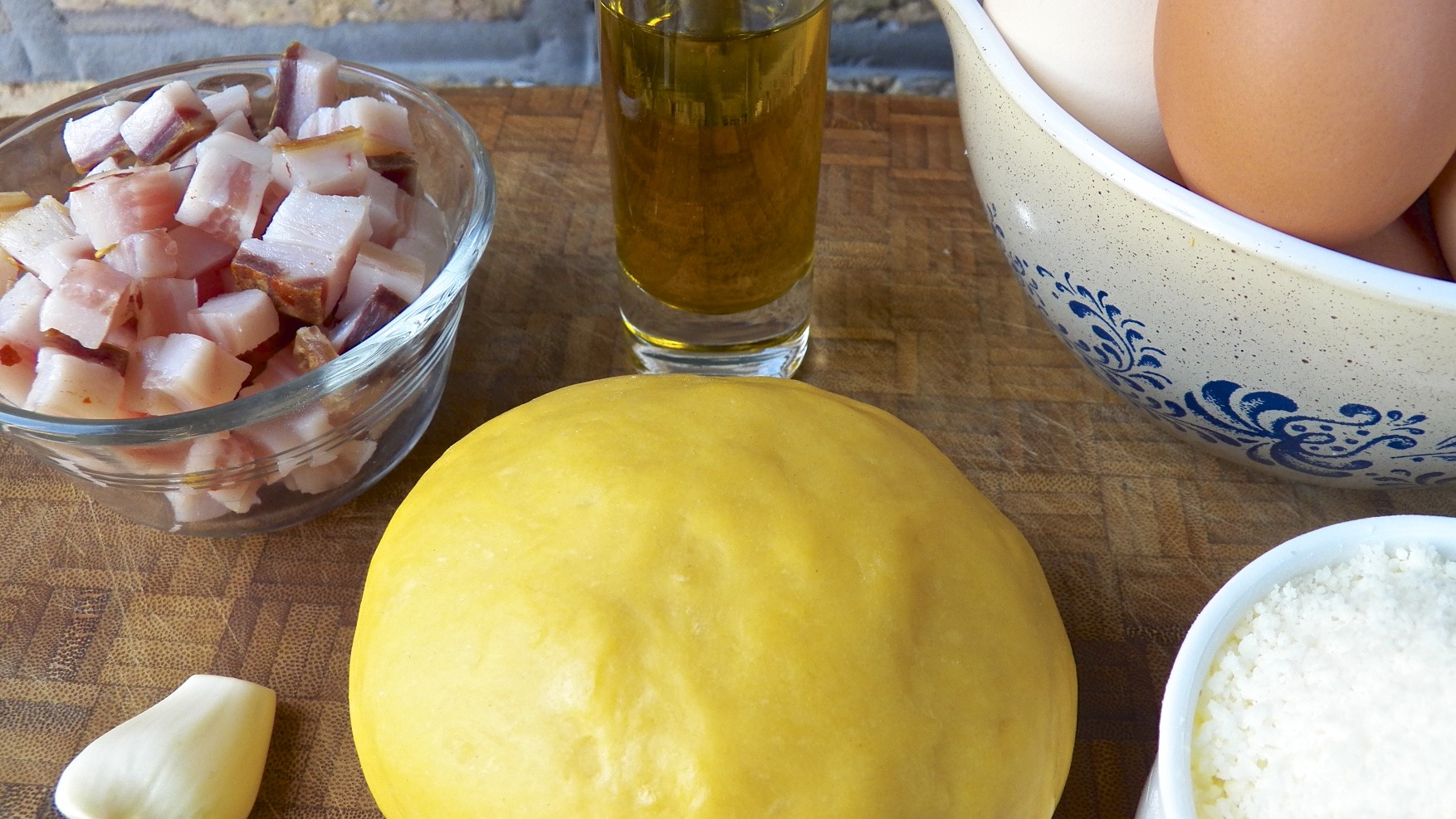
  • 1 lb spaghetti
  • 2 tbsp extra virgin olive oil
  • 4 oz. guanciale, ¼ inch dice (pancetta, prosciutto, bacon, or ham may be substituted)
  • 1 or 2 cloves of garlic, sliced
  • 3 eggs, beaten
  • 1 cup grated Pecorino Romano cheese – separated
  • ½ to 1 tsp freshly cracked black pepper
  • reserved pasta water
  • Parmesan or Romano cheese for garnish/serving

Directions

  1. Warm a large pasta serving bowl.
  2. Bring a large pot of heavily salted water to boil. Add the spaghetti and stir.
  3. Check the spaghetti package’s cooking instructions. You’ll want it to be 2 minutes shy of al dente when the rest of the ingredients are ready.
  4. Add half of the cheese to the 3 eggs and beat well to be rid of any lumps.
  5. In a large, deep frying pan, heat the oil over medium heat. Add the pancetta and brown, rendering all the fat. Do not over cook.
  6. Add the garlic and sauté for about a minute.
  7. While the garlic cooks, reserve a cup of pasta water, drain the pasta, and add the pasta to the frying pan.
  8. Continue cooking the pasta in the oil for 2 minutes, heating it thoroughly.
  9. Pour the frying pan’s contents into the warmed serving bowl. Add the egg and cheese mixture in a slow, steady stream, stirring constantly to prevent the eggs from scrambling. Once fully coated, add more cheese, the pepper, and as much pasta water as necessary to create a creamy sauce.
  10. Serve immediately with plenty of grated cheese and cracked black pepper available at the table.

*     *     *

Notes

For so few ingredients, this is a relative tricky dish to prepare. If not done properly, the pasta will not be hot enough to cook the eggs, raising the possibility of salmonella. To eliminate that risk, I only use pasteurized eggs when making this dish. On the other end of the spectrum, it is very easy to “scramble” the eggs rather than create a sauce. You can limit this risk by mixing the pasta and egg mixture off the heat, in a warmed bowl, and/or by adding a little of the hot pasta water to the egg mixture before it’s added to the pasta. This will, in effect, temper the eggs a bit. No matter how you do it, remember to keep the pasta hot and to work fast.

*     *     *

It’s déjà vu all over again …

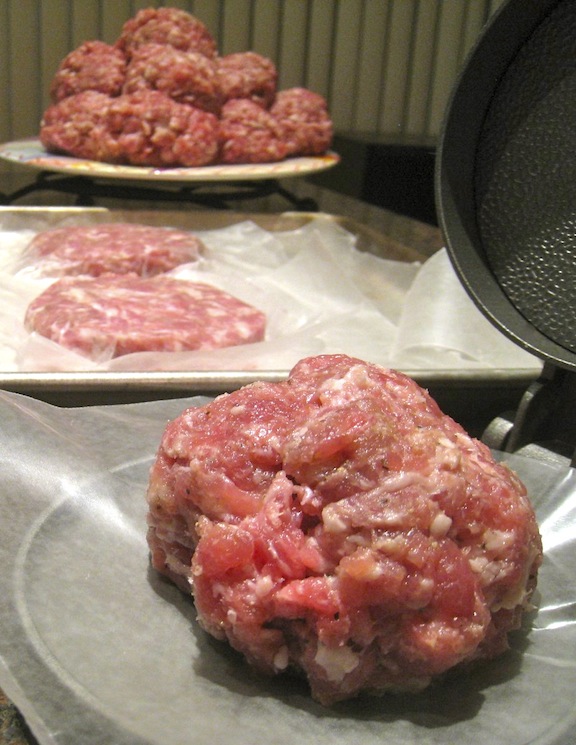
It was just about a year ago when I shared the Bartolini recipe for making sausage. Mild compared to most spicy sausages, ours depend upon garlic, white wine, and salt & pepper for flavoring. Consider them a platform on which to build your own sausage. Paprika, red pepper flakes and fennel seeds will change them up a bit, as will marjoram, mint, and oregano. Though these days we tend to form patties more often than sausages, the post is nonetheless chock full of sausage making information. Feel free to ask any questions that may arise. You can view the post by clicking HERE.

*     *     *

Coming soon to a monitor near you … 

Merluzz’ al Forno

*     *     *

Crostini e Bruschette

A few weeks ago I posted my last recipe in the series of making cheese at home, Italian Mozzarella. Within that post were photos of crostini & bruschette and, with the holidays quickly approaching, I thought this the perfect time to share both recipes. Besides, if you were successful and made a couple of pounds of mozzarella, eventually you’re going to tire of eating it “by the chunk” — and that’s when these recipes will come into play.

First a definition of terms. The word crostini means little toasts, whereas bruschetta has as its origin bruscare, to char or roast. They sound pretty similar to me. I’ve always thought the difference to be in the bread used. When I make crostini, I use a baguette, thinly sliced on the diagonal. For bruschette, I use a thicker slice taken from a loaf of Italian bread. I toast both before piling on the fixin’s and sometimes pop them back into the oven afterward. It really does depend on what’s being used to top each off. And speaking of the fixin’s, you can use pretty much anything you like.  Just stick with fresh ingredients and you won’t go wrong.

About a year ago, I posted a recipe for Gorgonzola and Honey Bruschette. At the time, I mentioned that I often use my toaster to toast the bread beforehand and store it in airtight containers until needed later that day. This is particularly helpful when entertaining. It’s just one less thing to worry about.  No matter when you toast the bread, though, try to serve these bruschette directly after preparation or they may become sodden.

 *     *     *

 *     *     *

Mozzarella and Tomato Bruschette Recipe

Ingredients

  • ⅔ inch (1.7 cm) slices of Italian bread
  • plum tomatoes, seeded and chopped
  • garlic, minced
  • a few tbsp of sweet onion, diced
  • fresh mozzarella, cut in 1/2 inch cubes
  • fresh basil leaves, hand torn
  • Italian seasoning
  • olive oil
  • Balsamic vinegar
  • dried oregano
  • salt & pepper

Directions

  1. Slice bread, brush with olive oil, and toast lightly
  2. Add a couple of tablespoons of olive oil to a frying pan over medium heat. Add the onion and garlic, sautéing for about a minute. Do not let the garlic burn.
  3. Add the tomatoes, season with salt and pepper, and cook until heated through.
  4. Remove from heat, add the basil, Italian seasoning, balsamic, and olive oil. Mix well and taste before seasoning with salt and pepper. Set aside.
  5. Add the cubed mozzarella once the tomato mixture has cooled to room temperature.
  6. When ready to serve, spoon some of the tomato-mozzarella mixture on top of each toasted bread slice, season lightly with salt and cracked black pepper, and garnish with a light sprinkling of dried oregano.

 *     *     *

 *     *     *

Crostini alla Caprese Recipe

Ingredients

  • ½ inch (1.2 cm) thick slices of baguette, cut on the diagonal
  • cherry tomatoes, sliced in half
  • fresh mozzarella, cut in ¼ inch (.6 cm) slices
  • fresh basil leaves
  • olive oil
  • red wine vinegar
  • salt & pepper

Directions

  1. Slice bread, brush with olive oil, and toast lightly.
  2. Pre-heat oven to 400˚F (204˚ C).
  3. Place tomatoes in a bowl, season with salt & pepper, and drizzle with olive oil.
  4. Place tomatoes on a baking sheet and then into the oven to roast for about 15 to 20 minutes. Do not allow to roast so long that the tomatoes completely collapse.
  5. Meanwhile, place a slice of fresh mozzarella and then a few small basil leaves atop each piece of toast.
  6. Remove tomatoes from the oven and when cool enough to handle, place one tomato half, cut-side down, on each piece of the toast with mozzarella and basil. If you prefer, add a light drizzle of olive oil and a few drops of red wine vinegar.  Serve immediately.

*     *     *

Notes

These antipasti should be made using fresh mozzarella. No, you needn’t make it yourself and you can find it now in most large grocery stores. Just to be clear, I’m not talking about the pre-shredded stuff used when making pizza. Fresh mozzarella is usually ball-shaped and is often packaged in water/whey. If you’re unsure, ask a person working at your store’s deli counter for assistance.

*     *     *

It’s déjà vu all over again …

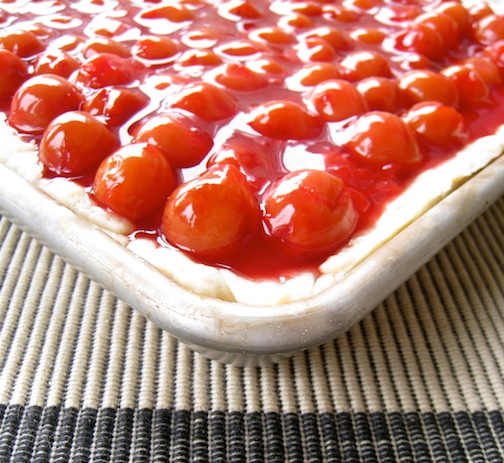
Since this post is somewhat party themed, I thought it best to resurrect a recipe that’s perfect when entertaining a large group. Cut into 3 inch squares, your guests will have no trouble munching on this bit of cheesecake while sipping on their cocktails, You can find the recipe for this Cherry Cheesecake Pizza by clicking HERE. If you need help deciding which cocktail(s) to serve, do what I do. Click HERE or HERE. While you’re there, be sure to take some time to check out both Greg’s and John’s blogs. You won’t be disappointed.

*     *     *

Coming soon to a monitor near you …

The Ketchup That Came Down The Mountain

*     *     *

The Proverbial Last Rose of Summer

“Sunset Celebration”

*     *     *

Mediterranean Sea Bass in Parchment

Branzino al Cartoccio

During the past 6 months, I’ve discovered not just an Italian market with an extensive fish counter but 2 fish mongers, as well. Their impact upon my diet has been incredible and I’ve enjoyed a far greater variety of seafood than ever before.  I’ve not seen some — whiting (merluzzo), eels (anguille), octopus (polipo) — since I was a boy. Others — clams (vongole), squid (calamari), red snapper, and the like — may have been more readily available but the fish and calamari were often frozen and finding clams was a hit-or-miss affair. So, suddenly having 3 sources for fresh (affordable) seafood is mind-boggling and I’ve taken full advantage of them. Mediterranean sea bass (branzino) is a case in point.

Up until I found the Italian market, branzino was something I only saw on the menus of restaurants. My usual sources for seafood certainly weren’t going to carry it, although I suppose I may have been able to order one. You can imagine my surprise when I looked at the market’s fish counter one day and saw no less than a dozen fresh branzini on display. I just could not pass them by — even though I was leaving for Michigan the next morning. I bought one, packed it in ice overnight, repacked it in ice in my cooler for the trip, and we arrived in Michigan, fresh as daisies, the next afternoon. After a quick run to a grocery, I fixed today’s recipe for Zia that night.  Unfortunately, the pictures from that dinner were too dark to be used in a post, so, I was forced to prepare the dish again here at home. I know. The sacrifices we bloggers must endure.

By now, you’ve probably surmised that al cartoccio is Italian for “in parchment.” For this dish, because of its length, I used 2 sheets of parchment paper to enclose the fish. With a smaller branzino, you may be able to use a single large sheet, folded in half.  Although this is a recreation of our meal that night, it’s not exactly what I had planned for us. True to form, I forgot to bring a few ingredients with me and her area’s markets did not have them in supply. The fish was nonetheless delicious but, if you’re interested, the “Mediterranean style” mentioned in Variations below is what I had originally intended for that evening.  No matter how you decide to prepare your fish, be sure to set aside a few of the diced vegetables and chopped herbs to be used as garnish before serving. They’ll add both texture and freshness to the dish.

*     *     *

Branzino al Cartoccio Recipe

Ingredients

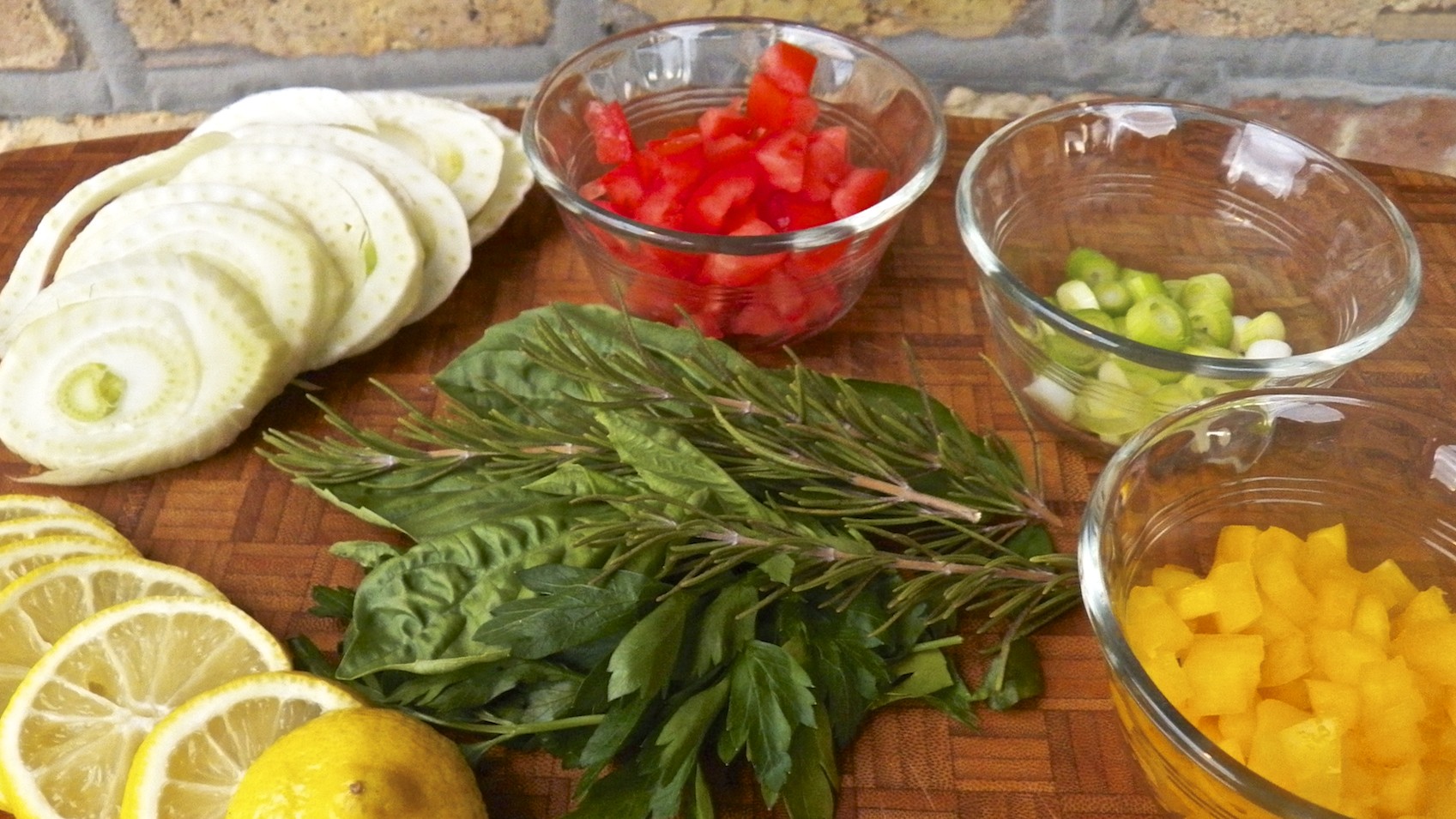
  • 1 branzino, cleaned, scaled, fins trimmed and, if desired,  head and tail attached
  • 1 fennel bulb thinly sliced
  • thinly sliced lemon
  • diced yellow bell pepper
  • diced, cored, & seeded tomato
  • chopped scallions
  • a couple stems of fresh basil
  • 1 or 2 rosemary branches
  • a few parsley stems
  • white wine
  • olive oil
  • salt & pepper
  • 2 sheets of parchment paper
  • additional diced vegetables with hand-torn basil & parsley for garnish

*     *     *

Oven Ready

*     *     *

Directions

  1. Pre-heat oven to 400˚F (204˚C).
  2. Place a large sheet of parchment paper on a large baking sheet.
  3. Place the sliced fennel in a straight line, forming a bed for the fish.
  4. Use a sharp knife to score both sides of the fish. Do not cut through the backbone. Depending upon its length, 3 or 4 parallel cuts should be made into each side of the fish. Season the fish, inside and out, with salt & pepper.
  5. Lay the fish on top of the fennel bed. Stuff the cavity with a loose bundle made with all the herbs.
  6. Cover the top of the fish, from gill to tail, with lemon slices and cover them with the chopped vegetables.
  7. Sprinkle a little wine across the entire fish and then repeat with olive oil.
  8. Cover the baking sheet with another sheet of equally sized parchment paper.
  9. Beginning on one side, grab the edges of both sheets of paper, fold them twice together, and use a stapler to permanently attach them to each other.
  10. Repeat Step 9 on the remaining 3 sides, creating a sealed pouch for the fish.
  11. Lightly brush the pouch’s top with olive oil before placing the pouch and baking sheet in the pre-heated oven.
  12. Bake for 20 to 25 minutes, depending upon the thickness of the fish. See Notes below.
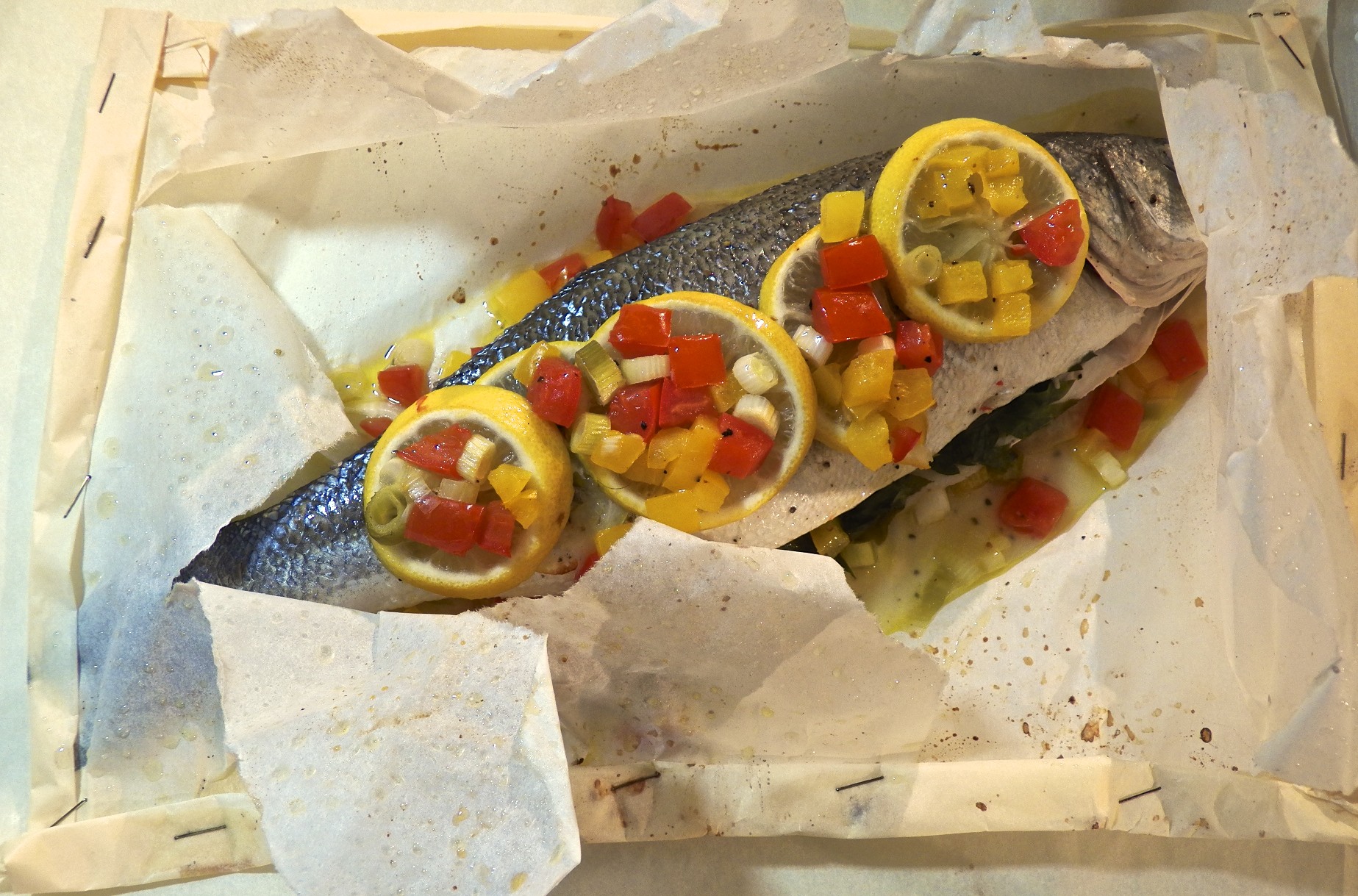
  13. Slide the pouch on to a serving platter and bring to the table. Pierce the top but be careful of the steam’s release. Peel back the paper to reveal your main course and serve, garnished with the reserved diced vegetables and chopped herbs.

*     *     *

Pronti!

*     *     *

Variations

If you prefer a more Mediterranean style, add some chopped olives to the vegetables, add some fresh oregano to the herbs within the cavity, and use a little dried oregano to season the chopped vegetables. Oregano is a strong-tasting herb. Be careful not to use too much. Feel like something from South of the  (US) Border? Swap cilantro for the parsley, add a little chopped jalapeño to the vegetables, and maybe a pinch or two of cumin. And no matter style you follow, you can’t go wrong with capers — unless you forget to add them like I did when I prepared this fish.

*     *     *

*     *     *

Notes

The cooking times may vary depending upon the size and thickness of the whole fish or even the fillets, if used. Though the pouch will protect your fish from drying out to a point, you don’t want to let it cook too long. A good rule of thumb for this or any fish roasted in parchment is to listen for the sizzle coming from inside the pouch. Most whole fish will be finished cooking from 7 to 9 minutes from that point; fillets will be finished in about 5 minutes.

You may have noticed that I used staples instead of a series of folds to seal the parchment ends. Once I saw Alton Brown do this, I abandoned the origami method of sealing the pouches. This is so much easier and reliable, especially when preparing a fish large enough to require 2 sheets of parchment paper.

*     *     *

It’s déjà vu all over again …

I’m just finishing up with this year’s canning, preserving, and pickling. One family favorite that I shared last year is the recipe for Zia’s Corn Relish. It’s a simple pickle, actually, and results in a great little condiment to serve with virtually any protein. It’s a little bit o’ sunshine on your dinner plate and who wouldn’t like that in the cold months ahead? Now, don’t worry if the “good” fresh corn is no longer available. Frozen corn can easily be used to make this relish and you can see the recipe by clicking HERE.

 *     *     *  

Coming soon to a monitor near you …

Crostini

 *     *     *

Tomato with Bread Soup

Pappa al Pomodoro

Columbus Day is right around the corner and I can think of no better way to commemorate the day than to share a recipe that typifies traditional Italian cooking. I’ve mentioned in the past that very little goes to waste in an Italian kitchen, bread being a perfect example. Like elsewhere in Europe, bread is baked or bought daily and seldom, if ever, is it discarded because it’s stale. Day old bread is used to make everything from bread crumbs to a delicious Tuscan salad known as Panzanella. {That recipe features Michigan heirloom tomatoes (What else?) and is from Bam’s Kitchen, a wonderful blog whose author currently lives in Hong Kong and offers recipes from around the world.}  Today’s recipe, Pappa al Pomodoro, is another that takes advantage of not just day old bread but, also, the glut of home-grown tomatoes that many experience during Summer. It is a simple dish to prepare but, oh, so very satisfying.

I cannot speak for everyone but I will say that the majority of us, growing up in Italian households, at one time or another experienced the simple pleasure of eating a piece of bread that had just been dipped in Mom’s or Nonna’s simmering pot of tomato sauce. As a boy, Mom would dunk a piece of crusty bread into the pot, blow on it a few times to cool the sauce, and then hand it to me with a warning to be careful because it was still hot. As I got older, I became an expert at sneaking a piece of bread into the pot and then my mouth in one fell swoop without her noticing. (Yeah, right!). Unfortunately, the sauce was every bit as hot as it was years before and a burned mouth was very often punishment for my devious ways. Even so, the reward of a piece of sauce-soaked bread made the risks worth while. And today, far too many years later to mention, my favorite way of checking the seasonings of my tomato sauce is with a chunk of bread, though I’ve grown a little more patient and a burned palate is rare.

Understanding that bit of my personal history may help you understand why I so enjoy Pappa al Pomodoro. Often described as having the consistency of baby food, one might wonder why ever would anyone like this soup. Well, one taste and you’re once again standing next to Mom or Nonna, eagerly waiting for her to blow on a sauce drenched tidbit. Here, though, instead of just having a crust of bread, you have an entire bowl to savor. Better still, the fresh basil and grated cheese gives this dish a wonderful aroma. I’m telling you, if you liked pieces of sauce-dipped bread as a child, you’re going to really enjoy this soup as an adult.

When making this soup, be sure to use the ripest tomatoes you can find. In fact, if they’re a little over-ripe, that’s just fine. As for the bread, it’s best to use day old bread with a good crust; fresh bread just won’t do. I use a small loaf of ciabatta and it works perfectly. If you’ve no day old bread, you can use fresh if you slice it and put it into a warm oven for a few minutes. You’re not trying to toast the bread, merely dry it somewhat, mimicking the feel of bread that’s just past being fresh. This is necessary because dried bread will receive the sauce much more readily than fresh. Think back to when you were a child. The best “samples” resulted from bread that had been fully drenched in the sauce. The same is true here. Lastly, be sure to garnish each serving with olive oil, freshly grated cheese, and a hand-torn leaf or two of fresh basil, the aromas of which will add so much to the dish.

*     *     *

Pappa al Pomodoro Recipe

Ingredients

  • 3 tbsp olive ol
  • 1 onion, chopped
  • 2 garlic cloves, minced or grated
  • 2½ lbs of tomatoes, preferably plums, peeled, cored, seeded, and chopped
  • 2 cups vegetable stock – water may be substituted
  • about 9 oz of day old, crusty Italian bread, cut into cubes (I use a small ciabatta loaf.)
  • 1 cup fresh basil leaves
  • salt & pepper, to taste
  • olive oil, grated Pecorino Romano cheese, and whole basil leaves for garnish

Directions

  1. Heat oil in a saucepan over medium heat. Add onions and sauté until translucent, about 5 – 8 minutes. Add garlic and continue cooking for another minute. Season lightly with salt and pepper.
  2. Add tomatoes, bring to a boil, and then reduce to a simmer. Cook until tomatoes begin to break down, about 5 minutes.
  3. Add the bread and stock to the pot, stirring until the bread is fully coated with the tomato mixture. Continue to simmer until the soup begins to have the consistency of  baby food.
  4. Hand tear the basil leaves, add to the pot, stir, and continue a low simmer for about 10 more minutes. Add more stock or water if it becomes too dry.
  5. Serve immediately, garnished with grated Pecorino Romano cheese, a drizzle of olive oil, and a leaf or two of fresh basil.

*     *     *

Notes

What if you live here, in Chi-town, and you want a bowl of Pappa al Pomodoro but it’s January. Fear not! Although fresh, vine ripened tomatoes are always preferable, you can make this soup with canned tomatoes just as easily. Instead of using the 2½ lbs. of tomatoes listed in the recipe’s ingredients, substitute one large can of San Marzano tomatoes, crushing them by hand before you add them to the pot.

Speaking of San Marzano tomatoes, shopping for a can of the real thing can be a daunting task. Many cans will claim to be filled with San Marzano tomatoes but, after close inspection of the labels, you’ll learn that they are mere plum tomatoes and not their more famous — and expensive — cousins. How do you tell the difference? Like authentic balsamic vinegar, San Marzano tomato sales and distribution are tightly controlled. Click HERE to learn what must be on a can’s label for all San Marzano tomatoes. By the way, if the canned tomatoes are crushed, chopped, or puréed, they are not true San Marzanos. See? Click on the link.

*     *     *

Coming soon to a monitor near you …

Italian Mozzarella!

*     *     *

It’s déjà vu all over again …

With Columbus Day fast approaching, I thought it appropriate to take a look at not one but two posts from the past. The first will share my family’s recipe for a ravioli filling that consists of veal, pork, spinach, cheeses, and seasonings. The second will show you how to use a ravioli die to make the pasta pillows. Click HERE to see the ravioli filling recipe and  HERE to learn how to make the ravioli.

*     *     *

Fig Preserves with Balsamic Vinegar and Black Pepper

Argh! “The best laid schemes o’ Mice an’ Men”. It’s happened again. I have a schedule for these posts. I really do. Today’s entry, for example, was to have been an instructional post detailing how to make Italian mozzarella. The Fates, however, intervened. In the days preceding my trip to Michigan, I failed twice to make the cheese.  I thought I’d be able to try again once I returned home but soon there were peppers to pickle, figs to preserve, olives to cure, and a seemingly endless stream of posts to read and comments to write. So — and by stating my plans I’m taking a big risk with those pesky Fates —  I decided to schedule Italian mozzarella for October 10th.

Now, pushing mozzarella off into the future left me in a bind.  I had no post for today. Earlier I mentioned I had figs to preserve. Well, that recipe suddenly became today’s post, meaning I had some writing to do. As you can see, I got it done but, as for the backlog of posts & comments, I’m still working on them. Sorry for the delay.

 *     *     *

 *     *     *

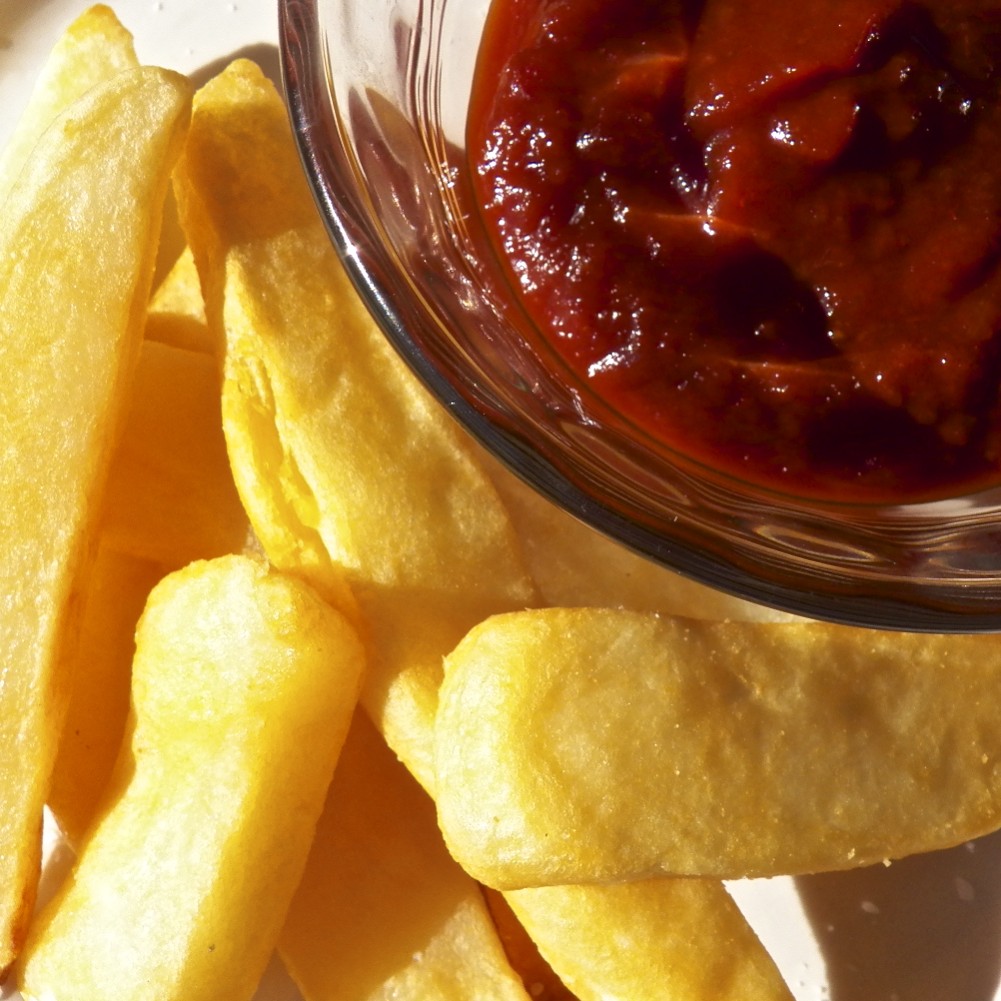
A few weeks ago, chaiselongue1 posted Jamming, an entry about making fig jam. (If you’re not familiar with this beautiful blog, olivesandartichokes, now is as good a time as any to check it out.) I thought that jam sounded delicious but that’s about as far as it went — until a market last week had crates of Mission figs for half the price I’d previously seen. Next thing you know, I’ve got 2 crates (about 3 lbs) of figs in my cart. Once I got home, I checked the Jamming post again, as well as the Pick Your Own website, as I always do before I preserve anything. Once there, a sentence caught my eye. “If you like strawberry jam, you’ll love fig jam.” That got me to thinking. I went back to the recipe I’d shared for strawberry jam with balsamic vinegar (thanks, Sarah!) and decided to use it as a guide for these preserves.

Unlike the strawberry recipe – but like Jamming — this recipe doesn’t use pectin. It takes a bit longer to prepare but if you take your time, the preserves will set as nicely as if you used pectin. Just like the strawberry jam, however, I included cracked black pepper. I really enjoyed the “bite” it brought to the strawberries. Lastly, these figs were sweet enough, allowing me to use less sugar than was used with the strawberries. Besides, I’ve got plans for these preserves that don’t involve toast. Stay tuned …

 *     *     *
*     *     *

Fig Preserves with Balsamic Vinegar and Black Pepper Recipe 

yield: 5 – 6 cups

Ingredients

  • 4 – 5 cups fresh Mission figs, prepped & chopped (about 3 lbs.)
  • 3 cups sugar
  • ½ cup water
  • 1 tsp butter (optional)
  • pinch of salt
  • ⅔ cup balsamic vinegar
  • ¼ cup lemon juice
  • 1 tbsp cracked black pepper

Directions

To Prepare

  1. Sterilize the jars and wash the jar lids and rings in hot, soapy water. Place lids and rings in a deep bowl and pour near-boiling water over them.
  2. Start bringing to boil a large, deep canning kettle of water to be used for the canning process and a second, smaller pot of water to be used to replenish water that may boil away during the canning process.
  3. Trim stem and bottom of each fig before chopping. When finished, use a potato masher to smash them.

To Make the Jam

  1. Place a small plate in the freezer. Place the figs, sugar, and water into a sauce pan over high heat and bring to a boil. Reduce heat to medium, add the salt, optional butter, and stir occasionally until a rolling boil is achieved. (A rolling boil is one that cannot be stirred away. Using a candy thermometer, that’s about 220˚F (104˚ C).)
  2. Once a rolling boil has been achieved, place a small amount of the fig mixture on the now frozen plate. Once the cooked figs have returned to room temperature, check to see if it is jam-like. If too runny, continue cooking for 10 minutes and test again. When the right consistency is achieved, remove from heat and continue to the next step.
  3. With a large spoon, carefully skim the surface to remove any foam.
  4. Add the balsamic, black pepper, and  lemon juice. Stir well to thoroughly combine.

To Preserve

  1. Using a funnel and large ladle, fill each jar to ¼ inch from the rim. Wipe the rim to make sure no jam has spilt, place a lid on each jar, and then the ring, tightening until “finger tight” but not as tight as you can make it. Act quickly, filling and capping all the jars.
  2. Jars placed directly on the kettle’s bottom might burst, so, a rack of some sort must be put into the canning kettle to cover the bottom. Many large pots have one, as do many pressure cookers.
  3. Keep each jar level as you place them, one by one, into the canning kettle filled with now boiling water. The jars should not touch each other, nor should they be allowed to tip over. Depending upon the size of the kettle and number of jars, you may need to work in batches.
  4. Once the jars are in the kettle, make sure that there is at least one inch of water over the top of the tallest jar(s). If not, add boiling water from the smaller pot mentioned in Step 2 of  To Prepare.
  5. Cover the pot and begin timing when the water returns to the boil. The jars must be boiled, “processed”, for 5 to 10 minutes, depending upon the size of jar used.
  6. Meanwhile, place a baking sheet on a level surface and line it with a clean kitchen towel.
  7. Once the time has passed, carefully remove each jar and place it on to the towel-lined baking sheet. Leave about an inch separating the jars.
  8. Once all the jars have been processed and placed on the baking sheet, remove the baking sheet & jars to a place that is draft-free and where they will remain undisturbed for 24 hours.
  9. After 24 hours have passed, check each jar to insure it’s sealed and then store on a shelf in a cool, dark place, where it will stay fresh for months.

*     *     *

Notes

Once opened, the preserves should be refrigerated and fully used within a month.

*     *     *

Coming soon to a monitor near you …

Pancetta-Topped Roast Loin of Pork with Fig Preserves

*     *     *

It’s déjà vu all over again …

It’s that time of year again. Concord grape time, that is. In our farmers markets, groceries, and vegetable/fruit stands, the grapes are on full display. Although a sure sign of Summer’s end, they do mean that it’s time to start making some jelly — and I’ve got a few pounds of the blue beauties just waiting to be transformed.  I’ll be following a recipe that I used last year. If you’re interested in doing the same or just want to check it out, you can do so by clicking HERE.

*     *     *

A Pasta for the Open

I don’t know about you but when I hear that the US Open Tennis Championships are about to begin, I immediately think of pasta. I mean, how could I not? So, when the Open starts, I naturally prepare some form of pasta to mark the occasion, just as so many of you do, I’m sure. In the past, it didn’t really matter what pasta was selected for that meal, and my choices have ranged from Bucatini to Ziti, and several pastas in-between. This all changed, however, one day when I toured the newly discovered Italian market’s pasta aisles. That’s where I discovered Racchette, a racket-shaped pasta.

*     *     *

*     *     *

Although I’m certainly no expert, I think it safe to say that Racchette are a relatively new pasta and virtually all are manufactured by machines. I mean, I just cannot imagine Nonnas — be they from Today or the 19th Century — rolling out dough sheets and making these little rackets. I know my Nonnas certainly didn’t — but if yours did, please leave a comment and I’ll be more than happy to amend this paragraph. Moving beyond Racchette’s manufacture, I can say, in all honesty, that the first any of the Bartolini women heard of Racchette was when I mentioned the pasta to my Zia a couple of weeks ago during a conversation. It should come as no surprise to anyone, therefore, that there is no Bartolini family recipe for Racchette.

Without a family recipe to use, I did what most do in this situation:  I googled it. That search returned thousands of results but most were very similar. That base recipe is one that I will make but I’ll do it in Spring, when the ingredients are fresh and readily available. Onward I went, wading through more of the search results until I came upon a recipe that was presented by the company that made the pasta. I went into kitchen, grabbed the box, and, sure enough, the recipe was on the back of the box of Racchette. (Isn’t it always the last place you look?) That recipe, Racchette California Style, is the one I’ll share today.

The recipe, as written, calls for red, white, and Marsala wines. When I prepared it, I used what I had on-hand, Pinot Grigio, Merlot, and a sweet Marsala. You may have better wine selections in mind (Jed) and, if you do, I hope you’ll use the Comments section to make your suggestions — and that includes ideas beyond wine selection. I think you’ll find this to be a simple, easy to prepare recipe. All you need to do now is to find the Racchette.

*     *     *

*     *     *

Racchette “California Style” Recipe

Ingredients

  • 1 lb Racchette
  • 1 handful fresh basil
  • 2 tbsp pine nuts
  • 1 clove garlic, smashed
  • 1 tsp grated Parmesan cheese
  • 1 tsp grated Pecorino Romano cheese
  • ½ cup white wine (I used Pinot Grigio)
  • ½ cup red wine (I used Merlot)
  • ½ cup Marsala wine (I used a sweet variety)
  • 2 tbsp butter, softened

Directions

  1. Bring a large pot of salted water to boil and cook Racchette per package directions or to taste.
  2. Meanwhile, add the basil, pine nuts, garlic, and cheese to a food processor until blended.
  3. Add the wines and process until well-mixed.
  4. When cooked to you liking drain the pasta. Add the softened butter to the sauce, giving it a creamier texture.
  5. Add the sauce to the pasta, toss, garnish with additional grated cheese & cracked pepper (optional), and serve.

Inspired by the De Cecco company’s Racchette California Style recipe

*     *     *

Notes

I must admit to having been surprised by this pasta. Neither Zia nor myself have ever used wine in pasta without cooking it, even if only for a few minutes. Using a total of 1½ cups of “raw” wine to dress a pound of pasta is completely new and something I never would have considered doing on my own. And the verdict? I enjoyed it. I make simple pastas with garlic, mushrooms, lemon, basil, or cheese as the predominant flavor within the “sauce”. Why not wine? Of course, if you’re not a wine lover, this dish isn’t for you. On the other hand, if you do enjoy a glass of wine every now and again, you just might want to give this dish a try.

*     *     *

It’s déjà vu all over again …

Just as was done in the last 2 posts, today’s look back will take advantage of the season’s harvest. Illinois is a leading producer of corn in this country and, even though the state is suffering the effects of a severe drought, there’s still plenty of corn in the farmers markets — at least in this area. This recipe for Corn Relish comes from Zia’s kitchen and is one that she prepared and canned every year. You can make it as spicy as you like and it is a terrific way to add a little Summer to your meal in the dead of Winter. Just be sure to make a double batch. It’s the only way to ensure you’ll have a few jars when Winter comes. Click HERE to see the full recipe.

*     *     *

By any other name …

In morning light …

*     *     *

Later that day

Never one to show up on time, she’s finally bloomed. Meet the last of my girls and last of my roses, “Marilyn Monroe”. Officially said to be apricot-colored, some say that the blooms are flesh-toned and mirror the complexion of its namesake.

*     *     *
Mom’s City Chicken and Grandpa’s Water Works

Funny how this Summer has worked out. At its start, I’d planned to continue making cheese with you, sharing some seasonal recipes, posting more ice cream flavors, and sharing photos of “my girls” and their companions in the garden. Suddenly, Labor Day is here and I’ve run out of time. We’ve still not made Italian mozzarella, I’ve a couple of tomato recipes to share, and there’s still a custard-based peach ice cream to make. Oh! Mustn’t forget the cobbler. Fall will just start late this year. To further complicate my schedule, today’s post was reserved for a special pasta celebrating the US Open Tennis Championship. That was before I saw a package of veal at the market. That changed everything.

Last year, Linda posted a recipe for City Chicken on her wonderful blog, Savoring Every Bite.  At the time, I commented that I’d not thought about City Chicken in years. Mom prepared a version but it’s been some 35 years since I last tasted her City Chicken. Had Linda not shared her recipe, who knows when I would have remembered Mom’s? Anyway, after Linda’s reminder, I decided to put City Chicken on the schedule — last Summer! Well, as you know, it never made it but I had every intention of sharing Mom’s recipe this Summer — and then it again got lost. Last week, however, I saw veal cubes at the market and immediately thought of City Chicken. Since it would make a great dish for the coming holiday weekend, Mom’s City Chicken was suddenly on the schedule. Its addition pushed my special tennis pasta back a week and, well, Fall’s arrival, at least on this blog, has been delayed yet another week. By the way, don’t be surprised if Thanksgiving and Christmas are celebrated in one post this year. Hopefully, I’ll then be able to start the New Year sometime in January.

((cue the harp))

Throughout my childhood, Mom served us City Chicken almost exclusively on Wednesday or Sunday, when Dad was home to work the grill. Although I’ve already mentioned The Barbecue, I’ve not talked much of the rest of our yard. You see, the two-flat was built on a vast expanse of land, in the very center of which was the beautiful, privately owned, Lake Bartolini (pictured below, click to enlarge). While we kids frolicked, Dad was likely at The Barbecue, grilling that night’s meal, City Chicken being a family favorite. In the years following the barbecue’s construction in 1959, Grandpa would build a garage with an enclosed patio, attach a grape arbor, and plant his tomatoes on the lawn just beyond The Lake, after the first of what would become yearly land-grabs. (His tomatoes needed more land, always more land.) When The Lake was lost, the much larger and deeper Bartolini Sea, was erected and filled. As we would all come to learn, ripening beefsteak tomatoes can somehow attract errant pool toys, especially whenever Grandpa strolled through the yard. When the Sea gave way to what must have been near tectonic forces, it was replaced by the even larger and more formidable Bartolini Ocean, the last of the series.

OK, that is the official account of the Crystal Blue Waters of the Bartolini, the version you’ll see on the historical markers that dot the area. Here, for the first time anywhere, is the real story.

Grandpa wanted a garden, desperately, and even though Lake Bartolini stood in his way, he would never do anything to disappoint his adoring Grandchildren. No, not Grandpa. His was a problem that would have befuddled Solomon. You can well imagine, therefore, Grandpa’s relief the morning we kids awoke to find Lake Bartolini had been completely drained. Upon close examination, we saw that one side of  The Lake was inexplicably peppered with holes, while the most attentive among us claimed to have overheard our Parents whispering something about buckshot. Grandpa’s subsequent claim that one of us kids was to blame fell on deaf ears. Our Parents, calmly and coolly, bought and built the Bartolini Sea. With walls made of corrugated steel, the Sea glistened just to the West of the where the original Lake once stood. Grandpa got his garden and we kids had a new, buckshot-proof, Sea in which to swim. All went well until that thing about tomatoes attracting pool toys was discovered, much to Grandpa’s great displeasure.

Not but a couple of years after it’s installation, again we awoke to find that our gorgeous swimming hole, the Bartolini Sea, was but a mere puddle. On one side of the Sea, in the corrugated steel, was a gash of not quite a foot long. Bent inward, the steel pierced the Sea’s lining and flooded the yard. Depending upon which Parent asked, Grandpa said that my Youngest Cousin or I did it with the lawn mower. In our defense, I will merely point out that an old push mower was used to maintain the lawns. Even if we teamed up, together pushing that relic and with a 100 foot running start, never could we two young boys get up enough steam to create so much as a dent, let alone pierce, that steel siding. Our wise Parents, though they never determined “the how”, quickly surmised “the who” and soon thereafter we were erecting the bigger, better, and even sturdier Bartolini Ocean. It remained in our yard until it died of natural causes, some years later. Grandpa, too, remained in his garden, ensuring both he and his tomatoes never went thirsty, for years to come.  Though this marks the end of Grandpa’s Water Works, this is hardly the end of his story. Frankly, I’m just getting started.

Now, back to the Present. Mom’s City Chicken couldn’t be any simpler to prepare. Equally sized cubes of veal, beef, and pork are marinated, skewered, wrapped with a rasher of bacon, and grilled. It really is that easy. I don’t give any amounts in the recipe to follow because so much will depend upon how many skewers are to be prepared. You can add, or subtract, spices to the marinade. Just be sure to make enough so that some can be reserved and later brushed on the skewers as they come off the grill. (Something I forgot to do for the photos.) Although the FDA no longer requires pork to be cooked well-done, many still prefer it cooked more than beef or veal. To accomplish this, I always place 3 pieces of meat on each skewer, pork always being the last/top one. As you’ll see in the recipe to follow, this will allow you to keep the pork closest to the fire, assuring it is cooked more than the other meats.

*     *     *

*     *     *

Mom’s City Chicken Recipe

Ingredients

  • Beef, cut into approx. 1½ inch cubes
  • Veal, cut into approx. 1½ inch cubes
  • Pork, cut into approx. 1½ inch cubes
  • Bacon, 1 rasher for every skewer
  • marinade

Marinade

  • juice and zest of one lemon
  • rosemary, chopped
  • garlic, minced or grated
  • Italian seasoning
  • olive oil
  • salt & pepper

Directions

  1. Add all the marinade ingredients to a bowl, whisk to combine, and set aside, reserving  a ¼ cup for later use. Place the meats into the bowl, mix until coated, and refrigerate for at least one hour or overnight
  2. Soak wooden skewers overnight. (This will prevent their burning during grilling.)
  3. When ready, light the grill.
  4. Using one thick skewer or 2 thin for each city chicken, pierce one end of a bacon rasher, followed by one piece of each type of meat. Be sure that the top piece of meat for each skewer is pork. After the pork is in place, wrap the meats with the bacon and secure its remaining end by piercing it with the skewer(s) tip(s).
  5. Once finished and the grill is hot, shut down part of the grill to facilitate  indirect grilling. Use a rag dipped in oil to grease the grill plate.
  6. Place the skewered meat on the grill with the pork closest to the fire/heat.
  7. Turn the meat after a few minutes, more or less depending upon the grill’s heat. The object is to cook the skewered meat without torching the bacon. The pork, being closest to the fire, will cook faster.
  8. With the meat still very rare, move the skewers directly over the fire/heat. Now the object is to crisp the bacon and to finish cooking the skewered meats. Turn the skewers occasionally to ensure even cooking.
  9. When grilled to your satisfaction, remove to a  platter, brush with reserved marinade, and serve.

*     *     *

Variations

Although Mom used all 3 meats, you needn’t if you prefer otherwise.  Use whatever meat(s) you like. The same is true for the bacon. I’m sure turkey bacon could be easily substituted.

Mom used 1 short, thick skewer for each of her City Chickens, skewers she got from her butcher. Try as I might, I’ve been unable to find them. Instead, I use 2 of the more readily available long, thin bamboo skewers. Before soaking, I trim off about 4 inches from each, making it much easier to grill them, especially if you’ve a small grill surface.

*     *     *

It’s déjà vu all over again …

Although some have already reached the end of tomato season, many of us are still harvesting the red beauties. One of my first posts featured Mom’s Tomato Antipasti that she made with Grandpa’s tomatoes. This time of year, his vines produced enough fruit to keep both families well-supplied and rarely was an evening meal prepared without tomatoes playing a role. Those who missed it the first time around  can find my post for Mom’s Tomato Antipasti by clicking HERE.

*     *     *

By any other name …

“Don Juan”

This tour of roses began on one side of my yard with “Opening Night”, a red hybrid tea rose, and ends on the opposite side of my yard with “Don Juan”, a red hybrid tea rose. (Who better to indulge my girls?)

*     *     *

The Kitchens have a Peach of a Jam

*     *     *

Peaches in this area are just passing their peak season and the farmers markets are filled with them. Over the next few weeks, peaches will disappear and the pears and apples will supplant them. For now, though, they seem to be calling to me, just as the tart cherries, blueberries, and strawberries did before them. So, I’ve answered their call and bought some each time I’ve gone to the market. Admittedly, the first purchases were eaten as-is. How could I not?  After that, I made ice cream and posted a recipe in honor of Mom’s birthday last week. Having made a few quarts of peach ice cream, it was time to move on.

Several weeks ago, when strawberries were at their peak for this area, I posted a strawberry jam recipe made with Balsamic vinegar and black pepper. In the Comments section of that post, Betsy, of Bits and Bread Crumbs, and Elaine, of Le Petit Potager, discussed making peach jam.  Betsy wondered about using balsamic and black pepper. Hmm …

After my last trip to the farmers market, I had what I thought was enough peaches to make a small-ish batch of peach jam — with a little balsamic vinegar. The recipe enclosed within the pectin packaging called for 4 cups of cleaned fruit. Incredibly, I somehow ended up with 7½ cups. I decided to use 6 cups here and to save the rest for a custard-based ice cream. (Recipe to come.) This recipe is very similar to the one used to make the strawberry jam, except I used white balsamic so that the peaches wouldn’t discolor; I used both lemon juice and zest; and, I didn’t add any pepper — maybe next time. Because I used so many more peaches than I had intended, I followed a tip from the Pick Your Own website. The author always adds an additional 20% of pectin than what the recipe calls for, just to ensure a good set. So, rather than add 49 g (1 envelope) I added 60 g to the peach mixture. My jam set perfectly although, next time, if I use 6 cups of peaches, I’ll increase the amount of white balsamic by another tablespoonful or two.

What if you’re not a balsamic lover? What if you just want to make some really good peach jam? Well, then, waste no time and click this link to go to Barb’s Just a Smidgen blog, where you’ll be treated to a fantastic recipe for making peach jam, not to mention a thorough, step by step, description of the canning process.

*     *     *

*     *     *

Peach with Balsamic Vinegar Jam Recipe 

yield: 7 – 8 cups

Ingredients

  • 6 cups fresh peaches, cleaned, peeled, sliced or chopped
  • 4 cups sugar – separated
  • 1 envelope + 20% more low-sugar pectin (60 g  total pectin)
  • 1 tsp butter (optional)
  • pinch of salt
  • juice & zest of one medium-sized lemon
  • ½ cup white balsamic vinegar

Directions

To Prepare

  1. Sterilize the jars and wash the jar lids and bands in hot, soapy water. Place lids and bands in a deep bowl and pour near-boiling water over them.
  2. Start bringing to boil a large, deep canning kettle of water to be used for the canning process and a second, smaller pot of water to be used to replenish water that may boil away during the canning process.
  3. Mix the pectin with ¼ cup of the sugar. Set aside.
  4. Working in batches, add sliced/chopped peaches into a large bowl and use a potato masher to smash them as much as you like. I skipped this step; my slices were thin and needed no further handling.

To Make the Jam

  1. Place the peaches and the pectin-sugar mixture into a heavy-bottomed pot over a med-high heat. A Dutch oven works nicely. Add butter, if desired, to limit foam.
  2. Stirring frequently, you are heating the peaches until a rolling boil is achieved at about 220˚F. A rolling boil is one that will not dissipate when the pot’s contents are stirred.
  3. Add the remaining sugar and stir well. Stir frequently while you wait for the pot to return to a rolling boil.
  4. Once a rolling boil has returned, keep stirring for exactly one minute before removing the pot from the heat.
  5. With a large spoon, carefully skim the surface to remove any foam.
  6. Add balsamic vinegar, lemon juice, and zest. Stir well to thoroughly combine.

To Preserve

  1. Using a funnel and large ladle, fill each jar to ¼ inch from the rim. Wipe the rim to make sure no jam has spilt, place a lid on each jar, and then the band, tightening until “finger tight” but not as tight as you can make it. Act quickly, filling and capping all the jars.
  2. Jars placed directly on the kettle’s bottom might burst, so, a rack of some sort must be put into the canning kettle to cover the bottom. Many large pots have one, as do many pressure cookers. (I use a rack from an old pot that has long since been discarded.)
  3. Keep each jar level as you place them, one by one, into the canning kettle filled with now boiling water. The jars should not touch each other, nor should they be allowed to tip over. Depending upon the size of the kettle and number of jars, you may need to work in batches.
  4. Once the jars are in the kettle, make sure that there is at least one inch of water over the top of the tallest jar(s). If not, add boiling water from the smaller pot mentioned in Step 2 of  To Prepare.
  5. Cover the pot and begin timing when the water returns to the boil. The jars must be boiled, “processed”, for 10 minutes.
  6. Meanwhile, place a baking sheet on a level surface and line it with a clean kitchen towel.
  7. Once 10 minutes have passed, carefully remove each jar and place it on to the towel-lined baking sheet. Leave about an inch separating the jars.
  8. Once all the jars have been processed and placed on the baking sheet, remove the baking sheet & jars to a place that is draft-free and where they will remain undisturbed for 24 hours.
  9. After 24 hours have passed, check each jar to insure it’s sealed and then store on a shelf in a cool, dark place, where it will stay fresh for months.

*     *     *

It’s déjà vu all over again …

This time of year, our farmers markets are filled with fresh fruits and vegetables, and with Labor Day barbecues quickly approaching, there’s no better time to make a batch of Chicago-style giardiniera. This colorful condiment is a great way to add some crunch, and a little heat, to your burgers, dogs, wurst, and sandwiches. The recipe was shared last August and you can find it by clicking  HERE.

*     *     *

By any other name …

“Sunset Celebration”

 *     *     *