Grape? Nuts!

I know, I know. I know what I said but what was I supposed to do? There they were, sitting incognito among the berries, containers of blue Concord grapes. How could I pass them by? It’s been a year, after all, since I saw some in a “high-end” grocery and first wondered about making jelly. Then, I saw their price. I could have bought a decent bottle of wine and a few jars of Smuckers for the cost of a few pounds of the blue beauties. Alas, I never saw them elsewhere and, when I returned the following week, even that store’s supply was gone. I resolved then and there to do better in 2011.

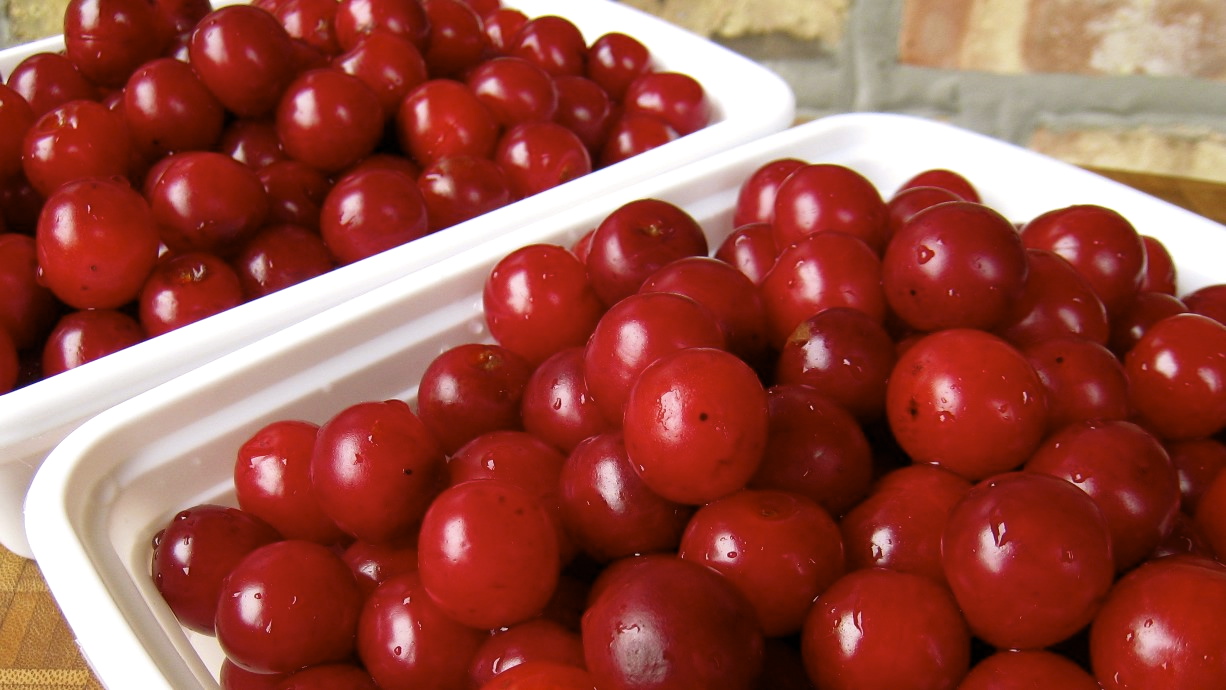
Before even one grape had been picked in 2011, the cherries came. Beautiful, red, tart cherries. Michigan’s sour rubies. Unable to resist, I bought some and made muffins. I soon bought more and made more muffins. I then bought even more and made even more muffins. My freezer now stuffed with muffins, I bought more and baked a pie. Then I bought more and froze them. And still the pushers vendors at the farmers’ markets had more for me to buy. Little did I know that the path to canning is laden with tart cherries.

At first, it wasn’t really canning. There was no hot water bath. You have to have a hot water bath for canning. Everyone knows that. This was just filling jars with cooked cherries; a means of occupying that dead space in the back of the fridge. Then came the Michigan strawberries. Smaller than the Gulliver-sized berries found at most groceries, these little babies are a third the size and three times as sweet. I just had to buy some, especially after I found Mom’s recipe for making strawberry jam. Mom was telling me to make jam. And so I did. Mom said to use a hot water bath. And so I did. This, as I told a few of you, still wasn’t canning. I was merely dabbling. Yes, that’s right. Dabbling. Well, the fruit of my dabbles hadn’t even set yet when I saw them, the Concords, at less than half the price of last year’s sighting. I ask you, how could I pass them by? Don’t even bother answering that question.  I bought ’em.

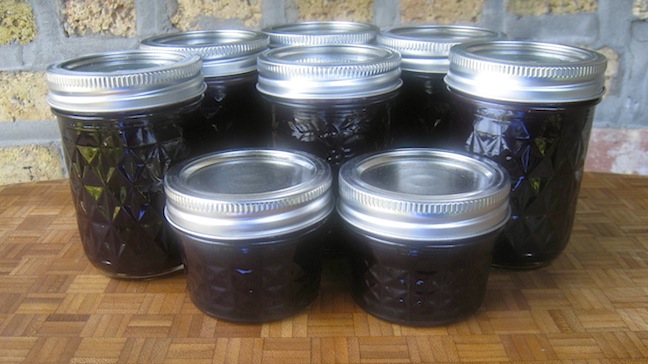
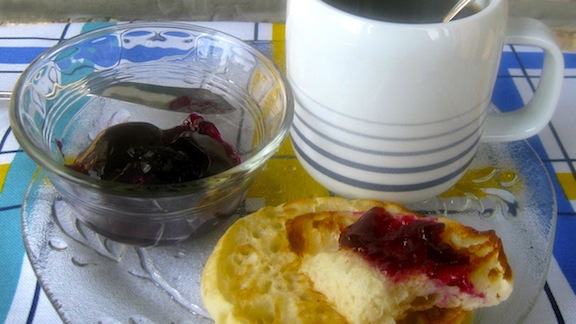
On the way home from the fruit marked, I stopped by a grocery and bought Certo brand’s low-sugar pectin. Next stop was a hardware store, the only place I know that carries little jars and lids. When I got home, I searched the recipe book Mom had given me but, unfortunately, there was no recipe for grape jelly. Turning to the internet, I found the Pick Your Own website and it has all the information one might need to can preserve just about anything. Now, armed with the pectin’s package instructions and the ever-so-helpful guidelines at Pick Your Own, I set out to make grape jelly. Lo and behold! About 2 hours and 1 ruined t-shirt later, I was the proud owner of 7 cups of Concord grape jelly. Moments before beginning this entry, I checked and all had set properly, their lids fully sealed. There remains but 1 thing to do.

Hello. My name is ChgoJohn and I’m a canner.

*     *     *
*     *     *

Concord Grape Jelly Recipe        

Ingredients

  • 4 – 5 pounds fresh Concord grapes, washed & sorted with stems removed
  • 3 1/2 cups sugar, divided
  • 1 box Certo low-sugar pectin
  • water

Directions

  1. In a heavy bottomed saucepan, add the grapes and 2 cups of water. Bring to a boil over med-high heat, reduce heat, and simmer for 10 minutes.
  2. If you own a food mill or Roma strainer:
    1. Run the semi-cooked grapes and liquid through the food mill or food strainer, extracting as much juice as possible.
    2. Pass the liquid through a jelly bag or a sieve lined with 3 layers of cheese cloth. Gently squeeze the bag or cheese cloth to fully extract more juice. If you squeeze too hard, you may force some solids through the cloth. Proceed to step 4.
  3. If you do not own a food mill or Roma strainer:
    1. Pour the semi-cooked grapes and liquid through a jelly bag or sieve lined with 3 layers of cheese cloth. This will take some time as the grape seeds and skins will clog the cloth’s “pores.”
    2. When able, gather the corners of the cheese cloth or the top of the jelly bag, secure them, and hang over a pot in the fridge or a cool place overnight.
    3. Next morning, gently squeeze the bag/cheese cloth to extract more juice. If you squeeze too hard, you may force some solids through the cloth.
    4. Pour the grape juice though a sieve that has been lined with 2 layers of cheese cloth. Gently squeeze the cloth to fully extract the juice.
  4. Precisely measure the grape juice. You will need 5 1/2 cups of juice for this recipe and you may add up to 1/2 cup of water to reach that amount.
  5. In a large bowl or container, measure exactly 3 1/4 cups of sugar.
  6. In a small bowl, combine the pectin and precisely 1/4 cup of sugar.
  7. In a large saucepan, over med-high heat, add the grape juice and the sugar-pectin mixture. Bring to a rolling boil. It should take about 10 minutes.
  8. At this point, your jars, lids, and bands should be fully cleaned and sanitized. The jars should still be hot.
  9. Add the 3 1/4 cups of sugar, mix well, and bring back to a rolling boil, stirring frequently.
  10. Once a rolling boil has been achieved, continue cooking for exactly 1 minute. Remove from heat and begin filling the jars. Once filled, wipe clean the mouth of each jar, seal with a lid & band, and place in a boiling water bath for 5 minutes — or as indicated for your elevation.
  11. Remove from the hot water bath and place on a towel-lined baking sheet. Do not disturb for 12 – 24 hours to insure a proper seal has been achieved.
  12. Store in cool, dark place for up to 1 year.
  13. If the jam is going to be eaten right away, don’t bother with processing and just refrigerate.

*     *     *
*     *     *

Notes

There you have it. I’ve admitted crossing over the Great Divide and into the Realm of Canning. I guess I should be at least a little upset over this turn of events but, frankly, how can I be upset when I’ve got a year’s worth of jams and jelly at my disposal? This canning thing ain’t so bad after all.

For everyone’s convenience, please form the “I told you so!” queue to your left.

*     *     *

Chocolate-Chocolate Chip Hazelnut Ice Cream

This is the 2nd in my series of ice creams commemorating the birthday month of my Mom and a number of people in my life. Last week’s recipe, pistachio nut ice cream, was almost exactly the same as the one she gave me years ago. Today’s recipe may not be found in the recipe book that Mom gave me but I still consider it to be her own. To create this ice cream, I used the base of the pistachio and replaced the nuts with other ingredients. The result is a chocolate-chocolate chip ice cream with hazelnuts. Mom would be proud.

Not to bore anyone, but I feel I must reiterate my warning about the use of raw egg in this recipe. When a recipe calls for raw egg, I use eggs with pasteurized shells, which may be found in the egg case at your grocery. Beyond that, I used milk chocolate chips but you can use whichever kind you prefer. As for the hazelnuts, I toasted them lightly before freezing them, like I did with the pistachios. This is to prevent them from becoming soggy during processing in the ice cream freezer. Lastly, you’ll note that the recipe calls for “a heaping 1/3 cup of unsweetened cocoa.” That’s because on my first attempt at creating this recipe, I accidentally dropped a heaping measure of cocoa into the cream before I could level it off. (Thanks, Max.) The ice cream was delicious and I’ve been repeating the accident ever since. (No, really. Thanks, Max.)

*     *     *

*     *     *

Chocolate-Chocolate Chip Hazelnut Ice Cream Recipe

yield: 1.5 quarts

Ingredients
  • 1/3 cup hazelnuts, roasted & roughly chopped
  • 1/3 cup chocolate chips, roughly chopped  (milk chocolate, semi or bittersweet may be used)
  • 1 egg
  • 1 cup half & half
  • a heaping 1/3 cup unsweetened cocoa
  • 3/4 cups sugar
  • 2 cups whipping cream
  • 1 tsp vanilla extract
  • 1/8 tsp Frangelico liqueur (optional)
  • chopped hazelnuts, for garnish

Directions

My Baby

  1. Place the hazelnuts in your freezer before starting.
  2. Place all the ingredients, except the nuts and chocolate chips, into a blender and “Stir” until well-blended.
  3. Refrigerate for at least a few hours or overnight.
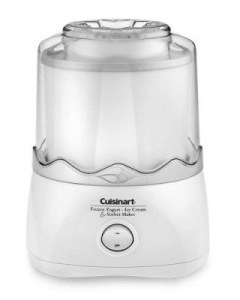
  4. Pour cream mixture into an ice cream maker and process according to manufacturer’s instructions.
  5. About 5 minutes before completion, pour the hazelnuts and chocolate chips into the machine and finish processing.   (See Notes)
  6. When completed, remove the ice cream from the canister to be either served or transferred to a sealable container until frozen to your liking.
*     *     *

Variations

As was the case with pistachio ice cream, there are plenty of recipes for chocolate ice cream on the internet, or, if books are more your style, “A Perfect Scoop” by David Lebovitz is a good place to start. No matter where your recipe comes from, you’ll soon discover that no store-bought brand can rival the taste of good, home-made chocolate ice cream.

Notes

Your machine may not recommend adding nuts and/or chocolate chips to the cream while the machine is running. If that’s the case, process the ice cream per the manufacturer’s instructions. When finished, add the nuts and chips to the semi-frozen cream, stir to fully combine, and either garnish & serve it or transfer it to a sealable container and place in the freezer.

*     *     *

Grandma’s Stuffed Vegetables

August was a good month for the Bartolini Clan at the old two-flat. Grandpa’s garden was in high-gear, easily producing enough tomatoes for all of both families’ needs. (Be sure to check out Mom’s Tomato Antipasti.) As the years passed, the garden grew and so did the selection of produce. Lettuce, swiss chard, eggplants, peppers, and, of course, grapes, all made their way onto our dinner tables in August, if not before. To augment his own “crops,” Grandpa and I made a weekly trip to Detroit’s Eastern Market every Saturday morning, where he would walk the aisles, haggling each farmer/vendor over the price of whatever it was that he wanted to buy. By the end of our “tour,” we’d return to the car with everything from fruits & vegetables to chickens (dead or alive) and, one memorable Saturday each year, a hog’s head to be made into head cheese. (You’ve not lived until you’ve walked around a crowded farmers’ market, carrying a hog’s head on your shoulder, stopping occasionally while your Grandfather haggled with some farmer over what amounted to 50 cents, if that.) Sunday was my Dad’s turn. Starting when we were very young, Sis & I accompanied him and our favorite stop was the bread bakery. While Dad chatted with his baker friend, we munched on bread straight from the oven. Along the way we might visit with friends or family, stop at an Italian market or 2, and then head to the grocery for whatever he hadn’t found at the previous stops. We’d return home, laden with all kinds of goodies, just in time for Sunday brunch.  That night, both families often dined together in a large, screen-enclosed room, “the patio,” which Grandpa had built adjacent to the garage. It easily accommodated the 12 of us and very often a few guests more.

*     *     *

Grandmas stuffed veggies 1

*     *     *

In retrospect, these dinners went off like a well-oiled machine. While Dad, Uncle, and Grandpa worked the grill and their beverages, Mom and Zia handled the rest, from setting the table to making sure that the “trouble-makers” among us 6 kids sat at separate ends of the long table. (One memorable response, walkie talkies, though well-played was extremely short-lived.) Aside from the grilled entrées, the meal itself featured side dishes made from the garden’s vegetables, as well as those that Dad and Grandpa had just purchased. Family favorites, that both women were quite capable of preparing, were tomatoes, eggplant, and onions that were halved, topped with a bread crumb mixture, and baked. Both Mom and Zia spoke of Grandma preparing vegetables in this way, which is similar to recipes for tomatoes Provençal. With Mom & Grandma’s birthday having been on the 15th, and Uncle’s birthday the 12th, I thought this would be the perfect time to share this family recipe.

Now comes the hard part. I have seen these vegetables prepared countless times, most recently a few weeks ago while visiting Zia. I have prepared them myself dozens of times, the most recent being last night. Never have I measured any of the ingredients nor have I seen them measured. Mom would get so exasperated with me as I asked her, repeatedly, what the measurements were for some dish, often this one. Now, far too late, I understand. More important than how much of this or that is the look and feel of the finished mixture. She and Zia use this breading mixture in a number of dishes. It’s consistency varies depending upon the dish and how it is cooked. When used with Grandpa’s  barbecued shrimp, it is very moist, almost dripping. Here, the vegetables are cooked at a much lower temperature than on a grill and, so, the breading isn’t as moist. Even so, you may prefer your topping to be more/less firm when served and the amount of oil used will determine that. Because of all this, I’m only posting guidelines and not a recipe. Use them as a base, adjusting where necessary to suit your own tastes.

*     *     *

Grandma’s Stuffed Vegetables

Select fully ripened tomatoes, small to medium-sized onions, and baby or small eggplants. If you use large, thick eggplants, they will require pre-roasting, as do the onions. Better to seek out relatively thin eggplants of about 4 – 6 inches in length.

For the stuffing, you will need about 2 – 3 tbsp of bread crumbs per vegetable half; about 1 tsp of freshly chopped parsley per vegetable; 1 – 2  garlic cloves, minced, depending upon the number of vegetables used; salt & pepper, to taste; and enough extra virgin olive oil to fully moisten the mixture. It should not be sopping or dripping wet.

Pre-heat oven to 400*. Remove a thin slice off of the top & bottom of each onion. This will allow them to “sit” without rolling while roasting. Halve each onion, score the cut side with a sharp knife, and brush lightly with olive oil. Season with salt & pepper and roast in the oven for 20 minutes.

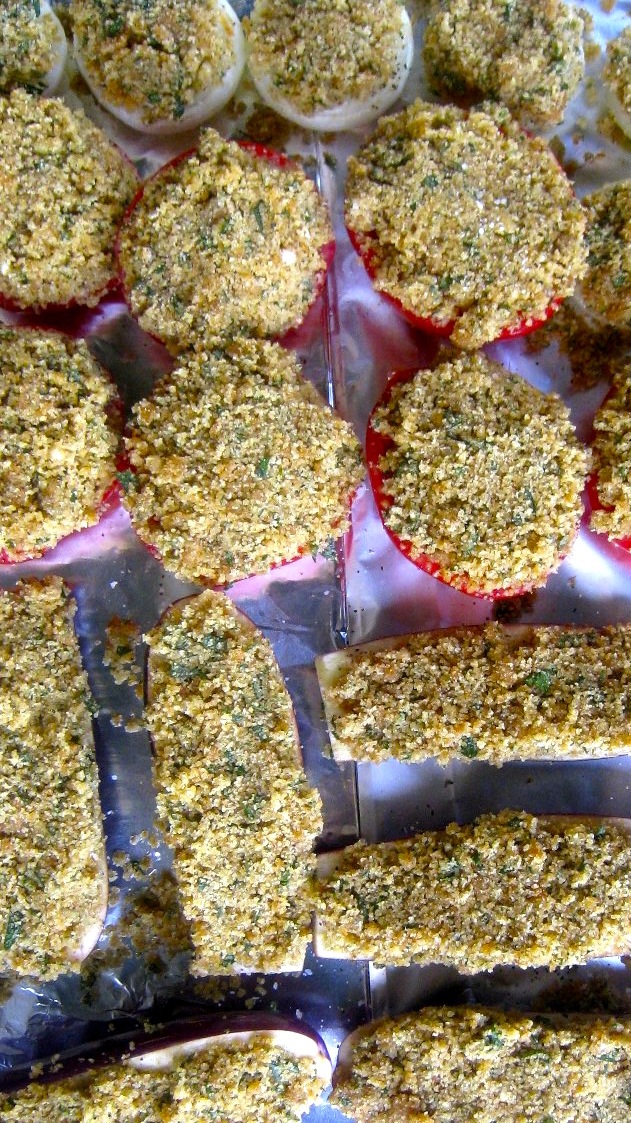
Meanwhile, create the bread topping. Combine bread crumbs, parsley, garlic, salt & pepper, and olive oil. Halve the tomatoes and gently squeeze each half to remove some liquid and the seeds.  Add the liquid and “tomato caviar” to the bread crumb mixture. Halve the eggplants, lengthwise, and use a knife to score the cut side a few times. Use a pastry brush to coat the cut sides of the eggplants & tomatoes with olive oil and then season with salt & pepper. By now the onions should be about ready to be removed from the oven. Place all the halved vegetables on a lightly oiled baking sheet or dish and season with salt & pepper. Reset the oven temperature to 350*

Cover the top of each vegetable half with the bread crumb mixture. When finished, drizzle lightly with olive oil and bake in a 350* oven for 40 – 45 minutes. Serve immediately.

Variations

These are the 3 vegetable that Grandma, and later Mom and Zia, used. I’ve, also, prepared zucchini and summer squash this way, treating them as I would eggplant.

*     *     *

Grandmas stuffed veggies 2

*     *     *

Notes

Left-overs can be easily re-heated in the microwave. Better still, with 2 slices of Italian bread, one of the tomato or eggplant halves makes a great sandwich. Grandma served these sandwiches to her girls for lunch and they, in turn, served them to us.

*     *     *

The Kitchens’ Strawberries be Jammin!

I know, I know. I do not can. The threat of giving my friends & loved ones the gift of botulism has pretty much kept me away from this age-old method of food preservation. Not only that, I’ve no room for the canning gear nor for the canned goods.  So, why then am I suddenly canning?

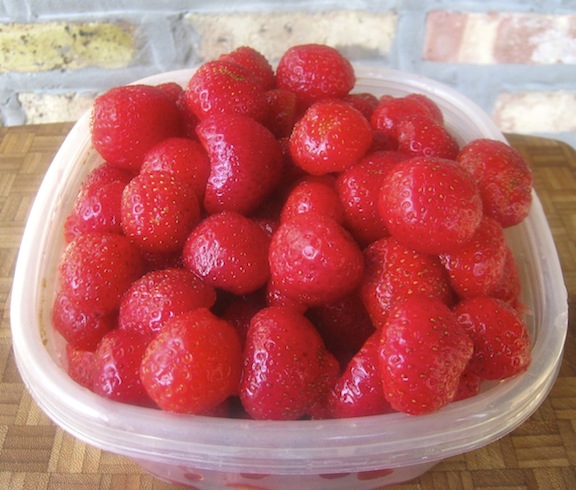
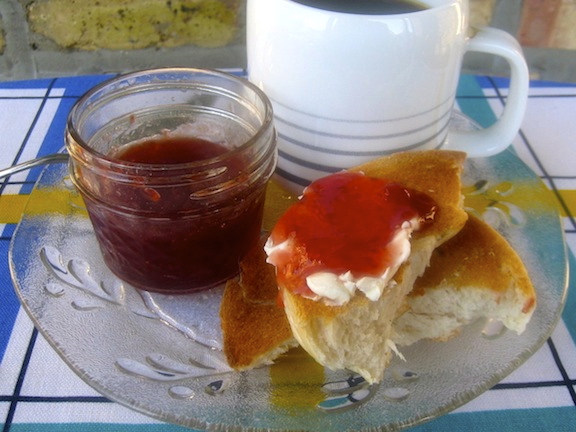
To begin with, last week’s canning experiment with cherry jam went very well. It jelled properly and the jars all sealed without using a water bath. Those who have tasted it liked it, and, most importantly, survived. Family, friends, and a few fellow bloggers were all quite positive, some even encouraging me to continue canning. One friend was particularly enthusiastic, although methinks the promise of freshly made grape jelly may have been the cause. You see, I had confided to him that I wanted to make grape jelly but that Concord grapes weren’t easy to come by. This isn’t exactly Napa Valley. I told him I would be going to the farmers’ market this morning to find grapes and, if all else failed, I might try canning some Michigan strawberries, if they were still available. What he didn’t know was that I had found Mom’s strawberry jam recipe in the recipe book she had given me years ago. All thus time I had ignored it because, as we all know, I do not can. Well, with no grapes to be found anywhere at the market, I bought 3 containers (pints?) of strawberries. I followed Mom’s recipe, with 1 exception. Remembering David Lebovitz’s recommendation of using lemon rind as well as lemon juice, I added the zest of 1 lemon to the fruit and sugar. Beyond that and as Mom had suggested, I used a potato masher to crush the hulled berries, which yielded a little more than 4 cups of smashed fruit. The fact that there was no need for store-bought pectin was a big plus; I didn’t have any. From there, the rest of the recipe is easy enough that I had no problems following it. An experienced canner and jammer should be able to do this in her/his sleep.

*     *     *

*     *     *

Mom’s Strawberry Jam Recipe        

Ingredients

  • 2 pounds fresh strawberries, hulled (4 cups smashed)
  • 4 cups sugar
  • 1/4 cup lemon juice
  • zest of 1 lemon

Directions

  1. In a heavy bottomed saucepan, mix together the strawberries, sugar, lemon and lemon juice & zest. Stir over low heat until the sugar is dissolved. Increase heat to high, and bring the mixture to a full rolling boil.
  2. Boil, stirring often, until the mixture reaches 220 degrees F (105 degrees C).
  3. Transfer to hot sterile jars, leaving 1/4 to 1/2 inch head space, and seal.
  4. Process in a water bath, allow to sit in boiling water for 10 minutes.
  5. After 10 minutes, carefully remove jars from boiling water and place on rack covered with a towel to prevent jars from shattering due to quick temperature change.
  6. Leave, untouched, for 12 to 24 hours to insure proper sealing.
  7. Store in cool, dark place for up to 1 year.
  8. If the jam is going to be eaten right away, don’t bother with processing and just refrigerate.

*     *     *


*     *     *

Notes

If unsure whether the jam will jell properly, you can test it. Just before you start preparing the strawberries, place a plate in your freezer. After your jam has reached 220*, take about 1/4 tsp of the hot jam, place it on the chilled dish, and return both to the freezer. After a couple of minutes, use your finger to “push” through the jam on the plate. If the jam wrinkles before your finger and does not flow to refill the path your finger took, the jam is ready to be placed in jars.

Oh! All evidence to the contrary notwithstanding, I do not can.

*     *     *

Pistachio Nut Ice Cream

Mom was a great lover of ice cream. In the Summer, it was she, far more often than the 3 of us kids, who suggested going out for ice cream after dinner. Dad rarely, if ever, refused her and, so, we’d pile into the car and off we went. Many years later, she and I would be in the car, returning to her home, when she would mention ice cream. The next thing I knew, we’d be standing at some counter waiting for our single scoop cones. Well, Mom’s birthday — as well as that of her Mother — was August 15th; Uncle’s birthday, Zia’s husband, was August 11th; the birthday of my Friend the kitchens’ Taste Tester was on the 7th; and my Friend the Entertainer’s birthday is August 20th — but wait, there’s more. In the Children’s Division, my Grand-Nephew’s birthday is the 1st and the Oldest of the Boys Upstairs has a birthday on the 18th. Well, with so many birthdays to honor, I’m going to post ice cream recipes for the next 3 Fridays of this, their “birthday month.” (My Friend the Entertainer believes that one’s birthday should be celebrated the entire month.) And whether you choose to make any of these 3 ice creams, make sure that on at least one of August’s warm nights, you get yourself a single scoop cone. You’ll soon discover what Mom knew all along: it’s a great way to end a day.

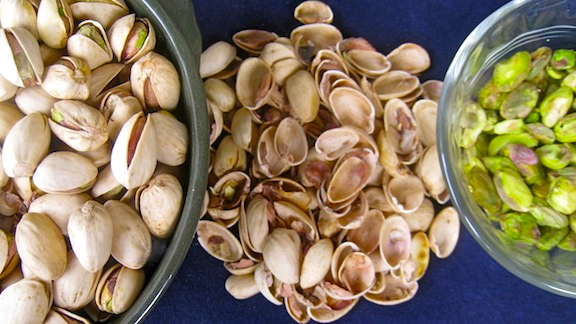
Today’s recipe, pistachio ice cream, is pretty much the same one that Mom gave to me in a recipe book years ago. It’s not a complicated recipe and there’s no custard to make. Still, there are a couple of things to consider. First, and most importantly, the recipe calls for 1 raw egg. Now, I am certainly not advocating the use of plain, raw eggs in this, or any, recipe. When a recipe calls for raw egg, I use eggs with pasteurized shells. You can find them in the egg case at your grocery and using them will eliminate any worry you might have when serving raw egg. Yes, they may cost more but the peace of mind is well worth it. With the “egg question” out-of-the-way, all that’s left is how to deal with the pistachio nuts. First off, I use roasted, unsalted nuts that I shell myself. It is much easier to remove the “paper” off of the nuts if you shell them yourself, and the less paper, the greener your ice cream. Still, even with every bit of paper removed, your pistachio ice cream will not be as green as store-bought. For that, you’ll need to add a few drops of food coloring. Whether to use food coloring is a decision for you to make. Secondly, while half of the pistachio nuts are ground in the blender, I freeze the other half in my freezer, based upon a comment by my Trusty Traveling Companion. Although he likes chopped pistachio nuts in his ice cream, he doesn’t like that they’re often a touch on the soggy side. By adding them to the ice cream already frozen, the problem is avoided.

*     *     *

*     *     *

Pistachio Nut Ice Cream Recipe

yield: 1.5 quarts

Ingredients
  • 2/3 cup pistachio nuts, shelled & roughly chopped – divided in half
  • 1 egg
  • 1 cup half & half
  • 3/4 cups sugar
  • 2 cups whipping cream
  • 1 tsp vanilla extract
  • 1/8  – 1/4 tsp almond extract
  • pistachio nuts, for garnish when serving

Directions

My Baby

  1. Place half of the pistachio nuts, the egg, and half & half into a blender and “Chop” until nuts are fully ground.
  2. Add everything but the reserved pistachio nuts to the blender and “Stir” until well-blended.
  3. Refrigerate for at least a few hours or overnight.
  4. Pour cream mixture into an ice cream maker and process according to manufacturer’s instructions.
  5. About 5 minutes before completion, pour the remaining pistachio nuts into the canister. (See Notes)
  6. When completed, remove the ice cream from the canister for serving or  transfer to a sealable container and placed in the freezer.
*     *     *

Variations

There are plenty of pistachio ice cream recipes on the internet offering far too many variations to list here. One particularly interesting method can be found on the Brown Eyed Baker’s website. In addition to adding chopped nuts to the cream mixture, he begins by steeping some of the pistachios in milk, extracting as much flavor as possible from the nuts. If you’re googling pistachio ice cream recipes, be sure to check his out.

Notes

Your machine may not recommend adding nuts to the cream while the machine is running. If that’s the case, process the ice cream per the manufacturer’s instructions. When finished, add the nuts to the semi-frozen cream, stir to fully combine, and either garnish & serve it or transfer it to a sealable container and place in the freezer.

*     *     *

Pasta with Shrimp

Having just returned from a visit with Zia, I decided I had better jot down this recipe while it was still fresh in my mind. This is one of those dishes that I never really think about while I’m preparing it. It just kinda happens. Besides, this wasn’t even the dinner I had planned.

I had intended all along to make  Trenette al Salmone for Zia during my visit. I should have brought smoked salmon with me but I was sure that I could get some in her area’s stores. Well, guess again. I went to her local groceries — “local” meaning 15 and 25 miles away, respectively, in opposite directions — and neither had smoked salmon. One of the stores happened to be running a special on large shrimp (25 – 30-ct), so I bought some and, under her watchful eye, I prepared dinner for us that night.

Like the smoked salmon dish, this is an easy meal to prepare. I prefer to use large, raw shrimp that are peeled, cleaned, and with tails removed. I cut them in half because they are otherwise too large to be eaten with pasta in a single bite, not to mention the larger the shrimp, the fewer to clean and prep. Where this dish differs from that of the smoked salmon, however, is that shrimp have a strong enough flavor that they won’t be overpowered by diced onion and garlic in the sauce. But for the onion and garlic, the same basic cream sauce is used in both dishes and neither uses cheese, as well. Remember, Italian recipes rarely, if ever, use cheese when seafood is a primary ingredient.

*     *     *

Pasta with Shrimp Recipe

Ingredients

  • 1/4 cup (1/2 stick) butter
  • 1 medium onion, chopped fine
  • 2 cloves garlic, minced
  • 1 cup heavy cream
  • 1 lb large (25 – 30 ct) shrimp, cleaned, peeled, tails removed, cut in half
  • 1 lb cooked thin spaghetti
  • 3 tbsp fresh parsley, chopped, separated
  • salt & ground white pepper, to taste
  • reserved pasta water

*     *     *

*     *     *

Directions

  1. Melt butter in a large, deep frying pan over med-high heat.
  2. Add onion and sauté until soft, about 3 minutes.
  3. Add garlic and continue sautéing for another minute.
  4. Add shrimp and sautéing for about 2 minutes. Shrimp should not be thoroughly cooked at this point.
  5. Add the cream and allow shrimp to finish cooking as the cream reduces slightly, about 2 – 3 minutes.
  6. Season with 2 tbsp of the parsley before adding the cooked spaghetti to the pan. Mix until the pasta is well-coated. If necessary, add a little of the reserved pasta water. Taste the dish and season with salt & pepper.
  7. Garnish with remaining tbsp of parsley and serve immediately.

Variations

You will find that different pastas, be they fresh or dried, absorb sauces at different rates. Reserving some of the starchy pasta water will help you deal with a “thirsty” batch of noodles or a sauce that was simmered too strongly and is a little dry. Not only that but the water, being starchy, can be used as somewhat of a thickening agent. Just bear in mind that the water is heavily salted, so, go easy on the salt until after you’ve added the pasta water.

*     *     *

My Cherry Amour, The Return (This time it’s personal)

OK! I admit it. I have a problem. At first it was interesting, even quaint. Then it became mildly neurotic, with close friends beginning to question my actions. Now, I’m afraid, it’s a full-blown obsession and I’ve been urged to seek help — until the concerned individual learns that s/he will be receiving the fruits of my addiction. How quickly concern becomes encouragement. Enablers all! To think, I was happily satisfied with my frozen stash of muffins and cherries. Thrilled that my cherry pie had been well-received and was good to the very last bite. All in all, there was certainly no need for me to seek out more cherries — until I noticed a “Jam” category at Tanya’s wonderful ChicaAndaluza blog.  Lo and behold! Just a few short weeks ago, she made cherry jam. My heart raced as I read her post. Ah! She canned her jam and I don’t can. (I suffer from botulismaphobia.) My heart beat returned to normal — but wait. She canned them without a water bath. How could this be? I used her post’s comment section to ask if it were possible to can something without a hot water bath, knowing full-well that it would be days before her answer was received, long after yesterday morning’s trip to the farmers’ market and, presumably, after this season’s tart cherries were gone. I was in the clear and the few remaining tart cherries within the tri-state area breathed a sigh of relief. And then the unthinkable happened. Tanya answered my question within 2 hours. TWO  HOURS!! I knew instantly that I was doomed.

*     *     *

*     *     *

Yesterday morning, Saturday, in the middle of a driving rain storm, Max & I headed to the farmers’ market. I promised myself that we would turn around and come home if the rain didn’t let up. In fact, it got worse as we drove north toward Evanston. Confidently, I drove onward. And then, about 1/2 mile from the market, it was as if Moses himself had waved his staff. The clouds parted and the rain stopped completely. Again, my heart began to race. Upon parking the car, I went immediately to both fruit stands that had, unwittingly, fed my addiction in prior weeks. There were no sour cherries to be found at either location. Relieved, I went about buying an assortment of vegetables — I’ve giardiniera to make. Within minutes, my shopping bags were full and I was headed back to the car, where Max and the traffic coördinator had been keeping company. That’s when I saw them. 8 quarts of tart cherries where, just minutes before, there had been none. The young woman apologized. Something about the rain. Arriving late. Being short-handed. I don’t really remember what else, if anything, was said; my head was reeling. I pointed to 2 quarts, paid her in silence, walked backed to my car, and drove home, managing to avoid looking Max in the eye the entire trip. Forget about whatever had been planned, the day had become cherry jam day.

*     *     *

*     *     *

Never having canned anything before, I referenced 3 sources. Tanya’s Summer Cherry Jam recipe, of course; David Lebovitz’s No-Recipe Cherry Jam; and the pectin envelope’s instructions. I pitted the 2 quarts of cherries and they yielded 3 lbs of cherries and juice. I reserved 8 oz, put the remaining portion into a food processor, and pulsed until the cherries were coarsely chopped. I then returned the whole cherries to the mix, per Lebovitz’s suggestion to keep a few cherries unchopped. The jars, all new, were washed in my dish washer, using the “sanitize” cycle. The lids were washed in warm soapy water, rinsed, and then placed in a deep bowl. While the cherries were being cooked, boiling water was poured over the lids and they remained in the water until needed. With everything now prepared, I followed Tanya’s recipe and made just about 7 cups of cherry jam. Thanks to Tanya, my first foray into canning wasn’t nearly as painful as I had feared. Even so, I think I’ll limit my future canning exploits to the making of jam. No need to press my luck.

*     *     *

Notes

We will NOT be going to the Skokie Farmers’ Market today — I think.

*     *     *


My Cherry Amour, Reprise (Bigger, better, badder!)

Having professed my love of tart cherries last week, I’m sure you can understand my remorse now that cherry season has come to an end. Rather than mourn their passing, however, I’ve decided to celebrate their sour little lives by baking one last cherry pie. (Put another way, I’ve got a freezer full of cherry muffins and there’s still another quart of pitted cherries in the fridge.)

I’ve used both of these recipes for several years now. The first, for pastry dough, uses a food processor to mix the dough. That alone makes it a winner in my book. The recipe, however, makes only enough pastry dough for one 9 inch pie crust. I’ve found that I get better results if I make 2 batches of dough, rather than doubling the recipe for a double-crusted pie. Don’t ask me why but that’s just the way it works. The recipe for the pie filling is about as simple as can be. Flour, not cornstarch or tapioca, is the thickening agent and there’s no need to pre-cook the fruit filling mixture before placing it into the pie shell. So, if you’re good working with pastry dough, you can have a pie in the oven pretty quickly. Me? It’s an afternoon project, often including wailing, the gnashing of teeth, and the rending of garments.

There is one last thing to consider, especially if you, like me, tend to throw common sense out the window when you see all the pretty quarts of tart cherries lined up in the market or at some farmer’s stand. I mean, how can you not buy a few quarts? It all makes perfect sense until you arrive home and realize that you have to pit them all before you can do anything else with them. Well, there is hope for us. I’ve found a website that should be called “How to deal with the fruit and stuff that result from ChgoJohn going to a farmers’ market.com?” It has been called, instead, Kraft Foods something or other and it explains how to freeze a variety of baked goods. You can reach it by clicking here and I recommend that you bookmark the site. It’s one of those web pages that you probably won’t need today, you may not need tomorrow, but you are going to need it some day.

*     *     *

Food Processor Pie Crust Recipe

Yield: One 9 inch pie crust

For best results:

  • Do not over-process the dough.
  • Use only enough water to create a crumbly texture.
  • Do not run the processor long enough to form a dough ball. Use your hands to do that.

Ingredients

  • 1 1/2 cups flour
  • 4 tbsp unsalted butter, chilled/frozen, cubed
  • 5 tbsp shortening, chilled/frozen, cubed
  • 1/2 tsp salt
  • 3 tbsp ice water

Directions

  1. Add flour and salt to the processor. Pulse it a few times to mix the 2 ingredients.
  2. Add the very cold butter and shortening cubes.
  3. Pulse the machine 3 times, with each pulse lasting a 3-count. Your ingredients will now be lightly mixed.
  4. With the machine running, slowly add the ice water. Do not add so much that a ball of dough forms. Remove the lid and, with your hands, test the dough to see if a ball of dough can be formed.
    1. If so, turn the dough until a very lightly floured service, form a ball, wrap it in plastic wrap, and refrigerate for 30 minutes.
    2. If a dough ball will not form, add a little more water, pulse the machine a couple of times, and test it again. When you can form a ball of dough, follow step A above.
  5. After 30 minutes, remove the dough from the fridge and roll it until large enough to completely cover the bottom of a 9 inch pie pan. Place the dough into the pan, trim any access, and return the crust and pan to the fridge until needed further.
  6. I usually postpone handling the 2nd pie crust, the “top,” until just before it is needed. The colder the dough going into the oven, the flakier the crust coming out.

*     *     *

Pie Eyed

*     *     *

Cherry Pie Recipe 

Ingredients

  • Pastry for 1 double-crust 9 inch pie.
  • 4 cups fresh, tart cherries, pitted
  • 1 1/3 cups sugar
  • 1/3 cup ap flour
  • 1/4 tsp salt
  • 1/4 tsp almond extract
  • 2 tbsp butter, cut into small cubes
  • 3 tbsp milk
  • sugar

Directions

  1. Pre-heat oven to 425*.
  2. Use half of the pastry dough to line the pie plate. Place it in the refrigerator to chill until needed.
  3. Gently combine the cherries, sugar, flour, salt, and almond extract.
  4. Roll out the other half of the pastry and prepare for use. If covering the entire pie, leave as is. If creating a lattice, cut the strips. If, as I did, you’re creating leaves, use a stamp to form them all, place on a baking sheet lined with parchment paper, and refrigerate until needed.
  5. Pour the cherry mixture into the chilled pie shell and dot the pie with the cubes of butter.
    1. If covering the entire pie, spread the top portion of the pastry dough, seal its edge with the bottom’s dough, crimp the edge, and create slits in the top to allow steam to vent.
    2. For a lattice cover, retrieve the strips and, starting at one end of the pie, weave a lattice across the pie’s top. (See Notes below.)
    3. For a leaf top, place the dough leaves across the top,  being careful to leave enough openings for steam to vent.
  6. Use a pastry brush to coat the upper crust with milk. Sprinkle the top with a light dusting of sugar.
  7. Bake on a baking sheet — in case of overflow — in a pre-heated 425* oven for 35 to 40 minutes until golden.
  8. Allow to cool before serving so that the filling sets properly.

*     *     *

"... And let's have another piece of pie."

*     *     *

Notes

The reason one sees so many lattice-topped cherry pies is because a woven top allows the pie’s juices to evaporate somewhat during the baking process, making for a better pie. Cook’s Illustrated Magazine’s book, Baking Illustrated (p. 148), suggests creating the lattice on parchment paper and not atop the pie. Once woven, place both the lattice and parchment paper in the freezer. When the lattice is firm, gently transfer it from the paper to the pie’s top and carefully connect it to the bottom crust. Brush it with milk, sprinkle with sugar, and bake as directed above.

And so ends this year’s journey down Cherry Lane, where pitting is such tart sorrow.

*     *     *


Mom’s Caponata

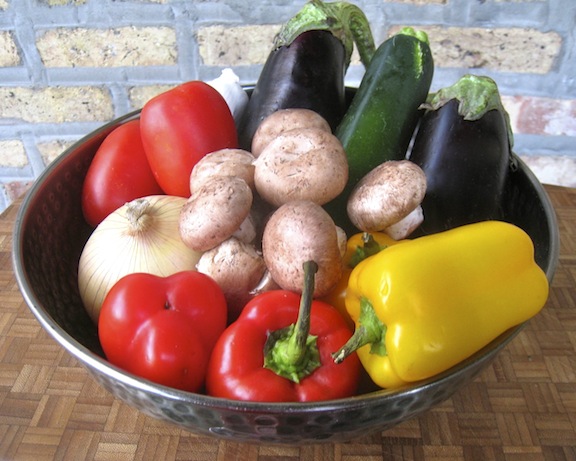
The origins of caponata may be found in Sicily but today it is served throughout Italy, in one form or another. Yet, as varied as the final dishes might be, 5 ingredients form the basis of virtually all renditions: eggplant, tomato, onion, garlic, and olive oil, with eggplant being the star of the dish. Beyond these 5, the additional components depend as much upon the individual cook as it does the region of Italy. There’s no better example of this than Mom’s recipe and the one that Zia, her sister, follows. Both included some bell pepper and mushrooms but Mom, also, added zucchini; Zia rarely, if ever, does. The difference here is minimal but, then again, their kitchens were only separated by less than 20 vertical feet. Imagine the differences when there’s hundreds of miles separating the kitchens. In fact, I’ve seen caponata recipes that include, among other things, olives, pine nuts (pignoli), fennel, capers, currants, celery, and even seafood. Seafood seems a bit much to me and I pretty much follow Mom’s recipe. Still, more important than which recipe to follow is finding the right ingredients. Like Mom & Zia, I’ll choose only those vegetables that are fresh and “in season,” for best results. And if you end up with caponata that looks suspiciously like ratatouille, well, I won’t tell anyone.

Whatever vegetables you choose to include, try to chop them evenly, creating pieces that are roughly the same size by type. I cut the “firm” vegetables — onions, peppers, etc. — into strips. The “soft” vegetables — tomatoes, zucchini, eggplant, etc. — are chopped into 3/4 to 1 inch cubes. By cutting the ingredients into strips and cubes, you’ll be adding visual interest to the final dish. When sautéing, begin with the most firm vegetables and proceed until you’ve added the softest. The end-result should be a dish of vegetables that are fully cooked and not at all al dente. Caponata may be served hot, warm or at room temperature. It can be served as a side dish or as an appetizer, where it can be used as a spread or to make bruschetta. Like Mom before me, very often I’ll use it to dress pasta, resulting in a delicious vegetarian dish. Best of all, to my tastes, left-over caponata can be used to make a delicious frittata the next morning. In fact, when I was a boy, Mom always reserved a portion for my breakfast the following day. Today, if I go to a farmers’ market in the morning, it’s almost guaranteed that I’ll be having some form of caponata that evening. You can guess what I’ll be having for breakfast the next morning.

*     *     *

Caponata Recipe

Ingredients

  • 3 tbsp olive oil
  • 1 medium onion, halved and sliced
  • 2 bell pepper, sliced into strips – gypsy, cubanelle, or Italian peppers may be substituted
  • 2 cloves garlic, minced
  • 3 tbsp freshly chopped parsley
  • 1 doz. button or crimini mushrooms, quartered
  • 2 medium eggplants, cubed (peeling optional)
  • 1 – 2 zucchini, cubed
  • 2 plum tomatoes, cubed
  • salt & pepper, to taste

A Good Day at the Market

Directions

  1. Add oil to a large fry pan and heat over a medium-high heat. Add onion and bell pepper, season with salt & pepper, and sauté until barely soft, about 5 minutes.
  2. Add garlic & parsley and sauté for 1 minute.
  3. Add mushrooms and continue sautéing for about 5 minutes.
  4. Add eggplant, zucchini, and tomatoes, stir to combine, season with salt & pepper, and sauté until done to your liking, at least 8 minutes more.
  5. The dish is now done and may be served hot, warm, or at room temperature.

Variations

As mentioned above, this basic recipe can be modified in any number of ways. Thinly sliced fennel, cubed summer squash, currants, pine nuts, celery, you name it, all may be added. Once you’ve assembled and prepared the ingredients, it’s just a matter of adding them to the pan in an order that assures each will be done to your liking. If the order that I’ve listed above doesn’t do that for you, change it to suit your palate.

Notes

Left-over caponata can be served with pasta or used to make a tasty frittata. I’ll devote a later posting to our frittata recipe but, for now, I’ll share the “easy” method. For this, pre-heat your oven to 375*. In a fry pan over med-high heat, re-heat the caponata. Meanwhile, lightly scramble enough eggs to insure ample coverage of the re-heated caponata. Pour the eggs into the fry pan and, like you would with scrambled eggs, use a slotted turner or spatula to gently pull back the edge to let the eggs run behind it. After a few minutes, place the pan in the pre-heated oven and bake for about 10 minutes or until the top of the frittata is set.  Top with grated cheese, if desired, and serve immediately.

Coincidentally, while this recipe was waiting to be published, our local PBS station aired a re-broadcast of an episode of Jacques Pepin’s “More Fast Food My Way” during which he prepared ratatouille. Not only did he mention how similar ratatouille was to caponata, he used it to dress some penne pasta. How about that? You can add “French chef” to the list of Mom & Zia’s many titles and accomplishments!

*     *     *

My Cherry Amour

point of pride for the Great Lake State, Michigan’s west coast is an incredible fruit belt. It’s hard to believe that those Winter storms blowing in from Lake Michigan help to create a climate that’s perfect for growing a variety of fruit. Of all the fruit grown, however, the one that I most anticipate is the tart cherry. Depending upon the weather each Spring, these cherries come into season sometime during the latter half of June and last but a few weeks. Now that doesn’t leave me much time to get my share. In years past, I’ve detoured while traveling to, or from, a visit home; I’ve made “cherry runs,” driving 2 1/2 hours each way to get to just the right farm; or the Fates have smiled upon me and I’ve come across some at one of our farmers’ markets — like this year. As thrilled as I am to be able to buy some without a long drive, I must say, buying directly from the farm does have its advantages. Not only are they less than half the price, but many farms sell them pitted and frozen, as well as whole. In one trip, I can get enough cherries for a couple of pies and a few batches of muffins, with nary a pit to be found.

This recipe was in a book of recipes Mom assembled for me after I moved to Chicago. She and her Sister, Zia, both gave me recipe books and I often refer to them. In fact, quite a few of the recipes already in this blog, and many more to come, are from those 2 books. The thing is, this recipe was not a part of the book; it was on an index card stuck within its pages. As a result, I have no idea where it actually came from or who gave it to me. As far as muffin recipes go, it’s pretty basic. It does, however, include an optional topping made of flour, butter, and sugar. Though not necessary, it does add a nice element to each muffin top. All facts considered, the only real problem I have with this recipe is that a dozen muffins, even if small, are a few too many for me, being I live alone. So, I’ll drop a few off with friends and freeze the rest. These freeze well and nothing starts the day off better than doing so with a home-made muffin. But what if cherry muffins do nothing for you? Then I suggest you check out this recipe for Blackberry Jam Muffins over at Katherine & Greg’s blog, Rufus’ Food and Spirits Guide. Not only is it a good recipe but theirs is a great blog to follow.

*     *     *

*     *     *

Cherry Muffin Recipe

Ingredients

  • 2 cups all-purpose flour
  • 3 tsp baking powder
  • 1/2 tsp salt
  • 1/2 cup sugar
  • 1/2 tsp cinnamon
  • 1/2 tsp almond extract
  • 1 egg, lightly beaten
  • 1/4 cup vegetable oil
  • 1 cup milk — buttermilk may be substituted
  • 2 cups cherries, pitted & roughly chopped by hand
  • OPTIONAL TOPPING
    • 3 tbsp cold, unsalted butter, cut into bits
    • 1/2 cup flour
    • 3 1/2 tbsp sugar

Directions

  1. Pre-heat oven to 375*. Either spray muffin tin with cooking spray or place one liner in each cup.
  2. In a large mixing bowl, whisk together flour, baking powder, salt, cinnamon, and sugar.
  3. In a separate bowl, combine egg, almond extract, vegetable oil, and milk.
  4. Add wet ingredients to dry and barely mix before adding the cherries. Mix entire batter until just combined. Batter should be lumpy. Muffins will be too dense if batter is over-mixed.
  5. Use an ice cream scoop or large spoon to fill each of 12 muffin cups equally.
  6. If topping is desired: Using a fork, combine the flour, butter, and sugar to create a crumble topping. Sprinkle an equal amount on top of each of the filled muffin cups.
  7. Bake until golden or the muffins pass the clean toothpick test, about 20 – 25 minutes.
  8. Allow to cool at least 5 minutes before removing from pan to cool further on a rack.

*     *     *

Good Morning!

*     *     *

Notes

As you can see, this recipe doesn’t rely upon a lot of sugar. I don’t want sugar to take away from the tartness of the cherries. Since I didn’t create the topping for this batch, I did, however,  give each muffin a very light sprinkle of sugar. While it won’t detract from the cherries, a light dusting of sugar will help to crisp the muffin top. And when you’re preparing the cherries, chop them by hand and not in a food processor. I’ve found that no matter how hard I try, a food processor over-chops the fruit. By using a large knife to roughly chop the cherries, you’ll end up with flavorful muffins containing large pieces of fruit.

*     *     *