
Linguine ai Frutti di Mare al Cartoccio
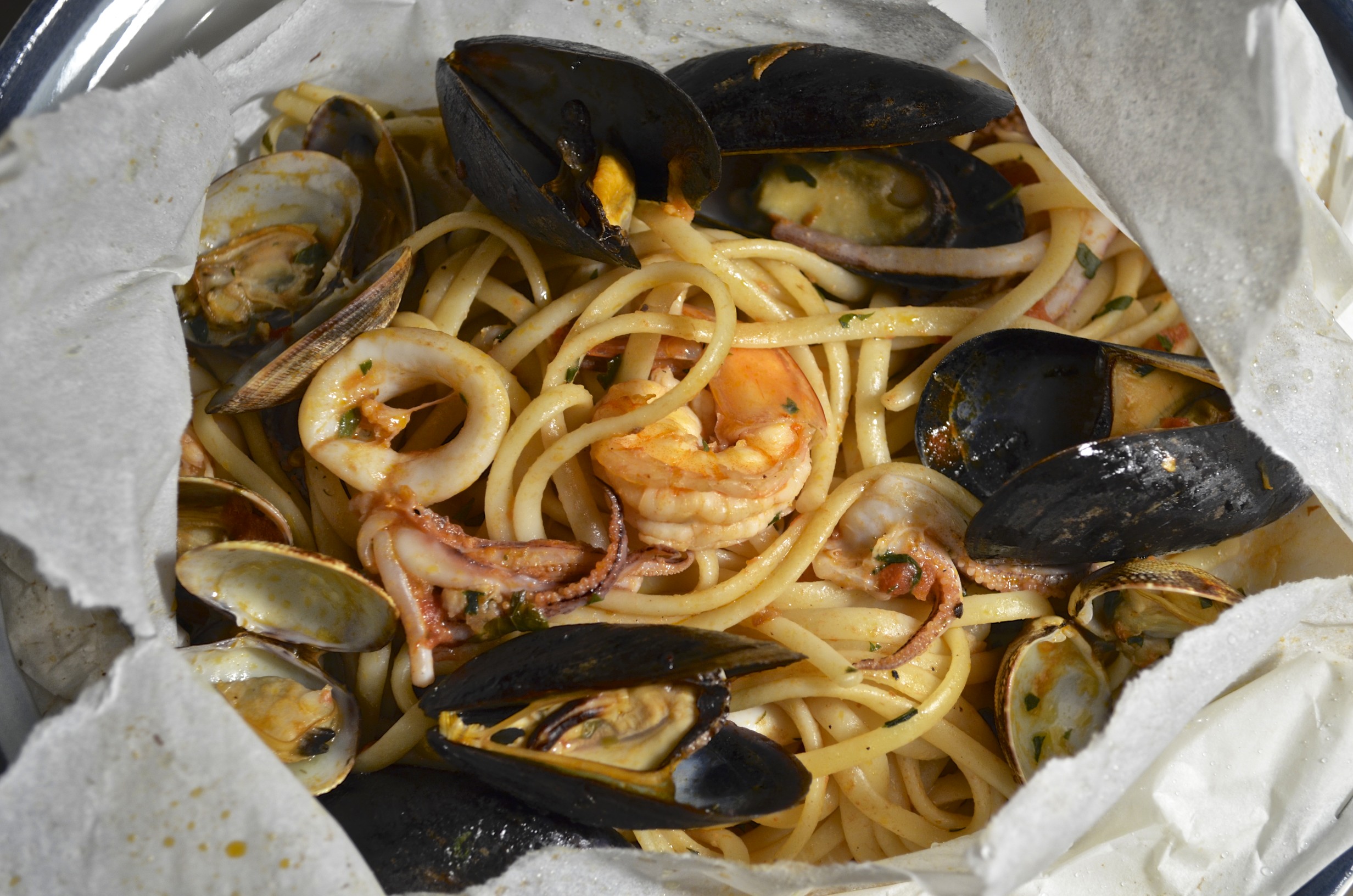
Yes, everyone, it’s Christmas Eve and, as many of you who’ve been with me for at least one Christmas already know, it’s a night of great anticipation and luscious seafood for many of us Italians. In fact, more than a few households will celebrate tonight with the Feast of the Seven Fishes. In the past, I shared a rather tongue-in-cheek story of the origins of this Feast but, instead of sending you there, I thought I’d reprint it for you here. What’s this? You already know the tale? Well, just skip the paragraph that follows and head straight to the video. That should keep you occupied until the others catch up. So, here is one version of how the Feast of the Seven Fishes came about …
Prior to the changes brought by Vatican Council II in the 1960′s, Christmas Eve was a “fast & abstain” day, meaning only 1 main meal could be consumed and no meat was to be eaten all day. For most Catholics around the World, it was a day of contemplation and that one meal was nothing special. With Christmas coming within hours, all eyes — and appetites — were focused on the big day — and dinner — soon to come. Not so the Italians. If tomorrow’s a big holiday and today you can only have one meal, why not make that meal special? And so they did. Can’t have any meat? No problem. With Italy being both peninsula and island, fish was very often more readily available than many meat products. And so it became a seafood banquet. Wait a minute! The Church may frown upon so grand a celebration on the eve of the birth of the Christ Child. Again, no problem. They made a point of serving seven fish, each one representing one of the Seven Sacraments of the Christian Faith. In one masterstroke, their seafood feast became an Act of Faith. What priest, bishop, or even Pope would dare interfere with these devout Catholics as they used the day’s only meal to commemorate the Seven Sacraments? (The fact that the clergy themselves were probably dining on an even more spectacular seafood supper didn’t hurt “the cause” either.) And so the Feast of the Seven Fishes was born and survives to this day wherever Italians call home.
* * *
* * *
OK then. Is everybody here? Let’s continue …
I first saw this dish prepared almost 20 years ago. An Italian chef, Nick Stellino, hosted a cooking show on PBS. That one episode not only showed me how to cook seafood pasta, Pasta dei Frutti di Mare, but it introduced me to the wonders of using parchment paper to envelope a dish. Since then, although I’ve made this dish a few times, I’ve made seafood pasta often and baked fish and/or vegetables in parchment or foil even more frequently.
* * *
Now, this one dish will give you 5 of the 7 fish needed for your feast. Please resist the urge to go for broke and add 2 more fish to the pot. All that will do is muddle the flavors or, worse yet depending on the seafood chosen, completely overpower the others. If you’re looking for suggestions, how about oysters on a half-shell, a nice octopus salad, a small salad with seared tuna, or a bit of baccalà salad. (A serving of baccalà in some fashion being the overwhelming choice of many Italian families.) Still not happy? Then do what I once did. Late one Christmas Eve afternoon, I was among the horde in a grocery store when I realized I was 2 fish shy of the required 7 for my own little feast. Not willing to spend any more time in the store while I weighed options, I went to the sushi counter and picked up a spicy tuna roll, before heading to the deli section to get a jar of pickled herring. Fish are fish, after all.
* * *
Speaking for my Zia and the rest of the Bartolini Clan,
We wish you a very Merry Christmas!
* * *

* * *
Linguine with Seafood in Parchment Recipe
yield: 3 servings (See Notes)
Ingredients
- 1/2 lb (225 g) fresh linguine, spaghetti, or tagliatelle — dried pasta may be substituted
- 4 tbsp olive oil, divided
- 1 small onion, finely chopped
- 1/4 tsp red pepper flakes
- 4 garlic cloves, minced or grated, divided
- 4 tbsp chopped parsley, divided
- 2 tbsp basil, chopped
- 1 small can (14.5 oz; 400 g) diced tomatoes
- 1/2 c white wine, divided
- 1/2 cup clam juice or shrimp stock (see Notes)
- 1 tsp dried marjoram (2 tsp if fresh)
- 6 mussels, (see Notes)
- 6 cherry-stone or manila clams, (see Notes)
- 6 scallops, cut in half (see Notes)
- 9 shrimp (see Notes)
- 3 calamari (see Notes)
- salt and pepper, to taste
- chopped parsley and basil for garnish
* * *


(Click any photo to enlarge)
* * *
Directions
- At least 30 minutes before you are to begin preparing the sauce, place the clams in a bowl filled with cold water. Change the water at least once and be sure to brush the clam shells before cooking them.
- Prepare a simple tomato sauce:
- Place 2 tbsp olive oil in a small sauce pan over med-heat. Once hot, add the onion, the red pepper flakes, season with salt & pepper, and sauté until translucent, about 5 minutes.
- Add 2 cloves of garlic and 2 tbsp of parsley, stir, and continue to sauté for another minute or so.
- Add 1/4 c wine, the tomatoes, 1 tbsp basil, season with marjoram, salt & pepper, and bring to a boil before lowering heat to a simmer.
- Allow to simmer until sauce has deepened in color and thickened, about 30 to 40 minutes. Taste for seasoning and adjust, if necessary.
- Put aside 1/2 cup for the recipe and reserve the rest for another day.
- Pre-heat oven to 375˚ F (190˚ C).
- In a large pot of salted boiling water, cook the pasta until 2 minutes before the package indicates it will be al dente. (See Notes)
- In a large, deep fry pan with a lid, add remaining olive oil over med-high heat. Add remaining oil, garlic, and parsley to the pan and sauté until fragrant, about a minute or so. Add the clams and mussels, cover the pan, and sauté for 2 minutes.
- Add the squid, shrimp, scallops, clam juice, tomato sauce, and the remaining basil and wine to the pan. Cover, increase the heat to high, and boil the ingredients for about 2 more minutes.
- Using a slotted spoon, remove the seafood from the pan, and place in a covered bowl. Reduce the sauce by half,
- By now, the pasta should be drained. Add it to the boiling sauce, stir to evenly coat, and sauté for a minute.
- Add the reserved seafood to the pan, mix, and heat till warmed throughout. At this point, discard any shellfish that have yet to open.
- Meanwhile, take a large piece of parchment paper — or aluminum foil — fold in half and place on a large serving platter.
- When the seafood and pasta are ready, place them along the fold of the parchment paper. Garnish with parsley and basil. Working quickly, use interlocking folds to join the top and bottom halves of the parchment paper. (See Notes)
- Alternately:
- Use separate sheets of folded parchment paper, one per serving.
- Split the pasta and seafood evenly among the sheets. Garnish with parsley and basil. Fold each, as indicated in Step 11 above.
- Place the parchment packet(s) on a baking sheet and place in the middle of a pre-heated oven.
- Bake for 5 minutes and remove to a large serving platter or individual plates. Do not pierce the parchment until at the table.
- Serve immediately and watch as your dinner guests open their parchment presents and get a whiff of that steam. This is why you go through the trouble of putting seafood pasta in parchment.
- Do not serve with grated cheese for it will overpower rather than enhance most of the dish’s seafood components.
Inspired by Nick Stellino, “Cucina Amore”, Pasta al Cartoccio di Mare
* * *

* * *
Notes
To store the fresh seafood
If you are to prepare this on Christmas Eve, the last place you want to be that afternoon is standing in line at the fishmonger. Fresh seafood will easily keep in your fridge for 24 hours if treated properly. I would not recommend storing beyond 24 hours.
- Remove the clams and mussels from their packaging and place in a colander. Cover with damp — not sopping wet — paper towels. Place the colander in a bowl in which some ice as been set. Do not use so much ice that it will immerse any of the colander’s contents when it melts or the mollusks may drown. Place the bowl with colander into your refrigerator until needed.
- Leave the shrimp, squid, and mussels in their packaging and store in the coldest part of your refrigerator. Do not freeze.
To prepare the seafood:
- The Clams: At least 30 minutes before they are to be used in the recipe, place in a bowl of cold water and soak. (Some believe adding a couple tbsp of corn meal to the water will cause the clams to eliminate any sediment.) Change the water at least once before the clams are needed. Just before use, scrub clean the shells with a small brush. Discard any that are open and that won’t close on their own power.
- The Mussels: Before use, remove the beard (a thread mass on one side) and use a brush to clean the shells. Discard any that are open and that won’t close on their own power.
- The Shrimp: remove the shell including the tail section, if desired. Save the shells to be used to make shrimp stock. Use a sharp paring knife to slit the top of each shrimp. This will reveal a dark-colored vein that should be removed.
- The Scallops: these may be sold with a muscle attached to one side. It is about an inch long and /14 inch wide. This should be removed as it is tough and unpalatable.
- The Squid: Use a sharp knife to cut each tube, creating rings that are a half-inch wide. If using the tentacles, cut them in half or quarters.
* * *


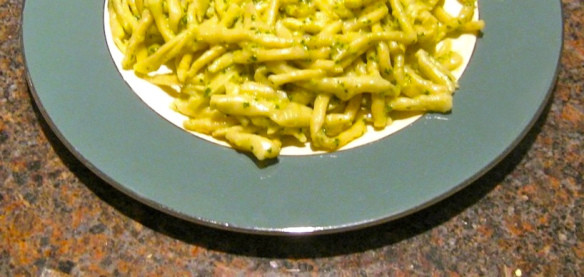
Homemade Linguine Cut Two Ways
* * *
You may find it easier to enclose your seafood in aluminum foil rather than parchment paper. The choice is yours to make.
Do not forget — as I did — to add a garnish of parsley and basil to each packet just before you seal them. Their presence adds to the aroma upon tearing the parchment.
Timing is everything with this dish. The seafood cannot be kept waiting for the pasta to be cooked lest it become tough and rubbery. If you feel that you cannot properly time the dishes together, go ahead and cook the pasta so that it finishes within a few minutes of starting the sauce. Pasta should be cooked about 2 minutes shy of al dente, as indicated on the package’s instructions. Drain the pasta, return it to the now-empty pot, coat very lightly with olive oil, and cover until needed.
You needn’t be an origami expert to fold and seal the parchment packets. That’s why the gods gave us staplers and don’t be afraid to use one.
As written, this recipe will give you 3 nice servings. If you wish, it will yield 4 primo piatto-sized servings, though you may want to adjust the amounts of seafood used.
The keen-eyed among you may have noticed that there seemed to be more seafood in the photos than was required by the recipe. You’d be correct. I usually buy a couple extra clams and mussels to account for any that may be spoiled and must be discarded. Not knowing that I had already done so, the fishmonger added a couple more, for the same reason. When I joked that the scallops looked “bad”, he agreed and added another 2 scallops to their previously weighed container. He then added 2 shrimp and another squid to their respective containers. This is how you earn life-long customers.
If you like, you can skip the parchment packets altogether and use this recipe to prepare a very good frutti di mare pasta. To do so, follow the recipe but cook the pasta for another minute before draining. Place the drained pasta into the sauce, as before, but cook it for only a minute before adding the seafood. Stir to combine, heat everything through, and serve immediately. Garnish with chopped parsley and basil.
This dish does not make good leftovers. None of the seafood will re-heat well at all. Try to prepare just enough to ensure your dinner guests are satisfied without having anything left on the serving platter.
As you may have noticed, I used a pastry brush to lightly coat the sealed parchment before placing it in the oven. There was no discernible effect to the parchment paper by doing this. Perhaps it’s because the oven temp was relatively low and the packet was in the oven so briefly. Whatever the reason, I won’t do it again for this recipe and excluded it from the recipe’s directions.
* * *
It’s déjà vu all over again …
 No series looking back at my family’s traditional Christmas dishes would be complete without including our recipe for Zuppa Inglesi. This highly anticipated dessert consisted of lady fingers that were “lightly flavored” with alcohol before being covered in lemon-flavored custard. There’s even an alcohol-free version so that no one seated at the table need go without. You can take a look at the recipe for this family favorite just by clicking HERE.
* * *
Coming New Year’s Eve to a monitor near you …

Booze
* * *









 from the Bartolini kitchens