Tricolor Risotto

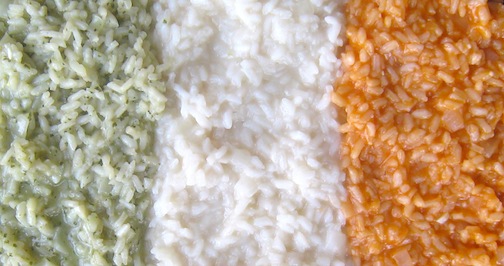
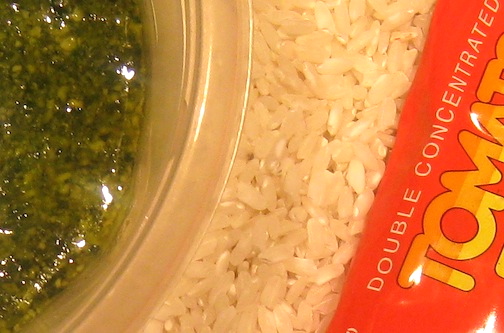
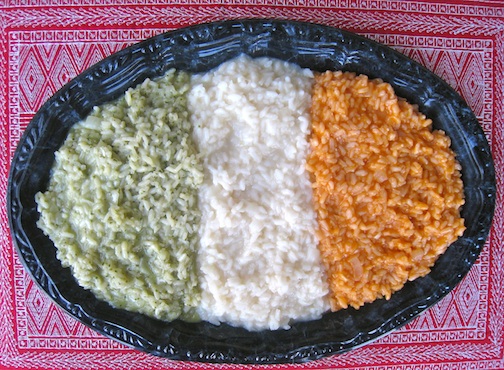
Having gone green for St. Patrick’s Day, I had to do something colorful to commemorate today, St. Joseph’s Feast Day. So, using pesto and tomato for color, we’re going to make tricolor risotto, a dish that features the green, white, and red of the Italian flag.

At its heart, this is a trio of simple risotto dishes. None of the usual ingredients — mushrooms, saffron, squash, etc. — are used because they would detract from the three colors. (Presentation, presentation, presentation!) You start cooking the rice in one pot and, when the time is right, the contents are split into thirds. Two of the thirds are then colored with either pesto or tomato paste and each pot finishes cooking on its own. It really is that simple and the resultant dish is a conversation starter, to be sure. More importantly, however, behind each of the 3 colors is a delicious dish of risotto.

*     *     *

Tricolor Risotto Recipe

total time: approx.  45 minutes

Ingredients

  • 8 cups chicken stock (for a meat-free diet, vegetable stock may be substituted)
  • 6 tbsp butter, divided
  • 1 large onion, finely chopped
  • 2 cloves garlic, minced
  • 3 cups arborio rice
  • 1 cup white wine (optional)
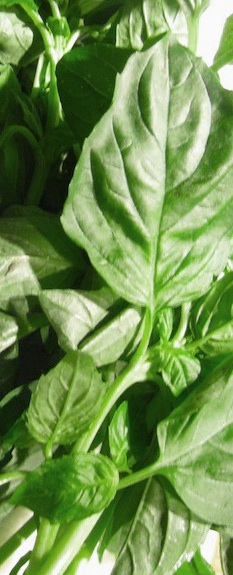
  • 3 – 4 tbsp pesto
  • 2 tbsp tomato paste
  • 1 cup grated parmesan cheese
  • salt & pepper, to taste
  • additional paremesan cheese for serving

Directions


  1. Heat stock in a sauce pan. Adjust heat to keep it hot but not boiling.
  2. Add 3 tbsp of butter to a large sauce pan over medium heat. Add onion and sauté until translucent, about 8 – 10 minutes. Add garlic and sauté for about 1 minute more.
  3. Add rice and stir until well-coated. Toast the rice for about 2 minutes before adding the wine. Stir frequently until the wine is absorbed.
  4. Add enough hot stock to cover the rice, about two ladles. Keep stirring the mixture and, when the liquid is absorbed, add another ladle or 2 of stock. Continue stirring, adding more stock when “dry,” for 10 minutes.
  5. After 10 minutes, place a third of the rice mixture into each of 2 additional sauce pans over medium heat. Add the pesto to 1 pan and the tomato paste to the other.
  6. You now have 3 saucepans of rice to maintain by adding stock, stirring until “dry,” and then adding more stock.
  7. Continue cooking all 3 batches until the rice is al dente, about 10 to 15 minutes. Add 1 tbsp of butter and 1/3 cup of parmesan cheese to each of the 3 pans. Mix well. Taste test for seasoning and adjust, if necessary.
  8. Serve on a platter with the white risotto in its center, flanked by the red and green versions.

*     *     *

*     *     *

Variations

The variations for this dish involve substituting freshly chopped parsley and basil — or even cooked chopped spinach — for the pesto. I always opt for pesto because I’m sure to have some in my fridge or freezer. As for the red side of the flag, a little marinara sauce can be used in place of the tomato paste.

*     *     *

Pesto

Pesto Genovese

Since tomorrow is St. Patrick’s Day, we’ll go green for this week’s recipe. Pesto was one of those dishes that I had enjoyed eating but never thought to make myself. Several years ago, before I moved to my present home, a good friend taught me how to make pesto using basil grown in my garden. I haven’t bought another drop since. Sure, we all know that pesto is great when combined with hot pasta but that’s only part of the story. Pesto-dressed pasta can, also, be served at room temperature and, if chilled, the addition of a few ingredients will make a great pasta salad. Moving beyond pasta, I’ll use a couple of tablespoons of pesto to flavor soups, sauces, in sandwiches, and in meat marinades. When roasting a chicken or game hen, a little pesto between the bird’s flesh and skin results in a very flavorful main course. The fact is that pesto isn’t just for pasta anymore.

As easy as pesto is to prepare, there are a few things to remember. First off, be sure to use only fresh ingredients. This is not the time to use dried basil or powdered garlic. Although I use a food processor to make my pesto, a high-speed blender may be used, as well. No matter which appliance you use, do not over-process the basil. If you do, your basil will darken considerably. Lastly, pesto can be stored in the fridge for up to one week and frozen for much longer. If you choose to freeze your pesto, however, do not add any cheese to it because it will not thaw properly. Instead, make your pesto without the cheese, freeze it, and after you thaw it, mix the pesto into your pasta, adding cheese as you do. And if you are going to freeze it, consider putting your pesto into an ice-cube tray. Once frozen, remove the cubes, place them in a bag, and store the bag in the freezer. Doing so will ensure that you’ll defrost only what you need.

*     *     *

Pesto Recipe

total time: approx. 10 minutes

Ingredients

  • 2 cups basil leaves, about 2 oz
  • 1/4 cup pine nuts
  • 2 – 3 cloves garlic, roughly chopped
  • 1/3 cup parmesan cheese
  • 1/2 – 3/4 cup extra virgin olive oil
  • 1/4 tsp salt
  • pepper to taste

Directions

  1. To your food processor or blender, add the pine nuts and garlic. Process about 20 seconds to chop the ingredients.
  2. Add the basil, salt, and pepper and pulse for a few seconds, about 3 or 4 times. This should give the basil a rough chop.
  3. Start the processor and pour the olive oil through the feed tube in a slow, steady stream. Stop the processor about 5 seconds after all the oil has been added.
  4. At this point, the pesto may be frozen for later use (see above).
  5. If you are not going to freeze the pesto, add the grated cheese and process just long enough to combine the ingredients.
  6. Pesto is now ready and may be served over your favorite pasta.

*     *     *

*     *     *

Variations

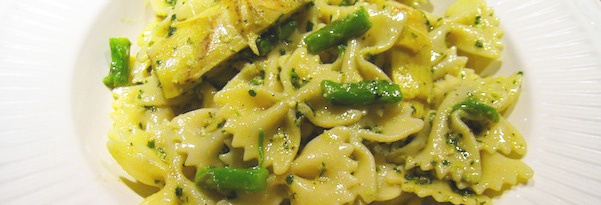
There are far too many variations to serving pesto for listing here. I mentioned a few in the introduction above and that was by no means a complete list. Pictured here is a dish of farfalle with chopped asparagus spears and marinated artichoke hearts, all of which has been dressed in pesto. I served it warm but I could have easily added some halved cherry tomatoes, a little chopped onion and maybe some chopped olives, stuck it in the fridge to chill, and served it as a pasta salad. As you can see, the possibilities are endless.

Notes

The amount of oil I use in this recipe will vary depending upon how I intend to use the pesto. If I’m going to use the it right away, I’ll use what’s indicated in the recipe above. If I’m going to make a chilled pasta salad, I may add a little more oil to the dish. If I’m going to freeze the pesto, I’ll reduce the amount of oil, as well as skip the cheese, making more of a paste. When I eventually use it, I’ll defrost it and coat my pasta with olive oil before adding the pesto. You, too, may wish to adjust the amount of oil to correspond with your own likes and dislikes.

*     *     *

Tomato Sauce with Tuna

Having been raised a Catholic, the arrival of Lent reminds me of the countless meatless Fridays of my youth. Even when “the rules” changed in the 60’s, our house continued the practice of fish on Fridays, for the most part, and that was due largely because we all liked fish — and the Bartolini Sisters knew how to cook them. I hope to get to some of those recipes later but, for now, I’m going to start with a pasta dish. (Big surprise!)

Next to a marinara, this is about as simple a sauce as one can make. With tuna as its protein, this sauce is not as strongly flavored as, say, a puttanesca. As a result, one needs to be careful not to overpower the tuna with a lot of strong herbs and spices. The recipe, as presented, is exactly as my family made on many a Friday, with the exception of the capers and mushrooms. I happen to love both with my pasta. As for you, if it isn’t a tomato sauce unless you taste oregano or some other herb, spice, or ingredient, then by all means add it. Just be careful not to overwhelm the tuna and, please, just say no to cheese.

*     *     *

*     *     *

Tomato Sauce with Tuna Recipe

total time: approx.  1 hour

Ingredients

  • 3 tbsp olive oil
  • 1 medium onion, chopped
  • 3 tbsp fresh parsley, chopped
  • 3 cloves garlic, minced
  • 2 tbsp tomato paste
  • 1 can (28 oz) tomatoes (use crushed, diced, or whole that you mash during cooking)
  • 4 – 6 button or crimini mushrooms, sliced — optional
  • 1 can (5 oz) of whole chunk tuna, water-packed, well-drained
  • 2 tbsp + 1 tsp fresh basil, chopped
  • 3 tbsp capers, drained — optional
  • salt & pepper, to taste
  • 1 lb pasta

Directions

  1. Add oil to a medium sauce pan and heat over a medium-high heat. Add onion, garlic, and parsley and sauté until onions are translucent, about 5 minutes.
  2. If using mushrooms, add them now and continue sautéing another 3 or 4 minutes.
  3. Add tomato paste and sauté for about 2 more minutes.
  4. Add tomatoes, stir to thoroughly combine, bring to boil, and reduce to a simmer. Bring a large pot of salted water to boil.
  5. After 30 minutes, carefully add tuna so that the chunks do not fall apart. Add pasta of your choice into the boiling water.
  6. When the pasta is cooked al dente, remove from heat and drain.
  7. Add 2 tbsp basil (and capers, if used) to the sauce and stir carefully.
  8. Combine cooked, drained pasta with the sauce, stir until well-coated, garnish with remaining basil, and serve immediately.

Notes

This is another quick sauce. If you cook it for too long after the tuna has been added, the chunks of tuna will disintegrate.

*     *     *

Spianata

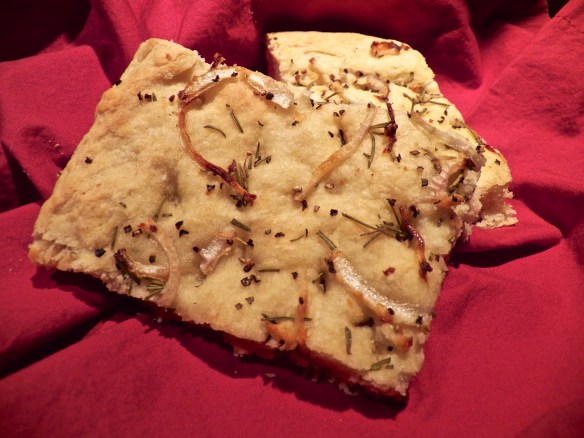
When I was a boy, Mom occasionally treated us all to home-made pizza. She’d make standard pepperoni or sausage pizzas for us kids but Dad’s was a special order. His pizza was called spianata and, unlike our kiddie versions, his was topped with only garlic, onion, rosemary, salt and pepper, resembling a rather plain focaccia. Yet, for so few ingredients, it made a very tasty pizza back then, while Zia and I use it today as a perfect accompaniment for any number of dishes.

*     *     *

*     *     *

The recipe I’m about to share starts with what is called a “sponge.” Fairly common to many Italian/European breads, it’s a mixture of water, yeast, and flour that’s allowed to rise overnight. The mixture, in a sense, ferments and the resultant bread is more flavorful, almost sourdough-like. (In fact, I often add some of my sourdough starter to the sponge instead of yeast.) Of course, you needn’t start with a sponge but the spianata is so much more flavorful if you do. Once the sponge has “spent the night,” the rest of the recipe is pretty straight-forward and you should have no trouble following it.

*     *     *

Spianata Recipe

Ingredients

For the sponge

A Sponge Worthy of Spianata

  • 1 cup flour
  • 1 cup warm water
  • 1 tsp active yeast

For the spianata

  • 1/2 cup olive oil, divided
  • 1 tsp salt
  • 2 cups flour

For the topping

  • 1/2 of a small onion, sliced thin
  • 1 clove garlic, sliced thin or grated
  • 3 tbsp fresh rosemary, coarsely chopped
  • olive oil
  • coarse salt & pepper

Directions

  1. Proof the yeast in warm water, add to the flour to make the sponge, mix well, cover, and set aside. The sponge should be allowed to rise for at least 8 hours but no more than 20. 12 to 16 hours is usually best, in my experience. When you are ready to proceed, the sponge’s surface should be mottled with bubbles and it should have a strong yeast scent.
  2. To the sponge, add the flour, 1/4 cup olive oil, and salt. Knead dough for 5 minutes. Dough should not be sticky. If it is, sprinkle with flour and continue kneading until absorbed.
  3. Place dough in an oiled bowl, cover, and let rise until doubled — from 1 to 2 hours. (If using only sourdough starter, it could take longer.)
  4. Punch the dough down, turn it onto a floured work surface, cover with a towel, and let rest for 15 minutes. Meanwhile, coat a 9″ x 12″ sheet pan with the remaining 1/4 cup of olive oil.
  5. After resting 15 minutes, place dough onto the pan and use your fingers to begin stretching it to fit the pan. When it covers about 2/3 of the pan, flip the dough over and continue stretching the dough until the entire pan is covered and there’s enough dough to create a ridge around the pan’s edge. Cover with a towel and let rise until doubled again, about 1 hour.
  6. Pre-heat oven to 425*. Place garlic and onion into a small bowl and moisten lightly with olive oil.
  7. Once doubled, remove towel and, with your fingers, poke the surface of the dough repeatedly. Sprinkle surface with garlic, onion, rosemary, coarse salt & pepper.
  8. Bake on oven’s center rack for about 25 minutes. The spianata should be lightly browned.
  9. Allow to cool slightly before cutting and serving.

Notes

Like most breads, spianata can be frozen easily. Once it is fully cooled, wrap it tightly in aluminum foil and place in your freezer. When you are ready to serve it, place it, still wrapped in foil, in a pre-heated 350* oven for about 25 minutes. Enjoy!

*     *     *

Puttanesca Sauce

I was a boy when I first heard one of the legends behind pasta puttanesca. Dom DeLuise was the guest host on the Mike Douglas Show and he told the tale while he prepared the dish. It has to do with the “ladies of the evening” of Naples and the strength of their perfume.  I don’t know whether it was the pasta or the tale but I remember both to this day. A variation of the story is that these same ladies used the sauce’s aroma to lure gentlemen callers into their parlors. I’m sure that there are other legends about this sauce’s origins and I’m equally sure that they all involve its strong aroma. Once you’ve prepared a puttanesca sauce, you’ll know exactly what I mean.

Virtually all puttanesca sauces rely principally upon 5 basic ingredients: tomatoes, anchovies, red pepper flakes, garlic, and olives. I prefer a sauce with some texture so I’ll use crushed, diced, or whole tomatoes that I’ve mashed with my spoon. This recipe may call for 6 anchovies but I’ll very often use the entire tin, unless there’s a Caesar salad in my immediate future. Although most recipes call for pitted, black olives, I’ve found that the addition of a couple large, green olives adds another flavor into the mix. The purchase of a small container of mixed olives at my grocery’s deli counter works perfectly.  Speaking of olives, they, along with the anchovies and capers, can be pretty salty. Be sure to taste the sauce before seasoning with salt and do so at the very end of cooking. Now, whether you find yourself in Italy or in an Italian restaurant here in the States, it is frowned upon to use grated cheese of any kind on a pasta dish made with seafood. As such, there are many who will say that a puttanesca sauce starts with anchovies and, therefore, cheese must not be used. Others are willing to bend the rules since the anchovies are not the “star” of the dish as, say, clams might be in a different recipe. To cheese or not to cheese? The answer to that question will be left entirely up to you. I know a minefield when I see one.

*     *     *

Puttanesca Sauce Recipe

total time: approx.  1 hour

Ingredients

The Basics

  • 3 tbsp olive oil
  • 1/8 to 1/4 tsp red pepper flakes
  • 6 anchovy fillets
  • 1 medium onion, chopped
  • 3 cloves garlic, minced
  • 1 – 28 oz can tomatoes
  • 3 tbsp tomato paste
  • 12 – 15 large Kalamata olives, coarsely chopped  (I’ll sometimes add a couple large, green Spanish olives.)
  • 3 tbsp fresh parsley, chopped
  • 2 tbsp + 1 tsp fresh basil, chopped
  • 2 tbsp capers, drained
  • salt & pepper, to taste
  • 1 lb pasta, cooked about 2 minutes shy of al dente — refer to package instructions


Directions

  1. Add oil to a large, deep fry pan and heat over a medium-high heat. Add pepper flakes & anchovies and cook for 2 minutes. Use the back of a wooden spoon to stir & mash the anchovies until they disintegrate into the oil.
  2. Add onion and sauté until onions are translucent, 8 to 10 minutes.
  3. Add garlic & parsley and sauté for 1 minute.
  4. Add tomato paste and continue sautéing for about 2 minutes.
  5. Add tomatoes, stir to thoroughly combine, bring to boil, and reduce to a simmer.
  6. After 30 minutes, add olives and continue simmering.
  7. After 10 minutes, add capers and 2 tbsp basil, stir to combine. Taste before seasoning with salt and pepper.
  8. Add drained pasta to the pan, stir to coat with the sauce, and continue cooking until pasta is al dente, 1 to 2 minutes. Serve immediately, garnished with remaining tsp basil.

Variations

This sauce is cooked relatively quickly and features bold flavors. To add another dimension, try using fresh tomatoes that have been picked in the height of the season. I usually use 10 to 12 ripe plum tomatoes that I’ve peeled after blanching them in boiling water for about a minute. Once peeled, chop and, if you like, seed the tomatoes before adding to the pan. The fresh tomatoes, anchovies, and olives combine to make one spectacular dish!

Notes

Like many of my tomato-based sauces, this one calls for a large can of tomatoes. Truth be told, I rarely use canned tomatoes. Mid-August, I start buying half-bushels of plum tomatoes at my area’s farmers’ markets. After washing, some are blanched, peeled, chopped, and then frozen in quart containers. The rest are run through my Roma strainer before being frozen. I try to freeze at least 45 quarts and that will ensure that I’ll have enough tomatoes to easily last through Spring. When the time comes to use them, depending upon the sauce I’m preparing, I can choose between the chopped or strained quarts, or, I can combine them. Best of all, there are no more trips to the grocery store for a can of tomatoes, only to return with 2 bags full of impulse buys.

*     *     *

Cacioni

Half-Moon Pie?

Cacioni are small, half-moon shaped pies which, in San Marino, are filled with greens, very often a combination of Swiss chard and spinach (cacioni con bietole e spinaci). In other parts of Italy, however, cacioni are filled with a variety of cheeses and, in one case, even beans are used. And then there’s Liguria where they make a torta pasqualina at Easter which is filled with greens — but the torte are much larger than cacioni and the filling also includes ricotta and grated cheese. Of all the recipes I’ve come across, however, only the Bartolini cacioni are deep-fried. In fact, Zia went to lunch with some Sammarinese friends a few years ago and one of the ladies brought baked cacioni for everyone. The idea of baking cacioni is a game changer for Zia and me. Up until now, we rarely made them because there was no way to store them. You fried and ate what you made and that was that. As such, it just wasn’t practical to make them if you lived alone. Now that baking is an option, however, we can make a dozen, reserve 2 for dinner, and freeze the rest. Suddenly, cacioni are back in our diets, but, what does this mean for you?

Well, I’m going to give you both options for preparing cacioni. The first will be deep-fried; the second will be baked using pastry dough. To that end, in a recent episode of Mad Hungry, Lucinda Scala Quinn prepared a pie crust that she used with her pocket pies. (If you’re not familiar with her blog, you should be.) Her recipe is perfect for cacioni and it really is fool-proof. No matter which cooking option you may choose, the filling will remain the same and we’ll start there.

*     *     *

Cacioni Recipe

(Swiss Chard & Spinach Filling)

Ingredients

  • 3 tbsp olive oil
  • 2 cloves garlic, crushed
  • 1 small yellow onion, chopped
  • 1 bunch  fresh Swiss chard, trimmed, leaves chopped after removal from stalks, stalks chopped and reserved
  • 1/2 pkg frozen chopped spinach, thawed  — use more or less, if you like
  • salt & pepper to taste

Directions

  1. Heat oil and garlic in a frying pan over medium heat until garlic begins to brown, about 5 minutes. Do not allow garlic to burn.
  2. Remove garlic, increase heat to med-high, add onion and as much of the chopped chard stalks as you prefer. Season with salt & pepper and sauté until translucent, about 8 to 10 minutes.
  3. Add chopped spinach to pan and continue sautéing until heated through, about 4 minutes.
  4. Add chard leaves, season with salt & pepper, and sauté until leaves are wilted and cooked to your preference.
  5. Place cooked greens in a colander or strainer, place a dish on top of the cooked vegetables, and place a heavy can or similar weight on top of the dish. This will help to drain as much liquid from the greens as possible before filling the cacioni.

*     *     *

Fried Cacioni

Swiss Chard & Spinach Cacioni

yield: 12 – 15 pies.

Ingredients

  • Swiss chard with spinach, sautéed and well-drained (recipe above)
  • 1/2 batch Mom’s pasta dough, rested for 30 minutes after preparation
  • Oil for frying — NOT olive oil

Directions

  1. Separate dough into quarters and wrap 3 quarters in plastic wrap.
  2. Using the remaining dough quarter, run it repeatedly through the pasta machine rollers until thin. If no. 1 is the widest setting, continue rolling the dough up to, and including, the no. 6 position.
  3. Spread the dough sheet on a flat surface. Using a bowl, saucer, or wide-mouthed mug/jar as a template, cut circles as large as you can on the dough sheet. Trim and reserve the excess dough for later use.
  4. Depending upon the size of the dough circle, place 2 to 4 tbsp of the chard filling in a line across the center of each one. Using a pastry brush or your finger tips, moisten the edge of each circle with water. Fold the pastry in half upon itself, creating a half-moon. Use a fork to press and seal the edges of the dough. Use the fork to prick each pie to let steam to escape during frying. Set aside.
  5. Continue until all the filling has been used. The left-over dough may be used to make the pasta of your choosing.
  6. Using a large frying pan, add enough vegetable/peanut oil to create a depth of 1 to 1 1/2 inches. To avoid boiling over, do not fill the pan over halfway full. (This is more a “shallow-fry” than deep-fry. Of course, if you prefer deep-frying, go for it.)
  7. Bring oil to 350*. Depending upon the pan size, fry 2, 3, or 4 cacioni at a time. Do not overcrowd. Fry until golden brown before turning each one over.
  8. Place a wire rack atop a baking sheet and place both into a warm oven. When each batch of cacioni are finished frying, place them on the rack in the oven to keep warm. Sprinkle with coarse kosher or sea salt.
  9. Repeat the process until all are fried. Serve immediately.

*     *     *

Baked Cacioni

Cacioni con Bietole e Spinaci

Note: This will require enough pastry dough as would be used to make a double-crusted, 9 inch pie. Use your own pastry dough recipe, try Lucinda’s cream cheese pastry dough, or buy it ready-made at your grocery store. Puff pastry, however, is not recommended.

yield: 10 – 12 pies.

Ingredients

  • Swiss chard with spinach, sautéed and very well-drained (recipe above)
  • pastry dough (see note above)
  • 1 egg yolk mixed with a tbsp of water to make a wash

Directions

  1. Separate dough into halves, wrap one half with plastic wrap and place in the fridge. Roll the remaining half as you would for a pie crust.
  2. Using a bowl, saucer, or wide-mouthed mug/jar as a template, cut circles as large as you can on the dough sheet. Trim and reserve the excess dough for later use.
  3. Depending upon the size of the dough circle, place 2 to 4 tbsp of the chard filling in a line across the center of each one. Using a pastry brush or your finger tips, moisten the edge of each circle with water. Fold the pastry in half upon itself, creating a half-moon. Use a fork to press and seal the edges of the dough. Use the fork to prick each pie to let steam to escape during baking. Set aside on a baking sheet lined with parchment paper.
  4. Continue until no more dough remains and then place the baking sheet into the fridge while you work with the second half of the pastry dough. Repeat the process until there is no more filling or dough.
  • TO COOK IMMEDIATELY
  1. Pre-heat oven to 375*
  2. Meanwhile, chill the cacioni for a few minutes before proceeding.
  3. Using a pastry brush, carefully coat the exposed surface of each pie with the egg wash. Sprinkle with salt.
  4. Place baking sheet into pre-heated oven and bake until golden brown, about 20 minutes.
  5. Serve immediately.
  • TO FREEZE & COOK
  1. Place newly prepared cacioni on a lined baking sheet and then into the freezer.
  2. After a couple of hours, place the cacioni into more permanent freezer containers.
  3. When ready to cook, DO NOT THAW. Pre-heat oven to 350*.
  4. Remove the cacioni from the freezer, place on a parchment-lined baking sheet, and, using a pastry brush, coat the exposed surface of each pie with egg wash. Sprinkle with coarse kosher or sea salt.
  5. Place the baking sheet into a pre-heated oven and bake until golden brown, about 30 minutes.
  6. Serve immediately.

Variations

Although my family has only used a combination of chard and spinach to fill our cacioni, there’s no reason other vegetables can’t be used. In fact, Zia and I are considering rapini (broccoli raab) as filling for some future cacioni — if I can ever remember to buy some and bring it with me when I visit.

Notes

Working on this recipe resulted in my making a couple dozen cacioni, both fried and baked. At one point, I had some left-overs that had been baked and were made with Lucinda’s pastry dough. Rather than refrigerate them, I placed them with some raw cacioni on one of the baking sheets in my freezer. Lucinda freezes her cooked pocket pies and re-heats them in the microwave, so, why not do the same with cacioni? Well, I’m happy to report that those frozen, fully baked cacioni were successfully re-heated in the microwave. They tasted great and I’ll definitely be doing this again. Special thanks to Lucinda and her Mad Hungry Blog. She’s the best!

So, there’s no longer a reason for us single folk not to enjoy cacioni on a regular basis. You can make a batch, bake what you need, and freeze the rest for future baking, or, if you prefer, you can bake them all, freeze the left-overs, and re-heat them in the microwave at some later date. Either way, you won’t be disappointed.

*     *     *

Steak Pizzaiola

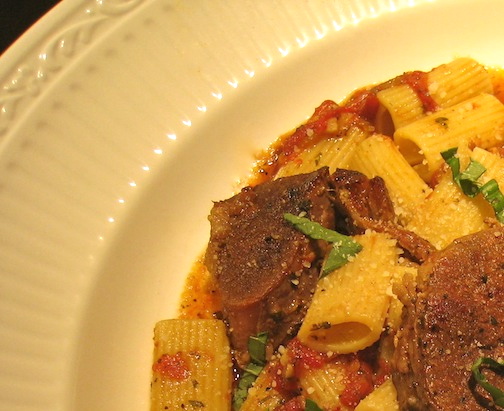
This is not one of my family’s recipes and I only started cooking it a relatively short time ago. Sure, I’d heard of steak pizzaiola but, for some reason, I always assumed that it was too complicated for me to attempt. Then, one night I saw a rerun of an “Everybody Loves Raymond” episode in which the recipe was a point of contention between Debra & Marie. After the show, I searched the web for the recipe and was surprised to learn just how easy the dish is to prepare. Basically, it’s a steak and marinara sauce served over pasta. Well, I decided to give it a try and I’ve continued to make steak pizzaiola ever since. It is one of those recipes where a minimum of effort results in a great dinner — and it’s a bargain to prepare, as well.

Exhibit A

Searching the web, I soon learned that, as easy as it is, there’s no one way to make steak pizzaiola. It’s as if there’s a different recipe for every cut of meat, especially since the better the cut, the less time needed to cook it. As a result, some recipes feature a steak that’s braised slowly in the sauce while, in others, the steak and sauce are cooked separately, to be combined just prior to serving. Although there’s something to be said for the “fast approach,” I very much prefer a slow and steady method of cooking for this dish. So, I look for a cheaper cut of meat, preferably “bone-in” for added flavor, and let it braise for a couple of hours in the oven. The sauce itself is uncomplicated and there’s no need for a lot of herbs and spices. The braising will do the work for you and infuse the sauce with a rich beef flavor. Now, my family uses very little oregano in its dishes but so many of the web recipes call for it that I’ve listed it here, among the ingredients. Use it instead of, or in combination with, the Italian seasoning, if you like. In fact, if oregano is a favorite of yours, you may want to increase the amount listed in the recipe below. As for the type of pasta to use, I prefer serving it with rigatoni, penne, or cavatappi but feel free to use whatever works for you and your family.

Exhibit B

*     *     *

Steak Pizzaiola Recipe

total time: about 2 1/2 hours.

yield: about 8 servings.

Ingredients

  • 2 – 3 pounds chuck steak, bone-in
  • 3 tbsp olive oil
  • 1/8 – 1/4 tsp red pepper flakes, depending upon taste
  • 1  medium yellow onion, chopped
  • 3 cloves of garlic, chopped fine
  • 2 – 3 tbsp tomato paste
  • 1 large can (28 oz.) tomatoes (I prefer diced or crushed)
  • 1 tbsp Italian seasoning or dried oregano or any combination of the two
  • 3 tbsp chopped fresh parsley
  • 2 tbsp chopped fresh basil
  • salt & pepper
  • 1 lb pasta, cooked al dente per package instructions, reserve 1 cup of pasta water
  • grated Pecorino Romano cheese

Exhibit C

Directions

  1. Pre-heat oven to 325*
  2. Heat oil in large, oven-proof, frying pan with a tight-fitting lid, over med-high heat.
  3. Season meat liberally with salt & pepper and sear in frying pan, about 4 minutes each side.
  4. Remove meat to a platter and add red pepper flakes to the pan. Cook for about  2 minutes.
  5. Add onions to the pan, season with salt & pepper, and sauté until translucent, about 6 – 8 minutes
  6. Add garlic and continue cooking for 2 minutes.
  7. Add tomato paste and continue cooking for 1 – 2 minutes.
  8. Add tomatoes, parsley, Italian seasoning and/or optional oregano, and stir to combine with pan’s contents. Season with salt and pepper.
  9. Return meat to the pan, cover the meat with sauce, cover tightly with lid, and place in center of oven.
  10. Braise meat for 2 hours, checking it every 30 minutes or so. Either flip the meat over or spoon more sauce over it.
  11. After 2 hours, begin heating water for the pasta and remove the lid from the pan in the oven. This will allow the sauce to thicken while the pasta cooks. When the pasta is al dente, reserve a cup of pasta water, drain the pasta, and check your sauce. If your sauce is too dry, use the pasta water to compensate.
  12. Place drained pasta in a large bowl. Take sauce out of the oven, remove any loose bones, and combine with cooked pasta. Garnish with basil and grated Pecorino Roman cheese.
  13. Serve immediately.

Exhibit D

Variations

As was mentioned earlier, some recipes call for using better cuts of meat than a chuck steak. Normally, those recipes do not need a long braise like the one that I’ve shared; the cut of meat is far more tender already. I very much prefer the long braise method, however, for it not only renders the meat fork-tender but the sauce’s flavors are more developed.

Notes

At one time or another, we all have some left-over pasta sitting in our fridge. Re-heating it can be a problem, unless you use Mom & Zia’s method. Rather than use the microwave, place about a tablespoon of butter and about 1/4 cup of water into a frying pan over med-high heat. Add the left-over pasta and sauté until heated through. Add a little more water if the pasta is too dry. Serve immediately, garnished with Pecorino Roman cheese. Understand that the pasta cannot possibly be al dente — that ship sailed the minute you put the left-overs into the fridge. This will, however, re-invigorate the sauce in ways that a microwave never could. As they say, “Try it. You’ll like it.”

*     *     *

Pesto Trapanese

Tis the Season

It’s the dead of Winter here in Chicago. As I write this, it’s 3* and the wind chill is well south of 0*. If ever there was a time for comfort food, this would be it. Most often, that would mean a stew or soup or a baked casserole of some sort — lasagna comes to mind. This time around, however, I’m going in a different direction altogether. I need me some Summertime and its name is Pesto Trapanese.

I first saw Lidia Bastianich, of Lidia’s Italy fame, prepare pesto Trapanese and it has since become a Summer staple of my diet. Like so many of her recipes, a few simple, fresh ingredients are combined to create authentic Italian fare. This dish, in particular, has many of the same ingredients of a fine marinara, with one critical difference. It is a pesto and, therefore, not cooked. The result is a pasta dish that screams “Summer!” Literally prepared in minutes, the flavors are fresh, like you just picked the basil and cherry tomatoes moments before — and come August, that is exactly what I do. So, when Winter’s winds howl and “Snow” is mentioned in just about every weather forecast, I turn to pesto Trapanese for my escape and it’s Summer in the City  — well, for one meal, anyway.

*     *     *

Pesto Trapanese Recipe

Ingredients

Fresh Ingredients

  • 1/4 cup slivered, blanched almonds
  • 2 1/2 cups (3/4 lb.) cherry tomatoes
  • 1/2 cup whole basil leaves
  • 1 clove garlic, crushed
  • 1 tsp kosher salt
  • pinch red pepper flakes, more to taste
  • 1 pepperoncini, roughly chopped
  • 1/2 cup olive oil
  • 1 lb cooked pasta (spaghetti or linguine)
  • 1/2 cup “pasta water,” held in reserve if needed
  • 1/2 cup grated parmesan cheese

Summer on a Plate

Directions

  1. Toast almonds over medium heat in frying pan atop stove, 2 – 4 minutes.
  2. Add almonds, cherry tomatoes, basil, garlic, salt, red pepper flakes, & pepperoncini into food processor or blender and run for about 1 minute.
  3. Remove spout and gradually add olive oil until fully incorporated.
  4. Mix with cooked pasta. Add some/all of reserved pasta water if pesto is too thick.
  5. Add grated cheese, mix well, and serve immediately.

Notes

  • Pesto may be made in advance and reserved for a couple of hours at room temperature, before being added to freshly cooked pasta. If its use is delayed longer than that, it should be refrigerated and may be kept up to 2 days.

*     *     *

Passatini

Passatini Soup

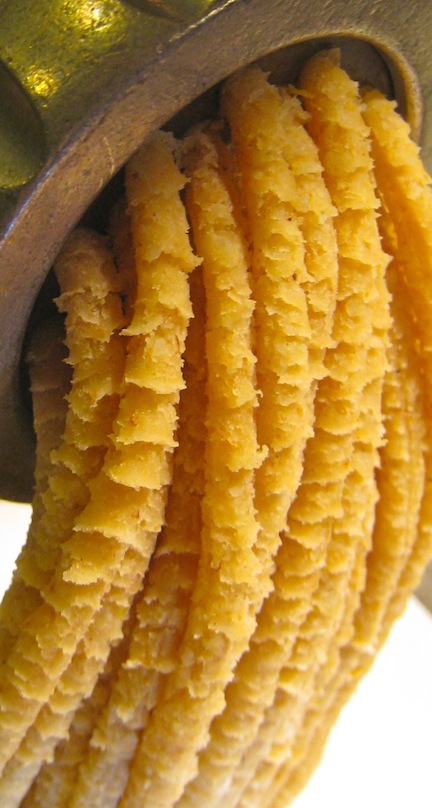
Let me start this post by stating that, when I was a boy, my Mom was the coolest Mom on the block. After I’d spent a morning hard at play, manufacturing Creepy Crawlers with my Mattel Thingmaker, guess what she served for lunch? Worms. That’s right, WORMS! How cool was that? Granted, we didn’t have actual worms for lunch but we did have passatini, a far more appetizing and tasty alternative. Sometimes called passatelli, passatini are noodles, of a sort, made with bread crumbs & cheese instead of flour and lightly flavored with lemon rind and nutmeg. The noodles themselves are extruded using a special press, a large-holed ricer, or a meat grinder. Once made, they can be added immediately to a pot of boiling stock or placed in single layers on baking sheets to be frozen. After a couple of hours, the now-frozen passatini may be gently placed into a container and stored in an area of the freezer where they won’t be disturbed. As you may have guessed, these noodles are more delicate than most and care needs to be taken when storing them. On the other hand, this recipe can be halved easily, thereby eliminating the need for freezing altogether. Whether freshly made or previously frozen, a steaming bowl of passatini is a meal fit for the coldest of Winter’s days. And if you happen to be serving children of a certain age, you, too, can be as cool as my Mom.

*     *     *

Passatini Recipe

total time: approx.  30 minutes

Ingredients

  • 4 large eggs
  • 2 cups bread crumbs
  • 1 to 1 1/2 cups grated cheese (parmesan or romano)
  • 1/2 tbsp lemon rind
  • 1/2 tsp ground nutmeg
  • chicken stock (vegetable stock may be substituted for a vegetarian diet)
  • grated cheese for serving

Freshly Pressed

Directions

  1. Combine dry ingredients in a large bowl.
  2. Add eggs and mix until a dough is formed. (I use my stand mixer and paddle attachment.)
  3. Form into a ball, cover, and let dough rest for 10 minutes.
  4. Using a large-holed potato ricer or meat grinder, extrude the passatini and place in a single layer on baking sheets, to be used immediately or frozen for later use, as explained in my comments above.
  5. Bring a pot of stock to boil, add the passatini, and reduce to a medium simmer. When the passatini begin to float, cook for 3 to 4 minutes more and serve.
  6. Be sure to have grated cheese available for you and your dinner companions.

Variations

I’ve seen recipes for passatini that include ground meat and even bone marrow, although I’ve never tasted them prepared in that way. I like my worms just the way they are.

*     *     *

Marinara Sauce

Spaghetti Squash Marinara

It seems that there are as many marinara sauces as there are cooks on TV. Everyone has a version and all that I’ve tried are equally good. Today I’d like to share a recipe that I learned from a PBS cooking show some 20 years ago.  I’ve long-since forgotten the show/chef’s name but I learned this marinara to serve with a very special lasagna. (You can find the lasagna recipe HERE.) Like any good marinara, this sauce can be used in any number of dishes.

*     *     *

Marinara Sauce Recipe

total time: approx.  1:45

Ingredients

  • 1 – 28 oz can crushed tomatoes
  • 1 – 15 oz can tomato sauce
  • 3 cloves garlic, minced
  • 2 tbsp extra virgin olive oil
  • 1/4 tsp red pepper flakes
  • 3 carrots, diced or grated
  • 1 celery stalk, chopped
  • 1 medium onion, chopped
  • 2 tsp dried marjoram
  • 1 tbsp fresh basil, chopped
  • 1 tbsp fresh parsley, chopped
  • 1/2 tsp salt
  • 1/2 tsp pepper
  • 1 cup dry red wine

Directions

  1. Add oil to a medium sauce pan and heat over a medium-high heat. Add pepper flakes and cook for 2 minutes.
  2. Place carrots, celery, and onion into a food processor and run until well-chopped. (This will prevent large chunks of carrot, celery, or onion in your sauce.)
  3. Add chopped carrots, onion, & celery to the pan and sauté until the mixture just begin to caramelize, about 8 to 10 minutes. (If you like, add sliced mushrooms midway through.)
  4. Add garlic, season with salt, pepper, & parsley and sauté for 2 minutes.
  5. Add crushed tomatoes, sauce, marjoram and wine. Stir to thoroughly combine.
  6. Bring to boil, reduce to a soft simmer, and cover.
  7. After 45 minutes, remove cover and continue to simmer for another 45 minutes.
  8. Add basil just prior to serving.

Variations

This sauce originally accompanied a lasagna recipe that included mushrooms. That’s why mushrooms aren’t among its ingredients. If you intend to use this recipe for something other than that particular lasagna recipe, feel free to add mushrooms –sliced or otherwise — about 5 minutes after the carrot, onion, & celery have been added. Continue sautéing as indicated above.

*     *     *