Passatini

Passatini Soup

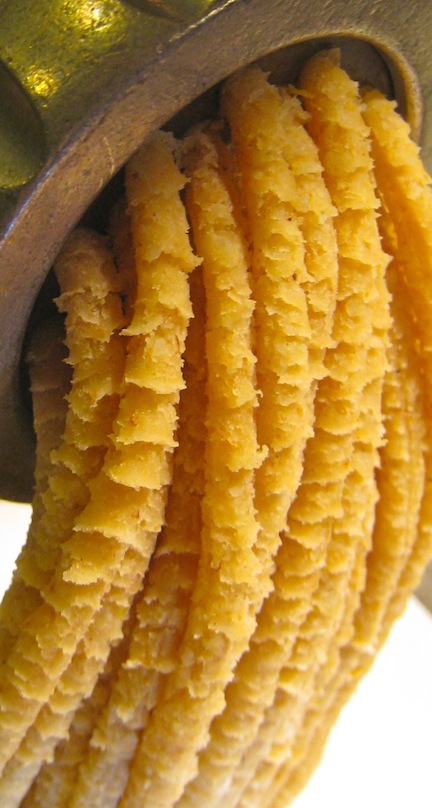
Let me start this post by stating that, when I was a boy, my Mom was the coolest Mom on the block. After I’d spent a morning hard at play, manufacturing Creepy Crawlers with my Mattel Thingmaker, guess what she served for lunch? Worms. That’s right, WORMS! How cool was that? Granted, we didn’t have actual worms for lunch but we did have passatini, a far more appetizing and tasty alternative. Sometimes called passatelli, passatini are noodles, of a sort, made with bread crumbs & cheese instead of flour and lightly flavored with lemon rind and nutmeg. The noodles themselves are extruded using a special press, a large-holed ricer, or a meat grinder. Once made, they can be added immediately to a pot of boiling stock or placed in single layers on baking sheets to be frozen. After a couple of hours, the now-frozen passatini may be gently placed into a container and stored in an area of the freezer where they won’t be disturbed. As you may have guessed, these noodles are more delicate than most and care needs to be taken when storing them. On the other hand, this recipe can be halved easily, thereby eliminating the need for freezing altogether. Whether freshly made or previously frozen, a steaming bowl of passatini is a meal fit for the coldest of Winter’s days. And if you happen to be serving children of a certain age, you, too, can be as cool as my Mom.

*     *     *

Passatini Recipe

total time: approx.  30 minutes

Ingredients

  • 4 large eggs
  • 2 cups bread crumbs
  • 1 to 1 1/2 cups grated cheese (parmesan or romano)
  • 1/2 tbsp lemon rind
  • 1/2 tsp ground nutmeg
  • chicken stock (vegetable stock may be substituted for a vegetarian diet)
  • grated cheese for serving

Freshly Pressed

Directions

  1. Combine dry ingredients in a large bowl.
  2. Add eggs and mix until a dough is formed. (I use my stand mixer and paddle attachment.)
  3. Form into a ball, cover, and let dough rest for 10 minutes.
  4. Using a large-holed potato ricer or meat grinder, extrude the passatini and place in a single layer on baking sheets, to be used immediately or frozen for later use, as explained in my comments above.
  5. Bring a pot of stock to boil, add the passatini, and reduce to a medium simmer. When the passatini begin to float, cook for 3 to 4 minutes more and serve.
  6. Be sure to have grated cheese available for you and your dinner companions.

Variations

I’ve seen recipes for passatini that include ground meat and even bone marrow, although I’ve never tasted them prepared in that way. I like my worms just the way they are.

*     *     *

Gobbi (Cardoni)

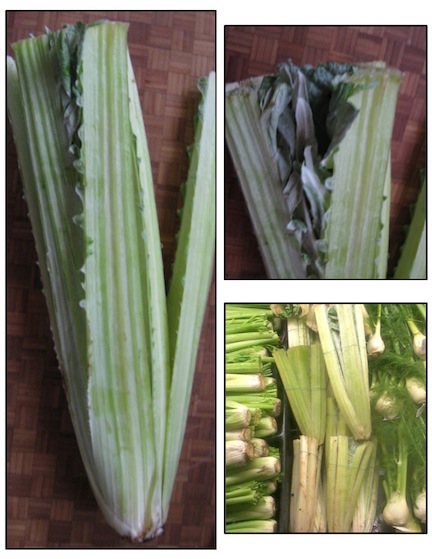
Whether you call them gobbi, cardoni or cardi, in Italian, or cardoons, in English, this vegetable may look like celery — on steroids! — but don’t be fooled. Gobbi are actually a distant cousin of artichokes and their tastes are surprisingly similar. Moreover, like the artichoke, gobbi have thistle-like characteristics which must be dealt with before serving.

Gobbi

To begin, you may need to discard one or two of the outer stalks if they are too large or have been badly bruised. Like celery, the inner stalks of the bunch will grow lighter in color and more leafy as you get closer to the center. Although some may enjoy the leaves, my family does not and trims them away. The back of the stalks have long filaments or strands running their full length, similar to celery. These, too, may be trimmed and a vegetable peeler can handle them. The last parts of the vegetable to be trimmed are the stalks’ edges. A knife or vegetable peeler will get the job done. Once a stalk is trimmed, it should be cut into 1 to 2 inch pieces and then placed in a bowl of cold, acidulated water. (That’s a fancy term for water into which the juice of a couple of lemons has been added.) This will help keep the pieces from turning brown as you trim the remaining stalks. Once trimmed, you’ll need to address gobbi’s inherent bitterness, which reportedly grows stronger as the plant matures. This can be easily countered by blanching the pieces in boiling, salted water. The length of time required depends upon your taste preference, for the longer they’re blanched, the less bitter they become. You may wish to let them go until they are just about fork-tender. Personally, I don’t mind a little of the bitterness to remain. The rest of the recipe is easy enough to follow.

If you’ve glanced at the recipe below, you may have noticed that it is practically the same as was described in an entry that detailed Mom’s method of cooking Vegetables. So, why a separate post for this one? Well, gobbi are seasonal, arriving in groceries & markets around Thanksgiving and leaving shortly after New Year’s Day. Whenever I see it, I’m reminded of the Christmases of my youth. Unfortunately, it’s been some time since I’ve come across gobbi in a supermarket, the last being 4 or 5 years ago. That time, I bought what little was available and shared my find with Zia. This year, out of the blue, I found it in no less than 4 markets. Why the sudden surge in availability is beyond me but I did take advantage of the situation. As often as I could, I bought some, cleaned & blanched it, and then froze it for future meals. Admittedly, I may have overdone it but, then again, who knows whether it will be back next year? I might as well feast on it while I can. Oh, don’t worry. I’ll be sure to bring some to Zia, too.

*     *     *

Gobbi Recipe

total time: approx. 30 minutes (includes prep time)

Ingredients

  • 1 head of gobbi, trimmed, cut, & soaking in acidulated water
  • 2 tbsp extra virgin olive oil
  • 2 cloves garlic, sliced
  • salt & pepper, to taste

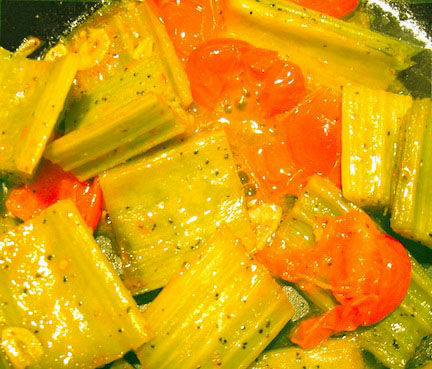
Gobbi Sautéed with Tomato & Garlic

Directions

  1. Place gobbi into a large pot of boiling, salted water. Return to boil and then reduce to a gentle simmer.
  2. When the gobbi has reached the desired tenderness and taste, remove from heat and drain away the water. To retain its green color, the gobbi may be placed immediately into an ice bath.
  3. Heat oil in a frying pan over medium heat. Add garlic and sauté for no more than two minutes before adding the blanched gobbi. Season with salt & pepper to taste.
  4. Continue cooking until the gobbi are fork-tender and heated through.
  5. Serve immediately.

Variations

  • The recipe, as written, is pretty straight-forward. I like to include a little tomato, “for color.” Just after adding garlic to the frying pan, I’ll add either some diced tomato, a little tomato paste, or, as pictured above, a few cherry/grape tomatoes that have been halved. A little chopped onion or shallot may be added, as well, but if you do,  sauté them for a few minutes before adding the garlic.

*     *     *

Fiocchetti

Fiocchetti

I was trying to find a recipe when I ran across one that I hadn’t thought about or tasted in decades. Fiocchetti are a sweet treat that Mom would make for us kids on occasion and I’ve just learned that they’re a popular item throughout Italy during Carnivale. (Who knew?) Depending upon where you are in Italy, fiocchetti  may be called: “chiacchiere”, “manzòle”, “bugie”, or “risole”. No matter what you call them, basically, they’re all the same: thin strips of sweetened dough that are deep-fried and coated with sugar. After reading that description, you can probably guess why Mom only made them for us “on occasion” and no more often than that.

“Fiocchi”

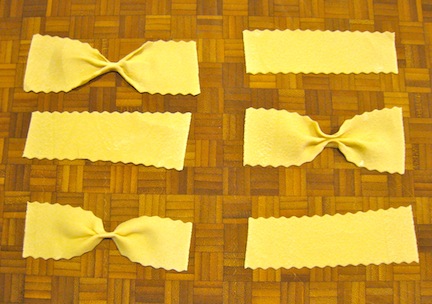
The word fiocchetti is derived from the word fioccho (pl. fiocchi) or ribbon(s). The strips, if left alone before frying, do indeed look like pieces of ribbon. Mom, however, would pinch each strip in its center, making them look like over-sized farfalle. She referred to them as either angel wings or bow ties. I can remember eating one, alone in my room, that I had stolen from the stove top while Mom was distracted. (Yeah, like a six-year-old would be able to pull off anything in that kitchen with Mom standing right there.) It was a recurring theme in our house. Mom would be cooking some treat and we three juveniles would be falling over each other trying to steal away a sample or two. It’s a wonder that any of them ever made it to the table.

*     *     *

Fiocchetti Recipe

total time: about 90 minutes, includes 60 minutes for dough to rest.

Ingredients

  • 2 cups all-purpose flour, plus as much as 1/4 cup more
  • 2 whole eggs
  • 2 egg yolks
  • 2 tbsp rum
  • 1 tbsp confectioners sugar
  • 1/8 tsp salt
  • oil for frying
  • additional confectioners sugar

Directions

  1. Mix together all ingredients and combine as if making pasta. Form a large ball.
  2. Put 1/4 c flour on work surface and knead dough, using as much of the flour as necessary to create a smooth and shiny dough. This should take about 10 minutes
  3. Cover in plastic wrap and refrigerate for at least one hour.
  4. Roll out dough until very thin and cut into strips about 6 inches long and from 1 to  3  inches wide, depending on your preference. If you like, pinch the center of each strip to create a bow-like shape.
  5. Deep fry in hot oil that has reached 350*. It should only take a minute or two for them to turn golden brown. Remove and drain on paper towels.
  6. Sprinkle with confectioners sugar before serving.

*     *     *

Mom’s Chicken (that’s not really) Cacciatore

I Dig It Mom's Way

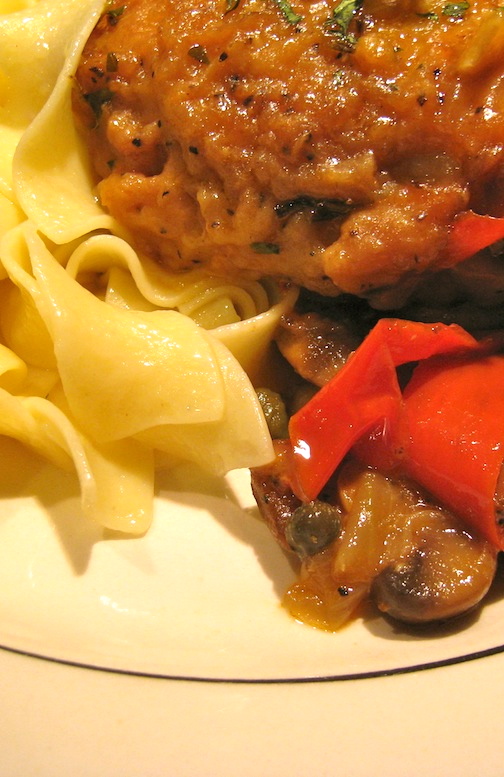
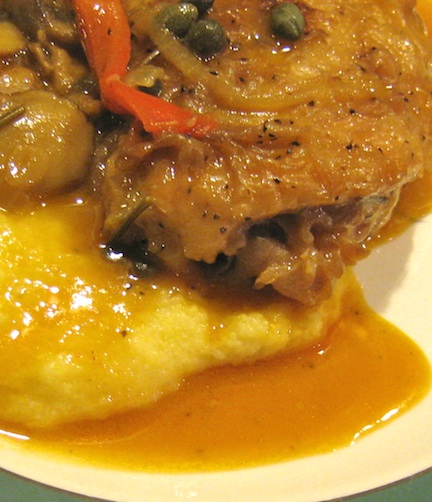
Traditionally, pollo alla cacciatore (hunter-style chicken) features chicken, pan-braised in a tomato sauce with mushrooms, served over pasta, very often spaghetti. I say “traditionally” because this is not the cacciatore Mom made. Her recipe did not result in a tomato sauce and Mom never served this dish over pasta. Although I will agree with the purists who’ll be quick to point out that this is not a true cacciatore, I very much prefer it Mom’s way if, for no other reason, than that I already make a number of tomato-based sauces. Making another one with chicken holds little interest for me. All of this doesn’t mean that tomatoes aren’t used in this recipe. I’ll add a diced tomato or about a tbsp of tomato paste “for color,” as Mom would say. Additionally, this recipe uses chicken thighs with the skin-on and bone-in because the combination adds so much flavor to the final dish. Of course, you may use whatever chicken parts you wish, with or without skin or bones, but your choices may affect cooking times. Use an instant read thermometer when in doubt. If you do not wish to use wine, one cup of chicken broth/stock may be substituted.

*     *     *

Mom’s Chicken (that’s not really) Cacciatore Recipe

total time: about 75 minutes.

yield: 5 or 6 servings

Ingredients

  • 1 pkg chicken thighs (5 or 6 thighs), with bone-in and skin-on
  • 2 tbsp extra virgin olive oil
  • 3 slices of bacon (or 1/4 lb. of pancetta),  chopped
  • 1/3 cup all-purpose flour
  • 1 large yellow or sweet onion, halved and sliced
  • 3 cloves garlic, sliced
  • 1 bell pepper, cut into strips
  • 8 oz. crimini or button mushrooms, sliced
  • 1 tomato, diced, or 1 tbsp tomato paste
  • 2 – 3 tbsp fresh rosemary, chopped
  • 1 cup white wine (or low-sodium chicken stock/broth)
  • 3 tbsp capers (optional)
  • 3 tbsp fresh parsley, chopped, for garnish
  • salt & pepper, to taste

Directions

  1. Heat olive oil in a large frying pan with lid over medium heat. Add bacon/pancetta and cook until crisp and the fat is rendered. Remove meat from pan and drain over paper towels.
  2. Meanwhile, season chicken with salt & pepper. Place flour in a plastic bag, place 2 chicken pieces in bag, and shake to coat. Remove chicken to a plate and repeat until all the chicken is coated with flour.
  3. Once the bacon/pancetta has been removed from the frying pan, increase the heat to medium-high and add the chicken pieces, skin-side down. Sauté until chicken is lightly browned, about 5 – 6 minutes, turn the chicken pieces over, and sauté until they, too, are lightly browned — another 5 minutes or so. Remove chicken to a plate.
  4. Remove all but about 3 tbsp of oil from the frying pan. Add the onion and begin sautéing. Lightly season with salt & pepper. Use a wooden spoon to clean the pan’s bottom of the brown bits. (These are where the flavor is.)
  5. After about 5 minutes, add the garlic & bell peppers and continue sautéing.
  6. After 5 minutes more, add the mushrooms.
  7. 5 minutes later, add the tomato/paste and sauté for 2 – 3 minutes. Season lightly with salt & pepper.
  8. Return the bacon/pancetta to the pan, season with the rosemary, return the chicken to the pan, and add the wine.
  9. Bring the pan to a boil before covering and reducing heat to medium-low.
  10. Continue cooking for 45 minutes or until chicken is fully cooked. (Use an instant read thermometer if in doubt.) Periodically, throughout the cooking, slightly shift the chicken pieces to prevent their sticking/burning. If the pan looks too dry, add a little water/chicken broth.  A few minutes before serving, sprinkle the capers over the pan’s contents. Taste the sauce to see if salt or pepper is needed.
  11. When finished cooking, remove to a serving platter and garnish with parsley.

Variations

Strictly speaking, I do not have any variations for this recipe. It’s pretty much the same recipe that Mom used. Where we part ways is in the serving. As was mentioned earlier, Mom never served her cacciatore over pasta.  On the other hand, I’m a pasta fanatic and I’m always on the look-out for ways to include pasta in a meal. For me, this recipe is delicious when served over wide noodles that have been buttered and lightly sprinkled with freshly chopped parsley. And on those extremely rare occasions when I’m not in a pasta mood, I’ll serve it atop polenta. Either way is aces in my book.

*     *     *

Spinach-Ricotta Stuffed Shells

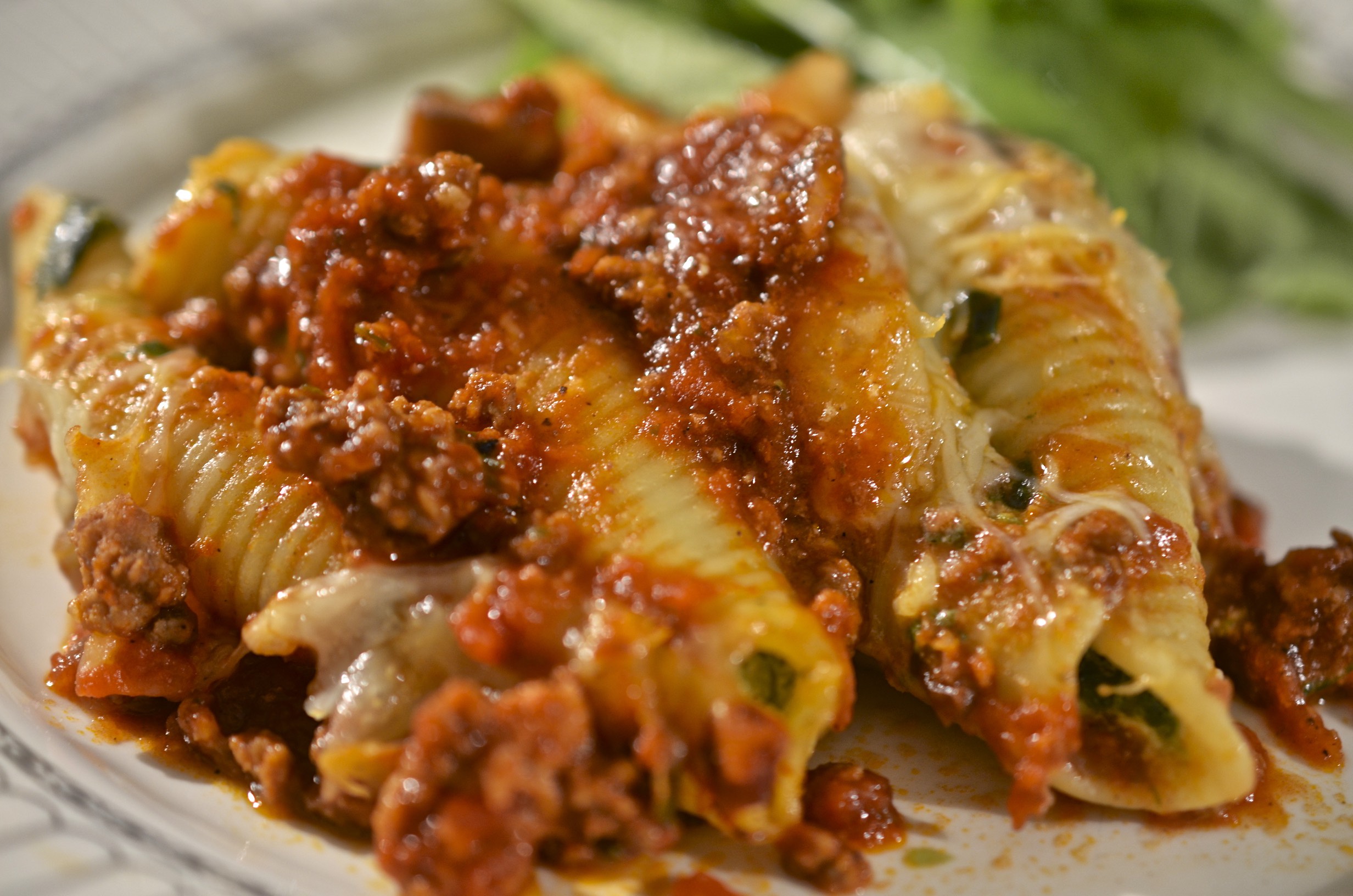
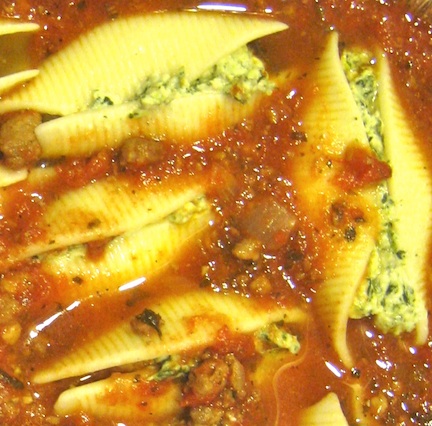
New ShellsLet me be clear about something. I love stuffed pasta shells. A cinch to make, they are the perfect blend of ricotta cheese, spinach, & pasta. I realize that some may feel that the same could be said for lasagna and they’d be correct, for the most part. My family’s lasagna recipe, however, doesn’t include ricotta, making it relatively unique, as far as lasagna goes. What’s more, we use very little ricotta in other recipes so these shells are a real stand out. In my last post, I described making ricotta and shared a recipe that yields about 2 pounds of the cheese. Well, that’s a lot of ricotta, as I soon found out. When all was said and done,  I had filled four 9 x 9″ aluminum cake pans with 12 shells apiece. (1 tray was destined for the oven; 2 for delivery to friends; and 1 was frozen.) I used that cooking experience as a guide for today’s recipe and halved the recipe, using 1 pound of ricotta. By the way, if you’re vegetarian or limiting red meat in your diet, use a marinara sauce instead of one with meat.

*     *     *

Spinach-Ricotta Stuffed Shells Recipe

total time: about 90 minutes. yield: about 24 shells.

Ingredients

  • 1 pound fresh ricotta (1/2 of home-made ricotta recipe)
  • 1 – 10 oz. pkg frozen chopped spinach, cooked and well-drained
  • 1 c grated parmesan cheese
  • 2 eggs, slightly beaten
  • 1 tsp kosher salt
  • 1/8 tsp ground nutmeg
  • 1 quart pasta sauce, marinara or meat-based
  • water
  • 1 box jumbo pasta shells, cooked following package directions, reserved in cold water.
  • 1 cup grated mozzarella, or more to taste

Directions

  1. Pre-heat oven to 350*. Butter one9 x 13″ baking dish/pan.
  2. Place ricotta, spinach, parmesan cheese, eggs, salt, and nutmeg into a bowl and combine, either by hand or using a stand mixer, until well-blended.
  3. Add about 2/3 of the sauce to the baking dish with a little water.
  4. One by one, fill each shell with 1 1/2 to 2 tbsp of the filling mixture and place in the baking dish.
  5. When the tray is filled, drizzle remaining sauce over the tops of the stuffed shells. Sprinkle with mozzarella and cover with aluminum foil.
  6. Place on oven’s center rack and bake for 30 minutes. Remove foil and continue baking for 15 minutes more.
  7. Remove from oven, let rest at least 5 minutes, and serve.

Variations Instead of spinach, cooked & chopped Swiss chard or broccoli rabe (rapini) may be added to the cheese before stuffing the shells. For a cheesier dish, use a few tablespoons of chopped, fresh basil or parsley in place of the spinach.

Notes

Extra shells may be frozen using either of 2 methods:

  1. Perhaps the easiest way to freeze them is to place the stuffed shells on a baking sheet lined with wax paper. Place the tray in the freezer and, after at least 2 hours, remove the shells and place in a container suitable for storage in the freezer. I wouldn’t suggest freezer bags because the pasta shells get rigid when frozen and bags may not offer enough protection. When you wish to cook them, treat the frozen shells as you would fresh and place them in a baking dish filled partway with sauce. Cover with foil, pace on center rack, and bake for 1 hour in a pre-heated 350* oven. After 1 hour, remove foil and insert tip of knife into the cheese of one of the shells in the middle of the tray. After a few seconds, remove knife and feel tip. If it’s just warm, cook, uncovered, for 15 minutes more. If the knife tip is hot, continue baking, uncovered, until the cheese on top is to your liking. If the knife tip is cold, the cheese isn’t heated. Put foil back onto the tray, cook for another 15 minutes, and test again.
  2. Alternately, you can prepare the shells in a tray as normal but put them in the freezer instead of the oven. Later, place them, covered with foil, in a 350* pre-heated oven for 1 hour. Refer to the prior note for testing the shells for doneness.

*     *     *

Home-Made Fettuccine, Linguine, Capellini

This is more an informational page than a recipe. As such, it only involves making the pasta noodles. Should you wish to see the pasta dough recipe, please refer to Mom’s Pasta Dough recipe.

Fettuccine

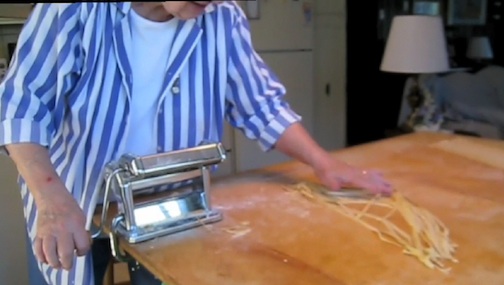
As was mentioned in the pasta dough entry, Mom cut the sfoglia by hand for much of my youth. Occasionally, I’ll do it myself although, to be honest, the width of my noodles aren’t nearly as consistent as were Mom’s. Whereas hers were perfect trenette, mine are more a collection of the various noodle sizes known to Man. Either way, thick or thin cut, you just can’t beat the taste of home-made pasta.

Although I follow Mom’s recipe for making the dough, I roll it into sheets using an attachment for my Kitchen Aid stand mixer, before using a hand-cranked machine to cut the noodles. Mom, as has been mentioned, used a machine with a hand-crank to roll out her dough and cut it into noodles. Both types of rolling devices work under the same principle. The dough is passed between 2 rollers, which are manually set at varying widths. Using the Kitchen Aid attachment as a guide, the no. 1 setting is where the rollers are at their widest, producing a very thick sheet of dough; no. 10 setting will produce an extremely thin dough strip. The relative thickness of the dough strips will depend upon their eventual use. When needed for lasagna, I stop after they’ve passed through the no. 5 setting. For noodles, I stop after setting no. 6. I use the same setting for large ravioli but will use no. 7 for small ravioli, where there isn’t so much filling. Zia, on the other hand, prefers to use no. 5 for her lasagna and noodles, with no. 6 being used for all of her ravioli. Again, let your own palate be your guide.

*     *     *

Home-Made Fettuccine, Linguine, Capellini

total time: approx.  45 minutes (includes drying time)

Ingredients

  • 1 1/2 lbs. fresh dough, made using Mom’s Pasta Dough recipe
  • extra all-purpose flour for dusting the work surface and pasta sheets

Directions

  1. Be sure the dough has been allowed to rest at least 15 minutes before starting to roll it.
  2. Using a knife or dough scraper, separate a ball of dough, roughly the size of a very large egg. With your hands, flatten the dough somewhat, making a square. Set your machine’s rollers to the widest setting and dust the rollers with flour.
  3. Place one edge of the dough between the rollers and turn the crank, causing the dough to grow thinner as it passes through the rollers. Lightly flour the dough, fold it in half upon itself, and pass it through the rollers again. Repeat this, without adjusting the rollers, a few times.
  4. Get another dough “egg” and repeat steps 2 & 3. In fact, get as many dough “eggs” as you are comfortable handling. Just remember to keep the remaining dough covered while you work with the “eggs.”
  5. Once you have rolled a few “eggs”, adjust the rollers to the next setting and pass each dough sheet through the rollers. If the dough is at all sticky, dust the sheets with flour. When all the sheets have been rolled, fold each in half and send through the rollers again.
  6. Adjust the rollers and repeat Step 5, again and again, until the strips are the desired thinness. You shouldn’t need to flour the strips between passes through the rollers.
  7. At this point, the dough strips will need to dry a bit before cutting. This could take anywhere from 5 to 20 minutes, or so. Much depends on your home’s temperature and humidity. If the strips aren’t dry enough, the freshly cut pasta will stick together and you’ll need to separate the noodles by hand. Just as strips that are too moist are a problem, so are strips that are too dry. In the latter case, the dough will crack & break during the cutting process. The dough strips need to be pliable.
  8. Once the sheets are suitably dried, pass them through the cutting rollers on your machine. Work the crank with one hand as you catch the noodles with the other. The freshly cut pasta may be lightly formed into bird’s nests or spread out on baking sheets, table tops, or floured towels. The pasta may be cooked immediately or allowed to dry completely, which should occur relatively quickly. If heat and humidity are a problem, freeze the freshly cut pasta to prevent mold from developing. Your pasta will store for weeks, whether dried or frozen, but the sooner used the better.

Variations

The steps outlined above use a machine to cut the fresh noodles. You can, if you like, try cutting them by hand. Take a strip of dough and fold it in half, thereby reducing its length by half. Fold it again in half, then again, and again, and again. The result should be a multi-layered dough strip about 2 – 3 inches wide. This is called sfoglia. Starting at one end and using a sharp knife, cut strips as thin as you like. Once the entire sfoglia has been cut this way, unfold the thin strips and these are your noodles.

*     *     *

Mom’s Pasta Dough

Hand-Rolling the Dough

Making pasta at home sure has changed a lot, just during my lifetime. For centuries, Italian women took a mound of flour, made a volcano-like cavity in its center, added a few eggs or some water, and slowly started combining the 2 ingredients. Eventually, a ball of dough would be formed, which they would knead before setting it aside to rest. (Let’s be clear: it’s the dough that rested.) Then, using long rolling pins, they rolled out the dough into huge sheets, 3 to 4 feet in diameter, and as thick as that day’s pasta required. The sheets would be laid somewhere to dry a bit before being folded repeatedly upon themselves to make sfoglia, which was then cut by hand with a sharp knife. It was the width of the noodle that determined the pasta — i.e., extremely thin: capellini (angel hair); somewhat thicker: spaghetti; a little thicker: trenette; a shade thicker: linguine; thicker still: fettuccine; etc. I think you get the idea. For generations, this is how pasta was made and our house was no different.  I have fond memories of the women of the house wielding their rolling pins; of wheels of dough drying on floured sheets covering tabletops, beds, and even the backs of chairs; of the family dog being banished while the dough dried; and, of the sound of Mom’s knife quickly cutting perfectly sized linguine, while holding a conversation with one of us or whomever entered her kitchen — and it was her kitchen. Then, about the time I entered high school, everything changed. Our family’s first pasta machine was purchased.

Sfoglia

Although relatively commonplace now, I’ve no idea how widespread their use was in the late 1960’s. I do know that Mom got her machine first and that things changed from that day forward. Mom’s long rolling-pin was all but retired. (She gave it to me a few years before she died.) Instead of round wheels of dough drying around the house, there were now strips of dough — and far fewer of them. You see, if you didn’t have to hand-roll the dough, you could do it more often and make less when you did. More change was to come when my sister and I bought Mom a food processor. Gone were the flour mounds and volcanoes, replaced by a 30 second whirl in this beauty built by Cuisinart.
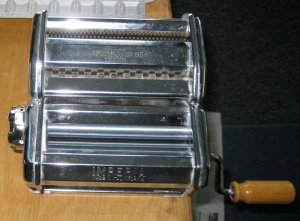
Pasta Machine

Against this backdrop of technological advancement stood my Dad, a bit of a “pasta purist.” He insisted that he could tell the difference between pasta that was hand-rolled and that which was rolled by machine. As my sister lovingly recalls, if Dad noticed Mom preparing to make pasta that morning, he’d remind her of the benefits of rolling the dough by hand and ask that she do so. Mom would agree and a satisfied Dad would leave for work. Dad’s car was barely down the street when Mom went to the cupboard and pulled out the machine. (As I mentioned, it was her kitchen.) Later, at dinner, the hint of a wry smile would grace Mom’s face as Dad praised her “hand-rolled pasta.”

Pasta dough recipes abound on the internet. Just google “pasta dough recipe” and you’ll see what I mean. The one constant that all of the recipes share is that there is nothing exact about making pasta dough. For starters, not all “Grade A Large” eggs are created equal; some are larger than others. As for the flour, not only do you have to contend with differences between the kinds of flour, things like humidity and how you measure it will affect your dough, as well. These things may seem minor but you have to remember that as little as a tablespoon of liquid can make your dough too wet or, if it’s lacking, too dry.
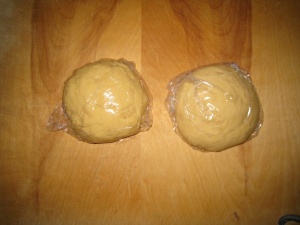
Double Batch

Dough at Rest

This recipe was given to Mom by long-time family friend, Emilia, who had converted a few recipes for preparation using a food processor. (“Milia” and her husband were my brother’s god-parents.)  I follow this recipe because it uses a specific amount of liquid, thereby removing any variance resulting from eggs of differing sizes. Though flour-related variables may remain, at least we’re using a constant amount of liquid. Beyond that, one thing is certain: when making pasta dough, experience is the most important ingredient.

This post will only cover making pasta dough. Future posts will detail its uses.

*     *     *

Pasta Dough Recipe

makes about 1.5 lbs

total time: approx. 45 minutes (includes 30 minutes rest)

Ingredients

  • 2 3/4 to 3 cups all-purpose flour
  • 4 whole large eggs + enough water to equal 1 cup of liquid. Egg should be allowed to sit on a counter for about 30 minutes before use.

Directions

  1. Place all ingredients in food processor and mix until a ball of dough forms, about 30 seconds. Place dough on floured work surface.
  2. Dough should not be stick to your fingers but should be moist enough to form a cohesive ball.
  3. Begin kneading the dough, adding flour or water, in small amounts, as required. Knead until a smooth dough is achieved, at least 5 minutes. The longer you knead the dough, the better the pasta’s texture will be.
  4. Cover with plastic wrap and set aside for at least 15 minutes or up to an hour. If dough is to be rested longer than an hour, place it in the refrigerator. When removed from the refrigerator, temper the dough by leaving it on a counter for 30 minutes before using.

Variations

  • I prefer to add a pinch of salt and a dash (about 1/8 tsp) of olive oil to my pasta dough.
  • For green (verde) noodles, mix a couple of tablespoons of finely chopped spinach with the flour before adding the egg liquid to the food processor. Zia recalls that, years ago, they used spinach baby food when making pasta verde. 

*     *     *

Biscotti

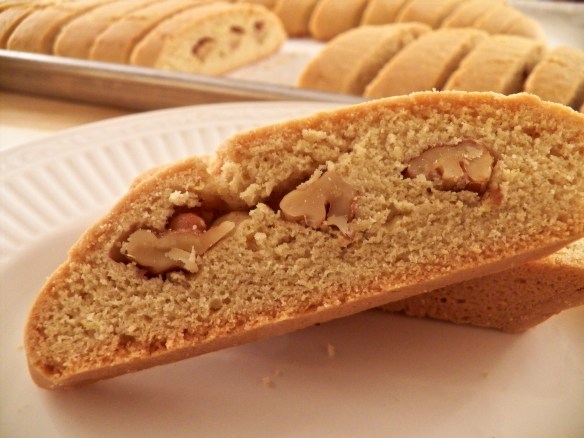
Like many households, the Thanksgiving to New Year’s Day holiday season at our house was a special time each year, complete with its own set of dishes and treats. These biscotti fit into that group, although I don’t know why. It’s not as if they’re festive-looking, like sugar cookies decorated to look like Santa or Christmas trees. Nor are they part of some widely accepted food tradition, such as eggnog at Christmas or turkey on Thanksgiving. Yet, the first of these biscotti would quietly make their appearance in our homes sometime around Thanksgiving and, come January, they would leave just as quietly. To this very day, Zia gives each of us some biscotti sometime during the holidays — and it wouldn’t be Christmas without them.

These two recipes came to the family via different paths. The first, Mom’s Pecan Biscotti, was given to her when I was a boy by a friend of the family who was, at the time, 90 years young. Our two families had ties that could be traced back to San Marino. The second recipe, Zia’s Anise-Flavored Biscotti, has been a part of Zia’s repertoire ever since she found the recipe in a Detroit News article some 50 years ago. Each year before the holidays, Mom and Zia would set aside one day for baking biscotti.  Mom would make the biscotti with pecans and Zia the anise-flavored. At day’s end, each would take half of  her biscotti and trade it for half of her sister’s. Generally speaking, we kids loved dipping the pecan biscotti into our milk, while the adults preferred to enjoy their anise-flavored biscotti with coffee after dinner. Should you decide to make both recipes at the same time, be sure to store the 2 kinds of biscotti separately. When stored together, it isn’t long before the pecan biscotti begin to take on the scent of anise.

*     *     *

Mom’s Biscotti with Pecans Recipe

cook time: approx.  1 hour total

Ingredients

  • 8 eggs
  • 1 lb.  powdered sugar
  • 1/2 cup granulated sugar
  • 3/4 lb. butter, softened
  • 2 heaping tsp baking soda
  • 9 cups of flour, sifted
  • Grated lemon rind from at least 2 lemons
  • Whole pecans (walnuts may be substituted)

Directions

  1. At medium speed, beat sugar and butter together until very light. Add eggs, one at a time, and continue beating until well-blended. At low-speed, add the lemon rind and baking soda. Gradually add the flour and mix well. The resultant dough will be pretty stiff.
  2. Divide the dough into 6 equal portions. Roll each into a rectangular shape, about 12 inches long. Line the center of each with the pecans and roll to form loaves that are about 11 inches long by 5 inches wide. Do not over-load with pecans because the loaves will crumble when you slice them later.
  3. Place the loaves on greased, floured baking sheets and bake in a pre-heated 350* oven for 30 minutes. Slice them while warm; they’ll crumble if you wait too long.

If you prefer to have them toasted, remove them from the oven after they have become a pale golden brown — usually in 15 – 20 minutes. Slice them, place them on their side, and return them to the oven for an additional 10 to 15 minutes. Turn them over midway through the cooking time.

*     *     *

Zia’s Anise-Flavored Biscotti Recipe

Note: Anise is a licorice-tasting herb common to the Mediterranean area.

cook time: approx.  1 hour total

Ingredients

  • 5 cups of flour, sifted
  • 6 eggs
  • 2 cup granulated sugar
  • 1/2 cup butter, softened
  • 4 tsp baking soda
  • 1/2 tsp baking powder
  • 1/2 tsp salt100_2314
  • 1 small bottle anise extract (approx. 2 tbsp)

Directions

  1. Sift flour, baking soda and powder together.  Set aside.
  2. In another bowl, beat butter with sugar on medium speed till creamy. Add eggs one at a time. When finished, add the anise flavoring.
  3. Slowly add flour mixture and beat at low-speed till well-blended. If the dough feels too stiff, add an extra dab of butter.
  4. Divide mixture in half and then half again. Form a loaf from each quarter and place 2 loaves on each baking sheet. Bake in a pre-heated 350* oven for 30 minutes. Slice them while warm; they’ll crumble if you wait too long.

If you prefer to have them toasted, remove them from the oven after they have become a pale golden brown — usually in 15 – 20 minutes. Slice them, place them on their side, and return them to the oven for an additional 10 to 15 minutes. Turn them over midway through the cooking time.

*     *     *

Vegetables (Verdure)

While growing up, Mom introduced us to a number of vegetables, with varying degrees of success depending upon the person. (Yes, I’m looking at you.) For the most part, she used one method when cooking vegetables and it’s pretty much the same as is used throughout Italy. I mention this, particularly the latter part, because we Americans tend to like our vegetables to be cooked but with some crispness retained. Well, not to disappoint anyone, but I’ve eaten my way across Italy a few of times and I’ve yet to be served a vegetable that was cooked al dente. It’s just not done, I’m afraid, but that doesn’t mean that the dishes aren’t tasty or are any less desirable. Besides, some, like kale or rapini, may be a little bitter while others, like Swiss chard, may have ribs or stems that are a little tough. This method of cooking will cut some of that.

Rainbow Chard

Although the recipe below mentions Swiss chard specifically, it’s the technique and not the vegetable that’s important. Briefly, you bring a pot of salted water to boil, blanch the vegetable for a few minutes, and sauté it in garlic-flavored extra virgin olive oil. Now, if you’ve watched any televised chefs, you’ve seen them do this, or something very similar, but they will place the vegetable in cold water after blanching. This will insure that the vegetable retains its brilliant color and, if I’m entertaining, I’ll do it, too. But I don’t entertain every night and placing them into an ice bath just adds another step and more time to my dinner prep, not to mention another dish to clean. I guess what I’m trying to say is that I don’t chill ’em if it’s just Max and me for dinner. Being color blind, he’s not likely to object.

*     *     *

Swiss Chard

serves 2

total time: approx.  30 minutes

Ingredients

  • 2 – 3 tbsp extra virgin olive oil
  • 3 cloves garlic, crushed
  • 1  bunch of Swiss chard.
  • 1 small yellow onion, sliced
  • 1 tsp salt
  • salt and pepper, to taste

Directions

  1. Add olive oil and garlic to a medium-sized frying pan and heat at medium until the garlic begins to brown, a few minutes. Discard the garlic, add the onion, and sauté until it becomes fully translucent and before caramelization starts.
  2. While the garlic is flavoring the olive oil, fill a medium sauce pan with water and bring to a boil.
  3. Meanwhile, clean and prep the chard. Leave as much of the stems as you find palatable. Separate the stems from the leaves and chop the stems into pieces no larger than one inch long. Rough chop the leaves into pieces slightly larger than you would for a salad.
  4. When the water boils, add the salt and then the chard stem pieces. The length of time the stems stay in the pot depends on how crisp you like them. The less time they boil, the more al dente they’ll be. A little before the stems are cooked to your liking, add the chard leaves to the pot.
  5. After 2 minutes, strain everything out of the boiling water and add to the frying pan with the onion. Be careful: the oil may splatter when it comes in contact with the wet chard.
  6. Raise the heat to medium-high, season with salt and pepper, and sauté the chard and onions until cooked to your liking. Serve.

Variations

Rather than list variations, here are some of the vegetables that can be cooked utilizing this method: rapini, asparagus, kale, broccolini, broccoli, cauliflower, green beans, cabbage, and even brussels sprouts. Some, like rapini or kale, may need more time sautéing, while others, like brussels sprouts will, also, need a lengthier time in the boiling water. You should skip the blanching altogether when you’re cooking delicate greens, like baby spinach, frisée, or arugula. Whether to include onions or, as pictured, a little tomato, is up to you and learning to flavor olive oil with garlic before sautéing is a neat trick. So, go ahead and give ’em a try. Let Common Sense and your own palate be your guides.

*     *     *

Pieda

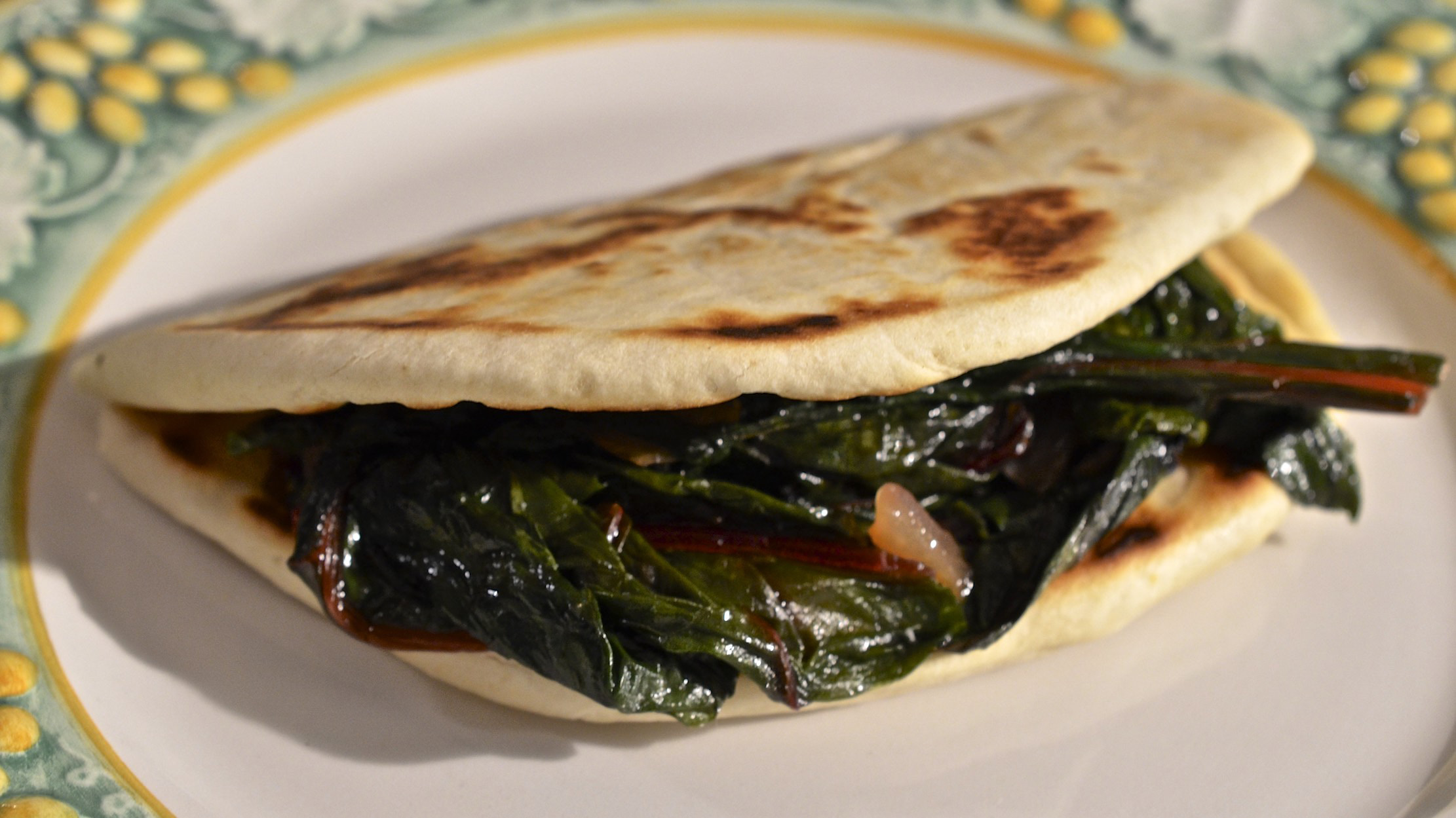
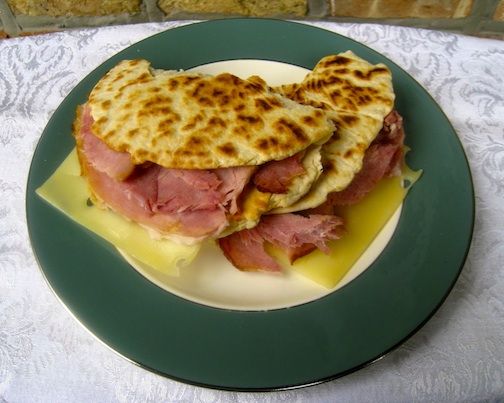
Located in the north of Italy, Emilia-Romagna is a collection of provinces, the southern border of which is shared with San Marino and Le Marche. Dad emigrated from San New Pieda 300Marino, Mom’s family from Le Marche. Pieda, today’s recipe, originated in Romagna but it came to our dinner table via San Marino.  It is a simple flatbread, similar to pita or tortillas, and, when folded in half, can be filled with lunch meat, cheese, or a variety of greens.  My family’s favorite was Swiss chard that had been blanched before being sautéed with a little sliced onion in garlic-flavored extra virgin olive oil . (See Mom’s way of cooking Vegetables.) No matter how you choose to fill them, pieda are best when served immediately after cooking.

*     *     *

Pieda Recipe

makes 6 – 8 pieces

total time: approx.  50 minutes (includes 30 minutes rest)

Ingredients

  • 3 cup flour
  • 1/3 cup Crisco (vegetable shortening)
  • 1 tsp baking powder
  • 1 cup milk

Directions

  1. Place all ingredients in food processor and mix until a ball of dough forms. Cover with plastic wrap and refrigerate for 30 minutes.
  2. Remove a small amount of dough and, using a rolling-pin, roll it out until it is about 6 inches in diameter and no less than 1/8 inch thick.
  3. Cook in a hot, non-stick frying pan over medium-high heat. It should only take a few minutes per side. Use a fork to prick any bubbles that may form during cooking. A side is done when it is mottled with brown spots of varying sizes.
  4. Place cooked pieda on a warmed dish in a warm oven until all are finished. Serve immediately.

*     *     *