Ravioli dei Bartolini

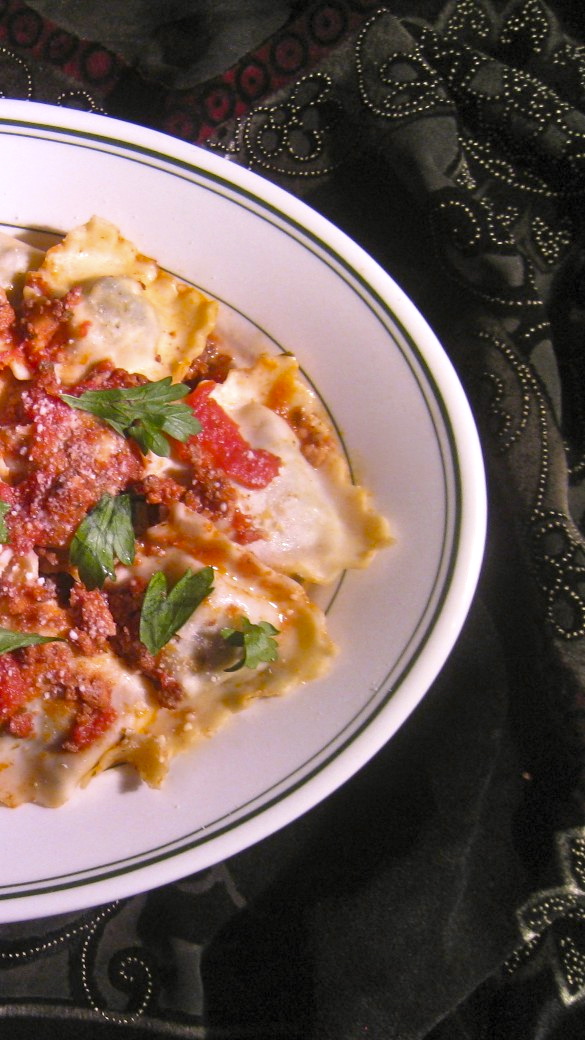
Happy Columbus Day everyone! And what better way to celebrate the Holiday than to share one of the Bartolini Clan’s favorite holiday recipes. Say the word “ravioli” to any of the old 2-flat’s former residents and you’re sure to conjure up memories of holidays past, specifically Christmas, New Year’s, and Easter. No matter which of the 2 dinner tables you visited on those evenings, there would be a large platter of ravioli taking center stage. (It was present on Thanksgiving, too, but The Bird was the star of that show.) As a kid, my attention was pretty much focused on that platter of pasta pillows — and dessert, of course — and I think the same would have been said by everyone at the tables, save Mom and Zia. Their perspectives would have been entirely different.

One must remember that in those days, the only freezer available to most households was a small compartment above the fridge. Consequently, if you wanted to serve your family ravioli, you made it the same day it was served. Well, there was absolutely no way that Mom and Zia were going to start making ravioli on a holiday afternoon. That meant that most holiday mornings, they were up at 5:00 am making ravioli for that evening’s holiday dinner. And then there was Christmas. We were allowed to get up during the night to discover what Santa had brought us and to play with our toys. It wasn’t until years later that we learned how our parents no sooner got the gifts wrapped and under the tree when we came charging out of our bedrooms. Mom and Zia were lucky to get a couple of hours of sleep before they started making ravioli. And they weren’t making just a few ravioli. They made enough for everyone at each of the two holiday tables, which often included guests as well as each family. For Mom, that meant ravioli for as many as 12 people. To this day, I don’t know how they did it.

It really is a shame that there are no pictures of these women making pasta and ravioli, for it really was something to see. Mom would make the filling the night before and store it in the fridge. (Woe be the child caught snatching filling from the fridge!) The next day, she would make 8 eggs worth of pasta dough using the “mound” method. (Mound the flour on a large pasta board, make a crater in the center, pour the eggs into the center, and use a fork to slowly bring the flour into the egg mass, being careful not to break the flour wall and allow the eggs to spill out.) Once the dough was made, kneaded, and rested, Mom used her 3+ foot long “rolling-pin” to create thin, circular pasta sheets, 3 – 4 feet in diameter. They were laid to dry by hanging them off the edge of the dining room table, the backs of chairs, even on sheets covering a bed, if one was “open.” Once dry enough, the sheet would be hung off the pasta board’s edge, half on the board and half off. The filling balls were then laid out on the pasta half-sheet in a grid, each equidistant from its neighbors. When they were all positioned, maximizing the surface area, the bottom half of the sheet was  brought up and over, enclosing the filling-covered top half. The long handle of a spoon or spatula was used to seal the pillows. The ravioli were then cut using a pastry cutter, moved to trays, and the next pasta wheel was moved into place. This continued until all the filling was used. The remaining dough, if any, would be hand-cut to form linguine or quadretti. (More about the latter in another post.) Just about the time she was finished cutting the last of the pasta, we kids would come bounding into the kitchen. “Merry Christmas, Mom! What’s for breakfast?”
The purchase of a pasta machine changed all that. Unable to make the large pasta wheels, Mom turned to ravioli dies to make her ravioli. Pictured just below is my collection.  The 2 dies on top are used for ravioli. The one on the top-left makes ravioli that are 2 inches square. That’s just about the size The Sisters were taught to make by hand. The ravioli form on the top-right makes ravioli that are 1.25 inches square. That’s about the size The Sisters made by hand once we kids came into the picture. (Kid-friendly ravioli. Who knew?)  The remaining 3 are used for soup ravioli, which Mom called cappelletti, “little hats.” Though normally rounded, some look similar to tortellini,  the die Mom used (lower left) was .75 inches square. As a result, the word “cappelletti” in our house wasn’t used to describe the pasta’s shape but its use — and that was in soup. Mom gave me her cappelletti die years ago but it’s too small for me to use in any way. (I’ve tried several times but, being ham-fisted, I cannot make the filling “balls” small enough to fit the die.) So, I bought the die on the lower-right. It makes raviolini that are 1 inch square and I use it to make my cappelletti. In the center is a press that makes traditional-looking cappelletti, each 1.25 inches in diameter. I, also, have 2 more ravioli makers, both not shown, but they don’t work very well. One attaches to my pasta machine and the other to my stand mixer. In both cases, they require that the dough sheets be about twice as thick as I am accustomed to using. The result is ravioli that is a bit more chewy than I prefer. What can I say? Mom spoiled us. 

*     *     *

Tools of the Trade

*     *     *

When it come to the pasta dough’s final thickness, let your own palate lead the way. Our pasta machines are calibrated from 1 through 10, with 1 being the thickest setting. Zia prefers to roll her dough up to and including the number 6 setting. I will use the same setting for large ravioli but for the smaller ravioli and cappelletti, I’ll roll the dough one more time, using the number 7 setting.

Once you’ve made the filling and pasta dough, creating the ravioli is easy enough, though time-consuming. Here’s Mom’s Pasta Dough recipe and, on Wednesday, I’ll share the recipe for their ravioli filling. (Future posts will share the filling recipes for sausage ravioli and cappelletti, as well as a few others we’ve tried along the way.) The pictures that follow will guide you through the ravioli making process far better than I ever could describe. Of course, it helps that they feature that world-renowned still photo model, “Zia,” in a sequence of never seen before shots taken where she lives, along the fabulous Michigan Riviera.  Ah, the life of the octogenarian super-model!

*     *     *

How to Make Ravioli
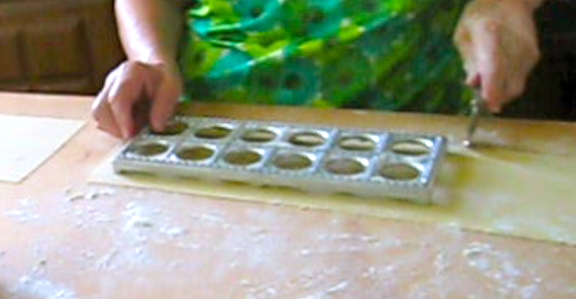
Step One: Cut dough strips into die-sized sheets

*     *     *

Step Two: Cover the die with a dough sheet

*     *     *

Step Three: Place filling across the die

*     *     *
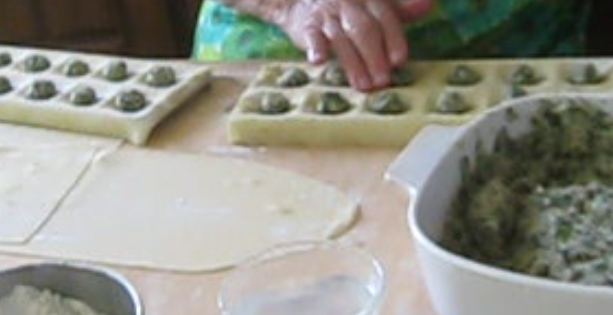
Step Four: Use dampened fingers to moisten ravioli “walls.”

*     *     *

Step Five: Cover filled die with another dough sheet

*     *     *

Step Six: Use a rolling-pin to seal the ravioli

*     *     *

Step Seven: Trim the excess dough

*     *     *

Step Eight: Flip the filled die

*     *     *
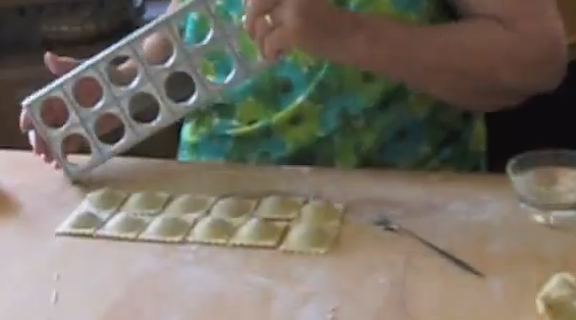
Step Nine: Unmold the ravioli

*     *     *

Step Ten: Lightly puncture the ravioli, meat-filled only

*     *     *

To Cook

  1. Bring a large pot of salted water to a rolling boil.
  2. Add the ravioli, return to boil, then reduce and simmer gently. (If boiled too hard, the ravioli may burst.)
  3. Ravioli normally take 5 – 8 minutes to cook, a couple of minutes more if frozen. Cooking times may vary depending upon the thickness of your dough, the filling, the size of the pot, etc. Taste one to insure they are done to your liking.
  4. Once the ravioli are cooked, carefully drain using a colander or sieve. You can use a Bolognese-style sauce or go meatless.

*     *     *

Variations

The method I’ve described is by no means the only way to make ravioli at home. Check out the Rufus’ Food and Spirit Guide to see Greg make ravioli completely by hand, similar to the method Mom employed but on a smaller scale. You can also see a slightly more modern approach by going to Sweet Caroline’s Cooking. With Thanksgiving just around the corner, her recipe for butternut squash ravioli couldn’t be better timed. Lastly, in an upcoming post, I’ll show you yet another method for making stuffed pasta.

Notes

You’ll note that Step Ten instructs that only meat-filled ravioli should be lightly punctured. This should be done if you intend to freeze the pasta. Doing so will allow any air sealed within each raviolo to escape during the cooking process. Too much trapped air will cause the raviolo to, in effect, balloon and it may burst before the filling can thaw and cook. We use the tines of a cocktail fork to do this but we don’t puncture cheese-filled ravioli. The cheese filling will often leak through the puncture holes. Try to fill each pillow with as much cheese filling, and as little air, as possible. This “balloon effect” should not be a problem if the ravioli are fresh (not frozen) when cooked.

Although not especially difficult, this is a time-consuming process. I’d recommend that you make enough for a couple of dinners and that you freeze what you won’t be using immediately that day. It’s easy enough. Place your freshly made ravioli in a single layer on lined baking sheets and into your freezer. 2 to 3 hours later, place the now frozen ravioli into bags or containers and return to the freezer. When needed, do not thaw before placing into boiling water, reduce to soft simmer, and cook till done to your liking, normally a few minutes longer than if freshly made.

And for heaven’s sake, keep an eye on Max at all times!

*     *     *

Spaghetti Aglio e Olio

Of all the pasta dishes one might make, spaghetti aglio e olio (spaghetti with garlic & oil) is, by far, the easiest to prepare. Ready in minutes, at its most basic, there are but 3 ingredients to this dish: pasta, garlic, and olive oil. That’s it. Now, understandably, there are many variations to the dish, the most common involve adding grated cheese (romano or parmesan)  and/or chopped red pepperoncini or pepper flakes. I am firmly planted on the side of those who love their pasta aglio e olio served with a few red pepper flakes and a good dusting of grated cheese. Still, even after adding these 2 ingredients, you can see that this is a most uncomplicated dish.

As a young adult still living at the old two-flat, I’d come home after a night out with the boys and, while they were in a drive-thru waiting for their sack o’ sliders, I was already fixing myself a plate of aglio e olio. One of those nights, as I was eating, Zia’s husband, “Uncle,” came down the back stairs to see what I was cooking. After a brief chat, he went back upstairs. A week or two later, the same thing happened but, this time, he mentioned how quickly I had prepared the dish. Realizing the implication, I was ready for him the next time. A couple of weeks later, after a night spent carousing with friends, I set about to make my late night dinner, only this time I slowed things down a bit. Sure enough, Uncle appeared but this time I was just about to add the pasta to the boiling water (butta giù in our house’s parlance). I added enough spaghetti for two and within minutes we were enjoying a late night snack together. We “dined together” several times after that and I always knew that if he didn’t appear by the time I was ready to butta giù, I would be dining alone. To this day, I cannot have a dish of pasta aglio e olio without thinking of those late night dinners together.

Throughout the years, this simple dish has continued to serve me well. After a 10 hour day at the office, I would arrive home and prepare a plate of aglio e olio within minutes. On those days/nights that I tended bar, a dish of this pasta officially marked the end of my day. Even now, if I don’t feel like cooking, I can whip up a batch of spaghetti aglio e olio in a fraction of the time it would take to have a dinner delivered. And I still find it every bit as satisfying as I did those many years ago, although, admittedly, Max is hardly the conversationalist that Uncle was.

*     *     *

Spaghetti Aglio e Olio Recipe 

Ingredients

  • 1 lb spaghetti (cappellini, spaghettini, linguine, or trenette may be used)
  • 1/2 cup extra virgin olive oil
  • 3 – 6 cloves of garlic, diced
  • 1/2 to 1 tsp red pepper flakes or 1 red peperoncino, diced (optional)
  • 1/2 cup grated cheese, separated – romano or parmesan may be used (optional)
  • reserved pasta water
  • chopped parsley, for garnish (optional)
  • grated cheese for serving (optional)

*     *     *

*     *     *

Directions

  1. Bring a large pot of heavily salted water to boil. Add the spaghetti and stir.
  2. Check the spaghetti package’s cooking instructions. About 3 minutes before the spaghetti is supposed to be cooked al dente, begin heating the oil in a deep frying pan. Add the pepper flakes (or peperoncino) & garlic and sauté until the edges of the garlic just begin to turn brown, no more than 2 minutes. Do not allow the garlic to brown completely or, worse yet, to burn. Your pasta should be ready about now.
  3. Reserve 1 cup of the pasta water, strain the pasta, add it to the frying pan, and stir to combine and to coat the pasta.
  4. Add a few ounces of the reserved pasta water to the pan with the pasta, more as needed. Allow the pasta to finish cooking, to your liking.
  5. Before serving, take the pan off of the heat, add all but 2 tbsp of the cheese,  and mix until well coated. Garnish with parsley & the remaining cheese. Serve immediately.

*     *     *

Variations

Since the recipe just presented already modified the original dish to include grated cheese and red pepper flakes, why stop there? About a year ago, I realized that I hadn’t any cheese — Gasp! — after I had already added my pasta to the pot of boiling water. Remembering what I’d seen on a number of cooking shows, I quickly tossed some bread crumbs into a frying pan, added the parsley that was to have been a garnish, and toasted the combination. When my pasta was ready to be served, I topped it off with the toasted bread crumbs — and I’ve done it many times since, sometimes with cheese, sometimes without. As it turns out, using bread crumbs in place of cheese is a Sicilian custom, as Ambrosiana recently verified. (Speaking of Ambrosiana, be sure to check out her blog, Tales of Ambrosia. Not only will you find great recipes & dishes, beautifully photographed, but you’ll be treated to scenes of an Italy that the tour books have yet to discover.)

*     *     *

Zia’s Corn Relish

Zia's Relish

Growing up, this would have been the time of year when Mom and Zia canned tomatoes. I vaguely remember the canning process itself but I do remember, vividly, being sent down to the cantina, “cellar”, to retrieve a quart or 2 of tomatoes when Mom was making sauce. Being arachnophobic, it took me forever to select jars with the least chance of having a spider lurking behind them. I never did come across a spider but, if I had, Mom surely would have heard the crash of jars smashing on the basement floor. Anyway, as their nests emptied — Mom & Zia’s nests, not the spiders’ — the need for tomatoes shrunk accordingly and eventually they stopped canning them altogether. But they didn’t stop canning. One of the things Zia canned was corn relish. Another condiment, this relish may be used to top any sandwich, sausage, or hamburger. Although not really a side dish, its acidity makes a spoonful or two a good accompaniment for meat or fish and, as was the case with the giardiniera recipe, I’m sure others will be offering serving suggestions as time goes by.

I didn’t set out to make corn relish this Summer and certainly didn’t plan on canning it. Speaking with Zia, I was surprised to learn that she hadn’t made the relish since 2006! Here I thought it had been about 2 years. After our call ended, I searched the web for recipes and none looked all that complicated. I spoke with her again late Friday, knowing that I would be going to the farmers’ market early Saturday morning. After a discussion, I decided to try my hand at it, she gave me the recipe, and I bought all the fresh ingredients at the market the following morning. By noon Saturday, I was canning corn relish and soon there were 4 pints cooling on towels.

*     *     *

*     *     *

The recipe I’m sharing is Zia’s recipe, with the exception of the optional jalapeño. It makes about 7 pints of corn relish and that is too much for me. So, I halved the recipe, using a little more than 5 cups of corn instead of the 10 cups required for her relish. Zia’s recipe calls for 2 cups of white vinegar. I found that most recipes on the web used at least twice that amount and used either white or apple cider vinegar. I happen to love vinegar’s acidity so I used 2 cups of vinegar in my relish, 1 cup of which was white and the other cup cider. Lastly, I prefer a little spice so I added a whole jalapeño, diced, to the mix. The resulting heat was just enough for my palate without being the least bit unbearable.

*     *     *

Zia’s Corn Relish Recipe

Ingredients

  • 10 cups corn kernels (about 16 – 20 ears)
  • 4 cups celery
  • 2 cups green bell pepper, diced
  • 2 cups red bell pepper, diced
  • 1 cup onion, diced
  • 1 whole jalapeño, diced (optional)
  • 1 3/4 cups sugar
  • 2 cups vinegar
  • 2 1/2 tbsp canning or pickling salt
  • 2 tsp celery seed
  • 1/4 cup AP flour mixed with a couple tbsp water
  • 2 tbsp dry mustard
  • 1 tsp turmeric

Directions

  • To prepare the relish
    1. This recipe requires that fresh corn be blanched for 5 minutes before being removed from the cob. Simply place the ears in boiling water for 5 minutes and remove to an ice bath. Once cooled, use a sharp knife to remove the kernels.
    2. In a large, heavy bottomed pot over med-high heat, combine the celery, bell peppers, onion, sugar, vinegar, salt, celery seed, and jalapeño, if using. Bring to a boil, stir occasionally, reduce and simmer for 5 minutes.
    3. Add the turmeric, mustard, corn, and the flour with water to the relish. Simmer for an additional 5 minutes and begin canning process.
  • To can the relish
    • The only canning instructions I received from Zia was to process the jars for 15 minutes in a boiling water bath. Now, that would have meant absolutely nothing to me but a few short weeks ago. Instead, today, I knew exactly what she meant. Nevertheless, I wanted — OK, needed — some sort of official validation that I was going to can this relish correctly, Once again, I turned to the Pick Your Own website where, lo and behold, there was a section about making and canning homemade corn relish. Their recipe is very similar to Zia’s and their canning instructions are laid out, step-by-step.

*     *     *

And so ends — and, believe me, I do mean “ends” — my brief and thoroughly unexpected visit to Cannery Row for 2011.

*     *     *

Chicken gizzards? No way!

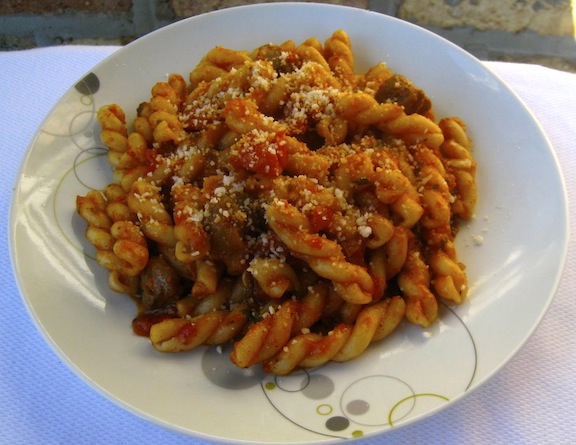
Admittedly, dishes featuring chicken gizzards are a hard sell and some of you will go no further than the picture above (Just click HERE, Cynthia.) and that’s fine.  Believe me, the majority of my family will be going with you. Since this blog was conceived as a means of recording and sharing my family’s recipes, however, I’d be remiss if I failed to mention these two. Who knows? Some future Bartolini Clan member may wish to know how to cook chicken gizzards and they won’t need to look any further than right here.

Mom and Zia were little girls when the Great Depression struck and our family, like so many others, was hit hard. By all accounts, these were lean times and our Grandparents struggled to put food on the table and keep a roof over their heads. Both Bartolini Girls marvel(ed) at how Grandma could make a single chicken last a full week, feeding a family of four in the process. Well, that’s when she could get a chicken. Both of today’s recipes come from that time. Mom often served us the first, a side dish of peas with gizzards, when I was growing up. No need to explain why it wasn’t an especially popular dish with my siblings. The second is a pasta dish that I “created” on my own. I remember telling Mom about it and, somewhat surprised, she recalled that Grandma used to make the same dish. Zia has mentioned that, as well. Since neither had ever mentioned or served me this pasta, I think it’s a sign that Grandma wants this dish prepared and, by sharing it here, I’m just doing my part to see that her wish is carried out.

I can’t speak of packaging during the Depression but, in today’s markets, one can usually find chicken gizzards and hearts sold together in 1 pound containers. Once cleaned and trimmed, I’ll divide them, with a quarter being reserved for the peas dish and the rest for pasta. One of the 2 portions will be set aside, even frozen, for later use. Cooking these meats can be a little tricky. To brown them like one would, say, beef chunks for stew, will render them nearly inedible. That shouldn’t be a problem if you follow the steps outlined in the recipes that follow.

*     *     *

Peas alla Nonna Recipe (aka Chicken Gizzards with Peas)

Ingredients

  • 5 or 6 oz chicken gizzards & hearts, cleaned and trimmed
  • 1/2 small onion, divided in halves
  • water
  • 1 tbsp olive oil
  • 2 tbsp butter
  • 1 plum tomato, chopped
  • 2 cups frozen or fresh peas
  • pinch of cloves
  • salt and pepper, to taste

Directions

  1. Place gizzards, half of the onion, and enough lightly salted water to cover into a medium saucepan, Cover, bring to a boil over med-high heat, and reduce to a soft simmer. Cook for 1 hour, checking periodically to ensure enough water remains. At the end of an hour, pour the pan’s contents through a strainer, discarding the onion and stewing liquid.
  2. Slice the remaining onion portion and roughly chop the stewed meat.
  3. In the same pan, heat oil and butter over medium high heat. Return gizzards to the pan, along with the sliced onion, and sauté until the onion is soft and translucent.
  4. Add tomato and sauté for a minute before adding peas, cloves, and a few tbsp of water to the pan. Season with salt and pepper, cover, and cook about 5 minutes or until peas are done to you liking.
  5. Serve immediately.

*     *     *

Pasta with Chicken Gizzards Recipe

Ingredients

  • 12 – 16 oz chicken gizzards & hearts, cleaned & trimmed
  • 2 tbsp extra virgin olive oil
  • 1/2 onion, chopped
  • 3 cloves garlic, minced
  • 1/2 cup dry white wine
  • 2 to 3 tbsp tomato paste
  • 1 large (28 oz) can tomatoes, whole or diced
  • 3 tbsp fresh parsley, chopped
  • 1 lb pasta, cooked to not quite al dente
  • grated parmesan cheese
  • salt and pepper, to taste

Directions

  1. Heat oil in a deep skillet over medium heat. Add gizzards and cook for 5 minutes. Do not allow to burn.
  2. Add onion, season with salt and pepper, and cook until translucent.
  3. Add garlic and sauté for 1 minute before adding the wine. Cook until almost all the wine has evaporated.
  4. Add the tomato paste and sauté for 1 to 2 minutes. Add parsley and tomatoes. If using whole tomatoes, tear them apart before adding to the pan. Season with salt and pepper.
  5. Bring to a boil, cover partially, and reduce to a soft simmer.
  6. The sauce should cook for 45 minutes. Check the pasta’s package directions and time its cooking so that the pasta is about 2 minutes shy of being al dente when the sauce is ready.
  7. Reserve some of the pasta water before adding the pasta to the frying pan. Mix well and continue cooking until the pasta is done to your liking. Add some of the reserved pasta water to the pan if the pasta becomes dry during this last step of the cooking process.
  8. Serve immediately, garnished with the grated parmesan cheese.

*     *     *

Notes

And so ends our treatment of chicken gizzards and hearts. Oh, don’t you worry. We’ll be coming back to these ingredients when the Bartolini Family Risotto recipe is shared. That won’t be for a while, however, so, all you chickens out there can rest easy. Your giblets are safe — for now.

*     *     *

Spumoni Ice Cream (It’s da Bomba!)

As you already know, a number of people in my life have birthdays in August. Mom, Grandma, Uncle, my Friend the kitchens’ Taste Tester, my Friend the Entertainer, my Grand-Nephew, and the Oldest of the Boys Upstairs were all born in August. Well, in their honor, and since this is the last day of their collective birthday month, why not go out with a bang? Today’s recipe is the Spumoni Bomba.

These past few Fridays, I shared recipes for pistachio, chocolate, and cherry ice cream. Not so coincidentally, these are the 3 flavors used to create spumoni ice cream, Mom’s favorite. Dad often brought home boxes of spumoni from the restaurant, with each individual serving conveniently wrapped in paper. Klondike bars? Who needed ice cream sandwiches when we had boxes of spumoni in the freezer? Anyway, if we’re going to celebrate the end of Mom’s birthday month, spumoni is the only way to go.

Before offering instructions for creating the Bomba, as well as the traditional “loaf,” a few things should be mentioned. First off, I knew all along that I would be making spumoni ice cream and that’s why I chose to use the same base for all 3 flavors. I wanted all 3 ice cream layers to have the same creamy texture on the palate. Using a custard-based chocolate layer with a yogurt-based cherry layer and Mom’s pistachio layer, for example, just wouldn’t work. Secondly, “authentic” spumoni recipes call for a variety of candied fruit pieces to be added to the cherry layer. For me, these chunks do not freeze well and consequently ruin the texture of the ice cream. So, I dropped ’em! Moving beyond the rejected candied fruit, this recipe will use 3 batches of home-made ice cream, with each batch equaling 1 1/2 quarts. Of course, the amount of ice cream required will depend upon the size of the bowls you use to create the bomba. If you don’t wish to make home-made ice cream, store-bought can be substituted. You’ll need to let the ice cream soften a bit before you add any fruits or nuts, if desired, and before you use it to make either the loaf or bomba. Lastly, unless you have 3 canisters for your ice cream maker, this is going to take more than 1 day to create.

*     *     *

Magic happens when you slice into a bomba!

*     *     *

Spumoni Bomba Recipe

Special equipment: a set of 3 nested mixing bowls, each decreasing in size. Mine were approx. 10″, 8″, and 6″ in diameter, and/or 1 bread loaf pan.

Ingredients

Directions

  1. While the chocolate-chocolate hazelnut ice cream is being made, cover the exterior of the middle-sized bowl with plastic wrap, place it in the largest bowl, and place both in the freezer until needed.
  2. When the ice cream has been made, reserve 1 cup of it and pour the rest into the largest bowl. Place the plastic-covered middle bowl into the first and press down, causing the ice cream to flow upwards between the 2 bowls. Stop applying pressure when the ice cream reaches the top of the outer bowl. Place both bowls back into the freezer for a few hours.
  3. Remove the middle bowl and plastic wrap. With an offset spatula, use the reserved ice cream to fill any cracks that the plastic wrap may have created in the surface of the chocolate layer. Cover the ice cream-covered bowl with plastic wrap and return it to the freezer.
  4. As soon as the ice cream maker’s canister is ready, begin making the pistachio ice cream.
  5. Cover the exterior of the smaller bowl with plastic wrap and place in the freezer.
  6. Once the pistachio ice cream has been made, reserve 1 cup and pour the rest into the chocolate ice cream-covered bowl. Place the smallest bowl into the semi-frozen pistachio and press down, causing the ice cream to flow upwards between the 2 bowls. Stop applying pressure when the ice cream reaches the top of the chocolate-covered bowl. Place both bowls back into the freezer for a few hours..
  7. Remove the small bowl and plastic wrap. With an offset spatula, use the reserved ice cream to fill any cracks that the plastic wrap may have created in the surface of the pistachio layer. Cover with plastic wrap and return it to the freezer.
  8. As soon as the ice cream maker’s canister is ready, begin making the Maraschino cherry ice cream.
  9. When completed, use the cherry ice cream to fill the remaining cavity. Cover with plastic wrap and place in the freezer until fully frozen.
  10. To serve, place the bowl in a hot water bath briefly while running an offset spatula or knife along the outer edge of the molded ice cream.
  11. Quickly invert the ice cream bomba onto a chilled serving plate, sprinkle with the chopped nuts, top off with cherries, and serve. (See Notes below.)

*     *     *

*     *     *

Variations

If you wish to go the more traditional route and create a spumoni loaf, use a bread pan as your ice cream mold. Fill to 1/3 with chocolate ice cream and place in freezer until firm. Next, fill another 1/3 with pistachio ice cream and return to freezer until firm. Lastly, use cherry ice cream to fill the rest of the bread pan, cover with plastic wrap, and return to freezer until firm. When ready to serve, follow the same instructions for unmolding the bomba.

*     *     *

*     *     *

Notes

Looking at the pictures, you may have noticed that the bomba’s cherry ice cream center is larger (thicker) than the other 2 layers. If you want your layers to be more consistent, you can either use a set of smaller bowls or make/buy more chocolate ice cream to form the outer layer. As it was, I used the entire quart-and-a-half batch made by my ice cream maker.

As you also may have noticed, serving a bomba in a heat wave does have its risks and unless you’ll be dining in a walk-in freezer, you can expect some melting to occur. If possible, unmold the bomba onto an ice-cold serving platter and place it back in the freezer for a short while before serving.

Pictured was a “surprise birthday bomba, ” the recipient of which, my Friend the Entertainer, didn’t mind “the thaw” one bit and even waited patiently for the pictures to be taken.

*     *     *

Maraschino Cherry Ice Cream

This is the third ice cream recipe in the series celebrating the birthdays of Mom, Grandma, Uncle, my Friend the kitchens’ Taste Tester, and my Friend the Entertainer, not to mention those of my Grand-Nephew and the Oldest of the Boys Upstairs. Just like its chocolate predecessor, today’s recipe uses the same cream base as was found in Mom’s pistachio nut ice cream recipe. Simple to make, I like its creamy texture and saw no reason to look elsewhere when developing this recipe. So, although today’s recipe was not in the recipe book she gave me, I still consider it to be her recipe and I think you’ll find that it’s pretty good.

When you look over today’s recipe, you’ll note that I strain the chopped cherries, press out as much of the liquid as possible, and then soak them in half & half. That’s an attempt to replace as much of the watery syrup with the thicker half & half, in the hope that the fruit pieces will not form ice shards when frozen. You see, probably my least favorite “features” of home-made ice cream are the ice shards that can result from using fruit in a recipe. I believe the water in the fruit is the culprit and if I can eliminate the water, the problem is solved.  My method may not be 100% effective but there are far fewer shards when the fruit is handled this way. If you are aware of a better way, by all means let me know. And, again, although the recipe calls for a raw egg, I always use eggs with pasteurized shells to eliminate any risk of contamination.

*     *     *

*     *     *

Maraschino Cherry Ice Cream Recipe

yield: 1.5 quarts

Ingredients

  • 2 doz Maraschino cherries, drained, coarsely chopped
  • 1/3 cup Maraschino cherry syrup
  • 1 egg
  • 1 cup half & half
  • 3/4 cups sugar
  • 2 cups whipping cream
  • 1 tsp vanilla extract
  • 1/8 tsp Kirsch liqueur (optional)
  • whipping cream, for garnish (optional)
  • 1 cherry per serving, for garnish

Directions

  1. Coarsely chop cherries, place in sieve, and use a spoon to press as much liquid out of the cherries as possible. Save liquid for later use.
  2. Soak cherries in half & half for at least an hour before proceeding.
  3. Once again strain the cherries and place the strained half & half into the blender along with the egg. “Stir” for a few seconds. Moisten the cherries with a tbsp or so of cream and refrigerate until later use.
  4. Add the reserved cherry juice, sugar, whipping cream, vanilla extract, and Kirsch, if using, to the blender and “Stir” until fully blended.
  5. Refrigerate for at least a few hours or overnight.
  6. Pour both the cream mixture and the chopped cherries in cream into the ice cream maker and process according to manufacturer’s instructions.
  7. When completed, remove the ice cream from the canister to be either served or transferred to a sealable container to be frozen to your liking.
*     *     *

Variations

Although there are many ice creams recipes made with cherries, I chose to make one with Maraschino cherries because it’s about as far removed from tart cherries as possible. Besides, as pink as it is, it’s sure to be a big hit among some members of the Barbie Set.

Notes

This being the last of August’s Fridays, one would think that it would mean an end to the ice cream recipes. Well, it’s not a “birthday 3 and a half weeks” but it is a “birthday month.” So, with this month ending on Wednesday the 31st, I’ve little choice but to offer one last recipe for an ice cream confection. See you next Wednesday.

*     *     *

Chocolate-Chocolate Chip Hazelnut Ice Cream

This is the 2nd in my series of ice creams commemorating the birthday month of my Mom and a number of people in my life. Last week’s recipe, pistachio nut ice cream, was almost exactly the same as the one she gave me years ago. Today’s recipe may not be found in the recipe book that Mom gave me but I still consider it to be her own. To create this ice cream, I used the base of the pistachio and replaced the nuts with other ingredients. The result is a chocolate-chocolate chip ice cream with hazelnuts. Mom would be proud.

Not to bore anyone, but I feel I must reiterate my warning about the use of raw egg in this recipe. When a recipe calls for raw egg, I use eggs with pasteurized shells, which may be found in the egg case at your grocery. Beyond that, I used milk chocolate chips but you can use whichever kind you prefer. As for the hazelnuts, I toasted them lightly before freezing them, like I did with the pistachios. This is to prevent them from becoming soggy during processing in the ice cream freezer. Lastly, you’ll note that the recipe calls for “a heaping 1/3 cup of unsweetened cocoa.” That’s because on my first attempt at creating this recipe, I accidentally dropped a heaping measure of cocoa into the cream before I could level it off. (Thanks, Max.) The ice cream was delicious and I’ve been repeating the accident ever since. (No, really. Thanks, Max.)

*     *     *

*     *     *

Chocolate-Chocolate Chip Hazelnut Ice Cream Recipe

yield: 1.5 quarts

Ingredients
  • 1/3 cup hazelnuts, roasted & roughly chopped
  • 1/3 cup chocolate chips, roughly chopped  (milk chocolate, semi or bittersweet may be used)
  • 1 egg
  • 1 cup half & half
  • a heaping 1/3 cup unsweetened cocoa
  • 3/4 cups sugar
  • 2 cups whipping cream
  • 1 tsp vanilla extract
  • 1/8 tsp Frangelico liqueur (optional)
  • chopped hazelnuts, for garnish

Directions

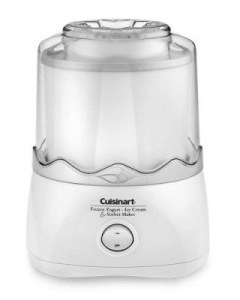
My Baby

  1. Place the hazelnuts in your freezer before starting.
  2. Place all the ingredients, except the nuts and chocolate chips, into a blender and “Stir” until well-blended.
  3. Refrigerate for at least a few hours or overnight.
  4. Pour cream mixture into an ice cream maker and process according to manufacturer’s instructions.
  5. About 5 minutes before completion, pour the hazelnuts and chocolate chips into the machine and finish processing.   (See Notes)
  6. When completed, remove the ice cream from the canister to be either served or transferred to a sealable container until frozen to your liking.
*     *     *

Variations

As was the case with pistachio ice cream, there are plenty of recipes for chocolate ice cream on the internet, or, if books are more your style, “A Perfect Scoop” by David Lebovitz is a good place to start. No matter where your recipe comes from, you’ll soon discover that no store-bought brand can rival the taste of good, home-made chocolate ice cream.

Notes

Your machine may not recommend adding nuts and/or chocolate chips to the cream while the machine is running. If that’s the case, process the ice cream per the manufacturer’s instructions. When finished, add the nuts and chips to the semi-frozen cream, stir to fully combine, and either garnish & serve it or transfer it to a sealable container and place in the freezer.

*     *     *

Grandma’s Stuffed Vegetables

August was a good month for the Bartolini Clan at the old two-flat. Grandpa’s garden was in high-gear, easily producing enough tomatoes for all of both families’ needs. (Be sure to check out Mom’s Tomato Antipasti.) As the years passed, the garden grew and so did the selection of produce. Lettuce, swiss chard, eggplants, peppers, and, of course, grapes, all made their way onto our dinner tables in August, if not before. To augment his own “crops,” Grandpa and I made a weekly trip to Detroit’s Eastern Market every Saturday morning, where he would walk the aisles, haggling each farmer/vendor over the price of whatever it was that he wanted to buy. By the end of our “tour,” we’d return to the car with everything from fruits & vegetables to chickens (dead or alive) and, one memorable Saturday each year, a hog’s head to be made into head cheese. (You’ve not lived until you’ve walked around a crowded farmers’ market, carrying a hog’s head on your shoulder, stopping occasionally while your Grandfather haggled with some farmer over what amounted to 50 cents, if that.) Sunday was my Dad’s turn. Starting when we were very young, Sis & I accompanied him and our favorite stop was the bread bakery. While Dad chatted with his baker friend, we munched on bread straight from the oven. Along the way we might visit with friends or family, stop at an Italian market or 2, and then head to the grocery for whatever he hadn’t found at the previous stops. We’d return home, laden with all kinds of goodies, just in time for Sunday brunch.  That night, both families often dined together in a large, screen-enclosed room, “the patio,” which Grandpa had built adjacent to the garage. It easily accommodated the 12 of us and very often a few guests more.

*     *     *

Grandmas stuffed veggies 1

*     *     *

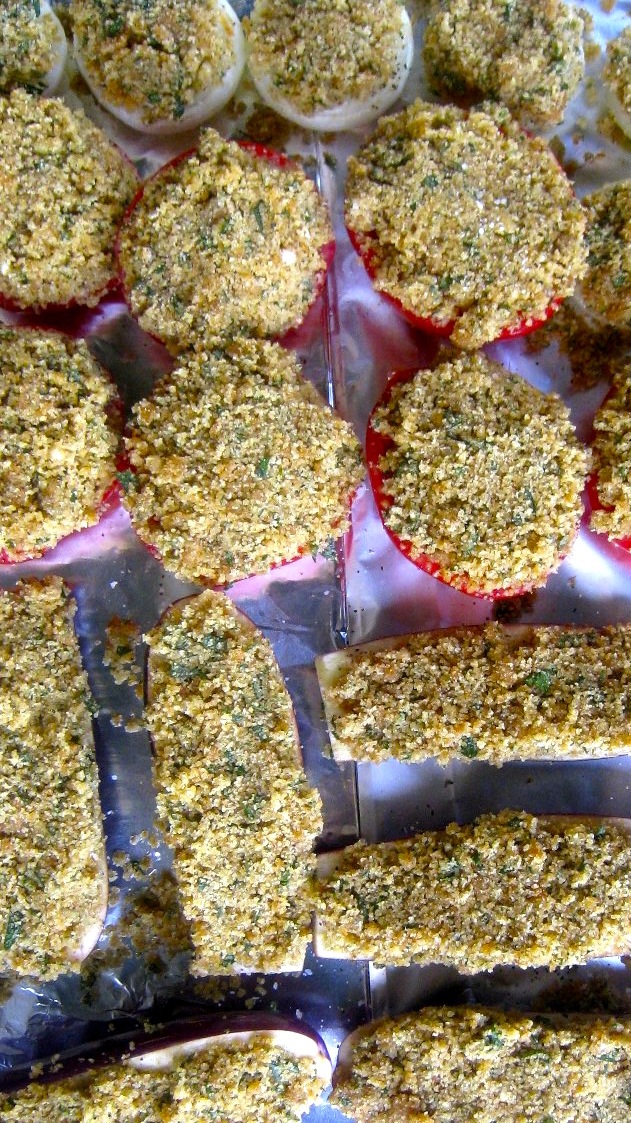
In retrospect, these dinners went off like a well-oiled machine. While Dad, Uncle, and Grandpa worked the grill and their beverages, Mom and Zia handled the rest, from setting the table to making sure that the “trouble-makers” among us 6 kids sat at separate ends of the long table. (One memorable response, walkie talkies, though well-played was extremely short-lived.) Aside from the grilled entrées, the meal itself featured side dishes made from the garden’s vegetables, as well as those that Dad and Grandpa had just purchased. Family favorites, that both women were quite capable of preparing, were tomatoes, eggplant, and onions that were halved, topped with a bread crumb mixture, and baked. Both Mom and Zia spoke of Grandma preparing vegetables in this way, which is similar to recipes for tomatoes Provençal. With Mom & Grandma’s birthday having been on the 15th, and Uncle’s birthday the 12th, I thought this would be the perfect time to share this family recipe.

Now comes the hard part. I have seen these vegetables prepared countless times, most recently a few weeks ago while visiting Zia. I have prepared them myself dozens of times, the most recent being last night. Never have I measured any of the ingredients nor have I seen them measured. Mom would get so exasperated with me as I asked her, repeatedly, what the measurements were for some dish, often this one. Now, far too late, I understand. More important than how much of this or that is the look and feel of the finished mixture. She and Zia use this breading mixture in a number of dishes. It’s consistency varies depending upon the dish and how it is cooked. When used with Grandpa’s  barbecued shrimp, it is very moist, almost dripping. Here, the vegetables are cooked at a much lower temperature than on a grill and, so, the breading isn’t as moist. Even so, you may prefer your topping to be more/less firm when served and the amount of oil used will determine that. Because of all this, I’m only posting guidelines and not a recipe. Use them as a base, adjusting where necessary to suit your own tastes.

*     *     *

Grandma’s Stuffed Vegetables

Select fully ripened tomatoes, small to medium-sized onions, and baby or small eggplants. If you use large, thick eggplants, they will require pre-roasting, as do the onions. Better to seek out relatively thin eggplants of about 4 – 6 inches in length.

For the stuffing, you will need about 2 – 3 tbsp of bread crumbs per vegetable half; about 1 tsp of freshly chopped parsley per vegetable; 1 – 2  garlic cloves, minced, depending upon the number of vegetables used; salt & pepper, to taste; and enough extra virgin olive oil to fully moisten the mixture. It should not be sopping or dripping wet.

Pre-heat oven to 400*. Remove a thin slice off of the top & bottom of each onion. This will allow them to “sit” without rolling while roasting. Halve each onion, score the cut side with a sharp knife, and brush lightly with olive oil. Season with salt & pepper and roast in the oven for 20 minutes.

Meanwhile, create the bread topping. Combine bread crumbs, parsley, garlic, salt & pepper, and olive oil. Halve the tomatoes and gently squeeze each half to remove some liquid and the seeds.  Add the liquid and “tomato caviar” to the bread crumb mixture. Halve the eggplants, lengthwise, and use a knife to score the cut side a few times. Use a pastry brush to coat the cut sides of the eggplants & tomatoes with olive oil and then season with salt & pepper. By now the onions should be about ready to be removed from the oven. Place all the halved vegetables on a lightly oiled baking sheet or dish and season with salt & pepper. Reset the oven temperature to 350*

Cover the top of each vegetable half with the bread crumb mixture. When finished, drizzle lightly with olive oil and bake in a 350* oven for 40 – 45 minutes. Serve immediately.

Variations

These are the 3 vegetable that Grandma, and later Mom and Zia, used. I’ve, also, prepared zucchini and summer squash this way, treating them as I would eggplant.

*     *     *

Grandmas stuffed veggies 2

*     *     *

Notes

Left-overs can be easily re-heated in the microwave. Better still, with 2 slices of Italian bread, one of the tomato or eggplant halves makes a great sandwich. Grandma served these sandwiches to her girls for lunch and they, in turn, served them to us.

*     *     *

The Kitchens’ Strawberries be Jammin!

I know, I know. I do not can. The threat of giving my friends & loved ones the gift of botulism has pretty much kept me away from this age-old method of food preservation. Not only that, I’ve no room for the canning gear nor for the canned goods.  So, why then am I suddenly canning?

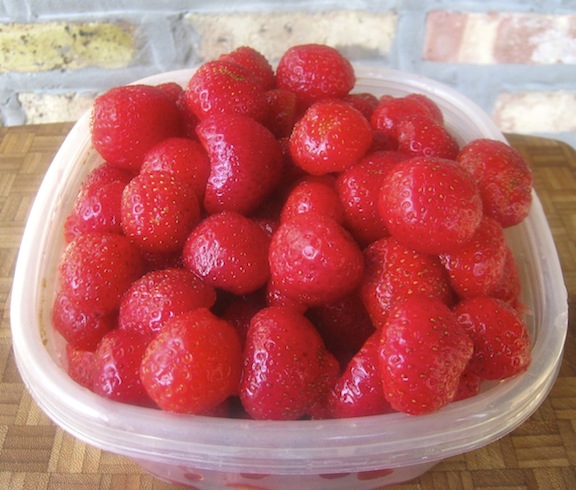
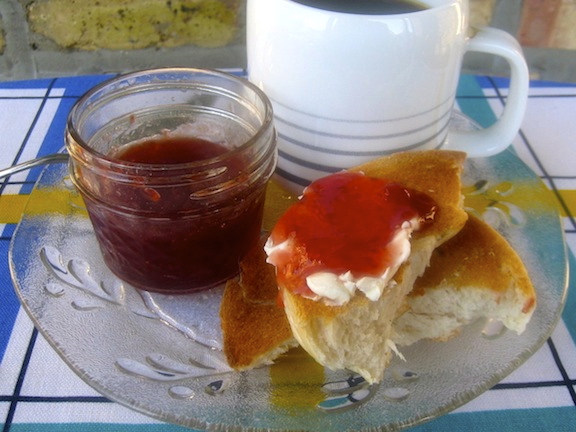
To begin with, last week’s canning experiment with cherry jam went very well. It jelled properly and the jars all sealed without using a water bath. Those who have tasted it liked it, and, most importantly, survived. Family, friends, and a few fellow bloggers were all quite positive, some even encouraging me to continue canning. One friend was particularly enthusiastic, although methinks the promise of freshly made grape jelly may have been the cause. You see, I had confided to him that I wanted to make grape jelly but that Concord grapes weren’t easy to come by. This isn’t exactly Napa Valley. I told him I would be going to the farmers’ market this morning to find grapes and, if all else failed, I might try canning some Michigan strawberries, if they were still available. What he didn’t know was that I had found Mom’s strawberry jam recipe in the recipe book she had given me years ago. All thus time I had ignored it because, as we all know, I do not can. Well, with no grapes to be found anywhere at the market, I bought 3 containers (pints?) of strawberries. I followed Mom’s recipe, with 1 exception. Remembering David Lebovitz’s recommendation of using lemon rind as well as lemon juice, I added the zest of 1 lemon to the fruit and sugar. Beyond that and as Mom had suggested, I used a potato masher to crush the hulled berries, which yielded a little more than 4 cups of smashed fruit. The fact that there was no need for store-bought pectin was a big plus; I didn’t have any. From there, the rest of the recipe is easy enough that I had no problems following it. An experienced canner and jammer should be able to do this in her/his sleep.

*     *     *

*     *     *

Mom’s Strawberry Jam Recipe        

Ingredients

  • 2 pounds fresh strawberries, hulled (4 cups smashed)
  • 4 cups sugar
  • 1/4 cup lemon juice
  • zest of 1 lemon

Directions

  1. In a heavy bottomed saucepan, mix together the strawberries, sugar, lemon and lemon juice & zest. Stir over low heat until the sugar is dissolved. Increase heat to high, and bring the mixture to a full rolling boil.
  2. Boil, stirring often, until the mixture reaches 220 degrees F (105 degrees C).
  3. Transfer to hot sterile jars, leaving 1/4 to 1/2 inch head space, and seal.
  4. Process in a water bath, allow to sit in boiling water for 10 minutes.
  5. After 10 minutes, carefully remove jars from boiling water and place on rack covered with a towel to prevent jars from shattering due to quick temperature change.
  6. Leave, untouched, for 12 to 24 hours to insure proper sealing.
  7. Store in cool, dark place for up to 1 year.
  8. If the jam is going to be eaten right away, don’t bother with processing and just refrigerate.

*     *     *


*     *     *

Notes

If unsure whether the jam will jell properly, you can test it. Just before you start preparing the strawberries, place a plate in your freezer. After your jam has reached 220*, take about 1/4 tsp of the hot jam, place it on the chilled dish, and return both to the freezer. After a couple of minutes, use your finger to “push” through the jam on the plate. If the jam wrinkles before your finger and does not flow to refill the path your finger took, the jam is ready to be placed in jars.

Oh! All evidence to the contrary notwithstanding, I do not can.

*     *     *

Pistachio Nut Ice Cream

Mom was a great lover of ice cream. In the Summer, it was she, far more often than the 3 of us kids, who suggested going out for ice cream after dinner. Dad rarely, if ever, refused her and, so, we’d pile into the car and off we went. Many years later, she and I would be in the car, returning to her home, when she would mention ice cream. The next thing I knew, we’d be standing at some counter waiting for our single scoop cones. Well, Mom’s birthday — as well as that of her Mother — was August 15th; Uncle’s birthday, Zia’s husband, was August 11th; the birthday of my Friend the kitchens’ Taste Tester was on the 7th; and my Friend the Entertainer’s birthday is August 20th — but wait, there’s more. In the Children’s Division, my Grand-Nephew’s birthday is the 1st and the Oldest of the Boys Upstairs has a birthday on the 18th. Well, with so many birthdays to honor, I’m going to post ice cream recipes for the next 3 Fridays of this, their “birthday month.” (My Friend the Entertainer believes that one’s birthday should be celebrated the entire month.) And whether you choose to make any of these 3 ice creams, make sure that on at least one of August’s warm nights, you get yourself a single scoop cone. You’ll soon discover what Mom knew all along: it’s a great way to end a day.

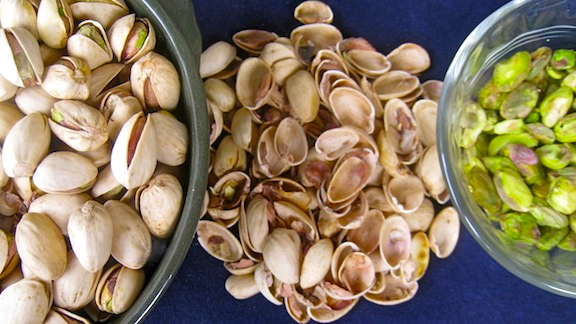
Today’s recipe, pistachio ice cream, is pretty much the same one that Mom gave to me in a recipe book years ago. It’s not a complicated recipe and there’s no custard to make. Still, there are a couple of things to consider. First, and most importantly, the recipe calls for 1 raw egg. Now, I am certainly not advocating the use of plain, raw eggs in this, or any, recipe. When a recipe calls for raw egg, I use eggs with pasteurized shells. You can find them in the egg case at your grocery and using them will eliminate any worry you might have when serving raw egg. Yes, they may cost more but the peace of mind is well worth it. With the “egg question” out-of-the-way, all that’s left is how to deal with the pistachio nuts. First off, I use roasted, unsalted nuts that I shell myself. It is much easier to remove the “paper” off of the nuts if you shell them yourself, and the less paper, the greener your ice cream. Still, even with every bit of paper removed, your pistachio ice cream will not be as green as store-bought. For that, you’ll need to add a few drops of food coloring. Whether to use food coloring is a decision for you to make. Secondly, while half of the pistachio nuts are ground in the blender, I freeze the other half in my freezer, based upon a comment by my Trusty Traveling Companion. Although he likes chopped pistachio nuts in his ice cream, he doesn’t like that they’re often a touch on the soggy side. By adding them to the ice cream already frozen, the problem is avoided.

*     *     *

*     *     *

Pistachio Nut Ice Cream Recipe

yield: 1.5 quarts

Ingredients
  • 2/3 cup pistachio nuts, shelled & roughly chopped – divided in half
  • 1 egg
  • 1 cup half & half
  • 3/4 cups sugar
  • 2 cups whipping cream
  • 1 tsp vanilla extract
  • 1/8  – 1/4 tsp almond extract
  • pistachio nuts, for garnish when serving

Directions

My Baby

  1. Place half of the pistachio nuts, the egg, and half & half into a blender and “Chop” until nuts are fully ground.
  2. Add everything but the reserved pistachio nuts to the blender and “Stir” until well-blended.
  3. Refrigerate for at least a few hours or overnight.
  4. Pour cream mixture into an ice cream maker and process according to manufacturer’s instructions.
  5. About 5 minutes before completion, pour the remaining pistachio nuts into the canister. (See Notes)
  6. When completed, remove the ice cream from the canister for serving or  transfer to a sealable container and placed in the freezer.
*     *     *

Variations

There are plenty of pistachio ice cream recipes on the internet offering far too many variations to list here. One particularly interesting method can be found on the Brown Eyed Baker’s website. In addition to adding chopped nuts to the cream mixture, he begins by steeping some of the pistachios in milk, extracting as much flavor as possible from the nuts. If you’re googling pistachio ice cream recipes, be sure to check his out.

Notes

Your machine may not recommend adding nuts to the cream while the machine is running. If that’s the case, process the ice cream per the manufacturer’s instructions. When finished, add the nuts to the semi-frozen cream, stir to fully combine, and either garnish & serve it or transfer it to a sealable container and place in the freezer.

*     *     *