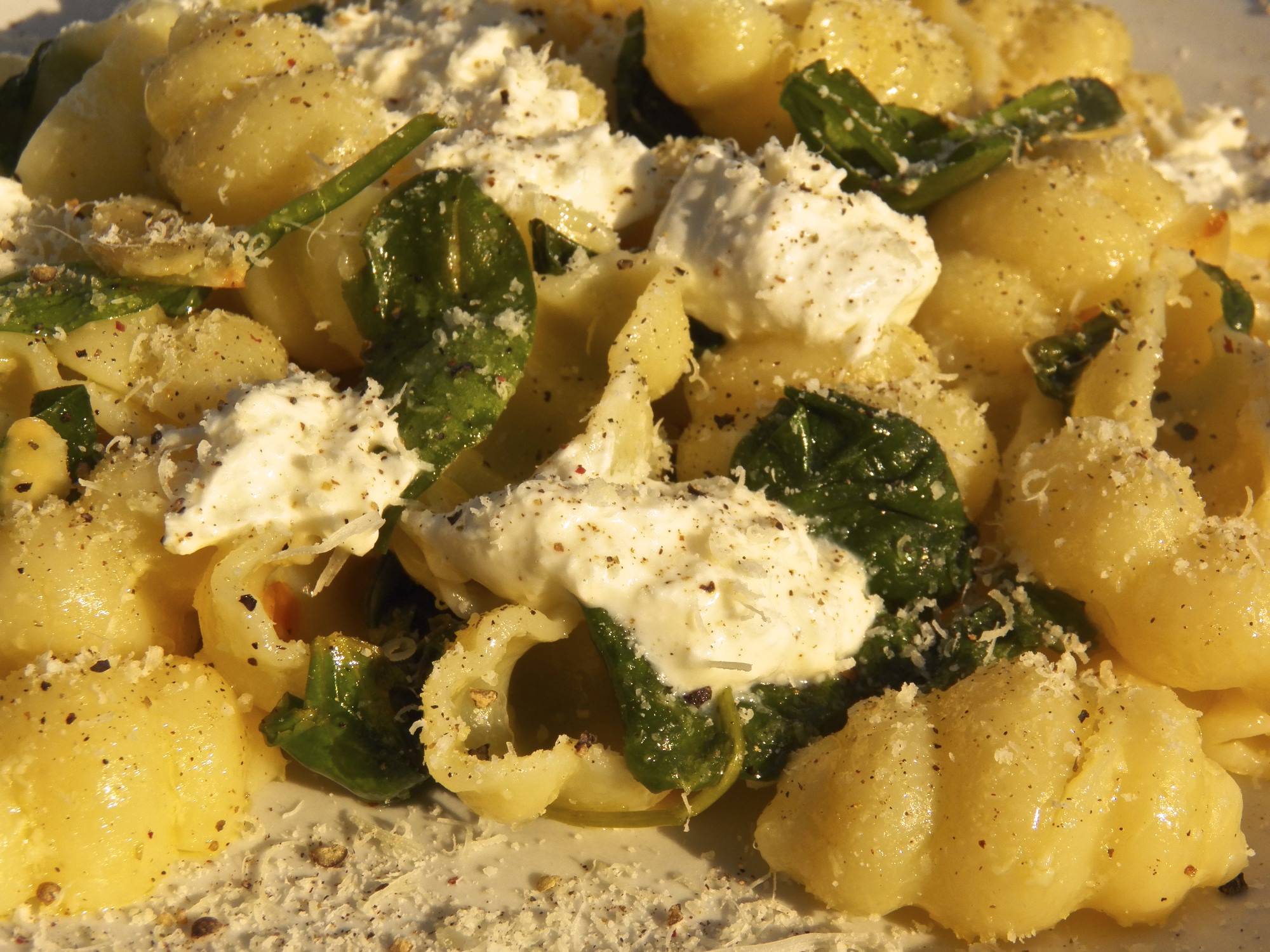
Gnocchi with Lemon, Spinach, and Burrata

If you came here expecting to find a recipe for those tasty little Italian potato dumplings, well, SURPRISE!  The gnocchi of today’s post are a type of pasta and have nothing to do with their namesake other than a similar shape. Now, I wish I could say that my family has prepared these for years but, the fact is, I stumbled upon these gnocchi during one of my voyages of discovery down the pasta aisle of the Italian market. Since I had already planned to share this recipe, I merely substituted one pasta for another.

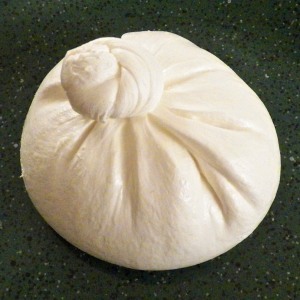
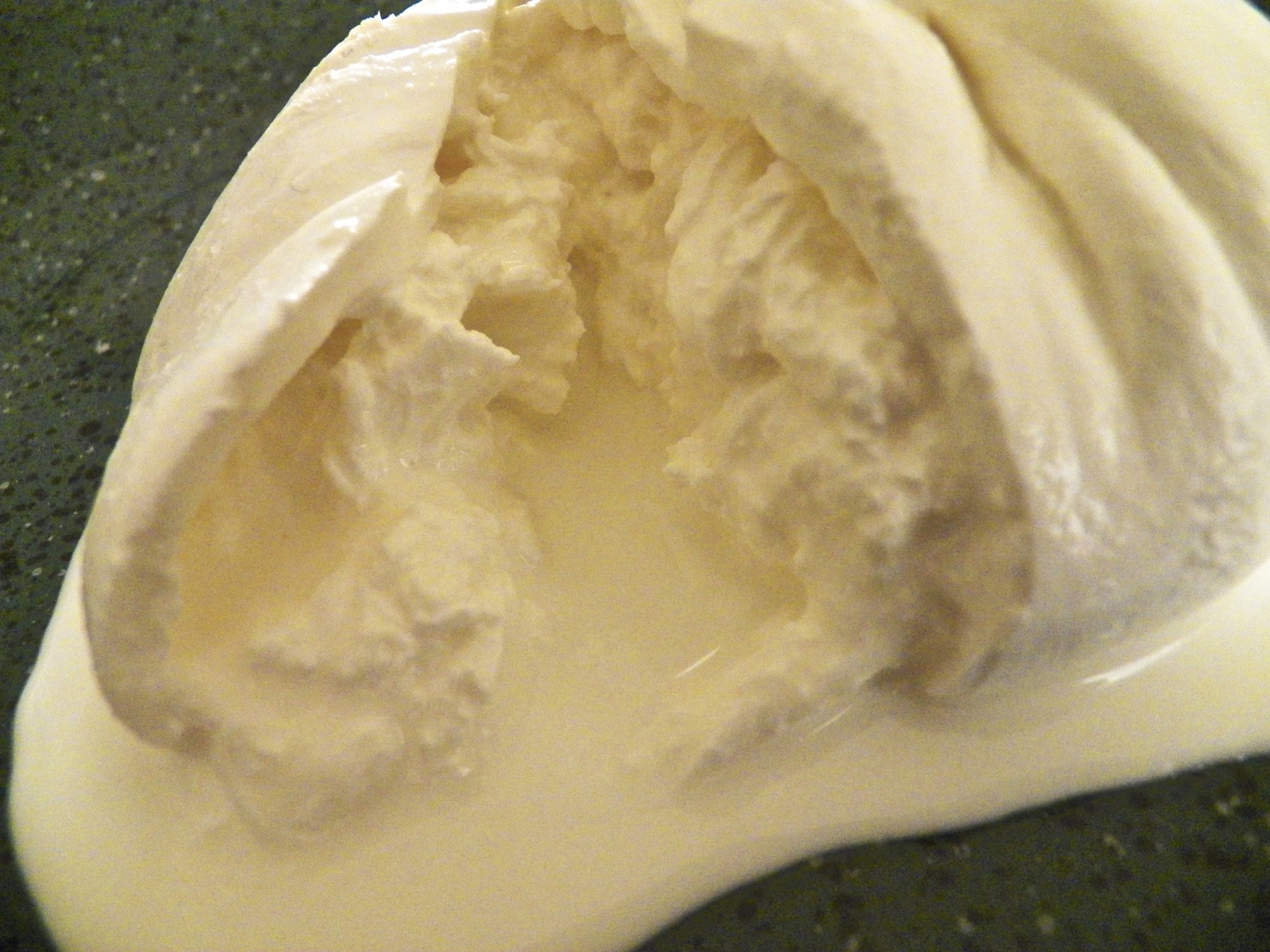
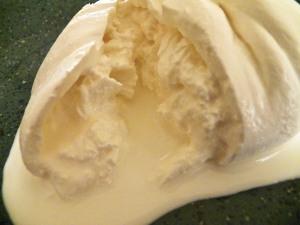
The pasta aside, the reason I wanted to share today’s recipe was to introduce burrata. If you’ve never tried nor heard of burrata, you’re in for a treat. Originating in Puglia, burrata is a fresh cheese that is closely related to mozzarella. To make it, a piece of newly formed mozzarella is stretched into a flat sheet and used to form a pouch. It is then filled with fresh cheese curds, “topped off” with heavy cream, and sealed.  (See photo below.) The result is about as rich a cheese as one could ever expect.

*     *     *
*     *     *

There are many recipes that feature burrata but the use of lemon is what drew me to this one. None of its flavors are so bold as to hide or overpower burrata’s creamy taste while the pasta shape lends itself to providing spots to capture bits of cheese and drops of cream.  Add some toasted slivered almonds for texture and you’ve a great dish of pasta, whether you serve it as a primo piatto or secondo.

Today’s recipe is straight-forward with little need for clarification. Just be sure to slice burrata on a rimmed dish or cutting board. You do not want to let any of the cream go anywhere but into your pasta. Beyond that, you’ll need to work fast. The pasta and olive oil mixture must be hot enough to wilt the spinach and, soon thereafter, melt the burrata.  A little reserved hot pasta water will help, as will bringing the burrata out of the refrigerator an hour earlier than needed to remove its chill. See? Nothing at all difficult and an incredible pasta is your reward.

*     *     *

*     *     *

Gnocchi Pasta with Lemon, Spinach, and Burrata Recipe

Ingredients

yield: 6 servings

  • 1 lb gnocchi pasta
  • ⅓ cup extra virgin olive oil
  • 2 tbsp butter
  • 2 cloves garlic, minced or grated
  • juice and zest of 1 Meyer lemon
  • 1 pkg (6 oz) fresh baby spinach
  • ¾ cup slivered almonds
  • grated nutmeg, to taste
  • 1 lb. burrata cheese, sliced and cut into 1 inch cubes
  • grated Pecorino Romano cheese
  • freshly cracked black pepper

Directions

  1. Place almonds in a small skillet over med-high heat and toast until lightly browned.  Remove from heat and set aside.
  2. Bring a large pot of salted water to boil and cook gnocchi per package directions or to taste.
  3. When pasta is approximately 4 minutes before being al dente, heat a large skillet over medium heat. Add butter and olive oil.
  4. Add the garlic to the hot oil/butter mixture and sauté until soft, about 1 minute. Do not allow to brown.
  5. Add the lemon juice and zest to the skillet and stir to combine. Keep hot until pasta is ready. If it reduces too much, replenish with pasta water.
  6. Drain the pasta and put it into a large bowl.
  7. Add the spinach, in thirds, to the gnocchi and mix well. Continue until all the spinach has been added to the bowl of gnocchi. (Adding it in batches will help to prevent clumping.)
  8. Add the almonds and a dash of nutmeg. Mix well.
  9. Add the hot butter/oil/lemon mixture to the pasta and toss, wilting the spinach as you do.
  10. Work quickly and once the spinach is lightly wilted, apportion 6 servings.
  11. Place an equal amount of burrata on top of each serving.
  12. Finish each serving with a sprinkle of Pecorino Romano cheese and freshly cracked black pepper, to taste.
  13. Serve immediately.

Inspired by Bon Appetit, December 2004

*     *     *

Variations

Not all of us have ready access to Meyer lemons, and, gnocchi pasta probably won’t be found in your neighborhood grocery. Don’t let a lack of either stop you from making this delicious pasta. If missing Meyer lemons, use the juice and zest of 1/2 “normal” lemon. If unable to find gnocchi pasta, try using campanelle (little bells), gigli (lilies), or, as pictured on the right, conchiglie (shells).

*     *     *

Notes

It cannot be stressed enough, the key to this dish is to work fast to insure that the spinach wilts and the burrata melts. Success means a great pasta for dinner.

Burrata’s creaminess makes it a natural for crostini and you may wish to reserve a bit just for that purpose. Use it in place of mozzarella to make the crostini described HERE and pictured on the left.

*     *     *

It’s déjà vu all over again …

Kale-filled Pieda

Kale-filled Pieda

Flatbread are common to many cuisines and Italian is no different. Originating in Emilia-Romagna, this flatbread is called piedina but in my Dad’s area within Italy, the Republic of San Marino, it’s called pieda. Easy to prepare, Mom served pieda with sautéed Swiss chard but you can serve it with cheeses, lunch meats, salad greens, or any combination of those. You can find the recipe by clicking HERE.

*     *     *

Coming soon to a monitor near you …

Last week I shared the recipe for Bartolini Lasagna. At the time, I called it “one of the jewels in the Bartolini Crown of Recipes.” Well, next week I’ll present another of our Crown’s jewels: Mom’s recipe for Cappelletti. Although not made in the traditional shape, these raviolini will turn an ordinary bowl of brodo into something really quite special.

*     *     *
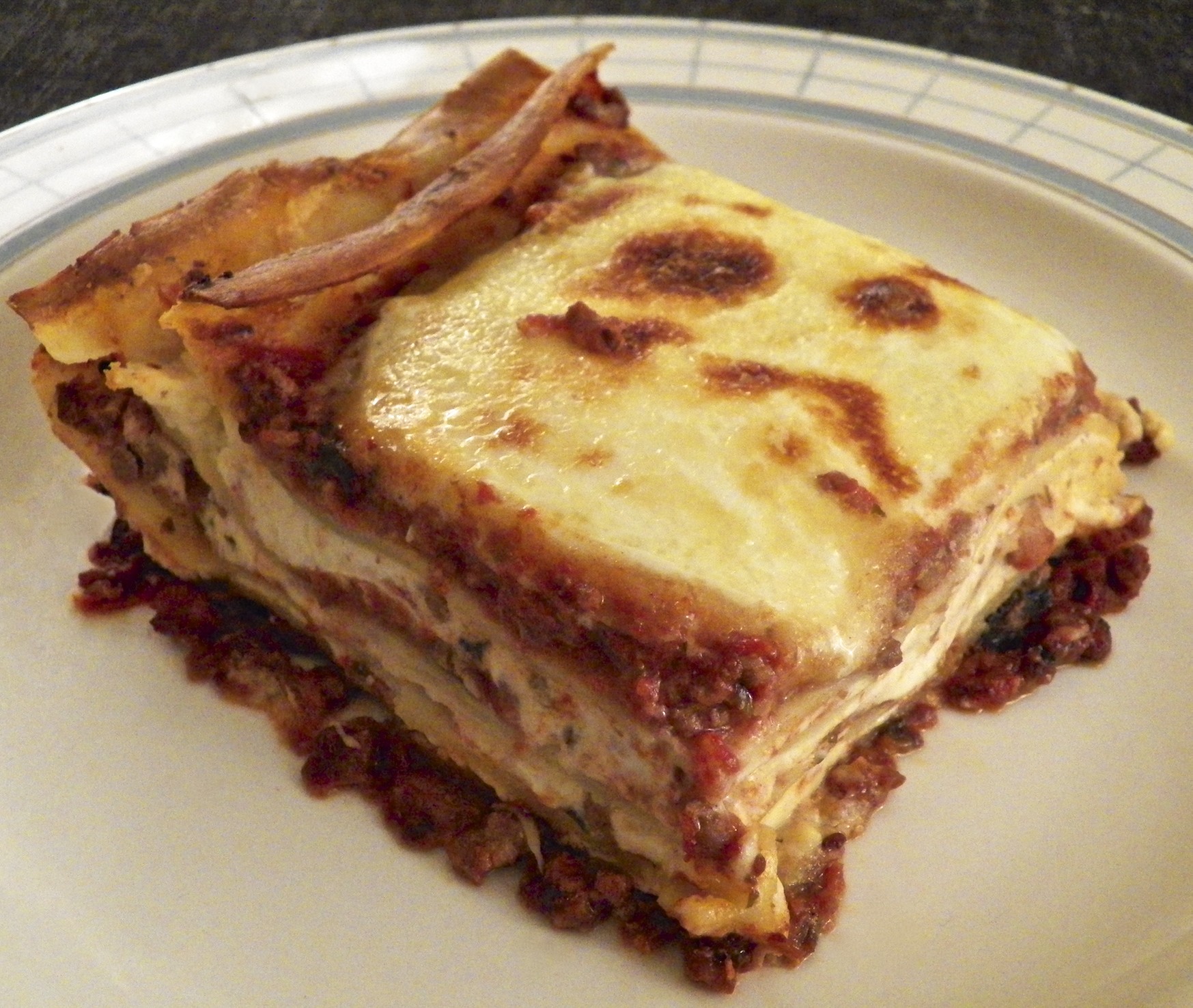
The Lasagna of My People — Lasagna dei Bartolini

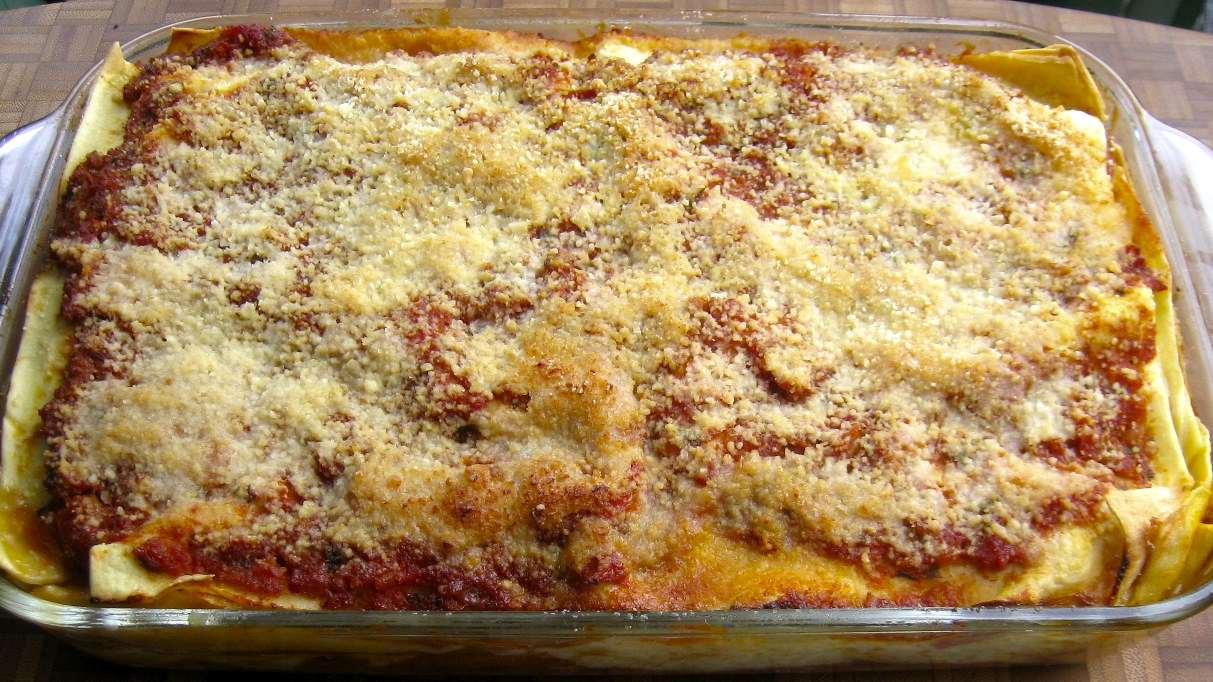
The third week of January is another birthday week for the Bartolini Clan. Nonna’s birthday was January 26th, a date my Cousin shares with her. Not to be outdone, tomorrow, the 24th, is my birthday. It’s not a significant one but, boy, am I getting close! In the past, I’ve tried to pick a dish as a means of celebrating the person and birthday. Well, with that in mind, today I’m going to share what I consider to be one of the jewels in the Bartolini Crown of Recipes: Bartolini Lasagna.

*     *     *

*     *     *

As I’ve mentioned in prior posts, ours is not a ricotta-filled lasagna. In fact, ricotta isn’t even among the three cheeses used. (I’ve a recipe for a ricotta lasagna and I’ll share it sometime in the future.) This lasagna’s cheese filling is entirely a Bartolini invention, although not the way I had always believed. For years, I assumed that this was one of the recipes that my Grandma had taught her girls. I told my friends that, as well. You can imagine my surprise when, a short while ago, Zia corrected me and explained how this recipe came about.  Years ago — certainly before my memories begin — she & Mom had grown tired of ricotta-filled lasagne and were dissatisfied with those that called for a besciamella sauce. They decided to try something different and, Ecco! Bartolini Lasagna was born. This is a lasagna that is unlike most others and one that family and friends alike thoroughly enjoy.

Speaking of friends, did I mention that this lasagna has therapeutic qualities? Yes, there is that. You see, one of the unfortunate consequences of maturing is that the good health one took for granted before reaching the age of 40 may not be as apparent beyond that age. Things happen and, when they do, oftentimes friends and family will respond with a variety of foods and baked goods to assist in the recuperation. Well, when illness strikes a friend, I hit back with lasagna. That’s right. Bartolini Lasagna. I know that when I’ve been in a similar situation, there were times when eating was, shall we say, problematic. On those occasions when my appetite did return, it often vanished — or worse — by the time I got my meal on the stove. A casserole, however, solves that problem. A serving can be placed in the microwave and served within a few minutes, ensuring the patient receives much-needed calories to fuel the recovery. And what better casserole-type dish is there than lasagna? It certainly has the calories and, by any standard of measurement, Bartolini Lasagna has proved beneficial to each friend’s convalescence. OK, to be fair, our lasagna isn’t comparable to the waters of Lourdes and you certainly won’t find any crutches hanging from my kitchen’s ceiling. Follow our recipe, though, and you’ll have one tasty lasagna. Even Lourdes can’t do that.

*     *     *

*     *     *

This is normally where I would mention points of concern for the day’s recipe. I really have none for our lasagna recipe other than to mention the noodles used. Today, you can purchase noodles that need to be cooked before use, “boil”, or those that need no prior cooking, “no boil.” Of course, if you prefer, you can make you own — which I would highly recommend.  No matter whose lasagna recipe you follow, using homemade noodles will transform your dish. (A friend once compared my lasagna noodles to pastry.) If you do make your own (see Notes), remember that they only need to be boiled for a few minutes and they’ll be ready for use in your lasagna. If you use “boil” noodles, follow the package directions. Once boiled, you can lay them flat on a baking tray, coating each with a little olive oil, or, lay them flat in a baking dish filled with cold water. Work quickly or they may stick to each other. If using “no boil” noodles, I’ve found that they work better if each is given a quick rinse in hot tap water before being placed in the lasagna dish/pan. Don’t fret if your noodles are a little larger that your baking dish or pan. The exposed edges will crisp during baking and many find that very enjoyable.

*     *     *

The Bartolini Lasagna Recipe

Ingredients

Tomato Sauce (click on sauce name for recipe)

Cheese Sauce (see Notes)

  • 6 tbsp (85 g) butter
  • 12 oz (1½ pkg) (339 g) cream cheese
  • 2 – 3 tbsp (29 – 44 ml) milk
  • Pecorino Romano cheese, grated

Lasagna

  • Enough cooked lasagna noodles (or “No Boil”) to make 3 or 4 pasta layers (see Notes).
  • mozzarella (sliced or grated)
  • Pecorino Romano cheese, grated

*     *     *

*     *     *

Directions

Prepare the Cheese Sauce

  1. Place butter, cream cheese, and milk in a microwave proof bowl. Place in microwave and cook, on High, for 3 to 4 minutes, depending upon the microwave’s power.
  2. Remove and whisk until smooth.
  3. Set aside

Assemble the Lasagna

  1. Pre-heat oven to 350* F (177˚ C).
  2. Generously butter a baking dish or non-reactive pan.

*     *     *

3. Coat the bottom of the dish with tomato sauce.

*     *     *

 4. Add 1 layer of noodles.

*     *     *

5. Coat the noodles with tomato sauce.

*     *     *

6. Add ½ or ⅓ of the cheese sauce, depending upon the number of layers,  and spread evenly. Sprinkle with Pecorino Romano.

Repeat Steps 4, 5, and 6 once or twice depending upon noodles used and dish/pan’s depth. (See Notes)

*     *     *

7. Add a final layer of noodles.

*     *     *

8. Cover with the rest of the tomato sauce.

*     *     *

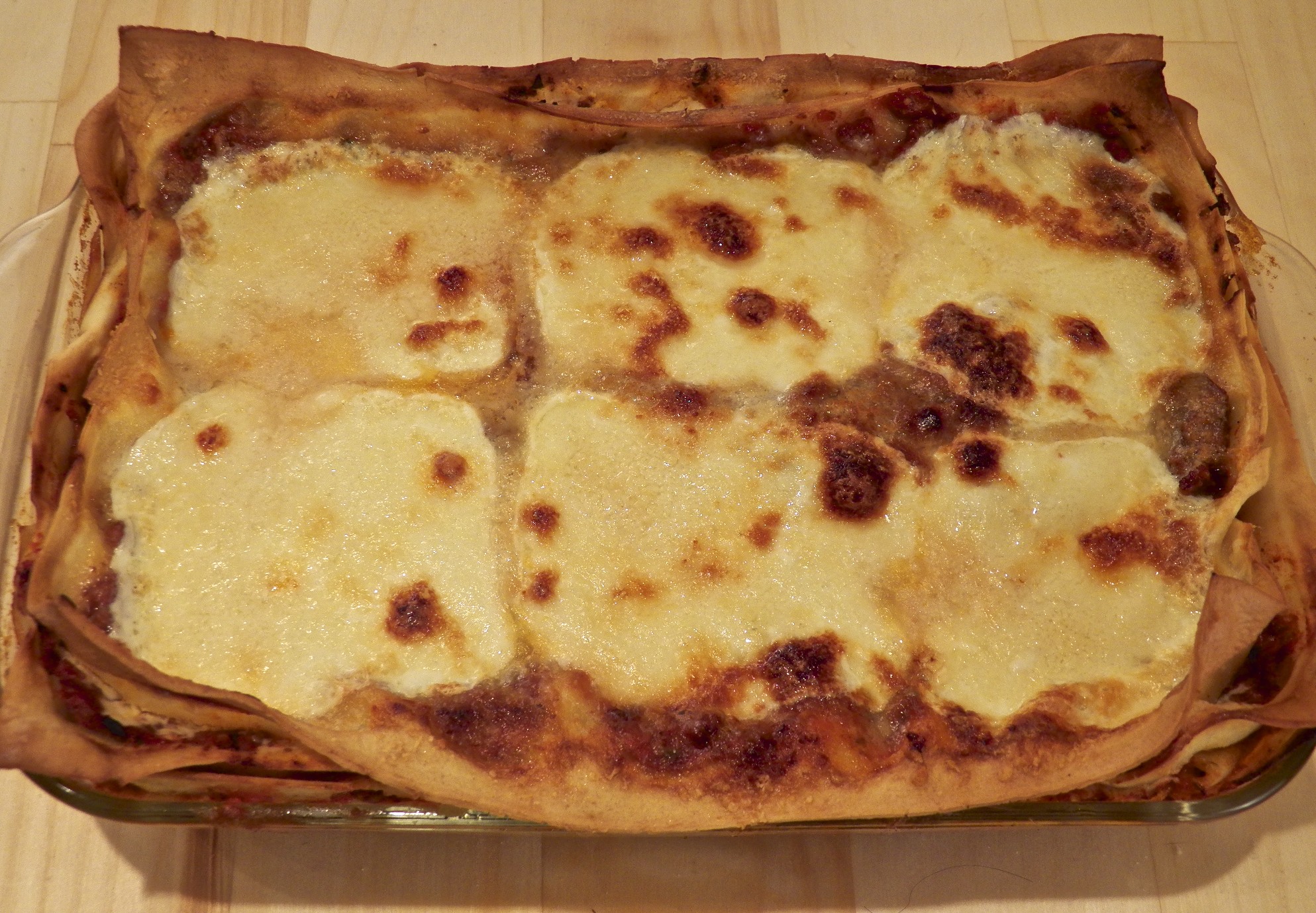
9. Place the mozzarella on top and sprinkle with Pecorino Romano cheese.

*     *     *

10. Place in pre-heated oven and bake until heated through, 40 – 45 minutes or until top layer of cheese is cooked to your liking. If using sliced mozzarella, once the lasagna has baked for 45 minutes, raise the oven temperature to 400˚ F (205˚ C) and continue until top layer of cheese is done.

*     *     *

Let rest 15 minutes before serving.

*     *     *

Notes

I use Mom’s Pasta Dough recipe for making lasagna noodles. This will result in approximately 1½ pounds (680 g) of dough. I used about 14 oz (500 g) of dough to make my noodles for an 11 X 7″ (28 X 18 cm) pan. Now, you can cut Mom’s recipe to make less dough, or, you can do as I do. Roll out the extra dough and use it to make linguine, fettuccine, pappardelle, fazzoletti,  or quadretti.

*     *     *

Fold, Cut, & Unfurl Pappardelle

*     *     *

When making homemade lasagna noodles, I roll them by machine until they are a little thicker than what I use for making linguine or pappardelle. If your rollers are at their widest at a setting of 1, then roll your dough up to and including setting 5. If your rollers are at their widest at 10, then roll your dough up to and including setting 6.

Much depends upon the type of noodles you use and the size of the baking dish or pan. If using store-bought noodles, “boil” or “no boil,” you’ll probably only be able to have 3 layers of noodles. If using homemade noodles, you can create another layer, if you wish. This is because store-bought noodles are thicker than those you’ll make by hand.

The amount of cheese sauce prepared in the recipe is intended for use in a 9 X 13″ (23  X 33 cm) baking dish. For that size dish, I estimate about 4 oz (113 g) of cream cheese and 2 tbsp (28.3 g) of butter for every layer of cheese sauce needed. Since I used homemade lasagna noodles, there were 4 layers of noodles and 3 layers of cheese sauce.

For a smaller dish/pan of 11 X 7″ (28 X 18 cm), no matter what kind of pasta or how many layers are created, I use 8 oz of cream cheese (226 g) and 4 tbsp (56.6 g) of butter with a little milk. If you prefer, you can scale back the ingredients, following my example with the larger pan. For me, frankly, scaling back the cream cheese would result in an ounce or 2 of cream cheese left in my fridge, where it will probably spoil before I think of it again. As they say, “In for a penny, in for a pound.” Might as well use all 8 oz and be done with it.

*     *     *

Variations

While discussing this recipe with Zia this past weekend, I learned that she prepares the cheese sauce differently than Mom did. Where Mom prepared her cheese sauce using butter, cream cheese, and a little milk, Zia only uses cream cheese and milk. She does, however, use enough milk to make up for the amount of butter Mom used. In short, Zia has never used butter in her lasagna while Mom and I’ve never made lasagna without it. Who knew?

As is the case with any lasagna or homemade pasta, you can go green, verde, if you like. When making your dough, add a few tablespoons of cooked, finely chopped spinach. The effect will be to die your pasta dough green. Use as you would any regular pasta dough.

*     *     *

It’s déjà vu all over again …

Not My Mom’s Lasagna

Since today’s post shared a lasagna recipe, I thought I would end with another. Using last week’s Blast from the Past Marinara Sauce, this lasagna features a parmesan besciamella with a layer of mushrooms and another with prosciutto.  Surprisingly light, the flavors within this lasagna are equally delicate. You can check out the recipe by clicking HERE.

*     *     *

Basic Meat Sauce

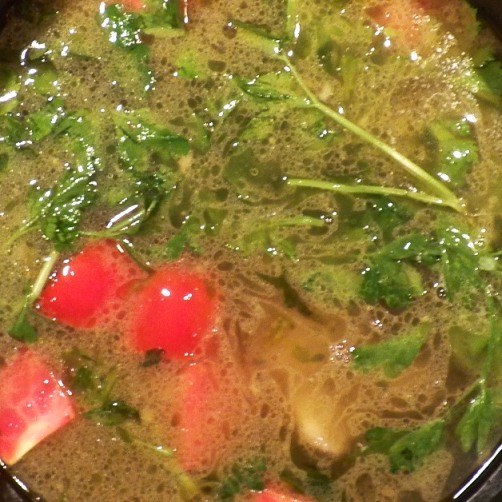
Sugo di Carne Odd, isn’t it? The part of each post that will give us trouble. Last week it was the photos and labels. Just how many pictures does one need of meat & vegetables floating in water? And do I call it “broth”, “brodo”, or “stock”? In the end, I chose one photo and used all three monikers.

This week it’s the post’s title. First off, I thought using the word “Sugo” might be confusing to a few people.  In English, sugo means “gravy” but, unlike some, we never referred to tomato sauce as “gravy”. It was either “sauce” or “sugo”. “Gravy” was the stuff you put on mashed potatoes. But that’s not the only problem in the title. This sauce is not a Bolognese, although I have that recipe and will share it later. I am a Marchigiano but it would be arrogant for me to call my sauce alla Marchigiani, meaning “in the style of Le Marche”. I guess I could say it’s dei Bartolini, meaning “of the Bartolini”, but that would imply that there’s one common sauce for us all. That’s hardly the case.

Back in the old two-flat, each adult was quite capable of making a sauce for pasta. Granted, it was exceptionally rare for one of the men to make a sauce but that doesn’t mean each didn’t consider himself to be a master chef when it came to making one. Oddly enough, each of the adults’ sauces was as different from the others as the cook who prepared it. In fact, I’d be willing to bet that if it were somehow possible to recreate each individual’s sauce, I would still be able to determine who prepared each. Yes, they were that distinctive despite using almost the exact same ingredients. “Almost” because there were two minor differences: Mom had her “secret” spice (See Notes) and Nonna might use a little marjoram. It remains a mystery to me how 6 people could have used the same ingredients and achieve such different results. Today, I add a little wine to my sauce and I don’t recall anyone else having done that. The point to all of this is to make clear that there is no one sauce of the Bartolini and for me to use that title for my sauce would be mighty presumptuous. Nevertheless, the bottom line is that I still needed a title for this post, so, I took the path of least resistance. “Basic Meat Sauce” it is.

"Until the juices run clear"

“Until the juices run clear”

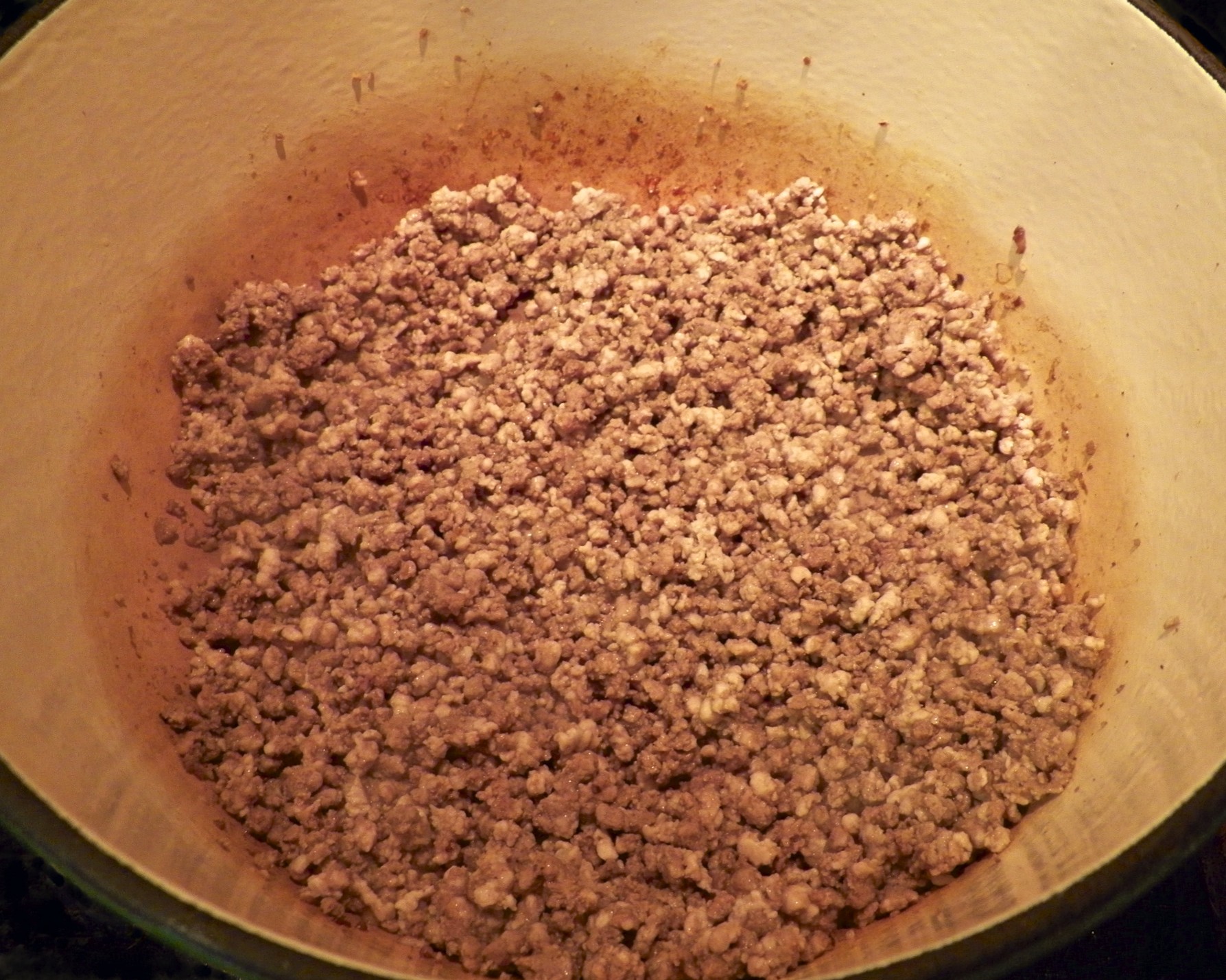
There are a few techniques that all of our tomato sauces include. In the first place, all of our sauces use onions. This is significant because the sweetness of the onion eliminates the need for the sugar that some add to their tomato sauces. When it comes to preparing a meat sauce, at one time large pieces of beef and pork were used and later served alongside of the pasta. Today those meats are ground before being added to the pot. Personally, I no longer buy ground meat and, as a result, am in better control of both the quality and fat content of my ingredients. Beyond that, the instructions for many sauces state to “Brown the meat.” Well, that’s half-right. If you only sauté the meat until the pink is gone, you’re missing an opportunity to add flavor to your sauce. As Zia says, make sure “the juices run clear” before you add anything else to the pot. This will ensure that all the liquid has evaporated, concentrating the flavor and leaving just fat behind. Only then can the meat really begin to brown and I’ll continue to sauté it for a few minutes more to do so. Lastly, I’ll add parsley and basil to the pot just like everyone else but I, also, go back and add more just after the sauce is taken off the heat. I find that doing so not only boosts the flavor of the sauce but adds to its aroma, as well.

 *     *     *

Basic Meat Sauce Recipe

yield: 2 quarts (1.9 l)

Ingredients

  • 3 tbsp extra virgin olive oil
  • 3/4 to 1 lb. (340 to 454 g) ground beef
  • 3/4 to 1 lb. (340 to 454 g) ground pork
  • 1 large onion, chopped
  • 8 cloves garlic, minced or grated
  • 4 tbsp fresh parsley, chopped – separated
  • 1 cup dry red wine
  • 10 crimini mushrooms, sliced – optional
  • 4 tbsp tomato paste
  • 2 quarts (1.9 l) tomatoes or 2 large (28 oz) cans, chopped
  • 2 tsp marjoram
  • 4 tbsp fresh basil, chopped – separated
  • salt & pepper

Directions

  1. Heat oil in large sauce pan over a medium-high heat. Once hot, add beef and pork, season lightly with salt & pepper, and sauté until the liquids run clear and the meat browns.
  2. Add onion, garlic, and half of the parsley. Stir, season lightly with salt & pepper, and continue to sauté until onion is translucent.
  3. Add the wine and sauté until all but a trace has evaporated.
  4. Optional: Add mushrooms and continue sautéing until soft, about 5 minutes.
  5. Add tomato paste, mix thoroughly, and continue to sauté another 2 minutes.
  6. Add the tomatoes, basil, marjoram, and stir to thoroughly combine.
  7. Bring to boil and reduce to a soft simmer.
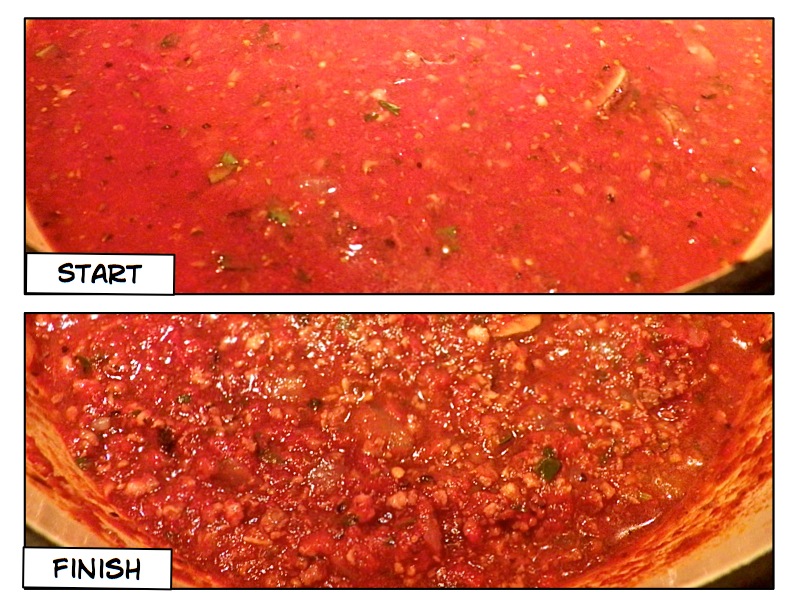
  8. Continue to simmer until the sauce deepens in color and thickens — about 2 hours. Stir occasionally.
  9. Remove from heat, add remaining parsley & basil. Stir to combine.
  10. Sauce is ready for use with your favorite pasta or, once cooled, for storage in your refrigerator or freezer.

*     *     *

*     *     *

Notes

Although this recipe makes two quarts, it can easily be halved to make one quart of sauce.

When you choose to add wine to your sauce will affect its impact on the end-result. If added early, as I did in today’s recipe, the wine will blend into the background, adding to the overall taste of the sauce. Adding it later, towards the end, the wine flavoring will be much more prominent. When preparing a meat sauce, I add the wine early on. For a marinara, I add it later, as you’ll see below. It is yours to decide which you prefer.

Mom did have a “secret” spice that she added to her sauce.  It’s not that I’ve a problem revealing the secret, it’s just that we cannot agree on what that spice was. It’s been over 10 years since I last had a taste and, speaking for myself, my memory isn’t what it used to be. Now, normally this would have meant the end of the discussion, except for one little thing. Recently, while rearranging my basement freezer’s contents, I came across a quart of Mom’s sauce that had fallen in among the ice bags that I used to create a false bottom in the freezer. (The bags were supposed to make things easier to reach and, ironically, prevent something from “getting lost” down there.) Granted, as far as discoveries go, this is not on a par with King Tut’s tomb but is it still a great find. I seriously doubt that the sauce is in any condition to be eaten but, hopefully, we’ll be able to determine just what Mom’s secret ingredient was. To that end, I plan to bring it to Zia — when I remember — and let her palate settle this matter, once and for all. Lest there be any doubt, let me assure you that Zia is a fair and impartial judge. She would never be swayed by the fact that I arranged for her to hold the hand and receive the blessing of her Patron, the soon-to-be-Saint Pope John Paul II.

*     *     *

It’s déjà vu all over again

Since I shared one tomato sauce today, I might as well take you back to an earlier post in which I shared a marinara (meatless) sauce. You can see the recipe by clicking HERE. It was one of my earliest posts, so, be kind.

And while you’re there, be sure to take the link to check out that lasagna recipe. I doubt you’ve seen one like it.

*     *     *

Engineering the Standing Rib Roast

In the past, I’ve mentioned how my family traditionally cooked porchetta, a fantastic pork roast, on New Year’s Day. To be sure, that is a remarkable main course for a New Year’s Day dinner — but it’s certainly not the only one. A number of years ago, I started serving standing rib roast for my dinner on New Year’s Day. At first, not knowing any better, I prepared it like I would any beef roast and, though the results were good, I was expecting fantastic. In the years to follow, I tried different roasting temperatures and even starting on a high temperature before shutting off my oven and letting the roast sit, undisturbed in the oven for 4 hours. Yes, that roast was cooked well but all the dinner’s side dishes had to be cooked on the stove top because the oven door was not to be opened under pain of poorly roasted meat. After I cooked a second standing rib following that method, I decided I wanted to try something else. Luckily, I stumbled upon a different approach. Analytical.

*     *     *
Engineers can cook. Who knew?

Engineers can cook. Who knew?

*     *     *

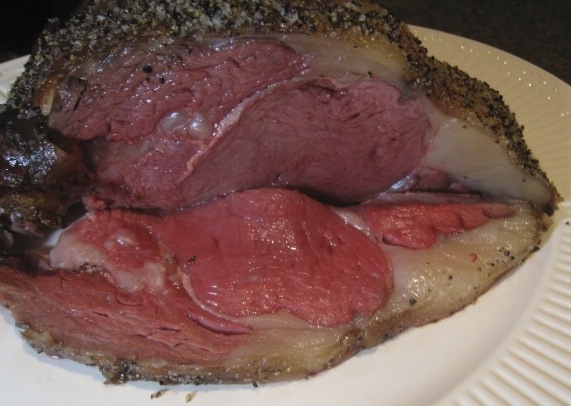
On another sleepless night — it’s 4:15 AM as I write this, by the way — I went surfing for a way to cook the perfect standing rib roast. I soon came upon a website, Cooking For Engineers, where an analytical approach is used for cooking — or so the site’s header claims. Well, I may not be aware of the analysis, if any, that lead them to this recipe but I do know a perfectly cooked roast when I see one. I have followed their instruction now 4 times and each roast has been roasted evenly throughout. There are no well-done slices at either end or gray area on the edges of each slice, with a medium-rare center.  As you can see in the photos, it is medium-rare throughout. And the best part of it all is that this is one easy roast to prepare. Incredibly so.

Day 1: Tsk. So young

Day 1: Tsk. So young.

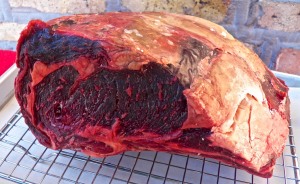
One of the keys to this dish lies in the aging of the meat. As much as one week before the dinner, you’ll want to select your roast. Once you get it home, unwrap the roast and place it on a rack, bone-side down, over a baking sheet in your refrigerator, where it will age for at least a day and no more than 7. Don’t be surprised if the aging causes changes in the roast’s appearance. It’s normal for it to darken and to lose from 10 to 15% of its weight, depending upon how long it is aged. According to our Engineer friends, aging will lend a “buttery texture” to the already richly flavored meat. Believe me. You do not want to skip this step.

Day 5: Aged & ready to go.

Day 5: Aged and better than ever.

Once you’ve aged the meat, you’ll need to prepare it for roasting. Remove the roast from the refrigerator and let it sit on the counter top for a couple of hours. For an evenly cooked roast, it must be at room temperature throughout. You may notice some unusually dark spots on the roast. These should be trimmed away. Use butcher’s twine to tie the roast lengthwise, in-between each pair of bones. This will help to ensure that the roast’s shape is maintained during the cooking process. Once the roast has been brought to room temperature, place a roasting pan on to the stove top and begin heating it. When hot, add a little olive oil to the pan. Place the roast into the now hot oil and sear it on all sides, spending about 3 minutes on each side to do so. Pre-heat your oven to 200˚ F (93˚ C). That’s right: 200˚ F (93˚ C).

Remove the seared roast from the hot pan and place a wire rack into the roasting pan. Heavily season the roast with salt & pepper on all sides. Place the roast on to the rack, insert a meat thermometer into its center, away from any bone, and place the roast & roasting pan on to the lowest rack in the oven. Set the thermometer for 125˚F (52˚C) for rare; 130˚F (55˚C) for medium rare; 145˚F (63˚C) for medium. Sorry but you’re on your own if you want to cook a fine piece of beef like this beyond medium.

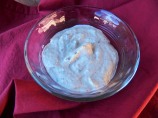
For roasts under 5 pounds, it should take about 45 minutes per pound to roast. For roasts greater than 5 pounds, it will take between 4 and 5 hours to cook properly. Once your target temperature has been reached, remove the roast from the oven, place it on a cutting board, tent it with aluminum foil, and let rest for 20 minutes. In the meantime, you can deglaze the roasting pan and use the drippings to create a sauce or add flour to make a roux before adding beef stock to make a gravy. Once rested, use your carving knife to first trim the entire roast off of the rib bones. If you prefer, you can also trim off the fatty end of the roast. Once trimmed, slice the roast in however many slices as are needed to serve everyone. Serve with a little horseradish sauce on the side. (Recipe to follow.)

Now, I ask you. Could it be any easier to cook standing rib than to age, season, sear, and roast at a low temperature? Once again, look at the photos. Each time I’ve listened to the Engineers, I served a roast that was evenly — dare I say perfectly? — cooked throughout.

Oh, one more thing. Leftovers. If you’re blessed with an extra slice, it will make a delicious sandwich the next day. Just sauté it in a little butter until heated through and serve on a favorite bun with a bit of horseradish or horseradish sauce.

To make horseradish sauce: combine equal amounts of plain yogurt (Greek pref.) and sour cream. Add horseradish to taste, some brown whole grain or Dijon mustard, a dash or two of Worcestershire Sauce, and salt & pepper to taste. Mix well and set aside. Serve at room temperature.

*     *     *

Notes

The original recipe specifically mentions to leave the roast uncovered as it ages. I’ve never aged it less than 3 days and certainly not more than 7, as the Engineer states. I’ll replace the fridge’s box of baking soda a day or two before I start the aging process and have never noticed any scent in my fridge. Of course, that just as well might have been the case had I not replaced the box. I guess I’ll never know.

Roasting a piece of meat at a low temperature means that its surface may not color as it would if roasted at a higher temperature. This is why the meat is seared before going into the oven. Just be careful to only sear the meat for 3 minutes per side. Searing it for longer periods will begin to cook the meat on the roast’s inside. Later, when the roast is carved, the end pieces will be cooked more than the rest of the roast, defeating the purpose for roasting the meat this way.

*     *     *

You can see the original recipe on the Cooking For Engineers website by clicking HERE.

*     *     *

It’s déjà vu all over again …

More gravy, please.

More gravy, please.

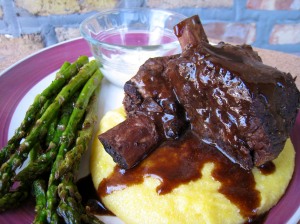
Since we’re starting the year off with a beef rib recipe, I’ll use another to end this post. With Winter here and snow having reached as far south as Texas, there are few better ways to heat up the kitchen than with a delicious braise in the oven. These beef short ribs will not only warm your kitchen, their aroma will fill your home like only good comfort food can. Be sure to serve them with mashed potatoes or polenta because you’ll want to take full advantage of that gravy. Click HERE to view the recipe.

*     *     *

Bartolini Sausage Ravioli

Ravioli della Salsiccia dei Bartolini

Christmas Day, New Year’s Day, Easter Sunday, and Thanksgiving all featured one dish, each and every year, and that was a platter of ravioli. Oh, to be sure, there was the obligatory roast of beef, or pork, or lamb, or turkey cooked to perfection on the table, too, along with all the customary fixin’s. None of it made any difference to me, for my eyes were fixated on the platter of pasta pillows. Everything else was a distraction to which “The Others”, my ravioli-eating competition, would, hopefully, fall prey. “Have some more turkey.” “Want some potatoes with that?” “Save room for dessert.” All music to my ears. As they sampled — and re-sampled — each and every one of Mom’s lovingly prepared dishes, only I remained true to the cause. It was ravioli all the way!

Back then we only had two filling recipes for our ravioli. The meat filling recipe I shared HERE and another, not yet shared, that’s used in soup ravioli (cappelletti) which is traditionally served for lunch on Christmas Day, as well as on other special occasions throughout the year. Well, that was until a few years ago. I had finally mastered the family sausage recipe when a friend asked if I’d ever made his favorite, sausage ravioli. I hadn’t and a subsequent phone call to Zia confirmed that no other Bartolini had either. Well, that just wouldn’t do.

*     *     *

*     *     *

It wasn’t long before I had made a half-recipe of ricotta and followed that with a couple of pounds of sausage, setting aside a pound of the seasoned meat. After cooking some chopped spinach and gathering some grated Pecorino Romano cheese, I was ready to go. I didn’t pay too much attention to amounts. This was just a test to see if these flavors would blend successfully — and they did. My next trip home, Zia and I made a batch of the filling, paying close attention to the ingredients’ amounts. The ravioli not only passed her taste tests, we devoted an entire Ravioli Day to the making of the new Bartolini Sausage Ravioli. If that isn’t acceptance, I don’t know what is. Today’s recipe is the result our collaboration.

Please note. When making sausage ravioli, there is but one commandment to follow: Know Thy Sausage. Compared to most store-bought or strongly seasoned homemade sausage, Bartolini sausage is rather mild — no fennel seed, for example — so I use a little less ricotta than specified in the recipe. That allows the sausage’s flavors to be more predominant. Most sausage meat tends to run on the salty side, as does Pecorino Romano cheese. Because of this, no salt is added to the ravioli filling. Before making your filling, be sure to fry a little of the sausage meat for a taste, adjusting the filling’s seasoning and, if necessary, ingredient amounts, accordingly.

*     *     *

Bartolini Sausage Ravioli Filling Recipe

Yield: See Notes below. 

Ingredients

  • pasta dough — recipe found HERE.
  • 1 lb. sausage meat, cooked and well-drained — recipe found HERE.
  • 1 pkg (10 oz) frozen chopped spinach, cooked and well-drained
  • 1 cup ricotta — recipe found HERE.
  • 1 cup grated Pecorino Romano cheese
  • 1 egg, slightly beaten

Directions

  1. Sauté meat over med-high heat until browned.
  2. Use meat grinder to finely process the meat. (See Notes.) Add all the ingredients into a mixing bowl and mix until well-combined.
  3. Cover the filling and refrigerate for a few hours or overnight.
  4. Once the filling has rested, you can begin making your ravioli.

*     *     *

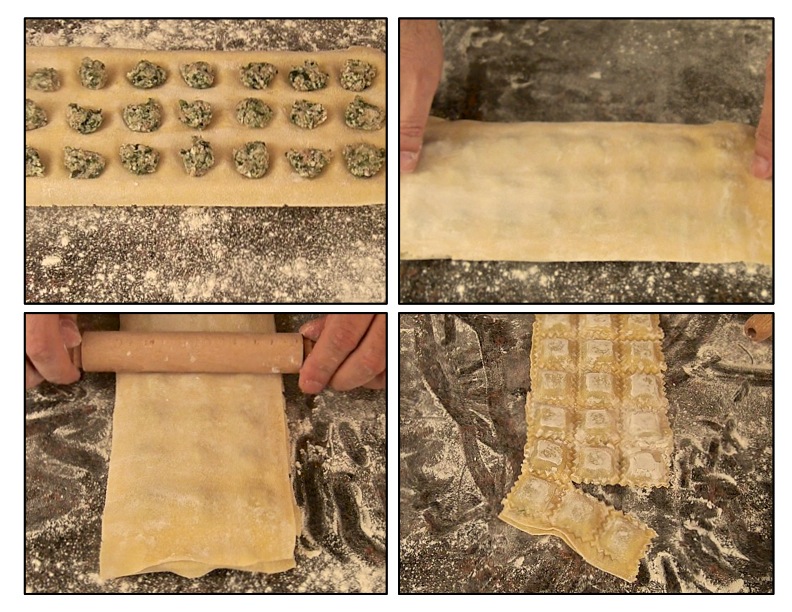
Ravioli Recap

To see a more complete set of instructions for making ravioli with dies, click HERE.

*     *     *

Notes

When I recently made these ravioli, I made 1 batch of this filling and 2 batches (8 eggs) of Mom’s pasta dough. I came away with 22 doz ravioli and 10 oz (284 g) of excess pasta dough, with which I made hand-cut linguine.  Now, I probably could have gotten away with using 6 eggs to make the pasta but that would have cut it close. I’d rather have too much pasta dough than find out I’ve not enough and have to make more. Besides, the linguine were delicious!

You do not need a meat grinder to make sausage; a food processor may be used instead. Place some meat into the bowl and pulse the blades until a coarse grind is achieved. Do not just turn it on and let it process. You’re not making pâté. When using sausage meat for ravioli, after it’s cooked, place it in the bowl and pulse it a few times until a smaller grind is achieved.

*     *     *

Pasta Equipment

I’ve been asked by a few people to talk about the pasta making equipment that I own. Since this is a ravioli post, I’ll start there.

I’ve two ravioli making attachments. One is for my stand mixer and the other attaches to my hand-cranked pasta machine. I’m not all that impressed with either of them. Both have a hopper, situated in the center, for the filling. Dough sheets are fed on either sides of the hopper, passing over a die as the filling drops. The ravioli are formed by the pressure exerted by rollers. My problem with both is that the dough sheets are thicker than what I am accustomed to using. The resultant ravioli have more dough than those of my youth. (Yes, I’m spoilt, but in the best possible way.) You, however, may very well find these ravioli to be acceptable — and that’s just fine. Be forewarned, though, that if the dough sheets are not thick enough, the filling will “run” between the ravioli, making one big mess.

Here is an instructional video to show you how the stand mixer attachment works. The hand-cranked pasta machine attachment works in very much the same way.

*     *     *

*     *     *

Anyone who has seen my ravioli posts will know that I prefer to use ravioli dies to make my filled pastas. Each will result in a ravioli of a unique size. Starting top-left in the photo below, this die will create 12 ravioli that are 2 inches (5 cm) square. (Bear in mind that, no matter the die used, each raviolo will expand a bit when cooked.) It’s interesting to note that this was the original size of the ravioli that Mom and Zia made by hand until we bambini came into the picture. These were too large for us to handle on our own and our parents had to cut them for us to eat. To help our ravioli dinners go more smoothly, Mom and Zia began making ravioli that were small enough for us little ones to handle on our own.

Which brings us to the die top-right of the picture. This will create 24 ravioli that are 1.25 inches (3.2 cm) square and this most closely resembles the size Mom & Zia made, and Zia continues to make, to this day.

Moving to the bottom-left of the photo, this die will create 40 raviolini that are 3/4 inch (2 cm) square.  Mom used these raviolini, calling them cappelletti, in soup. Try as I might, I’ve never gotten the hang of this die. The filling bowl is mighty small, the dough must be mighty pliable, and I end up mighty frustrated, which brings us to …

… the die located bottom-right of the photo. I use this die to make my cappelletti. Each cappelletti is 1 inch (2.5 cm) square and the die will make 48 of the pasta pillows. They may not be as petite as Mom’s but I can make these.

In the center of the photo is a round cappelletti stamp. This is the traditional shape for cappelletti. There was just no way Mom would ever have found the time to individually stamp enough cappelletti for a family of five. Frankly, I don’t know how she did it with the smallest of these dies but she did, repeatedly.

*     *     *

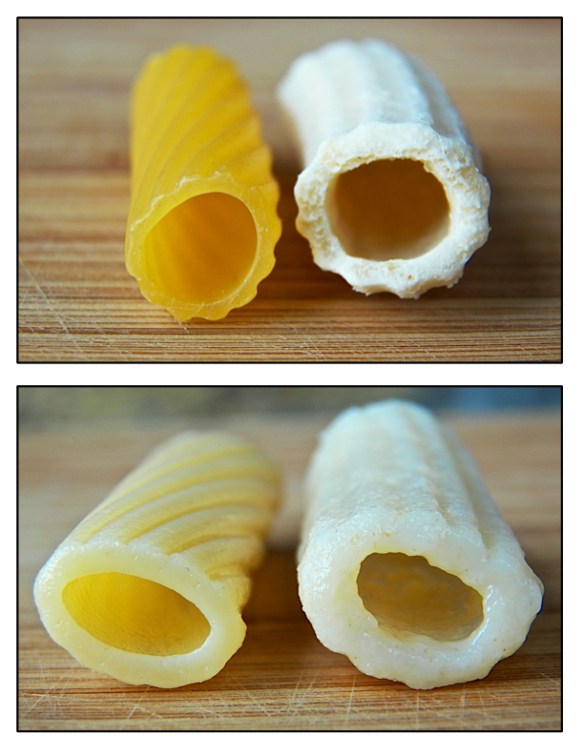
Lastly, in a recent post, I mentioned that Santa gave me a stand mixer attachment that makes a number of pastas — spaghetti, macaroni of 2 sizes, bucatini, fusilli, and rigatoni. I mentioned that the spaghetti was perfectly made but that some of the other pastas were thicker than what one would purchase at a grocery. This is not a problem for me for the superior taste of homemade pasta far outweighs any concerns about its thickness. Thinking that the eggs in my pasta dough may have been the cause for the difference, I said I’m make some dough using water and semolina flour to see if thinner pasta would result. Well, last week I made the dough and the pasta was no different from that which was made with the “egg dough.” Although I’ve no photos of rigatoni made with a pasta dough made with eggs, I did take pictures of rigatoni made with “eggless” pasta dough and compared it to a manufactured brand.

*     *     *

*     *     *

In the photo on the top, the raw, store-bought rigatoni is on the left and a freshly made specimen is on the right. Beneath that photo is another, similarly arranged picture, and both pastas are cooked. You can see that the homemade rigatoni are thicker than store-bought. The same holds true for the homemade bucatini, both macaroni, and fusilli. It is yours to decide whether that difference in thickness is a deal breaker.

*     *     *

It’s déjà vu all over again …

I know. It’s still Christmas in your home and the last thing you want to consider right now is dinner on New Year’s Day. Well, if you want to make that dinner truly special, you’ll need plenty of time so that you can find a picnic ham, skin-on, to make a Bartolini family favorite on the first day of the New Year. Pork Roast with Fennel, Porchetta con Finnocchio, is a spectacular dish, one sure to impress you dinner guests as you start 2013 off on the right foot. You can find the recipe by clicking HERE.

*     *     *

The Bartolini Clan hopes that Yours was a Wonderful Christmas

and

May Peace Reign in 2013.

Happy New Year!

*     *     *

Eel in the Style of Le Marche — Anguille alla Marchigiana

Our ship came in! This morning, I made what has become a daily call to the Italian market and learned that eels had been delivered late yesterday afternoon. I called a friend and within an hour, we were standing in front of the fish counter, watching the fishmonger net today’s entrée. Not but a few hours later, here I sit blogging about the dinner. Not too shabby, well, unless you happen to be an eel.

*     *     *
*     *     *

Throughout much of Italy, eel is a dish served traditionally around the holidays but is most commonly prepared in the southern portions of the country, with Naples famous for its eel. Very often one of the fishes served during Christmas Eve’s Feast of the 7 Fishes, eel is considered to be good luck for those who eat it. This is a very old custom dating back to the days when people believed snakes to be evil because of their role in the story of Adam & Eve. Because it so closely resembles a serpent, by eating eel one was symbolically triumphing over the devil and good fortune was sure to follow. I don’t know if that’s true but I’m buying a few lottery tickets, just in case.

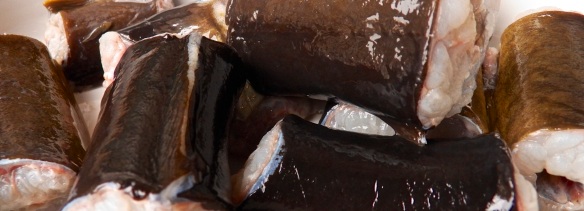
In the old two-flat, I can’t say that eating eel was a tradition at all. In fact, I only remember seeing it one time back then. I must have been no more than 5 years old because I could barely see over the edge of the sink. Even though “barely,” I did manage to get a glimpse of a sink full of the slimy devils. Needless to say, it was a sight that left a lasting impression. Speaking with Zia, that is probably the last time eel was prepared there. So, today’s post wasn’t just a recipe. It was yet another memory test for my long-suffering Zia. I must say, though, having just finished a delicious dinner, Zia came through again. The eel flesh not only remained intact, it’s flavor wasn’t overcome by the tomatoes and, in fact, the sauce had a mild seafood taste throughout. Now I just have to figure out a way to get some eel over to Michigan so she, too, can enjoy the fruits of her memory.

*     *     *
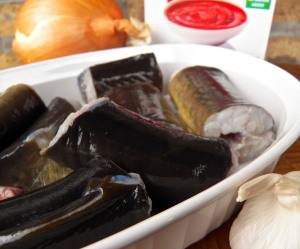
*     *     *
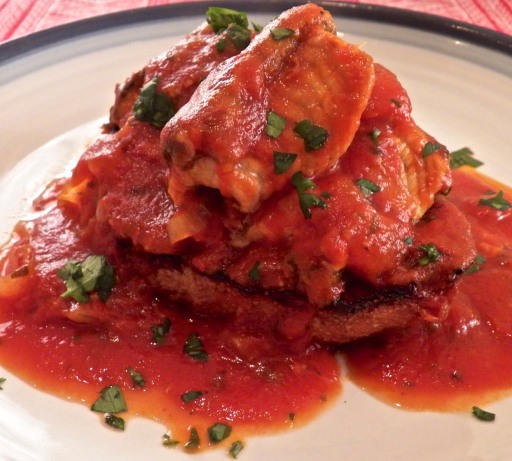
As she suggested, I prepared the anguille like we do much of our seafood, in a simple tomato sauce. In fact, this marinara is almost bland for there are no strong herbs or flavors present. Eel has a mild fish flavor and using something like organo or marjoram would definitely overpower it, leaving a tomato sauce devoid of any taste of seafood. We agreed that the eel might disintegrate if allowed to cook entirely in the sauce, so it was briefly pan-fried before being added it to the tomatoes.  Beyond that, the only change I brought to the recipe was with the basil. My family always tore by hand or chopped fresh basil before adding it to a sauce. Not long ago, I watched as Lidia added an entire stem of basil to her sauce and fished it out before serving. Well, if it’s good enough for Lidia, it is certainly good enough for me. If you, however,  don’t feel like adding a stem of fresh basil, then tear or chop away.

Oh! I should warn tell you one more thing about today’s protein. These eel are alive when purchased. You can bring them home and “take care of them” yourself or you can let your fishmonger do it for you. Um. No question. Let your fishmonger kill, gut, trim, and even chop the eel to your specifications. If you’re considering taking on any of the duties I’ve just mentioned, let me tell you that the term “slippery as an eel” is far more fact than fiction. I chose to chop the eel myself and it was a mistake, one that I’ll never repeat.

*     *     *

Anguille alla Marchigiana Recipe

Ingredients

  • 3 lbs. eel, cleaned with head & tail removed, chopped in 2 – 3 inch pieces.
  • 4 tbsp extra virgin olive oil, divided
  • 1 large sweet onion, sliced thin
  • 1 clove garlic, minced or grated
  • 4 tbsp fresh parsley, chopped, divided
  • 1 large can (28.5 oz) tomatoes
  • 1 stem fresh basil
  • 1 cup white wine
  • salt & pepper
  • thickly sliced, toasted Italian bread, for serving.

Directions

  1. In a large sauce pan, heat 2 tbsp of olive oil over med-high heat. Add onion and sauté for about 3 minutes before adding 3 tbsp of the chopped parsley. Continue to sauté until the onion is translucent, about 5 more minutes.
  2. Add garlic and sauté for a minute.
  3. Add tomatoes, basil, season lightly with salt & pepper, and bring pan’s contents to the boil before reducing to a simmer.
  4. After sauce has simmered for 15 minutes, heat the remaining oil in a large frying pan over med-high heat.
  5. Once the oil is hot, add the pieces of eel and sauté for about 7 minutes, being careful to insure that the pieces are evenly cooked.
  6. Carefully remove the eel and place it in the tomato sauce. Season lightly with salt & pepper.
  7. Use the white wine to deglaze the frying pan. Continue to cook the wine until it is reduced by half. Add the wine reduction to the tomato sauce and carefully stir the pan’s contents.
  8. Increase the heat to high, bring the sauce to the boil, then reduce the heat and simmer for another 15 minutes.
  9. Taste and adjust seasoning, if needed, one last time.
  10. To serve, set a piece of toasted bread on each plate and place eel pieces on top, followed by a generous amount of sauce. Garnish each serving with some of the remaining chopped parsley.

*     *     *

It’s déjà vu all over again …

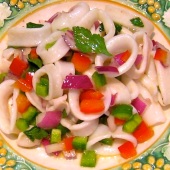
Calamari SaladA little over a year ago, I gave an account of how the Feast of the 7 Fishes came about. It was part of the post in which I shared Mom’s recipe for a Calamari Salad. Follow this recipe’s guidelines and you’ll have perfectly prepared calamari, not rubber bands. That post also included a round-up of 11 additional seafood recipes for anyone needing help with gathering 7 seafood dishes for the Feast. You can see it all by simply clicking HERE.

*     *     *

What’s this? You’re still a fish short?

Here’s a round-up of this past year’s seafood posts.

So, combining both posts, you now have 18 recipes from which to choose dishes for your Feast of 7 Fishes. Still having trouble? Try this: start your meal with Mom’s Calamari Salad. Next serve a bowl brimming with Brodetto. See? You’ve got 6 Fishes out-of-the-way already. Now, finish your meal with a bang: Branzino al Cartoccio. That’s 7 Fishes and you haven’t even broken a sweat.

*     *     *

Coming soon to a monitor near you …

Mom’s Brodo

*     *     *

Baked Whiting

Merluzzo al Forno

Today’s recipe comes from a half-century ago, a time when television shows were only broadcast in black and white; when a trip to the airport was something eagerly anticipated; when all (US) phones had a dial and many of those phones, being owned by Ma Bell, were rented; when music was purchased on large, black vinyl discs; and when Catholics were forbidden to eat meat on Fridays lest they face the fires of eternal damnation. Yes, that long ago.

*     *     *

*     *     *

When I think back to those days, I’m amazed at the variety of fish that found its way to our dinner table. Aside from the usual guests — i.e., baccalà (salted cod), stoccafisso (dried cod), tuna, vongole (clams), smelt, calamari (squid), perch, sepia, lumache (snails) — there were infrequent visitors but I was far too young to remember their names. Zia, my very own Encyclopedia Italiana, can’t remember their names either. So, you can well imagine my surprise when the fishmonger at the Italian market identified a type of fish in his display case as “merluzzo.” Merluzzo! I’d not heard or seen that fish in almost 50 years. I bought a couple, rushed home, and phoned my Aunt immediately.

Zia was every bit as surprised as I was. I really enjoy these phone calls and they’re why I spend so much time investigating a market’s pasta aisle, the cheese counter, the produce department, and interrogating the fishmonger. It makes my day when I uncover some treasure from long ago and then phone her with the news. To be sure, no matter the discovery, there’ll be some in a bag, a box, or a cooler the next time I come for a visit. And that dinner will be full of memories, some of which I’ll then share with you.

*     *     *

*     *     *

Now then, before discussing the recipe, I can no longer ignore l’elefante nella stanza. Our friends from across The Pond refer to merluzzo as “hake”, whereas here merluzzo is called “whiting.” (My sources on this “side” being my fishmongers and Fabio Trabocchi’s cookbook Cucina of Le Marche.) Although I am by no means an expert, I’ve learned that although the two fish aren’t exactly the same, the names “whiting” and “hake” are used interchangeably.  For the sake of argument, henceforth I’ll call today’s fish “merluzzo”. You, then, can translate it to mean whatever you like,  be that “whiting” or “hake”.  ChgoJohn, Peace Maker.

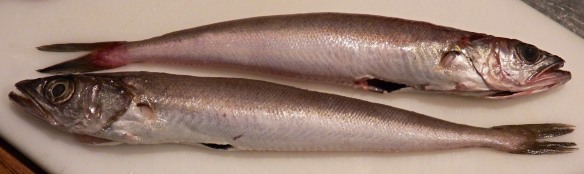
I’m going to dispense with my normal recipe format, for this dish doesn’t need it. Merluzz’ are small fish. Scaled and gutted, the 2 pictured were about 9 inches (23 cm) long and together weighed about 8 ounces (227 g). To stuff them, you’ll need about 1/3 of a cup of the breading mixture per fish and you may wish to make more, depending upon how you’ll cook or serve your fish.

This stuffing mixture is used in a number of the Bartolini family recipes. Grandma’s Stuffed Vegetables and Grandpa’s Barbecued Shrimp are 2 that I’ve shared so far. We, also, use it to stuff calamari and again with other baked fish, the recipes for which are forthcoming.  The only difference in its composition from one dish to the next is that, with seafood, lemon juice might be added.  It’s easy enough to make. Just combine (Panko) breadcrumbs, chopped fresh parsley, a little grated or minced garlic, salt & pepper, and olive oil. If you like, squeeze a little fresh lemon juice into the mix. Learning how much olive oil to use gave me fits. I pestered Mom with questions and was forever touching Zia’s mixture to get “the feel” of it.  You do not want a breading that is sopping wet with olive oil but neither do you want it barely moist. Too wet and you’ll have a greasy dish; not wet enough and it will dry out, and possibly burn, before the dish has finished cooking. Practice makes perfect.

Once the breading is made, salt & pepper the fish, inside and out, use the breading mixture to stuff it, and add a light drizzle of olive oil. Back in The Day, Grandpa would then secure the merluzzo in a hinged grill basket and place them on his barbecue, turning them after a few minutes. When finished, they would be removed to a serving platter and brought to the table. As you can see, that’s not what I’ve done.

To bake, place the stuffed fish on a lightly oiled baking sheet. Place any excess breading on top of the fish before drizzling with oil, and then place in a pre-heated oven of 375˚F (190˚C). Bake for about 20 minutes or until the breadcrumbs are golden brown. Times may vary depending upon the oven and size of the merluzzo. Remove to a serving platter and serve immediately. That’s still not as is pictured but this is how my family baked and served merluzzo.

*     *     *

*     *     *

One way I like to prepare them is to roast cherry/grape tomatoes with the fish. I make extra breading and use it to cover the fish. Once roasted, the resulting flavors of roasted tomato and breading are reminiscent of Grandma’s Stuffed Vegetables.

A third way to serve them is to prepare even more breading mixture and use it to as a bed and coating for the roasting fish. Once roasted, place the breading and fish atop cooked pasta that has been lightly dressed with olive oil and chopped parsley. Roasted cherry tomatoes would work here, too.

*     *     *

Notes

Don’t let a fear of fish bones prevent you from trying merluzzo. The bones are all attached to the spine and the “top-side” fillet readily lifts off of the fish with your fork. Once exposed, the entire spine is then easily removed, making the “bottom-side” fillet accessible. Just be careful with the meat taken from around the gills and you shouldn’t encounter any bones while eating.

*     *     *

It’s déjà vu all over again …

*     *     *

As I’ve said, seafood is the protein of choice in Italian households on the night before Christmas. My Brodetto, or fisherman’s stew, uses a variety of seafood in a lightly seasoned tomato broth to create a very special dish which, coincidentally, is perfect for Christmas Eve. Click HERE to learn how to make this stew.

*     *     *

Coming soon to a monitor near you …

Next week’s recipe is a mystery dish, my memories of which predate even merluzzo. As such, I’ve no teaser photos for you. I can’t even guarantee that I’ll find it before next Wednesday. If I don’t, I may delay next week’s post a day or two, hoping that something turns up. Don’t you worry. I’ve another seafood recipe, all set to post, if I’m not successful. Stay tuned …

*     *     *

Pan-Seared Salmon with Dill Sauce

As many of you may recall, recently I’ve located 3 fishmongers in my part of town. This was quite the lucky stroke, especially considering that for years now, only previously frozen fish was available to me — unless I wished to pre-order what I wanted. Yes, that was a possibility but there was little room for spontaneity. Living by myself, I don’t mind planning a dinner when guests are involved but when dining alone, I’ll often let the market decide what I’ll be preparing. Very often that meant that good, fresh fish were off the menu. Well, not anymore.

*     *     *

*     *     *

Now that I’ve a steady supply of quality fish, I’ve certainly taken advantage. Branzino, sturgeon, merluzzo, salmon, shark, and sea bream have all found there way to my table, as have more clams than I’ve had in the past decade. I’ve prepared the fish in parchment (al cartoccio), grilled (alla griglia); baked (al forno), stewed (in umido) or, like today, pan-seared. None is difficult or complicated to prepare, nor are any so bone-riddled as to be unpalatable. Although 1 specific dish may give you pause, I guarantee that you will be able to prepare the others without so much as batting an eye. So, with Christmas Eve approaching fast, I plan to present 3 fish dishes to you in December.

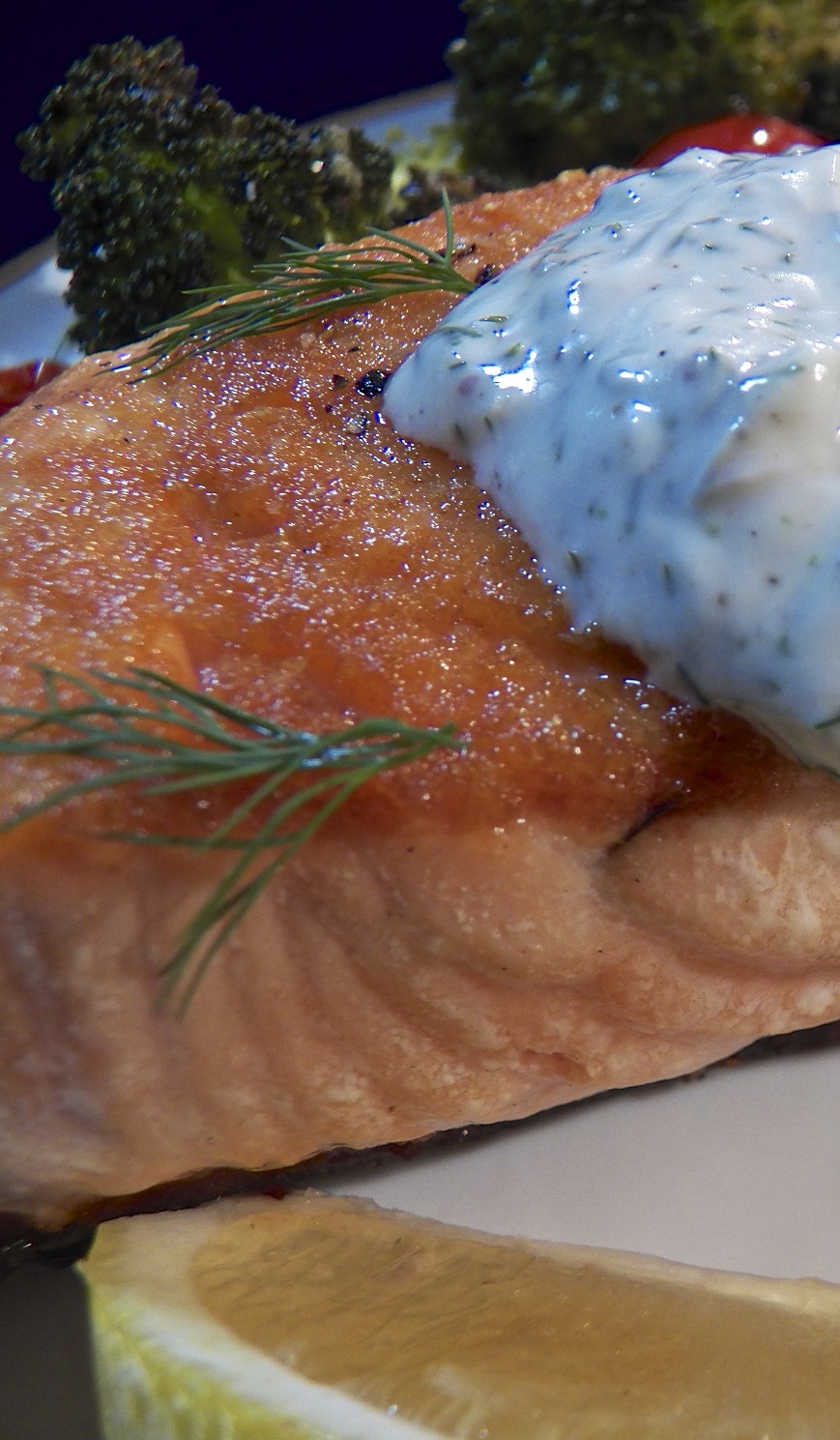
Today’s recipe is Pan-Seared Salmon Fillets. This is so easy to prepare that I debated blogging about it at all. Still, I was motivated to do so for the benefit of the younger members of my family.  Preparing fish can be a bit daunting for the inexperienced cook and a recipe like today’s is a confidence builder. With both the salmon and sauce taking less than 15 minutes to prepare, all you have to worry about is preparing a salad and whatever sides you prefer. The only way this meal could be easier is if you ordered it in a restaurant — and then it would cost you at least double.

*     *     *

Pan-Seared Salmon with Dill Sauce Recipes

Ingredients

Browned & Crispy

  • thick cut salmon fillets, skin in place
  • salt & pepper
  • extra virgin olive oil
  • lemon wedges for serving

Dill Sauce

  • 4 tbsp (low-fat) Greek yogurt
  • fresh dill, chopped + more for garnish
  • 1 small garlic clove, minced or grated
  • salt & white pepper

Directions

  1. Combine yogurt, dill, and garlic into a small bowl and mix well. Season with salt & pepper and set aside.
  2. Heat a few tablespoons of olive oil in a medium skillet over a med-high heat. Season both sides of the salmon with salt & pepper.
  3. When oil is hot, add the salmon fillets, skin side down.
  4. Turn fish over once skin is well-browned & crispy but not burnt. This should take 4 to 5 minutes.
  5. Continue to sear, flesh-side down, for about another 3 minutes. This will give you a fillet that is med-rare to medium internally. Cook more or less depending upon your own preferences.
  6. Serve immediately  garnished with chopped dill and accompanied with dill sauce and lemon wedges.

 *     *     *

Notes

To insure that the salmon cooks evenly, select yours from the thickest part of the salmon fillet. If you must use the “tapered end” of the fillet, you will need to adjust your cooking times accordingly and the salmon skin may not fully crisp.

Although the dill sauce may be prepared and served immediately, it is best when prepared a few hours in advance and allowed to sit so the flavors meld together. I prefer to serve it at room temperature and will allow it to sit on a counter for about an hour before serving.

There are definitely 2 schools of thought when it comes to eating the skin of cooked fish. This recipe specifically crisps the skin. If you enjoy eating crispy skin, serve the fillets skin-side up. If you prefer not to eat the skin, serve the fillets skin-side down. This will soften the skin and make it easier to avoid while dining.

*     *     *

It’s déjà vu all over again … 

With an eye towards Christmas Eve, I thought today’s Blast from the Past should follow this month’s fish theme. In many Italian households, baccalà (salted cod) is the centerpiece of the Christmas Eve dinner. Click HERE to learn how my family prepares this dish.

*     *     *

Coming soon to a monitor near you …

Pasta with spinach, lemon, and burrata cheese

*     *     *

What do a Zia, a Pope, and an Elf have to do with Today’s Pasta? (Part 2)

*     *     *

Ché bella Zia!

*     *     *

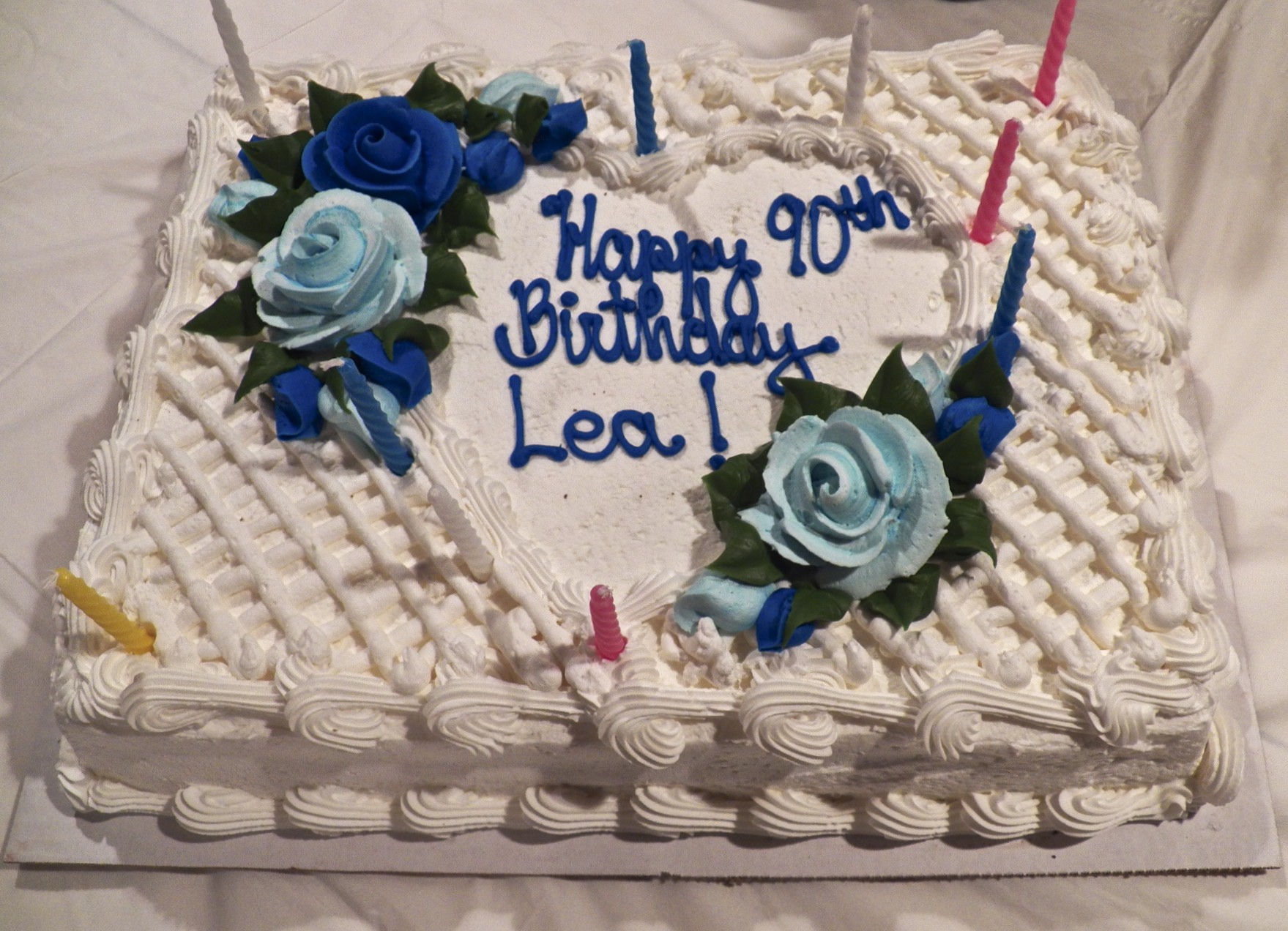
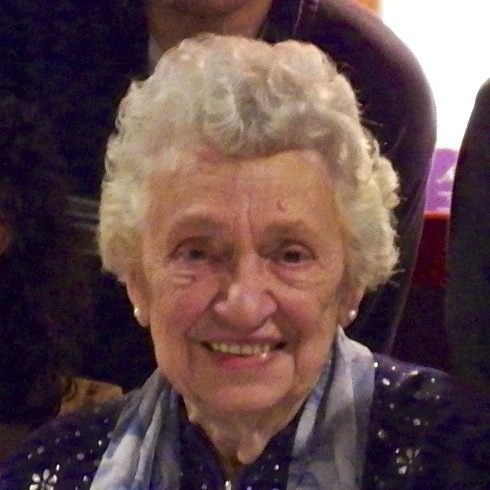
As was mentioned yesterday, today is the 90th anniversary of my Zia’s birth! Last Saturday, some 2 dozen Bartolini gathered at the home of one of her Grandsons for a surprise party in her honor. (Very heavy emphasis on the “surprise.”) The food was delish; the champagne chilled and plentiful (just how I like it); and the highlight of the evening was her Son’s slide show of family photographs. It was a wonderful night for this very special Lady and Matriarch of the Bartolini Clan. She deserves no less!

Now, back to our story …

*     *     *

2 Pieces of the Puzzle

*     *     *

Yesterday, I recounted my favorite story involving my Zia as a means of celebrating her birthday. What’s this? You missed it? Well, click HERE to view yesterday’s post. Once there, you’ll see how Zia and Pope John Paul II are connected. Don’t worry, we’ll wait for your return.

For the rest of you, I don’t expect you to sit idly by while the others catch up. Heavens no! Here’s a musical interlude to occupy your attention while we wait. (Thanks, Cris!)

*     *     *

(Remember this aria, Zia?)

*     *     *

Everybody here? Then let’s continue …

When we left our story, Zia and I had just experienced a close encounter of the Papal Kind and were in a taxi being ferried back to our hotel. When we arrived at the hotel, we skipped lunch, preferring to retire to our rooms. We had anticipated a memorable day and this was so much more than that, a truly once-in-a-lifetime experience. A rest was definitely in order — if for no other reason than to allow Zia to re-hydrate. Later that afternoon, as was our custom, room service delivered our caffè to Zia’s room. Normally, this is when we would have planned our dinner and evening. That night, however, we decided to “stay close to home” and made an early reservation at a restaurant just down the street from where we were staying.

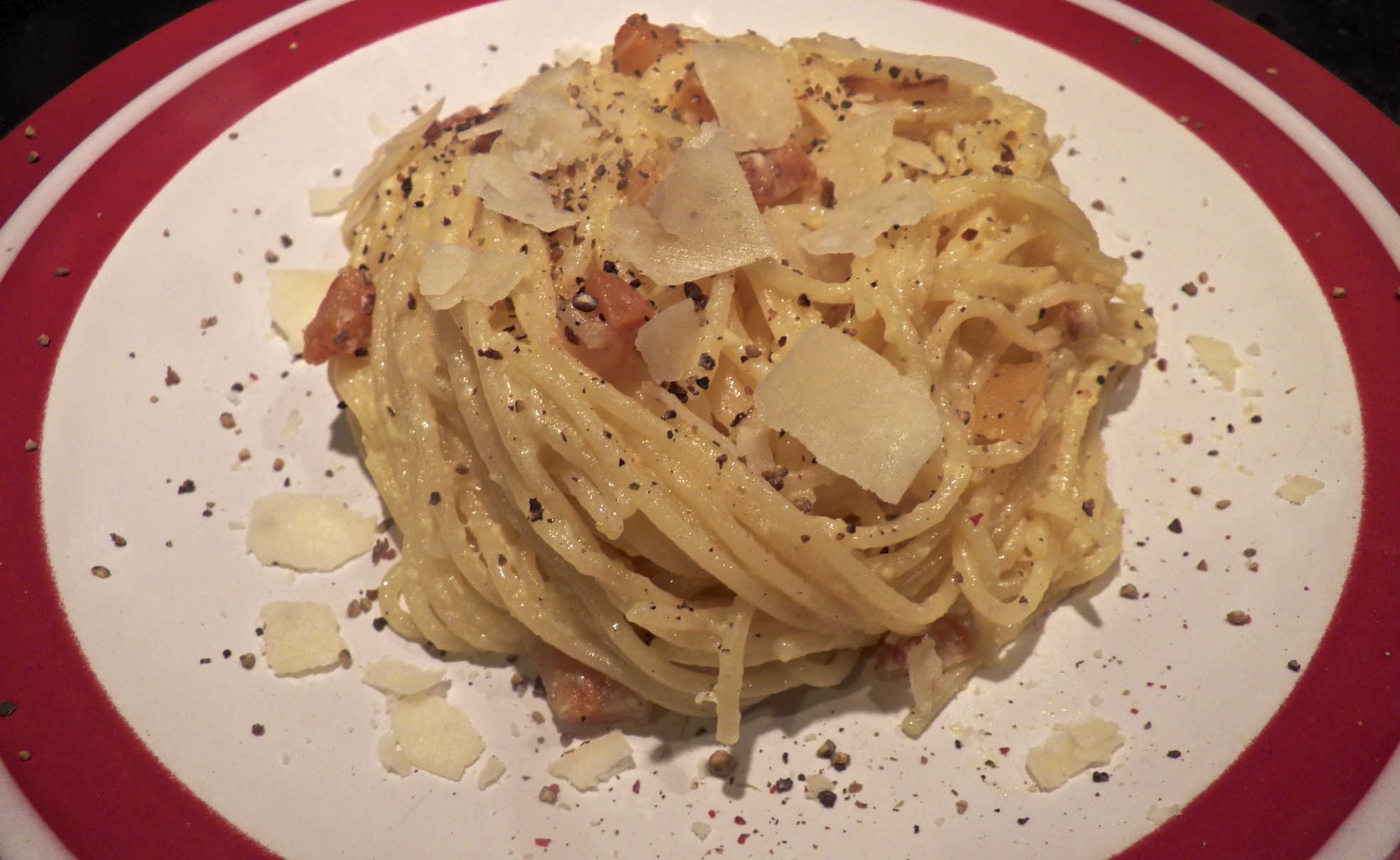
Not that much later, we were seated at the restaurant, our appetites still nowhere to be found. Now, one thing you should know about my Cara Zia is that she loves pasta every bit as much as I do. When we dined, we always enjoyed a primo piatto of pasta of some sort before ordering our secondi and contorni. So, absent an appetite, we did what came naturally: we ordered pasta.  Not so coincidentally, that pasta just happens to be today’s recipe, Spaghetti alla Carbonara.

*     *     *

Spaghetti alla Carbonara

*     *     *

Mom first prepared this dish for me when I was in my teens. She told me a legend that its name was derived from the coal miners that worked in the mines that surround Rome. As they ate their lunch, which often consisted of a plate of pasta, coal dust fell from their clothes and on to their plates. The dish’s ample use of black pepper is an homage, of sorts, to those miners and their lunches.

The version Mom served me usually contained bacon, although prosciutto was sometimes substituted, albeit rarely. Pancetta just wasn’t something that Mom and Zia used in their cooking. Remember, many of the Bartolini dishes began with a battuto of onion, garlic, parsley, and salt pork. There was no need for pancetta, too. As my experience as a cook grew, however, I began to use pancetta more frequently when I prepared this pasta.

Back in Rome, Zia and I noticed that this pasta was made with guanciale, something that was an unknown to me. Our waiter explained that guanciale comes from the pig’s jowls and, like pancetta, it’s cured but not smoked. Although now used throughout Italy, our waiter went on to explain that it is still most commonly used in Rome and its surrounding district of Lazio. Well, we needed no further urging. Zia and I ordered the Spaghetti alla Carbonara and so began my love affair with this cured meat. Unfortunately, it would take me 10 years to find a source for guanciale in my hometown but that’s a story for another day. Even so, in my mind, Spaghetti alla Carbonara will be forever linked to Zia and Pope John-Paul II.

OK. So far I’ve explained the connection between Zia and the Pope and how, on the day of their meeting, we dined on today’s pasta, Spaghetti alla Carbonara. Get ready, kids. Here comes Santa Claus!

*     *     *

No, that reindog isn’t Max.

*     *     *

In the years following that momentous day in St Peter’s Square, I’ve prepared Spaghetti alla Carbonara countless times. It is one of the few dishes I prepare using spaghetti because it’s just not my favorite form of pasta. You see, lacking the means to create this thin, round-shaped pasta, I had to rely on manufactured spaghetti. As you know, I prefer homemade pasta over pretty much all manufactured types. Still, when it came to this tasty dish, I gladly bought spaghetti and never thought twice about it. This all changed 3 years ago, almost to the day.

One afternoon, Martha Stewart was promoting a new attachment for a well-known stand mixer. This piece of equipment worked much like an extruder, forcing dough through interchangeable plates, creating macaroni, fusilli, rigatoni, bucatini, and, you guessed it, spaghetti. Later that day, I spoke with a good Friend (aka my Traveling Companion) and mentioned this pasta-making wonder of modern technology. A year later he would become a member in high standing of my blog’s tasting crew and, at this time, he had already been the beneficiary of many of my dishes and, well, experiments. He understood full-well the ramifications of this piece of equipment. Our conversation ended and that was the end of that, as far as I was concerned — or so I thought. About a week later, much to my surprise, UPS delivered the pasta maker. In its packaging was a card from Santa, wishing me a Merry Christmas. I called to thank my Friend but he denied having anything to do with it — a denial he maintains to this very day. Now, I’ve no reason to doubt my Friend or his word. If he maintains that Santa did, indeed, send me a gift, who am I to disagree? I would just like to point out, however, that he is the Elf holding the reindog in the picture above. Just sayin’…

There you have it. This is how my Zia, a Pope, and an Elf all helped to bring you today’s Spaghetti alla Carbonara. All that’s left to do, aside from presenting the recipe, is to say,

“Buon Compleanno, Cara Zia!”

*     *     *

*     *     *

Spaghetti alla Carbonara Recipe 

Ingredients

  • 1 lb spaghetti
  • 2 tbsp extra virgin olive oil
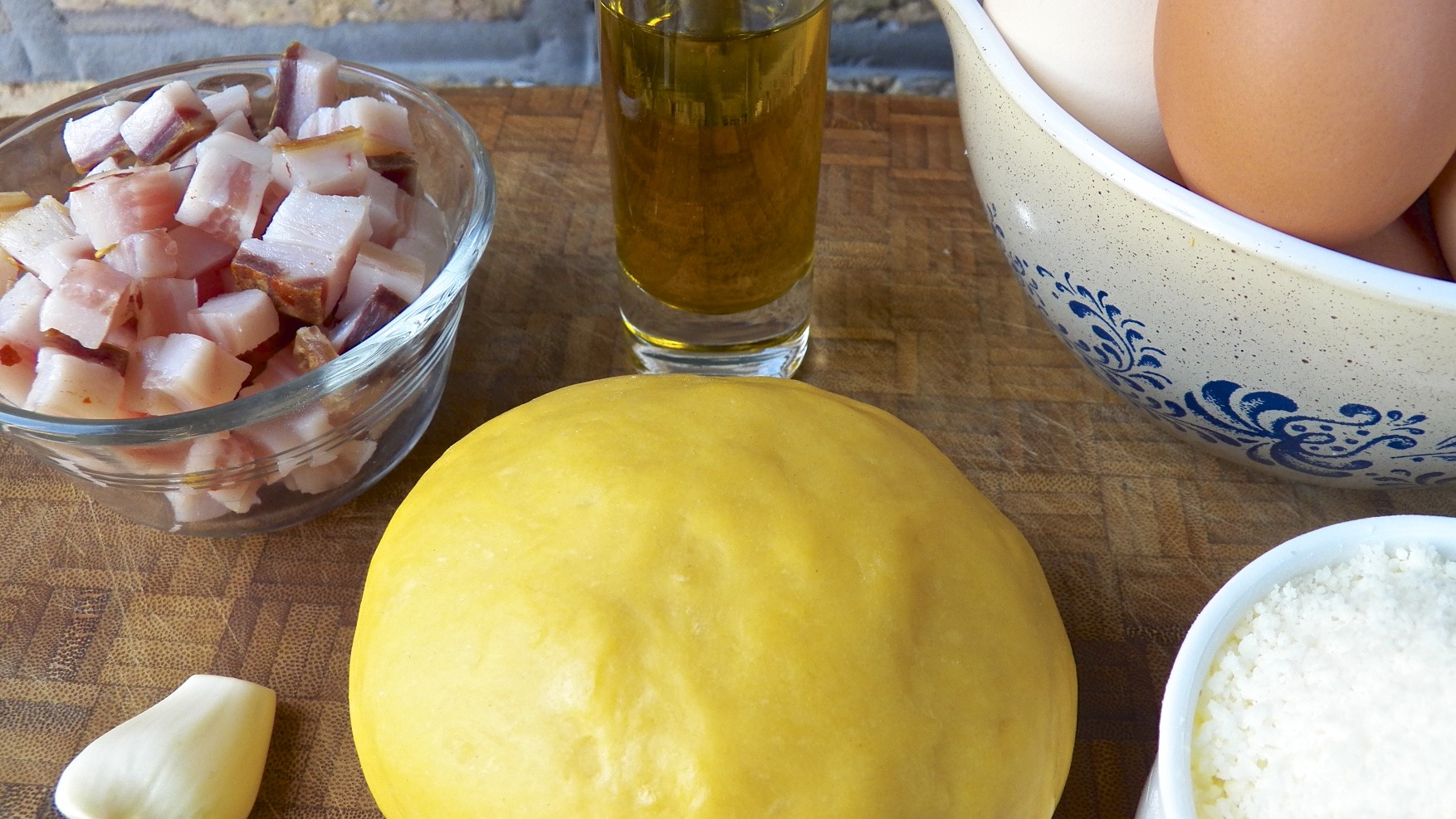
  • 4 oz. guanciale, ¼ inch dice (pancetta, prosciutto, bacon, or ham may be substituted)
  • 1 or 2 cloves of garlic, sliced
  • 3 eggs, beaten
  • 1 cup grated Pecorino Romano cheese – separated
  • ½ to 1 tsp freshly cracked black pepper
  • reserved pasta water
  • Parmesan or Romano cheese for garnish/serving

Directions

  1. Warm a large pasta serving bowl.
  2. Bring a large pot of heavily salted water to boil. Add the spaghetti and stir.
  3. Check the spaghetti package’s cooking instructions. You’ll want it to be 2 minutes shy of al dente when the rest of the ingredients are ready.
  4. Add half of the cheese to the 3 eggs and beat well to be rid of any lumps.
  5. In a large, deep frying pan, heat the oil over medium heat. Add the pancetta and brown, rendering all the fat. Do not over cook.
  6. Add the garlic and sauté for about a minute.
  7. While the garlic cooks, reserve a cup of pasta water, drain the pasta, and add the pasta to the frying pan.
  8. Continue cooking the pasta in the oil for 2 minutes, heating it thoroughly.
  9. Pour the frying pan’s contents into the warmed serving bowl. Add the egg and cheese mixture in a slow, steady stream, stirring constantly to prevent the eggs from scrambling. Once fully coated, add more cheese, the pepper, and as much pasta water as necessary to create a creamy sauce.
  10. Serve immediately with plenty of grated cheese and cracked black pepper available at the table.

*     *     *

Notes

For so few ingredients, this is a relative tricky dish to prepare. If not done properly, the pasta will not be hot enough to cook the eggs, raising the possibility of salmonella. To eliminate that risk, I only use pasteurized eggs when making this dish. On the other end of the spectrum, it is very easy to “scramble” the eggs rather than create a sauce. You can limit this risk by mixing the pasta and egg mixture off the heat, in a warmed bowl, and/or by adding a little of the hot pasta water to the egg mixture before it’s added to the pasta. This will, in effect, temper the eggs a bit. No matter how you do it, remember to keep the pasta hot and to work fast.

*     *     *

It’s déjà vu all over again …

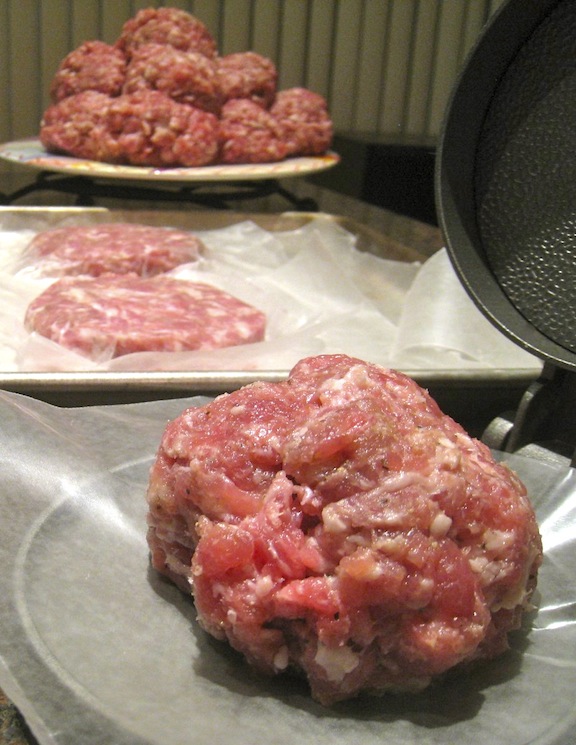
It was just about a year ago when I shared the Bartolini recipe for making sausage. Mild compared to most spicy sausages, ours depend upon garlic, white wine, and salt & pepper for flavoring. Consider them a platform on which to build your own sausage. Paprika, red pepper flakes and fennel seeds will change them up a bit, as will marjoram, mint, and oregano. Though these days we tend to form patties more often than sausages, the post is nonetheless chock full of sausage making information. Feel free to ask any questions that may arise. You can view the post by clicking HERE.

*     *     *

Coming soon to a monitor near you … 

Merluzz’ al Forno

*     *     *

What do a Zia, a Pope, and an Elf have to do with Today’s Pasta?

I thought that the combination of last week’s photo with this post’s title might capture your attention and, now that they have, I’ll waste none of your time.

First off, the Kitchens are now open again and I hope everyone’s Holiday and week went well. Thank you all for leaving Holiday wishes and “Likes” during my absence. You see, tomorrow is my Zia’s 90th birthday and I was in Michigan last Saturday for her surprise birthday party. (Happy Birthday, Bella!) What does this have to do with the riddle in the title? I’ll get there. Relax. In fact, grab yourself something to drink. A little Vin Santo would be appropriate.

*     *     *

*     *     *

As one would expect, during a celebration so grand as a 90th birthday party, stories are told involving the honoree and any number of the guests. My story, my favorite “Zia Story”, is one I’ve saved for just this occasion. My family and friends have heard it countless times, bless their hearts, and now it’s your turn.

During Mom’s illness, there were many evenings during which Zia and I passed the time chatting while watching television. Very often, my travels in Italy were the topic of discussion. I had tried, a number of times, to get Mom to come with me but her fear of flying was too great. Zia had no such fear and many of our evening chats ended with, “Well, maybe someday …”

After Mom passed, I continued to go to Michigan to help settle her affairs, as one might expect. During one of those trips. Zia and I decided that we could both use a little vacation and a trip to Italy was planned. The tragedy of 9/11 delayed our holiday and we left for the Old Country the following March. We spent a few days in Venice before taking a train to Florence. A few days after that and we were on a train heading for Rome.

 *     *     *

The Grand Canal of Venice

*     *     *

Oops! Forgive me. I’m getting a little bit ahead of myself. Before leaving the States, I spoke with a “regular” at the bar who was employed by American Express. (This is when AmEx still employed thousands of agents to handle all of your travel needs.) He suggested that we attend the Pope’s public Mass, conducted every Wednesday in St. Peter’s Square. I agreed and he made the necessary arrangements. Later I called the number he supplied and was told where in Vatican City to fetch our tickets. Being that Zia would be in a wheelchair — the day would be far too long and arduous for her to remain on her feet — the woman explained that we would be seated “off to the side with the other disabled.”  After Mass, she continued, the Holy Father would turn to give us all “a special blessing.” I was quite pleased and we were all set to go. Now, back to our story …

We arrived in Rome on a Thursday. There’d been a transit strike that day and we were lucky to get out of Florence. Over the next few days, we toured the Eternal City. Having been to Rome a few times, I made sure that we didn’t miss a church, museum, or marble chunk of ancient Rome. We sipped caffè on the Via Veneto, tossed coins in the Trevi Fountain, got stiff necks in the Sistine Chapel, and never met a gelato we didn’t like. We saw — and did — it all. On Tuesday, we travelled to Vatican City, picked up our tickets, and spent the rest of the day sight-seeing. After breakfast Wednesday morning, we hailed a taxi and headed back to Vatican City to watch Pope John-Paul II celebrate Mass.

By the time we got to St. Peter’s, the crowd had already begun to gather. For security purposes, the Square was cordoned off and everyone formed a queue to the right, walking along the colonnade. With me pushing Zia in her wheelchair, we joined them and it really wasn’t long before we got to the head of the line where metal detectors waited. A Swiss Guard motioned for us to leave the line and to use a detector reserved for people in our circumstance. Suddenly we were “special,” though we’d yet to realize just how much.

*     *     *

The Ponte Vecchio of Florence

*     *     *

After passing through the metal detector, we rolled alongside of the throng, passing across the front of the Square. The Altar sat atop a stage directly to our right and the Square, now filling with people, was to our left. When we got to the end of the stage, the Faithful turned to the left to finish circling the Square before being allowed to enter the viewing area from the back. Not us, however. Just before we were to turn, one of the Swiss Guards motioned for us to come to him.  We had to cross through the people and once we neared the Guard, he unhooked a velvet rope and indicated that we were to go that way. (See? “Special.”)  Alone, we made our way down a passageway, wondering all the while what was going on. At its end we had no choice but to turn to the right and, this time there was a ramp that ran parallel to the passage we had just traversed. Once we started up that ramp, it became clear that we were headed to the stage where the Altar stood.

Dumbfounded, we arrived at the top of the ramp not knowing which way to turn or what to do. Before us was St Peter’s Square, filling with people, and to our left was the Altar in the center of a stage that had been divided into large sections, some with seats. A gentleman in a gray tux with tails motioned for us to come to him and he positioned us in a section to the right of where the Altar stood.  I was given a chair and sat next to Zia in her wheelchair, The Pope would say Mass directly in front of us. Across, on the other side of the Altar, some newlywed couples sat, still dressed in their wedding finery. To their side were children, some of whom had apparently recently received their First Holy Communion. The view from that side was partly blocked by sound and lighting equipment. For reasons that would soon become clear, our view had no such obstructions. No one, save the Cardinals that attended him, would have a better view of that Mass than did Zia on that day. Needless to say, I was in a state of utter disbelief and Zia, wiping away tears, thanked me profusely. But wait, there’s more.

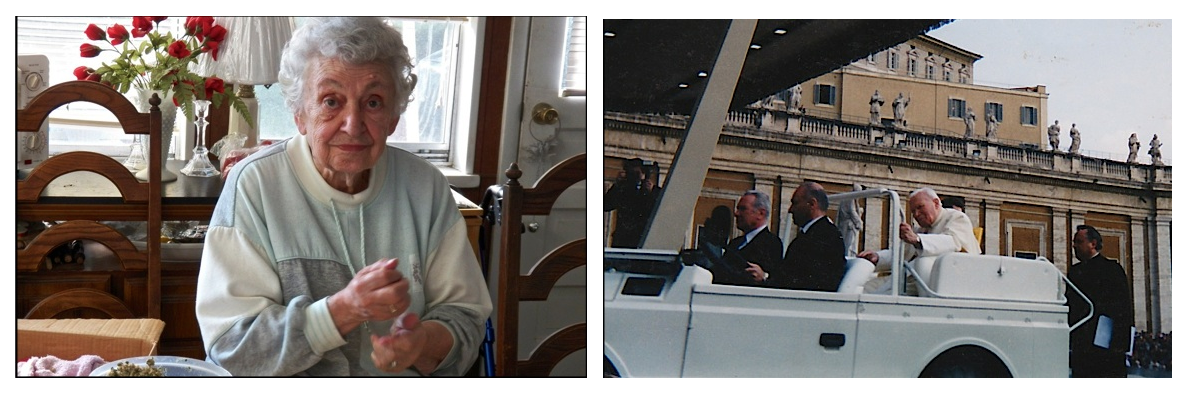
After what seemed like an eternity, we could hear a roar rising from the crowd. At the other end of the Square, the Pope could be seen riding the Pope Mobile through the Faithful. A few minutes later, he was riding up a ramp, passing between us and the Altar, naught but a few feet separating us. Had we left Vatican City right then, Zia would have been one very happy Bartolini — but there’s still more to this tale.

*     *     *

*     *     *

The Pope said Mass a mere 20 feet before us and the service took a little longer than one might expect, for he delivered his sermon in three languages, Italian, English, and Polish. And all the while Zia tearfully thanked me. It was near the end of the Mass when things really got interesting.

I was standing for the service’s final prayers when another man dressed in a gray tuxedo with tails indicated that he wanted me. He was standing behind the Altar, out-of-sight of the congregation, and as I stepped forward, all I could think was that this cannot be good. As I’ve said many times since, if I could have found a way to hide, to ‘blend in”, I surely would have. But when you’re one of the few standing on a stage in an area meant for wheelchairs, you’re a tad bit conspicuous. With no place to hide, I stepped forward and he immediately made it clear that he wanted me to push Zia. So, I pushed my bewildered Zia the 20 or so feet towards him and, as I did, others in wheelchairs began to queue up behind us.  When we got to him, he turned her chair so that we were facing the crowd and we then realized what was in store. About 15 feet before us was another similarly attired gentleman who began to wave us on. Our gentleman gave me a shove and suddenly we were leading a procession to meet Pope John-Paul II.

Poor Zia. By the time we reached the “waving man”, the two of us were a mess. Zia was sobbing and I frantically searched the clouded sky, fully expecting my death by lightning bolt. We turned to the left and there, 5 feet before us, stood His Holiness who, at this point in his life, was quite frail. Dressed in his familiar white robes, he stood, hunched over, facing away from us. We approached and, as if Cecil B. DeMille was in control of the lighting, the sun burst through the clouds. Pope John Paul turned to face us and we were both struck by how blue his eyes were, especially when contrasted against his pale complexion and now gleaming white vestments. “Stunning” does not begin to describe the effect. Shock turned to awe as he smiled, grabbed Zia’s hand, and blessed us. Within seconds, we were on our way towards another waving man who directed us to an “exit ramp.” Soon we were  heading back to the Square and we decided that we’d leave immediately. Speaking for myself and myself alone, never was the phrase “getting the hell out of here” more appropriate.

 *     *     *

The Colosseum of Rome

*     *     *

We reached the bottom of the ramp and through the corridor we rushed. When we re-entered the Square, there, on the 2 Jumbotrons for all to see, was a photo of our meeting the Holy Father, Zia in tears and me looking like a deer in headlights.  No, we do not have that picture. We were asked if we wanted a picture taken when we were first situated on the stage but we misunderstood, thinking he was going to take a picture of us seated there. Remember, we didn’t know that we were going to actually meet the Pope.

With our ginormous faces looming above, I quickly pushed Zia through St. Peter’s Square and out on to the street. Virtually no one else had left yet but then again few, if any, had received the “full Papal Treatment” that we had already experienced.  So, with little competition, we easily hailed a cab and within minutes were on our way back to our hotel, all the while Zia continued to wipe away tears as she thanked me.

*     *     *

And this is the end of Part I. You’ve now learned how Zia and Pope John-Paul II are connected — he is now her “Papa John” — and in Part II tomorrow Santa’s role will be revealed. All 3 of them, as you’ll learn, have a part to play in bringing you that dish of pasta pictured above.

*     *     *