
All right, mozzarella fans. This is it. You’ve waited patiently while I demonstrated how to make ricotta, goat cheese, cream cheese, mascarpone, and feta. Now it’s your turn. Today I’ll show you how to make mozzarella. Hopefully, you’ve tried to make at least one of the earlier cheeses so that you’ve some idea about creating & handling curds, clean breaks, sterilizing equipment, etc., because you’re going to need all of this experience — plus another trick or two — to make today’s cheese. I have to say, though, having a taste of freshly made mozzarella when still warm makes it all worthwhile. And, if that’s not enough, imagine making an Insalata Caprese of freshly made mozzarella with sliced tomatoes & basil, both picked moments before from your garden. Cambierà la vostra vita!
Now, before we get into the nuts and bolts of making mozzarella, there are a few things that need mention. First of all, mozzarella belongs to the pasta filata, “spun paste”, family of Italian cheese. Primarily made from buffalo or cow’s milk, provolone, scamorza, and caciocavallo are also members of this group. The curds of these cheeses are heated in water and spun before being pulled and stretched to make the cheese. If they aren’t spun or pulled properly, the cheese’s texture will not be right nor will the cheeses have that characteristic stretchy quality when melted.

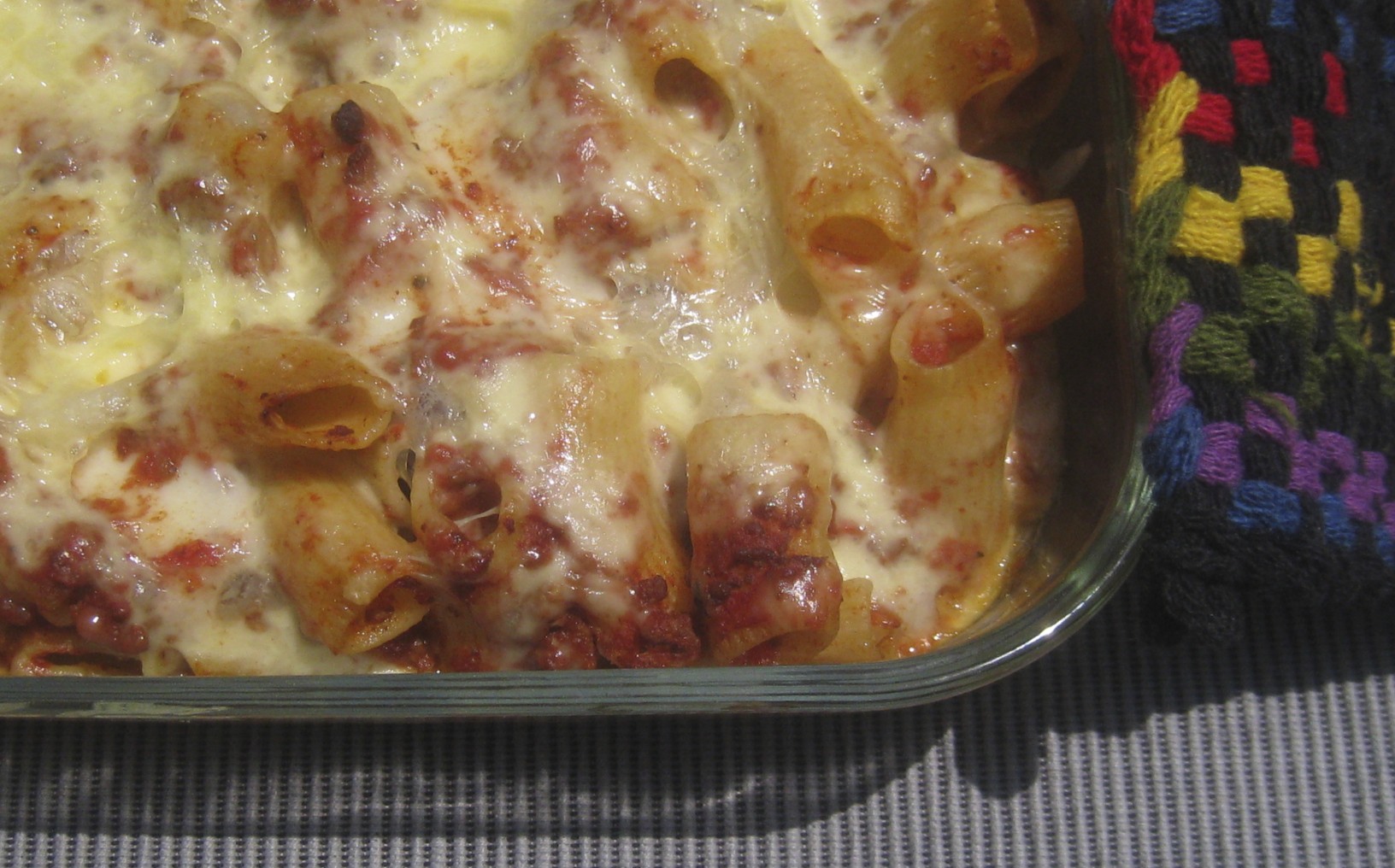
Rigatoni al Forno
Next, you may recall that in the feta post, I wrote that calcium chloride (CaCl) could be used to compensate for overly pasteurized dairy product and would result in firmer curds. While that is true and CaCl is used widely in cheese making, it can not be used when making any of the pasta filata cheeses. Using CaCl will toughen the curds, making that stretch impossible and ruining the texture of the finished cheese. So, with no agent to counteract the effects of over or ultra-pasteurization, you must use raw or pasteurized milk. When choosing pasteurized, select a whole milk from a local dairy to minimize the chances of it being over pasteurized. Some milk will have the pasteurization temperature posted on the container’s label. I use that milk, when I can find it, because the pasteurization temperature is low compared to most. Try as I might, I’ve been unable to make mozzarella from ultra-pasteurized milk.
Another thing about mozzarella is that it requires a level of acidity in order to form the curds — and this is where the processes diverge when making American versus Italian Mozzarella. Today we’re making American Mozzarella and we’ll add granulated citric acid to create the acidity required. (When we make Italian Mozzarella, we’ll let the curds sit overnight to develop the necessary acidity.) Citric acid is commonly used when making wine at home, in canning, and in a multitude of food manufacturing processes. It is quite inexpensive and can be purchased anywhere home brewing or wine making supplies are sold, at some pharmacies, on Amazon, or through the sites listed on my Cheesy Stuff page. You will not be able to make American Mozzarella without it nor can you substitute fresh citrus juice for it.
You’ll see “Lipase” included among the list of ingredients. Lipase is an enzyme that is used to enhance the flavor of mozzarella, Asiago, provolone, feta and blue cheeses. It can be purchased from the cheese making sites listed on my Cheesy Stuff page. It is not a necessary ingredient, however, so don’t worry if you cannot find or purchase it. If you do use it, however, add another ¼ tablet of rennet for each gallon of milk.
* * *

Simple salad of rocket, tomato, and mozzarella with red wine vinegar and olive oil.
* * *
Sorry about the quality of the photos to follow but this wasn’t an easy process to photograph while working alone. I, also, missed a photo or two but none so important that you’ll get lost. Lastly, you’ll notice that I use gloves when handling the curds. If you have asbestos fingers, you may not need to use them. I’ve found that they do offer some protection from the heated curds while they’re being stretched. I’ve heard that it is customary for women in Italy to keep a bowl of ice water nearby. They dip their hands in it when the heat becomes too much to bear. It’s not such a bad idea, even when wearing gloves.
Before beginning, please refer to my Cheesy Stuff page. Chock full of cheesy details, it provides information about ingredients, cleaning/sterilizing equipment, spices & seasonings, a few tips, and sources for supplies and information.
OK. If no one has any objections, let’s get this show on the road …
* * *
How to Make Mozzarella at Home
Ingredients
- 1 gal (3.67 L) whole milk — NOT ultra-pasteurized
- 1¼ tsp citric acid dissolved in a ¼ cup (60 ml) of cool distilled water
- ½ tablet rennet dissolved in a ¼ cup (60 ml) of cool distilled water
- ¼ tsp Lipase dissolved in a ¼ cup (60 ml) of cool distilled water — optional but, if using Lipase, add another ¼ tablet of rennet
- 1 tsp table salt
Directions
- Place milk in a non-reactive pot with a lid. Gently heat the mixture until 88˚F (31˚C), stirring occasionally to prevent scalding on the pan’s bottom.
- Add diluted citric acid and mix well. If using Lipase, add it now and mix thoroughly.
- Place pot where it will not be disturbed. Add dissolved rennet, stir thoroughly, and cover pot. Do not disturb for at least one hour. I wait two hours, if not a little more.
- As was done when making feta cheese, check for a clean break and, when achieved, go to step 6.
* * *

Clean break.
* * *

Bad break.
5. If a clean break is not achieved, wait an hour and test again. Still bad? Wait another hour. Still bad? Nothing to be done but dump the dairy and start over.
* * *

6. Use a long knife or offset spatula, and starting at one side of the pot, cut a straight line through the curd. Once the opposite side has been reached, create another slice about ½ in front of the previous cut. Repeat until the entire curd has been cut into horizontal slices.
* * *

7. Give the pot a quarter turn and, starting at one end of the pot, repeat the slicing process. When finished, the curd should be cut into ½ inch squares.
* * *

8. Now take the knife or offset spatula and, with the blade on an angle, slice through the curds from side to side at ½ inch intervals. This will cut the curds beneath the surface. Repeat this step twice, turning the pot and cutting the curds on an angle each time.
* * *

9. Gently stir the curds, cutting any that are larger than 1/2 inch.
* * *
10. Return the pot to the stove and gently heat the curds and whey until they reach 108˚F (42˚C), stirring frequently to prevent sticking on the pan’s bottom. Maintain that temperature for 35 minutes, stirring the curds occasionally to keep them separated.
* * *

11. Gently pour the pot’s contents into a sieve, separating the curds while reserving the whey. Allow to drain for 15 minutes. Break apart any large clumps of curds.
* * *
12. Place curds into a large bowl, season with salt, and mix thoroughly. Place ⅓ of the salted curds in a 2 cup measure and microwave on high for 45 seconds.
* * *

Curds straight from the microwave.
* * *

13. Use a spoon to combine the curds while distributing the heat, creating a single, large curd mass.
* * *

14. Once combined, remove but be careful. It’s hot. Note how dull it is.
* * *

15. Slowly stretch the curd like you would salt water taffy. If it breaks instead of stretching, re-heat the curd for another 15 seconds before trying again.
* * *

16. Fold in half onto itself.
* * *

17. Stretch it again. Continue to stretch & fold until the cheese is smooth and shines.
* * *

18. Form into a ball like you would bread dough for a dinner roll. Best if used right away. See Notes for storage tips.
* * *

1 gallon (3.67 L) of whole milk yields about 13 ounces (375 g) of mozzarella.
* * *
Notes
YouTube has a number of videos about making mozzarella. Often they begin with a cook pouring boiling water over curds that were either made or purchased off-camera. As you’ll learn in a few weeks, using boiling water to cook the curds is a part of the process when making Italian Mozzarella. Using a microwave, as indicated above, will work just fine for American Mozzarella.
According to Dr. Fankhauser, the whey reserved from above may be used to make ricotta. Similar to the traditional method of making ricotta, he directs that the whey be heated to 203˚F (95˚C), allowed to cool, and then filtered. I have never gotten an appreciable amount of ricotta from whey resulting from making American Mozzarella. I don’t even try anymore and just use some of the whey to store my mozzarella. If I want to make ricotta, I follow this recipe.
Mozzarella will remain good to eat for about 1 week but the sooner you use it, the better it will taste. It is at its peak when it is still warm after being stretched. If it is not to be used immediately, tightly wrap it in plastic wrap and set aside until needed. Do not refrigerate. If you’re not going to use it that day, do not wrap it but place it in some reserved whey, covered, and then refrigerate it. Be aware that once it is chilled, the texture — the creaminess — will change because the milk fats will harden. Restaurants will make mozzarella in the morning and whatever is left at the end of the day will be refrigerated and used in pizza the following day. American Mozzarella can be made in a couple of hours and, believe me, once you taste the difference between freshly made and mozzarella that you’ve chilled, you’ll want to use it all the same day you make it. Now, I have read where some store it coated in salt or in a bath of (sometimes flavored) olive oil. I’ve not tried either approach and, because of that, I won’t recommend them.
* * *
Inspired by the Fankhauser American Mozzarella webpage
and
“Home Cheese Making” by Ricki Carrol
* * *
By any other name …

“Judy Garland”
* * *

 Let me begin by stating that this post is not for everyone. You see, as a Cubs fan, I’m used to being treated with everything from derision to sympathy, and all points in-between. For some, the Cubs and their fans are nothing more than a losing bunch with no redeemable qualities whatsoever. Well, to those people we say, “So, what! We’ve got Flat Ruthie on our side.”
















 from the Bartolini kitchens