2 Brie are a Breeze

With Thanksgiving approaching fast, I thought that I’d share a few of the recipes that I’ve prepared over the years on Turkey Day. Let’s start with 2 baked brie recipes, one sweet and the other savory.

As a child, our holiday dinners always included a platter of pasta, usually ravioli. It’s a tradition that I’ve continued as an adult, always beginning special dinners for family & friends with a primo piatto of pasta. Well, with all that food to be prepared and consumed, something has to give — and it won’t be dessert, that’s for sure. So, I tend to go light with the appetizers. Besides, Max thinks that every bit of food that crosses the threshold into my his home is a potential snack. This means, in practical terms, the more appetizer dishes served, the more likely he is to “sample” one. As the graph to the right clearly shows, if 2 or fewer appetizers are served, Max will “score” a nibble less than only 30% of the time. Serve a 3rd, however, his chances more than double and he’ll snag something over 75% of the time! If 4 or more are served, you might as well put one of the appetizer trays on the floor in a corner. At least he’ll be out of the way as he noshes.

With the above in mind, I’ve found brie to be a good appetizer to serve but, rather than bake one large “wheel,” I make 2 smaller ones, a sweet and a savory. They’re easy enough to prepare, my guests can choose whichever they prefer, and, when combined, they are actually smaller than one large baked brie. That latter point will help to insure that my guests’ appetites will be saved for the actual dinner.  And, best of all, the odds are still in my favor that Max will not be joining us for appetizers. Of course, having been denied an appetizer, he will be even more hungry, as well as determined, when we move to the dining table. The question then becomes whether he will be able to scarf something from a kitchen counter or the stove top — yes, the stove top! — while I’m serving dinner. (Smart money will bet on the dog.)

*     *     *

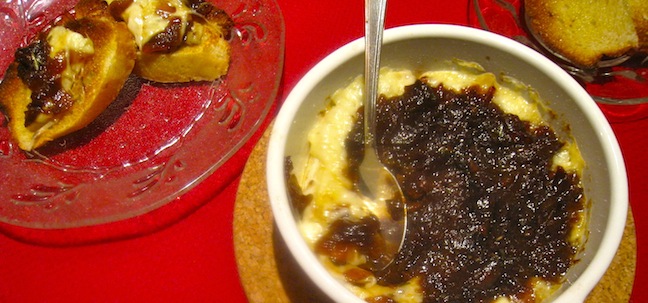
Baked Brie with Caramelized Onions and Rosemary Recipe
Ingredients

  • an 8 oz wheel of brie
  • 2 onions, chopped
  • 2 tbsp butter
  • 1 tbsp fresh rosemary, chopped
  • olive oil
  • 1 garlic clove, minced
  • 3 oz dry white wine, divided
  • salt & pepper, to taste
  • 1 tsp fresh rosemary, chopped, for garnish (optional)

Directions

  1. Place chopped onion and butter into a saucepan over medium heat. Season with salt and pepper and sauté until translucent, about 8 minutes.
  2. Add 1 tbsp chopped rosemary and continue cooking. The onions will become golden in color by the 30 minute mark. Keep cooking, stirring frequently. Onions need to brown but not burn. Do not rush. Lower the heat if necessary.  Add a little olive oil if pan becomes too dry.
  3. Pre-heat oven to 350˚.
  4. Once deep brown in color, add garlic and sauté for no more than 2 minutes.
  5. Add about 2 ounces of white wine and sauté until completely reduced.
  6. Use remaining wine to deglaze the pan and sauté until reduced completely.
  7. Check to see if salt & pepper are needed. (At this point, caramelized onions can be refrigerated for several days, in an airtight container, until needed.)
  8. With a large knife, carefully remove the rind from the brie’s top and discard.
  9. Place cheese in an oven-proof serving dish, cut-side up. Cover the brie with an even layer of caramelized onions.
  10. Bake in a 350˚ oven until cheese is melted, about 25 to 30 minutes.
  11. Let stand for 5 minutes. Garnish with remaining rosemary and serve.

Serving Suggestions

I prefer to serve this brie with assorted crackers and freshly made crostini — thin slices of baguette that have been lightly brushed with olive oil and toasted before being “wiped” with a cut garlic clove.

*     *     *

Brie en Croute with Raspberry and Almond Recipe

Ingredients

  • an 8 oz wheel of brie
  • 3 – 4 tbsp seedless raspberry jam
  • 1/4 cup sliced almonds, toasted — separated
  • 1 puff pastry sheet
  • 1 egg + 1 tbsp water, combined

Directions

  1. Pre-heat oven to 400˚.
  2. Open & spread 1 sheet of puff pastry dough atop a lightly floured work surface. Use a rolling pin to lightly smooth out any creases that may have been created by the folds.
  3. Carefully slice the brie into 2 half-layers.

    "Do you remember Becky, the little girl who lives next door? Well, she and her Mother dropped in just as I was unwrapping the puff pastry and ... "

  4. Coat the top of the lower half with the raspberry jam. Do not spread jam to the very edge; leave about a quarter-inch border.
  5. Evenly cover the jam with the sliced almonds, reserving 1 tbsp for garnish.
  6. Return top half of brie to the lower half.
  7. Place brie, upside down, onto the center of the pastry sheet. Bring up the edges of the pastry sheet to cover and enclose the brie. Trim away and save the excess.
  8. Place the brie, seam-side down on a parchment lined baking sheet. Use your hands to smooth out the pastry and make it form-fitting.
  9. Brush the exposed surface with egg wash.
  10. If artistic, use excess pastry to decorate the top.
  11. If, like me, you are anything but artistic, do the best you can and tell your guests that you let the neighbors’ 5 year-old help you with the decorating.
  12. Once decorated, brush the decorations’ surface with egg wash.
  13. Place in  400˚ oven and bake until golden brown, about 20 to 25 minutes.
  14. Allow to stand for 20 minutes before moving to a serving tray/platter. Garnish with remaining almond slivers and serve.

Serving Suggestions

I prefer to serve this brie with slices of apple and pear, as well as an assortment of crackers.

*     *     *

Variations

For the savory:

  • Instead of caramelized onion atop your brie, try Mandy’s delicious Onion Marmalade, from her blog The Complete Cookbook.
  • Replace the rosemary with the herb(s) of your choice. Herbs des Provence or thyme come to mind.

For the sweet:

  • The raspberry jam can easily be replaced with cherry or apricot jam. Sautéed apples with walnuts or prepared cranberries with pecans could also be used. The possibilities are endless.

Notes

Hot, melted cheese, long slivers of caramelized onion, and crispy crostini or crackers are a stain waiting to happen. By chopping rather than slicing the onions prior to caramelizing, I hope to lessen the odds of a mishap. Speaking of the onions, they can be caramelized days before being needed in the recipe. Just don’t make them too far in advance as they have a tendency to “disappear” the longer they sit in the fridge.

*     *     *

Lumache alla Bartolini

This is another within the series of posts which, quite frankly, is not for everyone, not even the intrepid tourist to the left. Truth be told, snails weren’t exactly popular among members of my generation at the old two-flat either. (If you wish to exit, you may do so HERE.) I am probably the only one to have eaten lumache back then and certainly am the only one willing to go back to that well again today. Still, if I’m going to record the family’s recipes for Posterity, I’m not about to start filtering them. Besides, the look on Zia’s face when I unveiled the lumache and announced my plans for dinner was priceless. This blog delights in ways I never dreamt possible!

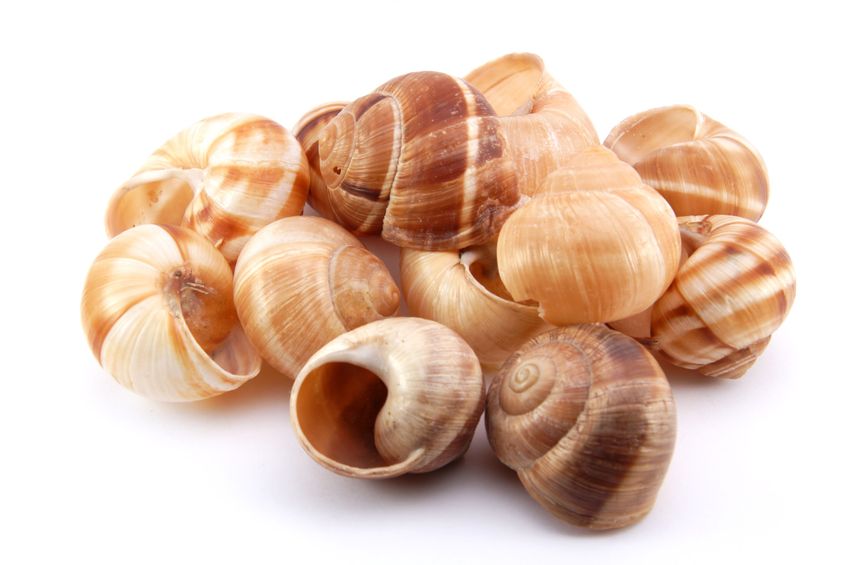
As I recall, lumache, or babbaluci as they are known in Sicily, was not at all a common dish at our dinner table nor, for that matter, at Zia’s. I only remember them being served 2, maybe 3, times. That’s probably because of the amount of work involved in preparing them for the table. They had to be soaked to rouse them from dormancy, scrubbed, boiled, scrubbed again, and either removed from their shells or left intact for further cooking. As you can imagine, this was no 1 day job. Mom would put water, vinegar, and the dormant lumache into her largest pot; place a colander atop the pot, weighted with a heavy book or pan; and, set it aside to let the lumache come out of their shells. As they came to life, they would leave the water and head up into the colander — hence the reason for the weight. Unfortunately, that weight wasn’t heavy enough to prevent me from snatching a pet when I was about 6 years old. It was, however, too heavy for me to replace properly before I returned to bed, my new pet snail in a water glass at my bedside. Mom was just a tad upset when she woke me the next morning. Her kitchen cupboards and counters were covered with lumache on the lam. Even my pet (the little tattle-trail!) was well on its way to my bedroom’s ceiling by that time. Funny thing. I don’t recall ever having a pet snail after that.

*     *     *

*     *     *

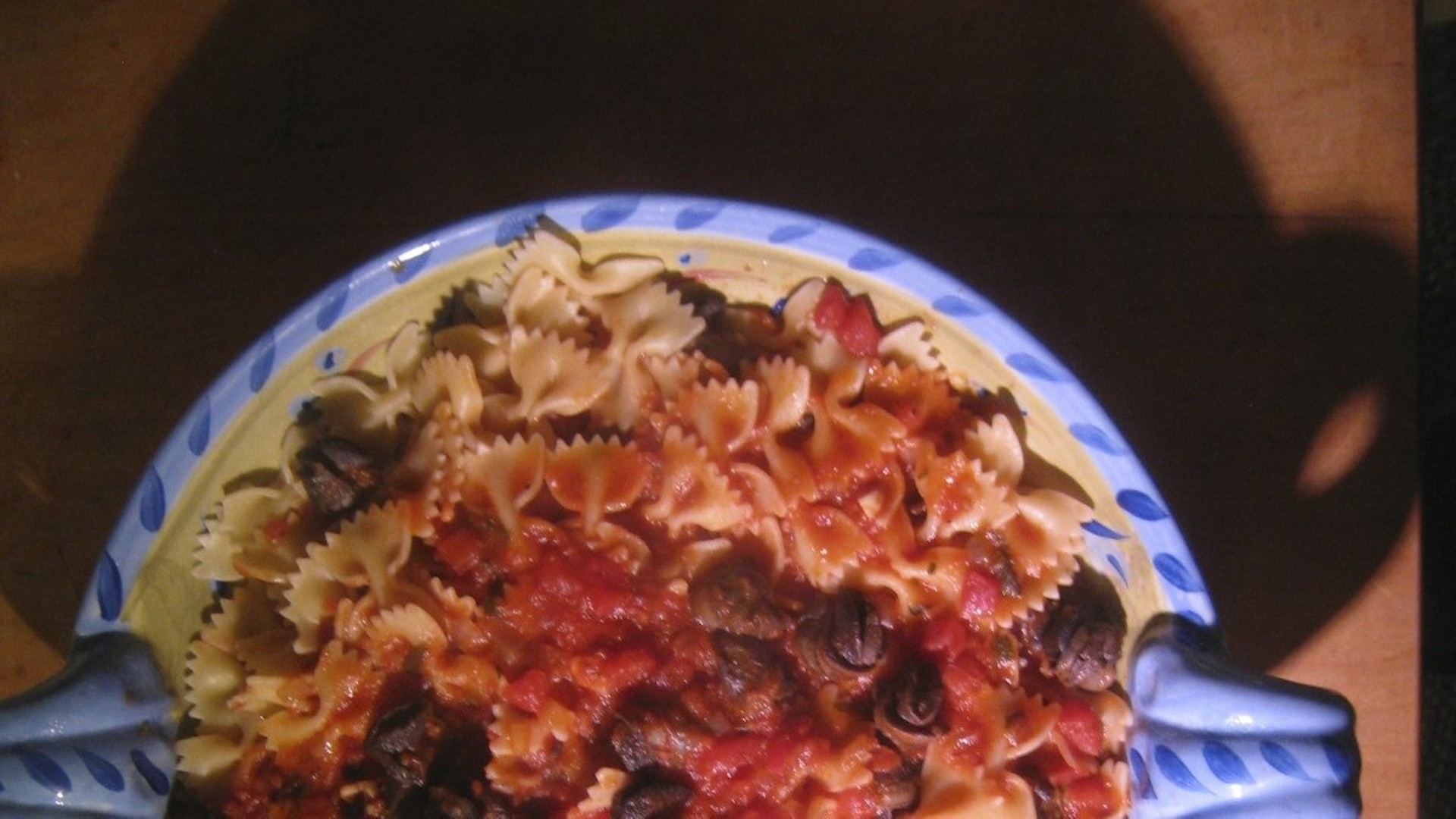
I’ve chosen to share this recipe today because of Mario Batali. On a recent rebroadcast of Molto Mario, he mentioned that lumache was one of several dishes that the people of Le Marche (the Marchigiani) prepare on All Souls Day. Well, with the Bartolinis being Marchigiani and today being All Soul’s Day, what choice do I have? So, the recipe I’m going to share is the very recipe the Bartolini Girls cooked those many years ago — with 1 exception. There was no way on Earth that I was going to start with dormant lumache. With Max in the house, that is surely a disaster waiting to happen. I can just see him running around my home, trying to lure me into a game of keep-away with some unlucky snail in his mouth, while I’m on a ladder retrieving the rest off of my kitchen’s walls. No, no, no! So, I did a little googling — and it paid off. On Amazon (of course!), I found canned lumache that were cleaned, shelled, trimmed, and ready for stewing. What was once a multi-day, very messy affair suddenly became as easy as preparing a tomato sauce. I ordered them and, once delivered, I packed them up and brought them to Zia for one most memorable dinner.

*     *     *

Lumache alla Bartolini Recipe 

Ingredients

  • 1 can (15 oz, 48 count) very large size lumache
  • 2 tbsp extra virgin olive oil
  • 1 large onion, chopped
  • 3 garlic cloves, diced
  • 1 can (14 oz) crushed tomatoes
  • 1 can (14 oz) diced tomatoes
  • 4 oz dry white wine
  • 3 tbsp parsley
  • 1 tsp marjoram
  • salt & pepper, to taste
Directions

  1. Heat olive oil in medium-sized sauce pan over med-high heat. Add onions and sauté until translucent, about 5 minutes. Season lightly with salt & pepper.
  2. Add garlic and sauté for another minute before adding the tomatoes, wine, marjoram, and parsley.
  3. Bring to a boil, reduce to a simmer, and continue cooking for about 45 minutes or until the tomatoes are cooked and the sauce has darkened.
  4. Add the lumache with the canning liquid and continue to simmer for about 30 minutes more. The sauce should be dark and thick.
  5. Season with salt & pepper, to taste, and serve.

*     *     *

Serving Suggestions

                                  *                         When she cooked lumache in their shells, Mom served them in deep soup bowls with a chunk of crusty bread on the side. When removed from their shells, lumache may, also, be served as a dressing for pasta or atop polenta.

*     *     *

Notes

Back in the days preceding Vatican Council II, when eating meat was forbidden on Fridays and other “days of abstinence,” Catholics were allowed to eat lumache because they were considered seafood. Well, in classic Italian cuisine, cheese is very rarely used in a dish featuring seafood and if the Church labels something as seafood, who are we to argue? The use of cheese, therefore, in a dish with lumache is frowned upon. On the other hand, what you serve in your own home is your own business. (Was that thunder?)

*     *     *
Apple Pie with a Cheddar Cheese Crust

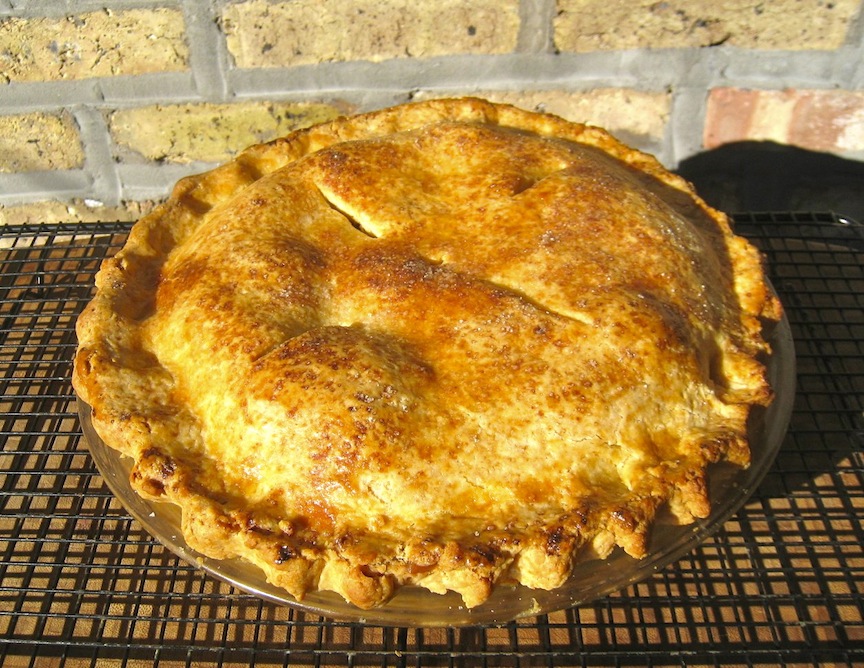
I’ll be the first to admit that serving apple pie with a slice of cheddar cheese is not necessarily a common thing to do and it certainly wasn’t a family tradition. In fact, I was a young adult when Uncle first told me about it. Since then, I’ve enjoyed apple pie with cheddar cheese several times although, to be honest, I’ll take vanilla ice cream before cheddar cheese any day. (I am my Mother’s son, after all.) Still, I was happy with my apple pie adorned with the occasional slice of cheddar until one day a few months ago. I was busy doing whatever and, in the background, there was a Food Network program on the TV. It was one of those shows I’ve grown to dislike, with people talking about how great some dish is at this diner or that restaurant without ever telling how it’s made. Well, I watch these programs to learn new techniques, to get recipes, to see a dish prepared. If I want to hear people talk about how good a dish is, I’ll go to a diner and survey the people eating at the counter. Anyway, a restaurant was mentioned that was known for its pie and which featured an apple pie with cheddar cheese in the crust. Aside from that comment and seeing some grated cheddar dumped into a commercial mixer, the actual recipe was left a mystery. Did I mention how much I dislike these shows? Anyway, my quest began that very day …

In the weeks that followed, I baked a number of test pies. I varied the amount of grated cheddar cheese in the crust from 2 to 6 ounces per crust. I adjusted the amount of fat in the crusts and even swapped spices in the filling. And left in my wake was a trail of apple pies that stretched from the shores of Lake Michigan to those of Lake Huron, not to mention devoted taste testers in both locales. In the end, I settled on using 4 ounces of grated, sharp cheddar cheese and 7 tbsp of fat per crust while, in the pie filling, I replaced nutmeg with cardamom. The result was a pie with a crust that was manageable when raw and, when baked, was relatively light with the distinctive — but not overpowering — taste of cheddar. Success!

With the cheddar question out of the way, let’s talk filling. Just like with our Thingamajig, I use both tart and sweet apples. For the sweet, I find that Fuji work best because they, like Granny Smiths, hold up well during baking. I prefer the apples in my pie filling to be in chunks rather than thinly sliced and that way they remain somewhat firm when baked. Once the apples are peeled, cored, and chopped, I heat them in a saucepan with some butter. All I’m doing is heating them through; I take them off the heat when their juices first begin to appear in the pan. I’ve found that this helps to prevent a finished pie that has a gap of over an inch between the apple pie filling and the crust “dome” above it. It’s important, though, to pull the apples off of the heat as soon as they start to render their juices and to cool them completely before assembling the pie. Cook them too long or fill the pie while they’re still hot and your apples will not be at all crisp when the pie has finished baking.

*     *     *

No pie dome here!

*     *     *

The Apple with a Cheddar Cheese Crust Recipe

Ingredients

  • For Apple Pie Filling
    • 6 Granny Smiths (or similar, tart apples) peeled, cored, and sliced evenly
    • 2 Fuji (or similar, sweet apple) peeled, cored, and sliced evenly
    • 3 tbsp lemon juice
    • 2 tbsp butter
    • 1/4 cup raisins, soaked in hot water and drained (optional)
    • 1/2 cup sugar
    • 1/4 cup dark brown sugar
    • 1/4 cup AP flour
    • 3/4 tsp cinnamon
    • 1/4 tsp cardamom (or nutmeg)
    • 1/2 tsp salt
    • 1 egg, beaten
    • sugar
  • For Each of 2 Pie Crusts
    • 1 1/2 cups AP flour
    • 1/4 tsp salt
    • 3 tbsp vegetable shortening, cut into cubes and well-chilled
    • 4 tbsp unsalted butter, cut into cubes and well-chilled
    • 4 oz. sharp cheddar cheese, grated
    • 3 tbsp ice water, plus 1 tbsp, if needed
    • 1 tbsp cider vinegar

Directions

  • For apple pie filling
    1. In a large mixing bowl, combine the apple slices and lemon juice. Stir to coat the apples.
    2. In a sauce pan large enough to hold the apples, melt the butter over medium heat.
    3. Add the apples and sauté just until the apples begin to give up their liquid. Do not cook until the apples grow soft.
    4. Meanwhile, in a small bowl, mix together the sugar, brown sugar, flour, cinnamon, cardamom, and salt.
    5. Return heated apple pieces to large mixing bowl.
    6. Add the raisins, if using, and spice mixture to the apples and gently stir until the apples are coated evenly.
    7. Set aside to cool completely and until the pie crusts are ready.

  • For Pie Crust – Best if each crust is made individually in the food processor.
    1. Add flour, cheddar cheese, and salt to the processor. Pulse it a few times to combine the 3 ingredients.
    2. Add the very cold butter & shortening cubes.
    3. Pulse the machine 3 times, with each pulse lasting a 3-count. Your ingredients will now be lightly mixed. If need be, pulse again.
    4. With the machine running, add the vinegar and then slowly add the ice water. Do not add so much that a ball of dough forms. Remove the lid and, with your hands, test the dough to see if a ball of dough can be formed.
      1. If so, turn the dough until a very lightly floured service, form a ball, wrap it in plastic wrap, and refrigerate for 30 minutes.
      2. If a dough ball will not form, add a little more water, pulse the machine a couple of times, and test it again. When you can form a ball of dough, follow step A above.
    5. While the dough rests in the fridge, prepare the 2nd crust.
  • Assembly, to occur only after filling is cooled completely and pie crusts rested
    1. Pre-heat oven to 400.
    2. After 30 minutes, remove the dough from the fridge and roll it until large enough to completely cover the bottom of a 9 inch pie pan. Place the dough into the pan, trim any access, and return the crust and pan to the fridge until needed further.
    3. Roll out the 2nd crust, though slightly smaller, it must be large enough to cover the pie with a little excess.
    4. Retrieve the pie’s bottom crust from the fridge, fill it with the apple pie mixture, and cover it with the 2nd pie crust.
    5. Seal the pie by gently lifting the bottom crust’s edge while placing the top crust’s edge behind it. Work you way around the entire pie.
    6. Again, working your way around the pie, crimp the edge to further seal the pie.
    7. Use the egg to coat the top crust. Sprinkle with sugar. Use a sharp knife to create steam vents in the pie’s upper crust.
    8. Bake in a pre-heated 400* oven for 15 minutes. Without opening the door, lower the heat to 375* and continue baking for 40 – 45 minutes.
    9. After a total time of 30 minutes, and 15 minutes thereafter, check to see if the crust’s edge is too dark. If so, cover with aluminum foil and continue baking.
    10. When top is golden brown, remove pie from oven and place on a cooling rack. I always allow my apple pie to cool at least 2 hours before serving.

*     *     *

Fresh from the oven

*     *     *

Variations

This recipe is more concerned about the crust than it is the pie filling. So, if you prefer sweet apples, walnuts, or currants, use them. If you hate raisins, ditch them. If you don’t like or haven’t any cardamom, use nutmeg. In short, change the filling to suit your tastes. The same goes with the crust. If you find that adding cheddar to your favorite pie crust recipe makes a better pie, then please come back here and tell us about it.

*     *     *

Notes

One last thing about the crust. Add too little cheddar and you won’t taste it; too much and the pastry dough is rendered unmanageable. And even under the best of circumstances, the cheddar cheese will affect the crust’s flakiness. So, it’s basically a trade-off. The trick is to add as much cheddar cheese flavor as you can without sacrificing too many of the crust’s better qualities. My taste testers and I agree that this recipe “works.” If you try it, I hope you feel the same way.

*     *     *

Dad’s Puffballs

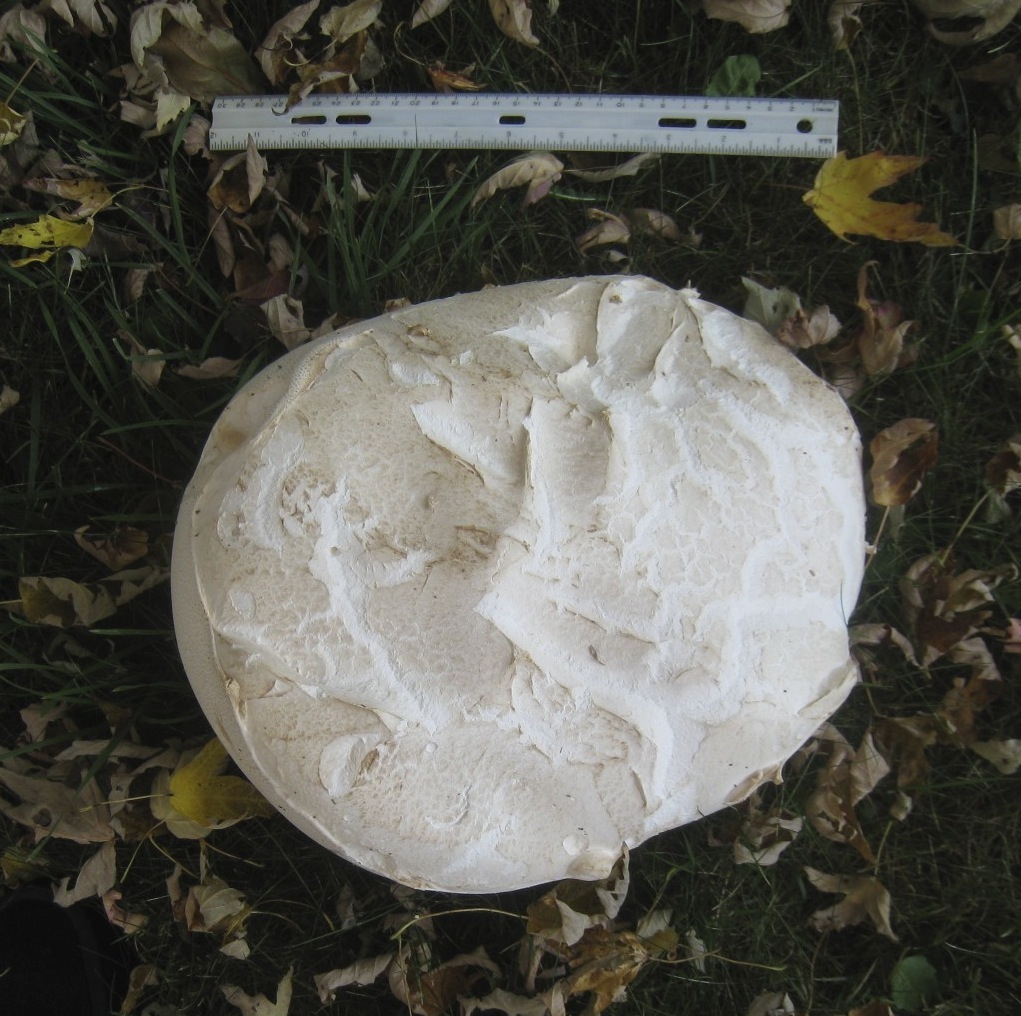
As many of you know, I was in Michigan last week, visiting Zia and my family. Luckily, my visit was timed perfectly for the annual arrival of puffballs. Pictured above, a puffball is a type of edible fungus with a mild, mushroom-like flavor. My Dad, some 25 years ago, found one growing behind Zia’s garage and we’ve enjoyed them ever since. Then again, my family has always had some sort of relationship with mushrooms. Both Mom & Zia told tales of going mushroom picking with Grandma when they were very young in as-yet undeveloped fields in Detroit. Prior to my being born, Mom & Dad lived in a house in which they grew mushrooms in a basement room that had a dirt floor. So, when Dad found a puffball and declared it edible, my family replied, “When do we eat?”

Max "picked" the smaller one about 1 week too soon. We suspect the larger was "trimmed" by a lawn mower when it was but a few days old.

Each year, usually in the first weeks of October, 1 to 3 egg-sized fungi appear in the lawn by Zia’s garage. In less than 2 weeks, these “eggs” will grow to be football-sized — and therein lies the quandary: when to pick them. Grab them too soon and you may be cheating yourself out of a few days’ growth. Picked too late and you’ll have no choice but to throw it away, hopefully back where you found it so its spores will produce next year’s crop. So, once you’ve decided it’s harvest time, what’s next? That’s easy enough. Pick them and, just before cooking, trim away the outer peel to reveal a flesh that’s relatively firm and pure white, like that of a white button mushroom cap — on steroids! If it is even the palest shade of green, yellow, or brown, discard the puffball because it has “turned.” Your best bet is to cook them as soon after harvesting as possible.

As mentioned earlier, puffballs have a very mild, mushroom-like taste and this limits the ways they can be cooked. One year, after a crop that yielded 3 huge puffballs, I brought one home and used part of it in a tomato sauce. Big mistake. Being so mild tasting, one could easily have mistaken the puffball cubes for tofu — not exactly the result I had in mind. Since then, I’ve restricted my use of them to 4 recipes. To begin with, if I cannot cook it within 2 days of picking, I’ll chop the puffball into cubes and lightly sauté them in butter. I place the partially cooked cubes on sheet pans and into my freezer. When fully frozen, I place the cubes in bags to be stored for later use in omelets.

*     *     *

Breadcrumbs (l), Flour (r)

*     *     *

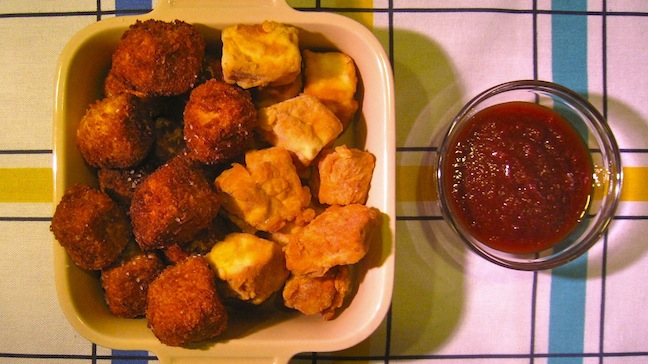
When he brought the first one home, Dad suggested that Mom cut it into cubes before breading and frying them. So, she cubed it, floured the cubes, dipped them into an egg wash, and then coated them with seasoned bread crumbs before deep frying. Pictured above, are cubes prepared in this way using Panko bread crumbs. Oddly enough, as Zia mentioned, they’ll remind you of toasted marshmallows, albeit a little mushroom-y. Also pictured are puffball cubes prepared with a 2nd coating of seasoned flour rather than bread crumbs. Although good, I much prefer the Panko-coated. By the way, the dipping sauce pictured is homemade ketchup that was inspired by Tanya’s Up The Mountain Spicy Tomato Ketchup over at her Chica Andaluza blog. Her sauce is fantastic and better, by far, than any ketchup that I’ve ever tasted.

*     *     *

Parmesan Coated

*     *     *

The 4th and final preparation is a method I found at the Mycological Society of San Francisco website. If you’ve a mushroom-related question, this is a good place to start looking for an answer. Their recipe, Parmesan Puffballs, involves coating slices of puffball with grated parmesan cheese instead of breadcrumbs or flour. Fried in a mixture of butter and olive oil, these are a tasty alternative to the other methods. Truth be told, however, the parmesan cheese is the real star of this dish; the puffball being overwhelmed by the flavor of fried cheese. Although not quite the dish one might expect, any excuse to eat fried cheese is all right in my book.

*     *     *

Notes

In the years since Dad brought home that first puffball, my family has enjoyed them many times. Never once has anyone experienced any discomfort or problem after eating them. Still, as is the case with any mushroom or fungus, if in doubt, do not eat.

*     *     *

Just One Thing More

So, you think you had a rough night?

*     *     *

No, those aren’t puffballs. The night before we (Lucy, Max, and I) left for Michigan, Lucy laid an egg, pictured above to the left of a “large” chicken egg. That was 2 weeks ago and she normally lays a clutch of 2 eggs over the course of 2 to 3 days. The trip obviously affected her delivery schedule but, the way she’s acting, I expect to find this egg’s Irish twin in the corner of her cage within the next day or 2.

*     *     *

Filling for Ravioli dei Bartolini

The Bartolini Girls made 2 versions of filling for their pasta. One, used in cappelletti, was served in soup while the other was for ravioli and dressed in sauce. A couple of years ago, I decided to try my hand at making sausage ravioli, using our family sausage recipe. The results were good enough to serve Zia, gain her approval, and now the Bartolini Clan has 3 ravioli fillings made with meat. Today I’m going to share the “saucy” filling; we’ll get to the “soupy” and sausage fillings in later posts.

I have 2 versions of Mom’s recipe. The original, which is little more than a few notes, and the one that’s part of a recipe book she gave to me after I moved to Chicago. Both are pictured below and, for obvious reasons, I follow the more complete version of the two. This is the same recipe that Zia follows when we have Ravioli Day. Similar to Sausage Day, once or twice a year we’ll devote a day to making ravioli so that she’ll have plenty for her family when they visit. We work well together as a team and that night’s dinner is always a good one. Never one to wait for dinner, however, Max has been known to steal a few errant ravioli that may have wandered too close to the pasta board’s edge. On one memorable Ravioli Day, he managed to inhale 35 of the pasta pillows. That was about 10% of that afternoon’s production and, not so coincidentally, the last ravioli that Max has enjoyed, to date.

*     *     *

*     *     *

When you look at the recipe, you’ll note that in the original version, Mom used nutmeg but cloves is used in the version she gave me. I’ve no idea why or when she modified the recipe, only that she gave me the book in the early ’80’s.  As is the case with any of our ravioli fillings, the meat is cooked before being ground in a meat grinder. I once tried using a food processor but did not like the results at all. The filling became a thick purée without any real texture, and I definitely prefer some texture. The recipe, also, calls for ground pork and veal but if Mom couldn’t find veal, she often substituted chicken or turkey. Living here, I’ve no problem finding any of the ingredients but it’s good to know that there are alternatives should you run into problems or be averse to using veal. The rest of the recipe is easy enough. The “fun” part will come when we make the ravioli and you can see how we do that HERE.

*     *     *

Filling Recipe for Ravioli dei Bartolini

Yield: Enough filling to be used with 8 eggs of pasta dough. Recipe found here.

Ingredients

  • 1 1/2 lbs. ground pork
  • 1 1/2 lbs. ground veal (chicken or turkey may be substituted)
  • 2 – 3 tbsp butter
  • 1 pkg (10 oz) chopped spinach (cooked and well-drained)
  • 1 pkg (8 oz) cream cheese
  • 1 cup grated romano or parmesan cheese – your choice
  • 2 or 3 eggs slightly beaten
  • dash of cloves (optional)

Directions

  1. Sauté meat in butter. Season lightly with salt.
  2. Use meat grinder to process the meats. Add all the ingredients into a mixing bowl and mix until well-combined.
  3. Cover the filling and refrigerate for a few hours or overnight.
  4. Once the filling has rested, you can begin making your ravioli.

*     *     *

*     *     *

Notes

Pictured above  is ravioli filling pre-formed into “balls.” Sometimes, while the pasta dough rests, Zia & I will use the time to create some, giving us a jump on the day’s production.

Mom and Zia used this filling exclusively for ravioli. I’ve used it in a few other dishes – i.e., stuffed shells, cannelloni, and, on occasion, a rotello. We’ll get to these recipes, too.

*     *     *

Ravioli dei Bartolini

Happy Columbus Day everyone! And what better way to celebrate the Holiday than to share one of the Bartolini Clan’s favorite holiday recipes. Say the word “ravioli” to any of the old 2-flat’s former residents and you’re sure to conjure up memories of holidays past, specifically Christmas, New Year’s, and Easter. No matter which of the 2 dinner tables you visited on those evenings, there would be a large platter of ravioli taking center stage. (It was present on Thanksgiving, too, but The Bird was the star of that show.) As a kid, my attention was pretty much focused on that platter of pasta pillows — and dessert, of course — and I think the same would have been said by everyone at the tables, save Mom and Zia. Their perspectives would have been entirely different.

One must remember that in those days, the only freezer available to most households was a small compartment above the fridge. Consequently, if you wanted to serve your family ravioli, you made it the same day it was served. Well, there was absolutely no way that Mom and Zia were going to start making ravioli on a holiday afternoon. That meant that most holiday mornings, they were up at 5:00 am making ravioli for that evening’s holiday dinner. And then there was Christmas. We were allowed to get up during the night to discover what Santa had brought us and to play with our toys. It wasn’t until years later that we learned how our parents no sooner got the gifts wrapped and under the tree when we came charging out of our bedrooms. Mom and Zia were lucky to get a couple of hours of sleep before they started making ravioli. And they weren’t making just a few ravioli. They made enough for everyone at each of the two holiday tables, which often included guests as well as each family. For Mom, that meant ravioli for as many as 12 people. To this day, I don’t know how they did it.

It really is a shame that there are no pictures of these women making pasta and ravioli, for it really was something to see. Mom would make the filling the night before and store it in the fridge. (Woe be the child caught snatching filling from the fridge!) The next day, she would make 8 eggs worth of pasta dough using the “mound” method. (Mound the flour on a large pasta board, make a crater in the center, pour the eggs into the center, and use a fork to slowly bring the flour into the egg mass, being careful not to break the flour wall and allow the eggs to spill out.) Once the dough was made, kneaded, and rested, Mom used her 3+ foot long “rolling-pin” to create thin, circular pasta sheets, 3 – 4 feet in diameter. They were laid to dry by hanging them off the edge of the dining room table, the backs of chairs, even on sheets covering a bed, if one was “open.” Once dry enough, the sheet would be hung off the pasta board’s edge, half on the board and half off. The filling balls were then laid out on the pasta half-sheet in a grid, each equidistant from its neighbors. When they were all positioned, maximizing the surface area, the bottom half of the sheet was  brought up and over, enclosing the filling-covered top half. The long handle of a spoon or spatula was used to seal the pillows. The ravioli were then cut using a pastry cutter, moved to trays, and the next pasta wheel was moved into place. This continued until all the filling was used. The remaining dough, if any, would be hand-cut to form linguine or quadretti. (More about the latter in another post.) Just about the time she was finished cutting the last of the pasta, we kids would come bounding into the kitchen. “Merry Christmas, Mom! What’s for breakfast?”

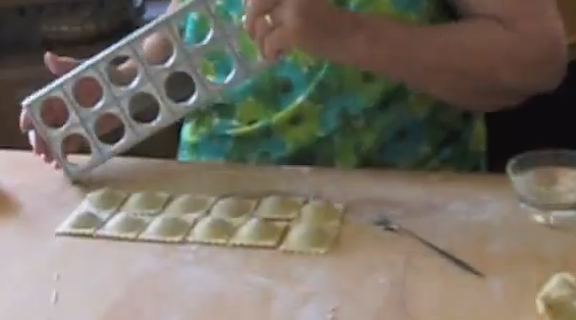
The purchase of a pasta machine changed all that. Unable to make the large pasta wheels, Mom turned to ravioli dies to make her ravioli. Pictured just below is my collection.  The 2 dies on top are used for ravioli. The one on the top-left makes ravioli that are 2 inches square. That’s just about the size The Sisters were taught to make by hand. The ravioli form on the top-right makes ravioli that are 1.25 inches square. That’s about the size The Sisters made by hand once we kids came into the picture. (Kid-friendly ravioli. Who knew?)  The remaining 3 are used for soup ravioli, which Mom called cappelletti, “little hats.” Though normally rounded, some look similar to tortellini,  the die Mom used (lower left) was .75 inches square. As a result, the word “cappelletti” in our house wasn’t used to describe the pasta’s shape but its use — and that was in soup. Mom gave me her cappelletti die years ago but it’s too small for me to use in any way. (I’ve tried several times but, being ham-fisted, I cannot make the filling “balls” small enough to fit the die.) So, I bought the die on the lower-right. It makes raviolini that are 1 inch square and I use it to make my cappelletti. In the center is a press that makes traditional-looking cappelletti, each 1.25 inches in diameter. I, also, have 2 more ravioli makers, both not shown, but they don’t work very well. One attaches to my pasta machine and the other to my stand mixer. In both cases, they require that the dough sheets be about twice as thick as I am accustomed to using. The result is ravioli that is a bit more chewy than I prefer. What can I say? Mom spoiled us. 

*     *     *

Tools of the Trade

*     *     *

When it come to the pasta dough’s final thickness, let your own palate lead the way. Our pasta machines are calibrated from 1 through 10, with 1 being the thickest setting. Zia prefers to roll her dough up to and including the number 6 setting. I will use the same setting for large ravioli but for the smaller ravioli and cappelletti, I’ll roll the dough one more time, using the number 7 setting.

Once you’ve made the filling and pasta dough, creating the ravioli is easy enough, though time-consuming. Here’s Mom’s Pasta Dough recipe and, on Wednesday, I’ll share the recipe for their ravioli filling. (Future posts will share the filling recipes for sausage ravioli and cappelletti, as well as a few others we’ve tried along the way.) The pictures that follow will guide you through the ravioli making process far better than I ever could describe. Of course, it helps that they feature that world-renowned still photo model, “Zia,” in a sequence of never seen before shots taken where she lives, along the fabulous Michigan Riviera.  Ah, the life of the octogenarian super-model!

*     *     *

How to Make Ravioli

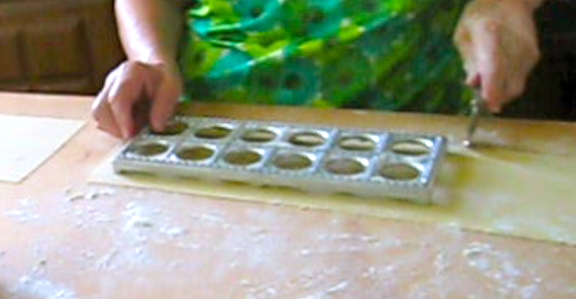
Step One: Cut dough strips into die-sized sheets

*     *     *

Step Two: Cover the die with a dough sheet

*     *     *

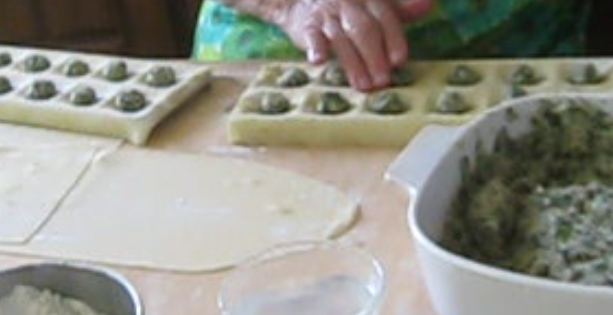
Step Three: Place filling across the die

*     *     *

Step Four: Use dampened fingers to moisten ravioli “walls.”

*     *     *

Step Five: Cover filled die with another dough sheet

*     *     *

Step Six: Use a rolling-pin to seal the ravioli

*     *     *

Step Seven: Trim the excess dough

*     *     *

Step Eight: Flip the filled die

*     *     *

Step Nine: Unmold the ravioli

*     *     *

Step Ten: Lightly puncture the ravioli, meat-filled only

*     *     *

To Cook

  1. Bring a large pot of salted water to a rolling boil.
  2. Add the ravioli, return to boil, then reduce and simmer gently. (If boiled too hard, the ravioli may burst.)
  3. Ravioli normally take 5 – 8 minutes to cook, a couple of minutes more if frozen. Cooking times may vary depending upon the thickness of your dough, the filling, the size of the pot, etc. Taste one to insure they are done to your liking.
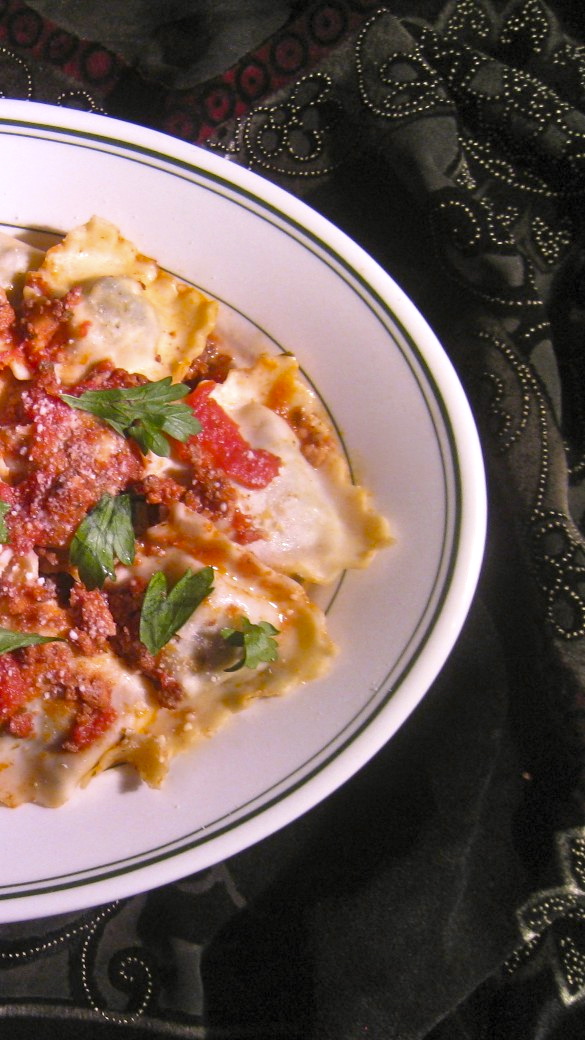
  4. Once the ravioli are cooked, carefully drain using a colander or sieve. You can use a Bolognese-style sauce or go meatless.

*     *     *

Variations

The method I’ve described is by no means the only way to make ravioli at home. Check out the Rufus’ Food and Spirit Guide to see Greg make ravioli completely by hand, similar to the method Mom employed but on a smaller scale. You can also see a slightly more modern approach by going to Sweet Caroline’s Cooking. With Thanksgiving just around the corner, her recipe for butternut squash ravioli couldn’t be better timed. Lastly, in an upcoming post, I’ll show you yet another method for making stuffed pasta.

Notes

You’ll note that Step Ten instructs that only meat-filled ravioli should be lightly punctured. This should be done if you intend to freeze the pasta. Doing so will allow any air sealed within each raviolo to escape during the cooking process. Too much trapped air will cause the raviolo to, in effect, balloon and it may burst before the filling can thaw and cook. We use the tines of a cocktail fork to do this but we don’t puncture cheese-filled ravioli. The cheese filling will often leak through the puncture holes. Try to fill each pillow with as much cheese filling, and as little air, as possible. This “balloon effect” should not be a problem if the ravioli are fresh (not frozen) when cooked.

Although not especially difficult, this is a time-consuming process. I’d recommend that you make enough for a couple of dinners and that you freeze what you won’t be using immediately that day. It’s easy enough. Place your freshly made ravioli in a single layer on lined baking sheets and into your freezer. 2 to 3 hours later, place the now frozen ravioli into bags or containers and return to the freezer. When needed, do not thaw before placing into boiling water, reduce to soft simmer, and cook till done to your liking, normally a few minutes longer than if freshly made.

And for heaven’s sake, keep an eye on Max at all times!

*     *     *

The Apple Thingamajig

I’d planned to start this post by extolling the apple and its many uses but it’s hard to sing a fruit’s praises when there’s a thingamajig dangling atop your blog, metaphorically speaking, of course.  So, I might as well explain the name of this dish and get it over with — in a minute or two.

I’ve been busy elsewhere the past few days, so, these acknowledgements are a tad late. Last Friday, Kristy, of Eat, Play, Love was kind enough to pass me the Versatile Blogger Award, as did Eva of Kitchen Inspirations the very next day. Kristy’s blog is a family affair, featuring 2 gourmands-in-the-making, Mr. N and Miss A. Her recipes come from around the World and the blog’s stars are adorable. 4 spoons all the way! Eva’s blog is a treat, as well. Visit her blog and you may find yourself having brunch in a Montreal café or sharing a Moroccan feast that she researched and prepared herself. And every post is beautifully photographed. If you haven’t already done so, do yourself a favor and visit these 2 wonderful blogs. And as for the award itself, I am very thankful for the honor but, having just received this award a week ago, I won’t be passing it along. (As I mentioned to Kristy, I fear putting us all into some sort of infinite loop.) I will, however, refer you to my post of a week ago. Now, about that thingamajig …

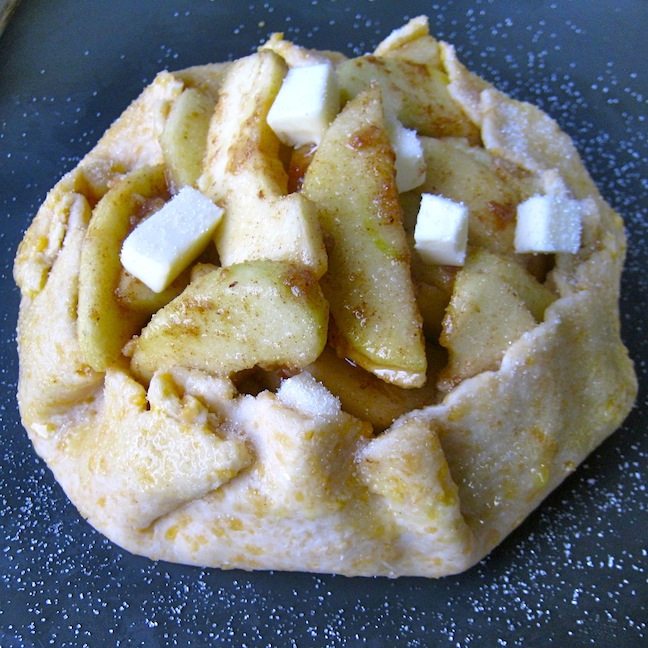
Several years ago, at about this time of the year, my cooking shows were all featuring apple pies. Now, I love apple pie but had shied away from making them because my pie crusts were terrible and the poor apples turned to mush. That Fall, I decided to teach myself how to bake a pie and, every week to 10 days, I baked an apple pie. Well, with parents who were children of the Great Depression, we learned very early on that one  never wastes food. Period. So, if I made a pie, I ate a pie. True, eventually my pies got better and I was confident enough to share them with friends — but I ate a whole lotta pie before then. Still, even though I eventually settled on recipes for both crust and filling, one pie is a lot if you live alone, as Zia and I often commiserated. As a result, neither of us baked apple pie because we didn’t want to be greeted by the same pie every time we entered our kitchens for the next week or so. That was until 2 years ago. It was about that time that we both saw cooks on television prepare apples in a form that was part pie and part tart. They called them “open-faced” pies or tarts but, to our minds, they’re neither. So, we started calling them apple “thingamajigs” and the confusion ended, at least between the two of us. Best of all, an apple thingamajig is half the size of a pie and, therefore, better suited to our swinging single lifestyles.

Now, there are plenty of recipes around for thingamajigs and mine is based upon my apple pie recipe, with one notable exception. I include cheddar cheese in my apple pie crust but not here. Being a thingamajig has only one crust, the cheddar cheese flavor is too mild to be noticed and adding more cheese to the recipe only serves to make the crust unmanageable. So, the cheddar is reserved for double-crusted pies and it’s probably just as well. (My apple pie recipe with a cheddar crust is forthcoming.) A thingamajig, being open-faced, is less “runny” than a normal pie due to evaporation during baking. (See Notes.) As you’ll see and much to my liking, the apple slices remain firm and more apple flavor retained. As for the apples themselves, I always use tart apples, preferably Granny Smith, but I also add a sweet one — Fuji or Honeycrisp — to the filling, usually in a 3 tart to 1 sweet apple ratio. That way, you get an occasional taste of sweet among the sour. Raisins or currants will do the same. To that end, I don’t use a lot of sugar nor a number of spices in my apple filling. Why use tart apples if you’re going to add a ton of sugar and spice to the filling? For me, when it comes to apple filling, less is more.

*     *     *

The Apple Thingamajig Recipe

Ingredients

  • For Pie Crust
    • 1 1/2 cups AP flour
    • 1/4 tsp salt
    • 5 tbsp vegetable shortening, cut into cubes and well-chilled
    • 4 tbsp unsalted butter, cut into cubes and well-chilled
    • 3 tbsp ice water
    • 1 tbsp cider vinegar

  • For Apple Filling
    • 3 Granny Smiths (or similar, tart apples) peeled, cored, and sliced evenly
    • 1 Fuji (or similar, sweet apple) peeled, cored, and sliced evenly
    • 2 tbsp lemon juice
    • 1/4 cup sugar
    • 2 tbsp dark brown sugar
    • 2 tbsp AP flour
    • 1/2 tsp cinnamon
    • 1/8 tsp nutmeg
    • 1/4 tsp salt
    • 1 egg, beaten
    • sugar
    • butter

Directions

  • For Pie Crust
    1. Add flour and salt to the processor. Pulse it a few times to mix the 2 ingredients.
    2. Add the very cold butter & shortening cubes.
    3. Pulse the machine 3 times, with each pulse lasting a 3-count. Your ingredients will now be lightly mixed. If need be, pulse again.
    4. With the machine running, add the vinegar and then slowly add the ice water. Do not add so much that a ball of dough forms. Remove the lid and, with your hands, test the dough to see if a ball of dough can be formed.
      1. If so, turn the dough until a very lightly floured service, form a ball, wrap it in plastic wrap, and refrigerate for 30 minutes.
      2. If a dough ball will not form, add a little more water, pulse the machine a couple of times, and test it again. When you can form a ball of dough, follow step A above.
    5. While the dough rests in the fridge, prepare the filling.

  • For Apple Filling
    1. In a large mixing bowl, combine the apple slices and lemon juice. Stir to coat the apples.
    2. In a small bowl, mix together the sugar, brown sugar, flour, cinnamon, nutmeg, and salt.
    3. Add the spice mixture to the apples and gently stir until the apples are coated evenly.
    4. Set aside until the pie crust is ready.


  • Assembly
    1. Roll the dough as if making a bottom crust for a 9 inch pie.
    2. Place the apples in the center of the dough circle, leaving a 2 inch border around the filling. Creative types may wish to carefully place the apples in a circular design. (That is soo not me.)
    3. Carefully lift the border, working your way around the filling, crimping as needed. You are creating the crust for your open-faced thingamajig.
    4. Dot the top of the apple filling with small bits of butter.
    5. With a pastry brush, lightly coat the exposed crust with the beaten egg. Sprinkle the sugar.
    6. Place in a pre-heated 375* oven and bake for 40 to 45 minutes or until golden brown.
    7. Should not be served piping hot but may be served warm.

*     *     *

Variations

Just like its cousins the tart and pie, you can add ingredients to the filling to suit your own tastes. In the past, I’ve added raisins, currants, and chopped walnuts to the filling and enjoyed each. And, of course, you can change this dessert completely by selecting different apples. I like tart; you may prefer sweet. Lucky for us, there are plenty of apples to choose from.

*     *     *

Notes

Because there are fewer pie juices to contain, this pie crust can be rolled thinner than you would for a pie and, as a result, you can easily make 2 thingamajigs — as I often do and did today. I keep one for myself and give the other to a friend.  I believe it was Confucius who said, “It is easier to give someone a thingamajig than it is to give half a pie.”

*     *     *

Spaghetti Aglio e Olio

Of all the pasta dishes one might make, spaghetti aglio e olio (spaghetti with garlic & oil) is, by far, the easiest to prepare. Ready in minutes, at its most basic, there are but 3 ingredients to this dish: pasta, garlic, and olive oil. That’s it. Now, understandably, there are many variations to the dish, the most common involve adding grated cheese (romano or parmesan)  and/or chopped red pepperoncini or pepper flakes. I am firmly planted on the side of those who love their pasta aglio e olio served with a few red pepper flakes and a good dusting of grated cheese. Still, even after adding these 2 ingredients, you can see that this is a most uncomplicated dish.

As a young adult still living at the old two-flat, I’d come home after a night out with the boys and, while they were in a drive-thru waiting for their sack o’ sliders, I was already fixing myself a plate of aglio e olio. One of those nights, as I was eating, Zia’s husband, “Uncle,” came down the back stairs to see what I was cooking. After a brief chat, he went back upstairs. A week or two later, the same thing happened but, this time, he mentioned how quickly I had prepared the dish. Realizing the implication, I was ready for him the next time. A couple of weeks later, after a night spent carousing with friends, I set about to make my late night dinner, only this time I slowed things down a bit. Sure enough, Uncle appeared but this time I was just about to add the pasta to the boiling water (butta giù in our house’s parlance). I added enough spaghetti for two and within minutes we were enjoying a late night snack together. We “dined together” several times after that and I always knew that if he didn’t appear by the time I was ready to butta giù, I would be dining alone. To this day, I cannot have a dish of pasta aglio e olio without thinking of those late night dinners together.

Throughout the years, this simple dish has continued to serve me well. After a 10 hour day at the office, I would arrive home and prepare a plate of aglio e olio within minutes. On those days/nights that I tended bar, a dish of this pasta officially marked the end of my day. Even now, if I don’t feel like cooking, I can whip up a batch of spaghetti aglio e olio in a fraction of the time it would take to have a dinner delivered. And I still find it every bit as satisfying as I did those many years ago, although, admittedly, Max is hardly the conversationalist that Uncle was.

*     *     *

Spaghetti Aglio e Olio Recipe 

Ingredients

  • 1 lb spaghetti (cappellini, spaghettini, linguine, or trenette may be used)
  • 1/2 cup extra virgin olive oil
  • 3 – 6 cloves of garlic, diced
  • 1/2 to 1 tsp red pepper flakes or 1 red peperoncino, diced (optional)
  • 1/2 cup grated cheese, separated – romano or parmesan may be used (optional)
  • reserved pasta water
  • chopped parsley, for garnish (optional)
  • grated cheese for serving (optional)

*     *     *

*     *     *

Directions

  1. Bring a large pot of heavily salted water to boil. Add the spaghetti and stir.
  2. Check the spaghetti package’s cooking instructions. About 3 minutes before the spaghetti is supposed to be cooked al dente, begin heating the oil in a deep frying pan. Add the pepper flakes (or peperoncino) & garlic and sauté until the edges of the garlic just begin to turn brown, no more than 2 minutes. Do not allow the garlic to brown completely or, worse yet, to burn. Your pasta should be ready about now.
  3. Reserve 1 cup of the pasta water, strain the pasta, add it to the frying pan, and stir to combine and to coat the pasta.
  4. Add a few ounces of the reserved pasta water to the pan with the pasta, more as needed. Allow the pasta to finish cooking, to your liking.
  5. Before serving, take the pan off of the heat, add all but 2 tbsp of the cheese,  and mix until well coated. Garnish with parsley & the remaining cheese. Serve immediately.

*     *     *

Variations

Since the recipe just presented already modified the original dish to include grated cheese and red pepper flakes, why stop there? About a year ago, I realized that I hadn’t any cheese — Gasp! — after I had already added my pasta to the pot of boiling water. Remembering what I’d seen on a number of cooking shows, I quickly tossed some bread crumbs into a frying pan, added the parsley that was to have been a garnish, and toasted the combination. When my pasta was ready to be served, I topped it off with the toasted bread crumbs — and I’ve done it many times since, sometimes with cheese, sometimes without. As it turns out, using bread crumbs in place of cheese is a Sicilian custom, as Ambrosiana recently verified. (Speaking of Ambrosiana, be sure to check out her blog, Tales of Ambrosia. Not only will you find great recipes & dishes, beautifully photographed, but you’ll be treated to scenes of an Italy that the tour books have yet to discover.)

*     *     *

A Zucchini for Your Penne

For the last 10 weeks, or so, my weekends have begun with an early Saturday morning trip to the Evanston Farmers Market. (Sunday mornings are reserved for the Skokie Market.) Granted, my purchases have changed now that Summer is ending but one vegetable I rarely go home without is fresh zucchini. Whether I serve it within Mom’s caponata, stuffed like Grandma’s eggplant, sautéed with onion in olive oil, or served with pasta, a week doesn’t go by without zucchini making at least one appearance at my dinner table. So, when I recently watched Jamie Oliver prep zucchini and yellow squash for a penne dish, I sat up and took notice.

Normally when I prepare these 2 vegetables for my pasta dish, I either cut them into quarter-inch disks or shred them with my food processor. Jamie took them and, with a few simple cuts, fashioned them into penne look-alikes, and then prepared them carbonara-style. You can see his recipe here. I, however, prefer my carbonara cooked the more traditional way, so, I’ve chosen to cook these aglio e olio, with garlic and oil. (Coming soon: the recipe for spaghetti aglio e olio.) You may have a favorite way of fixing zucchini with pasta and I see no reason for you to change now. This post isn’t so much about how to cook the zucchini as it is how to prepare it. Even so, I’ve included general guidelines that I followed when I cooked the dish.

To begin, I selected 2 zucchini and 2 summer squash, each about 6 inches long, to be cooked with 1/2 pound of penne. You can easily see how you can increase or decrease the ratio of vegetables to pasta according to you own preference. Once that was decided, I started preparing the veggies as pictured below. Briefly stated, cut them into quarters; trim away the seed-filled center; and cut, diagonally, into penne-sized strips.

Clever, no? Anyway, to cook, add penne pasta to a pot of salted, boiling water. The package instructions for the penne I used stated the penne would be ready in 13 minutes. As a result, I planned to drain the pasta after cooking for about 10 minutes. So, once the penne is in the water and it has returned to the boil, start the clock. At the 5 minute mark, add about 3 tbsp extra virgin olive oil into a deep frying pan over medium-high heat. Once hot, add 1 or 2 minced cloves of garlic and sauté for about 30 seconds. Add the zucchini and yellow squash, season with salt & pepper, and continue to sauté until the 10 minute mark. Reserve some of the pasta water, drain the pasta, and add the pasta to the pan with the vegetables. Continue to sauté until the pasta is cooked to your liking. Add some of the reserved pasta water, if needed. When cooked al dente, remove from heat and mix in 1/4 cup grated parmesan cheese. Serve immediately, garnished with more cheese and chopped fresh parsley.

As I’ve mentioned, the point here is the preparation of the zucchini and summer squash. If aglio e olio isn’t for you, this dish could just as easily be prepared with a cream or marinara sauce, instead. For the latter, I would sauté the zucchini and summer squash in a little butter, timing them so that they’d be cooked to my liking when the penne is cooked al dente.  Mix the vegetables with the cooked penne and dress both with the marinara. Garnish with a little grated cheese and some chopped parsley before serving immediately.

*     *     *

Don’t sit under that apple tree. Make apple sauce!

I love this time of the year. Here in Chicago, Winter’s relentless, Spring’s nonexistent, Summer’s hot & humid, but Fall, beautiful, wonderful Fall is our reward for putting up with the rest of the year’s weather. The days are warm, the nights cool, the lakefront a thing of beauty and the Park, which borders the Lake for pretty much the full breadth of the City, gradually transforms from lush green to a multi-colored patchwork. As nice as that all sounds and is, truthfully, there’s but one thing missing and, surprisingly, it has little to do with my adoptive home but everything to do with the time of year. It’s apples. I love apples. Cook ’em, bake ’em, turn ’em into sauce. Give me a pie, a tart, a crisp, a cobbler. How about a muffin? A piece of cake? A slice of  bread? A stack of flapjacks? Or, if all else fails, just give one to me raw. Believe me, you cannot go wrong offering me apples in any way, shape, or form.

So, for years, when Fall rolled around, I set about making pies and cobblers, with an occasional loaf of bread or a baked apple thrown in for good measure. This all changed 2 Summers ago when I bought my Roma Sauce Maker. (Do you hear a harp? I always hear a harp when I mention that strainer.) I bought it to process my tomatoes before freezing but I quickly learned that it was good for making apple sauce. Well, that was a game changer around this place.

In prior posts, I’ve mentioned the two boys that live above me with their Mom. The oldest, like most kids, loves sweets of any kind. The youngest is his polar opposite and doesn’t like sweets. Period. This poses a problem for me. I’d love to bring them ice cream, cookies, or whatever it is I’m making in the kitchen but I shy away from it because I don’t want the little guy to feel left out. That, however, was before my Roma Sauce Maker came home. (C’mon! You had to have heard that!) The Li’l Guy, you see, loves apple sauce. So, this time of year, he gets all the apple sauce he wants. That was, until very recently. Now, I CAN, which means the apple sauce I make today can, and will, be given to him next May when I give his brother some cookies, or, in July when I make ice cream for the house. And, best of all, he can still have plenty of apple sauce now, too! There really is an upside to this canning business. Who knew!

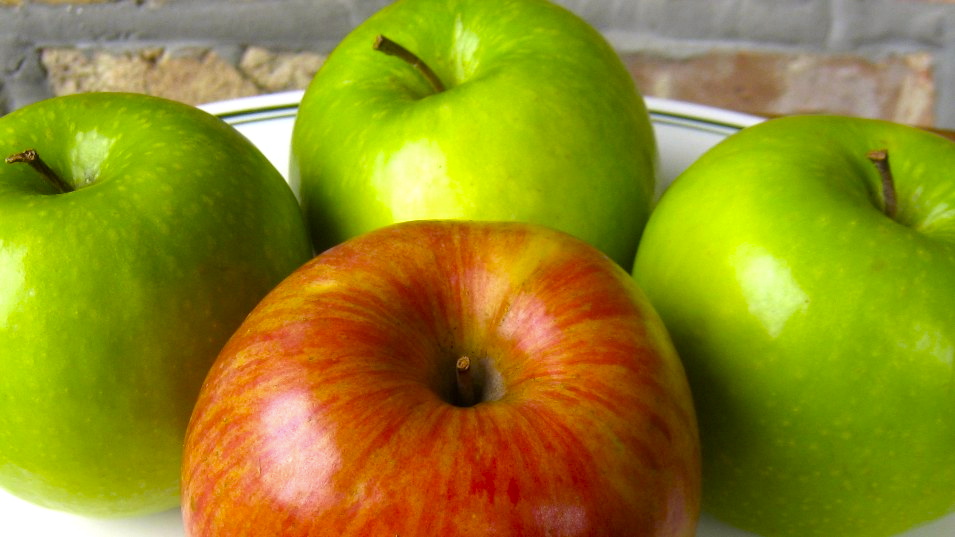
Now, as for the sauce, I am by no means an expert but I have had some pretty good luck with it. To begin, I never use anything but apples, a few ounces of organic apple juice, and a pinch of salt. That’s it, no sugar whatsoever and, for that matter, no cinnamon either. I use about 4 kinds of apples, all sweet, for every batch of sauce. This week, as shown, I used Molly Delicious, McIntosh, Honey Crisp, and Regal Gala. Because they’re so small, I selected 7 Galas and 6 of each of the other varieties; their total weight being 10 and a half pounds (4.8 kg). Although there’s no need to core or peel the apples when you use a strainer or food mill,  you still need to cut up the apples. So, I used my corer/slicer and, in about 10 minutes, had all of these in the pot and ready to go. Since I don’t add sugar or cinnamon to my apple sauce, there really isn’t a recipe to share. Instead, I’ll give you the steps that I follow and, as you’ll soon find out, making apple sauce isn’t at all difficult.

First off, select apples known for their sweetness — i.e., Gala, Honey Crisp, McIntosh, Pink Lady, Fuji, Delicious, Macoun, and Golden Delicious, to name a few. Begin by washing all the fruit and, if you have a strainer or food mill, cut the apples into equal-sized slices or chunks. If no strainer, peel and core the apples before chopping the apples. Place the apple pieces into a heavy bottomed sauce pan over medium heat. Add 4 to 6 oz apple juice and simmer, stirring frequently. You want the apple slices to be soft when finished. This could take anywhere from 30 to 60 minutes, depending upon your stove, the pot, the amount of apples, and whether you’ve offended the gods that morning. Once soft, pass the apples through your food strainer or food mill, separating the peel, core, and seeds from the pulp. If you haven’t a strainer or food mill, once the apples are soft enough, you can mash them with a potato masher or force the pulp through a sieve. No matter which method you use, place the resultant pulp into a sauce pan. This is when I season it with a pinch of salt. You may wish to add sugar or cinnamon, to taste. If you’ve chosen your apples carefully, however, I think you’ll be surprised to learn just how sweet it is — and how totally unnecessary the sugar is. At this point, you can place it in your fridge where it will last about a week; cool it and freeze it; or can it.

If you chose to can it, according to the Pick Your Own website, you will need to re-heat the sauce; use clean, sterile jars that are still hot; use sterile tops and lids; and process in a boiling water bath for 15 minutes if using pint containers or 20 minutes if using quarts. Once removed from the boiling bath, place on a towel-covered baking sheet and place in a spot away from drafts where they will remain undisturbed for 12 to 24 hours.

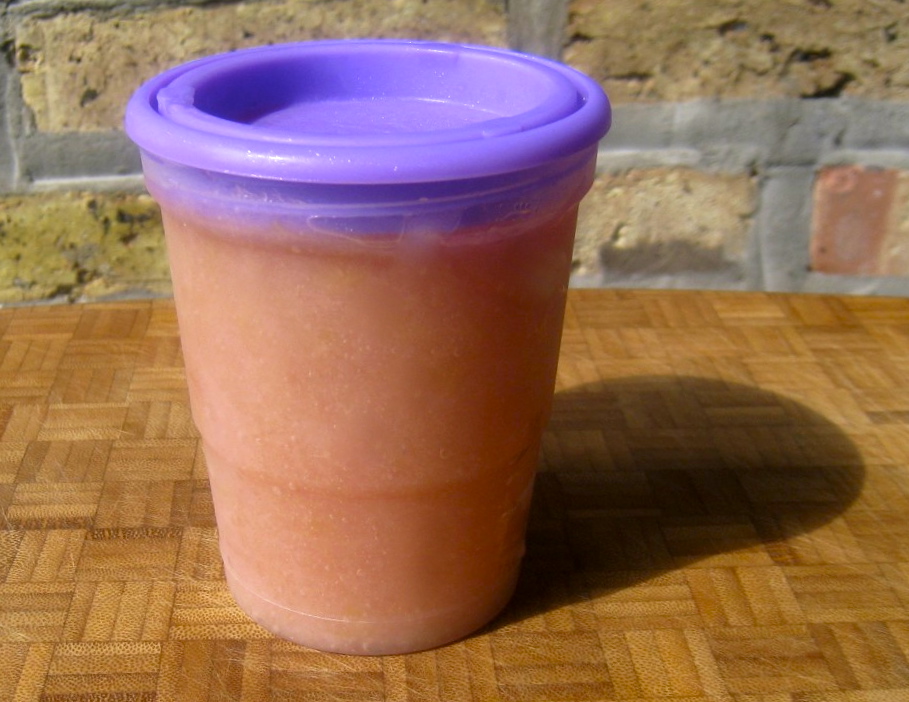
My 10 and a half pounds of apples resulted in 6 pints of apple sauce. I canned 3 pints and froze the remainder in 6 single cup-sized containers. He doesn’t know it yet but there’s going to be one happy little boy living above me.

*     *     *

OK. One last time. Roma Sauce Maker! All right, this time I agree with you. I couldn’t hear the harp because the fanfare was blaring. You did hear the fanfare, right? Right?

*     *     *