Home-Made Fettuccine, Linguine, Capellini

This is more an informational page than a recipe. As such, it only involves making the pasta noodles. Should you wish to see the pasta dough recipe, please refer to Mom’s Pasta Dough recipe.

Fettuccine

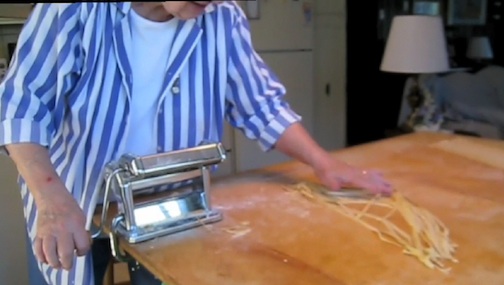
As was mentioned in the pasta dough entry, Mom cut the sfoglia by hand for much of my youth. Occasionally, I’ll do it myself although, to be honest, the width of my noodles aren’t nearly as consistent as were Mom’s. Whereas hers were perfect trenette, mine are more a collection of the various noodle sizes known to Man. Either way, thick or thin cut, you just can’t beat the taste of home-made pasta.

Although I follow Mom’s recipe for making the dough, I roll it into sheets using an attachment for my Kitchen Aid stand mixer, before using a hand-cranked machine to cut the noodles. Mom, as has been mentioned, used a machine with a hand-crank to roll out her dough and cut it into noodles. Both types of rolling devices work under the same principle. The dough is passed between 2 rollers, which are manually set at varying widths. Using the Kitchen Aid attachment as a guide, the no. 1 setting is where the rollers are at their widest, producing a very thick sheet of dough; no. 10 setting will produce an extremely thin dough strip. The relative thickness of the dough strips will depend upon their eventual use. When needed for lasagna, I stop after they’ve passed through the no. 5 setting. For noodles, I stop after setting no. 6. I use the same setting for large ravioli but will use no. 7 for small ravioli, where there isn’t so much filling. Zia, on the other hand, prefers to use no. 5 for her lasagna and noodles, with no. 6 being used for all of her ravioli. Again, let your own palate be your guide.

*     *     *

Home-Made Fettuccine, Linguine, Capellini

total time: approx.  45 minutes (includes drying time)

Ingredients

  • 1 1/2 lbs. fresh dough, made using Mom’s Pasta Dough recipe
  • extra all-purpose flour for dusting the work surface and pasta sheets

Directions

  1. Be sure the dough has been allowed to rest at least 15 minutes before starting to roll it.
  2. Using a knife or dough scraper, separate a ball of dough, roughly the size of a very large egg. With your hands, flatten the dough somewhat, making a square. Set your machine’s rollers to the widest setting and dust the rollers with flour.
  3. Place one edge of the dough between the rollers and turn the crank, causing the dough to grow thinner as it passes through the rollers. Lightly flour the dough, fold it in half upon itself, and pass it through the rollers again. Repeat this, without adjusting the rollers, a few times.
  4. Get another dough “egg” and repeat steps 2 & 3. In fact, get as many dough “eggs” as you are comfortable handling. Just remember to keep the remaining dough covered while you work with the “eggs.”
  5. Once you have rolled a few “eggs”, adjust the rollers to the next setting and pass each dough sheet through the rollers. If the dough is at all sticky, dust the sheets with flour. When all the sheets have been rolled, fold each in half and send through the rollers again.
  6. Adjust the rollers and repeat Step 5, again and again, until the strips are the desired thinness. You shouldn’t need to flour the strips between passes through the rollers.
  7. At this point, the dough strips will need to dry a bit before cutting. This could take anywhere from 5 to 20 minutes, or so. Much depends on your home’s temperature and humidity. If the strips aren’t dry enough, the freshly cut pasta will stick together and you’ll need to separate the noodles by hand. Just as strips that are too moist are a problem, so are strips that are too dry. In the latter case, the dough will crack & break during the cutting process. The dough strips need to be pliable.
  8. Once the sheets are suitably dried, pass them through the cutting rollers on your machine. Work the crank with one hand as you catch the noodles with the other. The freshly cut pasta may be lightly formed into bird’s nests or spread out on baking sheets, table tops, or floured towels. The pasta may be cooked immediately or allowed to dry completely, which should occur relatively quickly. If heat and humidity are a problem, freeze the freshly cut pasta to prevent mold from developing. Your pasta will store for weeks, whether dried or frozen, but the sooner used the better.

Variations

The steps outlined above use a machine to cut the fresh noodles. You can, if you like, try cutting them by hand. Take a strip of dough and fold it in half, thereby reducing its length by half. Fold it again in half, then again, and again, and again. The result should be a multi-layered dough strip about 2 – 3 inches wide. This is called sfoglia. Starting at one end and using a sharp knife, cut strips as thin as you like. Once the entire sfoglia has been cut this way, unfold the thin strips and these are your noodles.

*     *     *

Mom’s Pasta Dough

Hand-Rolling the Dough

Making pasta at home sure has changed a lot, just during my lifetime. For centuries, Italian women took a mound of flour, made a volcano-like cavity in its center, added a few eggs or some water, and slowly started combining the 2 ingredients. Eventually, a ball of dough would be formed, which they would knead before setting it aside to rest. (Let’s be clear: it’s the dough that rested.) Then, using long rolling pins, they rolled out the dough into huge sheets, 3 to 4 feet in diameter, and as thick as that day’s pasta required. The sheets would be laid somewhere to dry a bit before being folded repeatedly upon themselves to make sfoglia, which was then cut by hand with a sharp knife. It was the width of the noodle that determined the pasta — i.e., extremely thin: capellini (angel hair); somewhat thicker: spaghetti; a little thicker: trenette; a shade thicker: linguine; thicker still: fettuccine; etc. I think you get the idea. For generations, this is how pasta was made and our house was no different.  I have fond memories of the women of the house wielding their rolling pins; of wheels of dough drying on floured sheets covering tabletops, beds, and even the backs of chairs; of the family dog being banished while the dough dried; and, of the sound of Mom’s knife quickly cutting perfectly sized linguine, while holding a conversation with one of us or whomever entered her kitchen — and it was her kitchen. Then, about the time I entered high school, everything changed. Our family’s first pasta machine was purchased.

Sfoglia

Although relatively commonplace now, I’ve no idea how widespread their use was in the late 1960’s. I do know that Mom got her machine first and that things changed from that day forward. Mom’s long rolling-pin was all but retired. (She gave it to me a few years before she died.) Instead of round wheels of dough drying around the house, there were now strips of dough — and far fewer of them. You see, if you didn’t have to hand-roll the dough, you could do it more often and make less when you did. More change was to come when my sister and I bought Mom a food processor. Gone were the flour mounds and volcanoes, replaced by a 30 second whirl in this beauty built by Cuisinart.

Pasta Machine

Against this backdrop of technological advancement stood my Dad, a bit of a “pasta purist.” He insisted that he could tell the difference between pasta that was hand-rolled and that which was rolled by machine. As my sister lovingly recalls, if Dad noticed Mom preparing to make pasta that morning, he’d remind her of the benefits of rolling the dough by hand and ask that she do so. Mom would agree and a satisfied Dad would leave for work. Dad’s car was barely down the street when Mom went to the cupboard and pulled out the machine. (As I mentioned, it was her kitchen.) Later, at dinner, the hint of a wry smile would grace Mom’s face as Dad praised her “hand-rolled pasta.”

Pasta dough recipes abound on the internet. Just google “pasta dough recipe” and you’ll see what I mean. The one constant that all of the recipes share is that there is nothing exact about making pasta dough. For starters, not all “Grade A Large” eggs are created equal; some are larger than others. As for the flour, not only do you have to contend with differences between the kinds of flour, things like humidity and how you measure it will affect your dough, as well. These things may seem minor but you have to remember that as little as a tablespoon of liquid can make your dough too wet or, if it’s lacking, too dry.

Double Batch

Dough at Rest

This recipe was given to Mom by long-time family friend, Emilia, who had converted a few recipes for preparation using a food processor. (“Milia” and her husband were my brother’s god-parents.)  I follow this recipe because it uses a specific amount of liquid, thereby removing any variance resulting from eggs of differing sizes. Though flour-related variables may remain, at least we’re using a constant amount of liquid. Beyond that, one thing is certain: when making pasta dough, experience is the most important ingredient.

This post will only cover making pasta dough. Future posts will detail its uses.

*     *     *

Pasta Dough Recipe

makes about 1.5 lbs

total time: approx. 45 minutes (includes 30 minutes rest)

Ingredients

  • 2 3/4 to 3 cups all-purpose flour
  • 4 whole large eggs + enough water to equal 1 cup of liquid. Egg should be allowed to sit on a counter for about 30 minutes before use.

Directions

  1. Place all ingredients in food processor and mix until a ball of dough forms, about 30 seconds. Place dough on floured work surface.
  2. Dough should not be stick to your fingers but should be moist enough to form a cohesive ball.
  3. Begin kneading the dough, adding flour or water, in small amounts, as required. Knead until a smooth dough is achieved, at least 5 minutes. The longer you knead the dough, the better the pasta’s texture will be.
  4. Cover with plastic wrap and set aside for at least 15 minutes or up to an hour. If dough is to be rested longer than an hour, place it in the refrigerator. When removed from the refrigerator, temper the dough by leaving it on a counter for 30 minutes before using.

Variations

  • I prefer to add a pinch of salt and a dash (about 1/8 tsp) of olive oil to my pasta dough.
  • For green (verde) noodles, mix a couple of tablespoons of finely chopped spinach with the flour before adding the egg liquid to the food processor. Zia recalls that, years ago, they used spinach baby food when making pasta verde. 

*     *     *

Biscotti

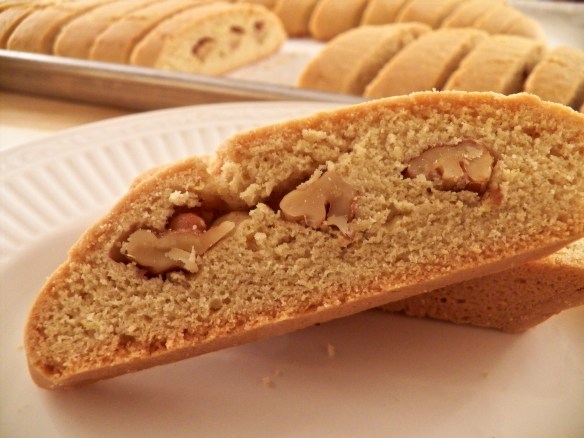
Like many households, the Thanksgiving to New Year’s Day holiday season at our house was a special time each year, complete with its own set of dishes and treats. These biscotti fit into that group, although I don’t know why. It’s not as if they’re festive-looking, like sugar cookies decorated to look like Santa or Christmas trees. Nor are they part of some widely accepted food tradition, such as eggnog at Christmas or turkey on Thanksgiving. Yet, the first of these biscotti would quietly make their appearance in our homes sometime around Thanksgiving and, come January, they would leave just as quietly. To this very day, Zia gives each of us some biscotti sometime during the holidays — and it wouldn’t be Christmas without them.

These two recipes came to the family via different paths. The first, Mom’s Pecan Biscotti, was given to her when I was a boy by a friend of the family who was, at the time, 90 years young. Our two families had ties that could be traced back to San Marino. The second recipe, Zia’s Anise-Flavored Biscotti, has been a part of Zia’s repertoire ever since she found the recipe in a Detroit News article some 50 years ago. Each year before the holidays, Mom and Zia would set aside one day for baking biscotti.  Mom would make the biscotti with pecans and Zia the anise-flavored. At day’s end, each would take half of  her biscotti and trade it for half of her sister’s. Generally speaking, we kids loved dipping the pecan biscotti into our milk, while the adults preferred to enjoy their anise-flavored biscotti with coffee after dinner. Should you decide to make both recipes at the same time, be sure to store the 2 kinds of biscotti separately. When stored together, it isn’t long before the pecan biscotti begin to take on the scent of anise.

*     *     *

Mom’s Biscotti with Pecans Recipe

cook time: approx.  1 hour total

Ingredients

  • 8 eggs
  • 1 lb.  powdered sugar
  • 1/2 cup granulated sugar
  • 3/4 lb. butter, softened
  • 2 heaping tsp baking soda
  • 9 cups of flour, sifted
  • Grated lemon rind from at least 2 lemons
  • Whole pecans (walnuts may be substituted)

Directions

  1. At medium speed, beat sugar and butter together until very light. Add eggs, one at a time, and continue beating until well-blended. At low-speed, add the lemon rind and baking soda. Gradually add the flour and mix well. The resultant dough will be pretty stiff.
  2. Divide the dough into 6 equal portions. Roll each into a rectangular shape, about 12 inches long. Line the center of each with the pecans and roll to form loaves that are about 11 inches long by 5 inches wide. Do not over-load with pecans because the loaves will crumble when you slice them later.
  3. Place the loaves on greased, floured baking sheets and bake in a pre-heated 350* oven for 30 minutes. Slice them while warm; they’ll crumble if you wait too long.

If you prefer to have them toasted, remove them from the oven after they have become a pale golden brown — usually in 15 – 20 minutes. Slice them, place them on their side, and return them to the oven for an additional 10 to 15 minutes. Turn them over midway through the cooking time.

*     *     *

Zia’s Anise-Flavored Biscotti Recipe

Note: Anise is a licorice-tasting herb common to the Mediterranean area.

cook time: approx.  1 hour total

Ingredients

  • 5 cups of flour, sifted
  • 6 eggs
  • 2 cup granulated sugar
  • 1/2 cup butter, softened
  • 4 tsp baking soda
  • 1/2 tsp baking powder
  • 1/2 tsp salt100_2314
  • 1 small bottle anise extract (approx. 2 tbsp)

Directions

  1. Sift flour, baking soda and powder together.  Set aside.
  2. In another bowl, beat butter with sugar on medium speed till creamy. Add eggs one at a time. When finished, add the anise flavoring.
  3. Slowly add flour mixture and beat at low-speed till well-blended. If the dough feels too stiff, add an extra dab of butter.
  4. Divide mixture in half and then half again. Form a loaf from each quarter and place 2 loaves on each baking sheet. Bake in a pre-heated 350* oven for 30 minutes. Slice them while warm; they’ll crumble if you wait too long.

If you prefer to have them toasted, remove them from the oven after they have become a pale golden brown — usually in 15 – 20 minutes. Slice them, place them on their side, and return them to the oven for an additional 10 to 15 minutes. Turn them over midway through the cooking time.

*     *     *

Vegetables (Verdure)

While growing up, Mom introduced us to a number of vegetables, with varying degrees of success depending upon the person. (Yes, I’m looking at you.) For the most part, she used one method when cooking vegetables and it’s pretty much the same as is used throughout Italy. I mention this, particularly the latter part, because we Americans tend to like our vegetables to be cooked but with some crispness retained. Well, not to disappoint anyone, but I’ve eaten my way across Italy a few of times and I’ve yet to be served a vegetable that was cooked al dente. It’s just not done, I’m afraid, but that doesn’t mean that the dishes aren’t tasty or are any less desirable. Besides, some, like kale or rapini, may be a little bitter while others, like Swiss chard, may have ribs or stems that are a little tough. This method of cooking will cut some of that.

Rainbow Chard

Although the recipe below mentions Swiss chard specifically, it’s the technique and not the vegetable that’s important. Briefly, you bring a pot of salted water to boil, blanch the vegetable for a few minutes, and sauté it in garlic-flavored extra virgin olive oil. Now, if you’ve watched any televised chefs, you’ve seen them do this, or something very similar, but they will place the vegetable in cold water after blanching. This will insure that the vegetable retains its brilliant color and, if I’m entertaining, I’ll do it, too. But I don’t entertain every night and placing them into an ice bath just adds another step and more time to my dinner prep, not to mention another dish to clean. I guess what I’m trying to say is that I don’t chill ’em if it’s just Max and me for dinner. Being color blind, he’s not likely to object.

*     *     *

Swiss Chard

serves 2

total time: approx.  30 minutes

Ingredients

  • 2 – 3 tbsp extra virgin olive oil
  • 3 cloves garlic, crushed
  • 1  bunch of Swiss chard.
  • 1 small yellow onion, sliced
  • 1 tsp salt
  • salt and pepper, to taste

Directions

  1. Add olive oil and garlic to a medium-sized frying pan and heat at medium until the garlic begins to brown, a few minutes. Discard the garlic, add the onion, and sauté until it becomes fully translucent and before caramelization starts.
  2. While the garlic is flavoring the olive oil, fill a medium sauce pan with water and bring to a boil.
  3. Meanwhile, clean and prep the chard. Leave as much of the stems as you find palatable. Separate the stems from the leaves and chop the stems into pieces no larger than one inch long. Rough chop the leaves into pieces slightly larger than you would for a salad.
  4. When the water boils, add the salt and then the chard stem pieces. The length of time the stems stay in the pot depends on how crisp you like them. The less time they boil, the more al dente they’ll be. A little before the stems are cooked to your liking, add the chard leaves to the pot.
  5. After 2 minutes, strain everything out of the boiling water and add to the frying pan with the onion. Be careful: the oil may splatter when it comes in contact with the wet chard.
  6. Raise the heat to medium-high, season with salt and pepper, and sauté the chard and onions until cooked to your liking. Serve.

Variations

Rather than list variations, here are some of the vegetables that can be cooked utilizing this method: rapini, asparagus, kale, broccolini, broccoli, cauliflower, green beans, cabbage, and even brussels sprouts. Some, like rapini or kale, may need more time sautéing, while others, like brussels sprouts will, also, need a lengthier time in the boiling water. You should skip the blanching altogether when you’re cooking delicate greens, like baby spinach, frisée, or arugula. Whether to include onions or, as pictured, a little tomato, is up to you and learning to flavor olive oil with garlic before sautéing is a neat trick. So, go ahead and give ’em a try. Let Common Sense and your own palate be your guides.

*     *     *

Turkey Stock

At the time of this writing, Thanksgiving is upon us and I just spent a half hour in the kitchen, preparing a pot of turkey stock. Unlike this year, I usually host a small group for Thanksgiving and try to get as much done ahead of time as possible. Now, just because I’ve made other plans for this holiday doesn’t mean that I’ll be without turkey sandwiches after the holiday, for that just wouldn’t do. For me, the days following Thanksgiving are reserved for sandwiches –or sammiches, if you prefer — of turkey, stuffing, and cranberry sauce, stacked high and topped with lettuce and mayo, and surrounded by two slices of whatever bread struck my fancy at the bakery, if I haven’t baked something myself. As I’ve often told my Thanksgiving guests, those sandwiches are the reason for my hosting the dinner every year and I make sure that they all go home with enough leftovers to make at least one sandwich of their own. So, even though I’ve made other plans for this Thanksgiving, I’m going to pick a day and cook myself a mini-turkey dinner. Rest assured that while I’m dining on a small roast turkey breast, dressing, and cranberry sauce, I’ll be dreaming of the turkey sammiches that are sure to follow. Anyway, back to the turkey stock.

I’ve found that by making the stock a few days ahead, I free up a burner on my stove on the Big Day and it’s one less thing to worry about. Not only that but having a couple quarts of turkey stock sure does come in handy. I use some of it to make the gravy; I combine some with white wine and use it to baste the turkey the first few times; and I, also, use it when I’m preparing my stuffing/dressing. Lastly, and perhaps most importantly, I take a small amount, 1/4 to 1/3 cup, and heat it in the microwave. When I’ve finished carving the bird and all the meat is arranged on the platter, I use this bit of piping hot stock to moisten and re-heat the platter’s contents — but don’t over do it. The object is to moisten, not drench. Do it right and your guests will marvel at how moist the bird’s breast meat is.

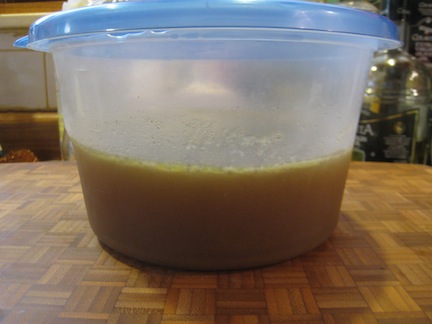
Ready for the Freezer

Because I use it to prepare the gravy and stuffing, I want my stock to mirror the turkey’s flavoring as much as possible. To that end, I season the stock with the same spices that I use on the bird. I, also, sauté the vegetables and turkey parts in an attempt to mimic the flavor of roasting. Speaking of the turkey parts, I found out, years ago, that the turkey neck wasn’t large enough to give me enough stock. That’s when I began buying turkey wings and using them as the base of my stock. One package should be large enough to give you at least 2 quarts of stock. That’s more than enough for my purposes. (I usually freeze the leftover stock and make a delicious risotto on a cold day in December.) A couple of years ago, I began using smoked turkey wings (thank you, Tyler Florence!) and the stock has become all the more flavorful. If you can find them at your local market, by all means give them a try.

The stock that I made earlier today — that formed the basis of this recipe — used 3 smoked turkey wing sections, about 2 lbs., and 3 quarts (6 pints) of water. The resulting stock was fine for my purposes but, had it been weak-tasting, I would have reduced it further by simmering it a while longer. Lastly, salt and pepper were used sparingly, so that I can better control the seasoning in the “end-dishes,” namely the gravy, stuffing/dressing, and turkey basting liquid.

*     *     *

Basic Turkey Stock Recipe

total time: approx.  3.5 hours

Ingredients

  • 2 lbs turkey wings, smoked if available
  • 2 – 3 tbsp extra virgin olive oil
  • 1 medium onion, cut into large chunks
  • 2 carrots, cut into chunks
  • 2 celery stalks, leaves included, cut into chunks
  • 3 garlic cloves, smashed
  • 4 – 6 parsley sprigs
  • 2 sprigs thyme
  • 2 sprigs rosemary
  • 1/8 tsp poultry seasoning
  • 1/8 tsp ground sage
  • salt and pepper, to taste
  • 3 quarts water

Directions

  1. Heat the olive oil in a large stock pot over medium-high heat. Add the onions, carrots, and celery, season lightly with salt and pepper. Stir occasionally while sautéing until the vegetables are lightly carmelized, about 10 minutes. Remove from pan and reserve.
  2. Season turkey wings with poultry seasoning, sage, and lightly with salt and pepper before placing in the stock pot. Sauté until browned, about 4 – 5 minutes, turn over, and repeat.
  3. When the turkey is well-browned, add the garlic to the pan and cook for a minute or so. Add the cooked vegetables, the remaining herbs, and the water to the pot. Bring to a boil before reducing to a low simmer. Periodically skim the film off of the surface. After 2.5 hours, taste the stock and adjust seasoning, if necessary. Continue to simmer for an additional half hour.
  4. After simmering for 3 hours, take the stock off of the heat to cool somewhat. Remove the turkey wings and reserve. Pour stock through a fine mesh strainer and discard the cooked vegetables and herbs. Refrigerate the stock.
  5. Once the stock is well-chilled, the fat should have risen to the top and can be removed relatively easily. Remove the fat before storing the stock in air-tight containers in the refrigerator, for a few days, or in the freezer, for a few weeks.

Variations

Aside from using smoked turkey in place of raw wings, there are no variations to this recipe. There are, however, a few things that you can do with the boiled turkey meat. Once the bones are removed, it can be used, as-is, for sandwiches or added to a few other ingredients to make turkey salad. Of course, you can leave it on the bone and have a nosh later that night while watching TV.

Note: The day after Thanksgiving, remove all the turkey meat from the bones and use the carcass to make stock. There’s no need to add the herbs (rosemary, thyme, poultry seasoning, or sage)  and you may need to use an additional quart of water, depending upon the bird’s size. Since the bird is already cooked, the soup will not need to simmer for 3 hours. I usually cook mine until the stock tastes “right.” That may mean allowing it to reduce a bit, depending upon the bird’s size and amount of water used.

The Last Word: Earlier, Max added to his already lengthy resumé when he “tasted” the turkey stock as it cooled atop the stove. He must have liked it because he returned to it as soon as I left the room. Needless to say, I’ll be heading to the grocer’s tonight and starting up another pot of stock tomorrow.

*     *     *

Slow Cooker Beef Stew

Yes, you read that correctly: beef stew is next on the agenda. We’ll get to that but first I’ve got some ‘splaining to do. One of Chicago’s grocery chains has closed selected stores around town, renovated them, and is now re-opening each in grand style. One such re-opening occurred recently in my neighborhood and, of course, I attended and brought a friend. While there, he took advantage of one of the sales, buying a 4 lb bottom round beef roast. As you may already know, this cut of beef is not particularly well-marbled and isn’t the most tender of cuts. As such, it responds well to stewing or braising and is perfect for slow cooker stew. My friend asked if I had a recipe and I sent him this one in an email. Since I have the recipe handy, I might as well include it here now rather than later.

Before I share the recipe, however, we should probably look at a few of the ingredients. First off, I tend to avoid the grocery’s beef that’s pre-cut into chunks and labeled “beef for stew”. When I make stew, I prefer pieces that are 2 – 3 inches in size and those that are pre-cut are usually about half that size. So, I buy a 2 – 3 lb chuck, top round, or, as already mentioned, a bottom round roast. Once I get home, I cut the roast into chunks the size of my choosing. Of course, if you prefer smaller pieces, by all means go for it.

Zia and six-month-old Max.

Next, let’s look at the vegetables. If you’re considering making stew in a slow cooker, chances are you’ll be setting it up before leaving for work. Unless you have a sous chef, the last thing you’ll want to do is spend time chopping and cleaning your veggies. That’s why I recommend a small bag of new red or Yukon gold potatoes,  frozen pearl onions, and organic baby carrots. Only the potatoes need washing and everything can be thrown into the slow cooker as-is. If you prefer, feel free to use any type of carrot, potato, and onion that’s available. Just be sure to cut them into approximately equal-sized pieces so that they cook evenly.

Last to be mentioned is the wine. Although I use a few ounces of wine in this recipe, it’s not necessary and can be skipped, if you like. This isn’t boeuf bourguignon, after all. If you live alone, like I do, opening a bottle of wine just to use a few ounces in a recipe isn’t practical. I certainly don’t want to drink the rest with my dinner and watching it degrade on a counter or in the fridge is not the answer. I’ve found that the mini bottles of wine — about 5.5 ounces each — are the perfect solution. Our supermarkets sell them in sets of four and offer a variety of grapes. I buy one set of red and another of white. If a recipe calls for wine, I can use one of these bottles and have little, if anything, left over. Granted, these wines aren’t going to be of the same quality as those found in my wine rack but, then again, I’m not about to open an expensive bottle of wine just so that I can pour a few ounces into a stew. I’ll leave it for you to decide whether to use wine and, if you do, which one to choose. A general rule of thumb, however, states that if a wine isn’t good enough to drink, one shouldn’t cook with it. So, avoid the “cooking wines” at your grocery.

*     *     *

Slow Cooker Beef Stew Recipe

yield: 6 – 8 servings

prep time: approx.  30 minutes

cook time: 8 – 9 hours

Ingredients

  • One  2 – 3 lb beef roast, cut into 2 – 3 inch chunks (less expensive cuts of meat are fine for this recipe)
  • 3 tbsp all-purpose flour
  • 3 tbsp olive oil
  • 1 small package of new red or Yukon gold potatoes.
  • 1/2 small bag of organic baby carrots
  • 1 package frozen pearl onions
  • 1/2 package (about 4 oz) button or crimini mushrooms, quartered (more/less may be used according to your preference)
  • 1 small bottle (5..5 oz) red wine
  • 2 bay leaves
  • 3 – 4 sprigs of thyme
  • One 32 oz. box low-salt, fat-free beef stock
  • salt & pepper, to taste

Directions

  1. Spray the inside of the slow cooker with your favorite cooking spray.
  2. Place olive oil in a frying pan and heat over medium-high heat.
  3. Meanwhile, use paper towels to pat dry the beef chunks, season them with salt & pepper, and place them into the now hot frying pan. DO NOT CROWD. The pieces should not touch each other or they will steam and not brown. You may need to do this in batches. Do not disturb the meat. After 3 minutes, gently lift one piece to see if it has browned. If not, return the piece as it was and wait another few minutes before checking again. Once it is browned, turn it over, as well as all the other chunks in the pan, Repeat this process until all the meat is browned on all sides. Remove the meat and place in the slow cooker. If needed, add a little more olive oil to the frying pan before browning the 2nd, or 3rd, batch of meat.
  4. Remove the frying pan from the heat, add the wine, and return to medium heat. Use a wooden spoon to scrape off any residue from the pan’s bottom. Once the pan is “clean,” reduce heat to low.
  5. Sprinkle the flour on top of the meat in the slow cooker. Add the bay leaves and thyme sprigs.
  6. Add potatoes, carrots, onions, and mushrooms, in that order, to the slow cooker.
  7. Season with 1/2 tsp salt & 1/8 tsp pepper (more/less if you prefer).
  8. Pour the now-heated wine over the slow cooker’s contents.
  9. Add enough beef stock to cover the beef chunks. It’s OK if some of the mushrooms or carrots are above the liquid.
  10. Set slow cooker on “high” for one hour and then “low” for another 7 hours. Alternately, you can set your cooker on “low” and cook for 9 hours.
  11. Remove bay leaves & thyme sprigs before serving.

Variations

Although not really a variation, I have made this recipe but without the potatoes. I then serve it over a bed of plain rice or one of buttered, wide egg noodles. Before doing so, I check to see if the gravy is thick enough for serving this way. If not, I use a slotted spoon to remove most of the cooker’s content’s to a platter, leaving the liquid behind. Turn the cooker to “high” and while the gravy heats, mix a couple tbsp of corn starch into about a 1/4 cup water. Add to the slow cooker, stir thoroughly, and heat on “high” for 10  minutes before returning the stew meat & veggies to the cooker. By the time everything is heated through, another 5 – 10 minutes, the gravy should be thick and ready to serve.

*     *     *

Pieda

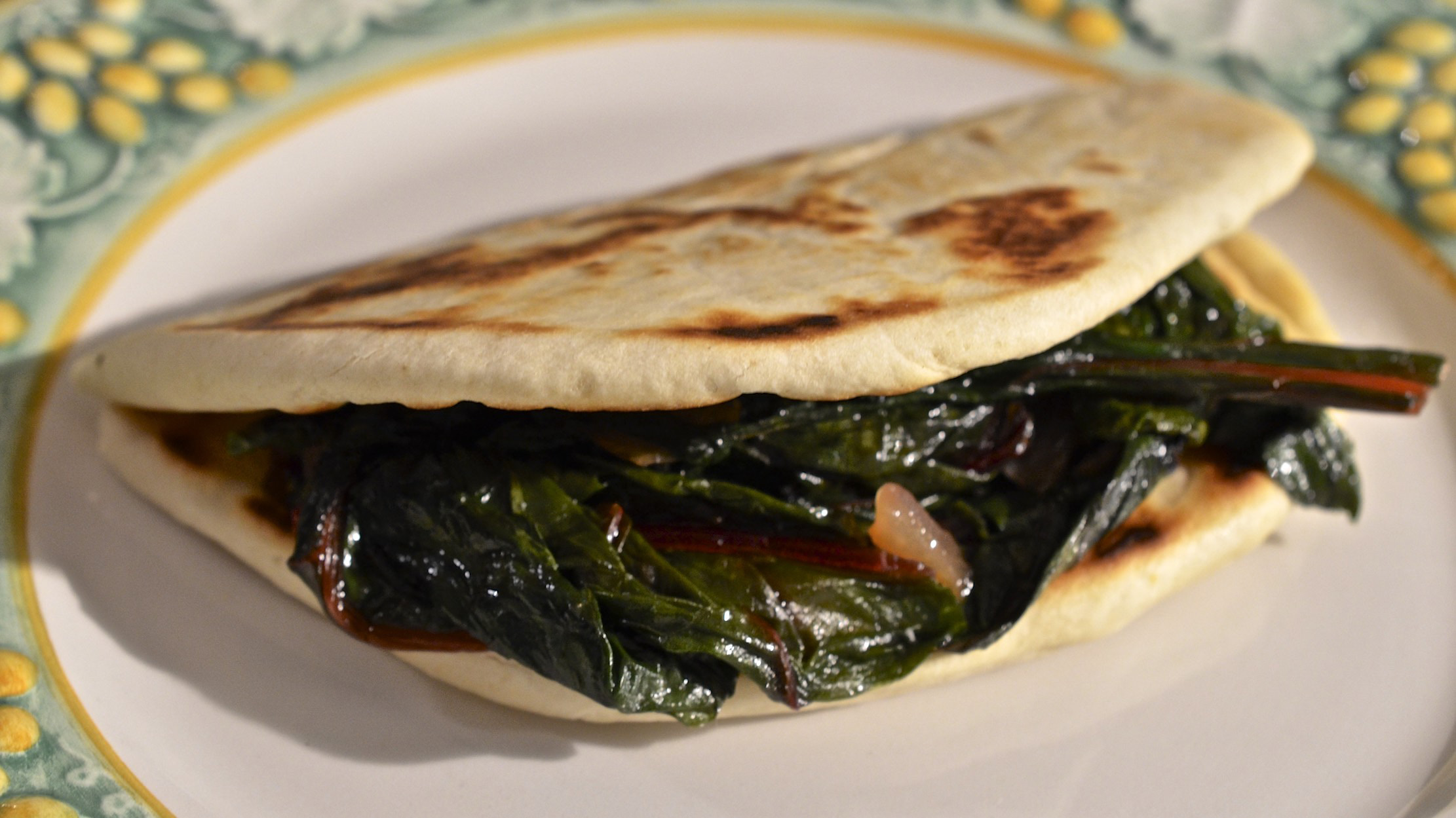
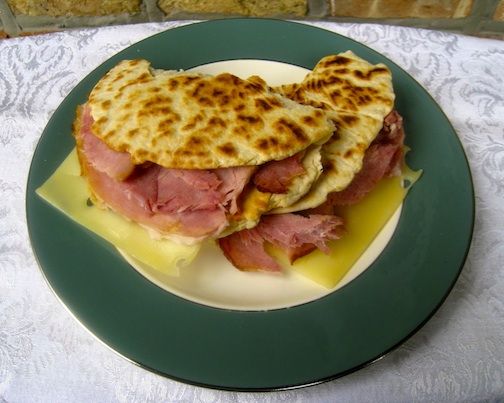
Located in the north of Italy, Emilia-Romagna is a collection of provinces, the southern border of which is shared with San Marino and Le Marche. Dad emigrated from San New Pieda 300Marino, Mom’s family from Le Marche. Pieda, today’s recipe, originated in Romagna but it came to our dinner table via San Marino.  It is a simple flatbread, similar to pita or tortillas, and, when folded in half, can be filled with lunch meat, cheese, or a variety of greens.  My family’s favorite was Swiss chard that had been blanched before being sautéed with a little sliced onion in garlic-flavored extra virgin olive oil . (See Mom’s way of cooking Vegetables.) No matter how you choose to fill them, pieda are best when served immediately after cooking.

*     *     *

Pieda Recipe

makes 6 – 8 pieces

total time: approx.  50 minutes (includes 30 minutes rest)

Ingredients

  • 3 cup flour
  • 1/3 cup Crisco (vegetable shortening)
  • 1 tsp baking powder
  • 1 cup milk

Directions

  1. Place all ingredients in food processor and mix until a ball of dough forms. Cover with plastic wrap and refrigerate for 30 minutes.
  2. Remove a small amount of dough and, using a rolling-pin, roll it out until it is about 6 inches in diameter and no less than 1/8 inch thick.
  3. Cook in a hot, non-stick frying pan over medium-high heat. It should only take a few minutes per side. Use a fork to prick any bubbles that may form during cooking. A side is done when it is mottled with brown spots of varying sizes.
  4. Place cooked pieda on a warmed dish in a warm oven until all are finished. Serve immediately.

*     *     *

Mom’s Tomato Antipasti

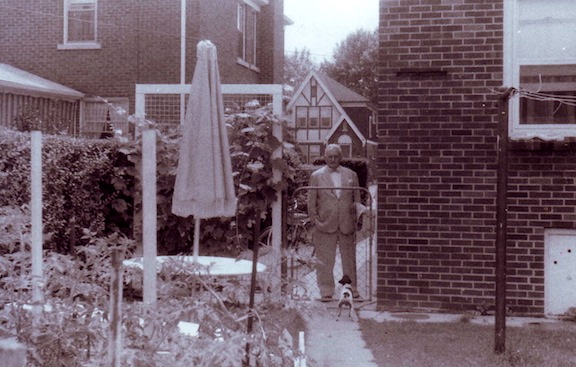
Even more simple than its predecessor, this is my second recipe post and it, too, comes from my childhood. I was raised in Detroit, in what we Chicagoans refer to as a “2-flat.” My family of five lived on the first floor and Zia’s family of five lived on the second. My Grandpa, Mom & Zia’s father, also lived “upstairs,” as did Zia’s mother-in-law, Nonna, on occasion whenever she visited from Canada. Every Summer, Grandpa’s world revolved around his garden, more specifically: his tomatoes. Early each Spring, he planted seeds that he had harvested from the largest beefsteak tomato of his previous year’s crop. A few weeks later, he would select at least 2 dozen of the best seedlings for planting within “his half” of the back yard. Sometime around mid-July, the first of the tomatoes would ripen and from that point until the first frost, we had fresh tomatoes whenever we wanted. Not so coincidentally, it was around mid-July that Mom’s tomato antipasti would make their first appearance of the season on our dinner table.

I’m sure that most are familiar with insalata caprese, where slices of tomato are adorned with slices of mozzarella and basil leaves. A drizzle of olive oil and, sometimes, a splash of vinegar complete this summertime favorite. Although similar, Mom’s dish has 1 ingredient too many for some palates, but that just means there’s more for me.

*     *     *

Grandpa, His Tomatoes & Guard Dog, “Cookie”

*     *     *

Mom’s Tomato Antipasti

yield: 1 platter

prep time: approx.  10 minutes

Ingredients

  • 2 or 3 large ripe tomatoes, evenly sliced (more may be required, depending upon the platter size)
  • 1 small can of anchovies in oil, drained and separated into fillets
  • 2 tbsp chopped fresh basil (more may be required, depending upon the platter size)
  • 2 tbsp chopped fresh parsley (more may be required, depending upon the platter size)
  • extra virgin olive oil
  • red wine vinegar
  • salt & pepper, to taste
  • parmesan cheese

Directions

  1. Arrange the tomato slices in one layer across a serving platter. Season with salt & pepper.
  2. Separate the platter into halves and place 1 anchovy on each tomato slice within one of the halves.
  3. Sprinkle the entire platter with the chopped basil and parsley.
  4. Drizzle the entire platter lightly with extra virgin olive oil before adding a splash of red wine vinegar.
  5. Give a light sprinkling of parmesan cheese to the side of the platter that does NOT contain anchovies.
  6. Serve.

Variations

Taken as-is, this recipe comes with its own variation. If you like, you can separate the tray into 3 equal sections, prepare 2 sections as indicated above, and fill the 3rd with insalata caprese, as pictured above..

*     *     *

Pasta in Bianco (Plain/White Pasta)

That’s me, with my trusty steed at the ready.

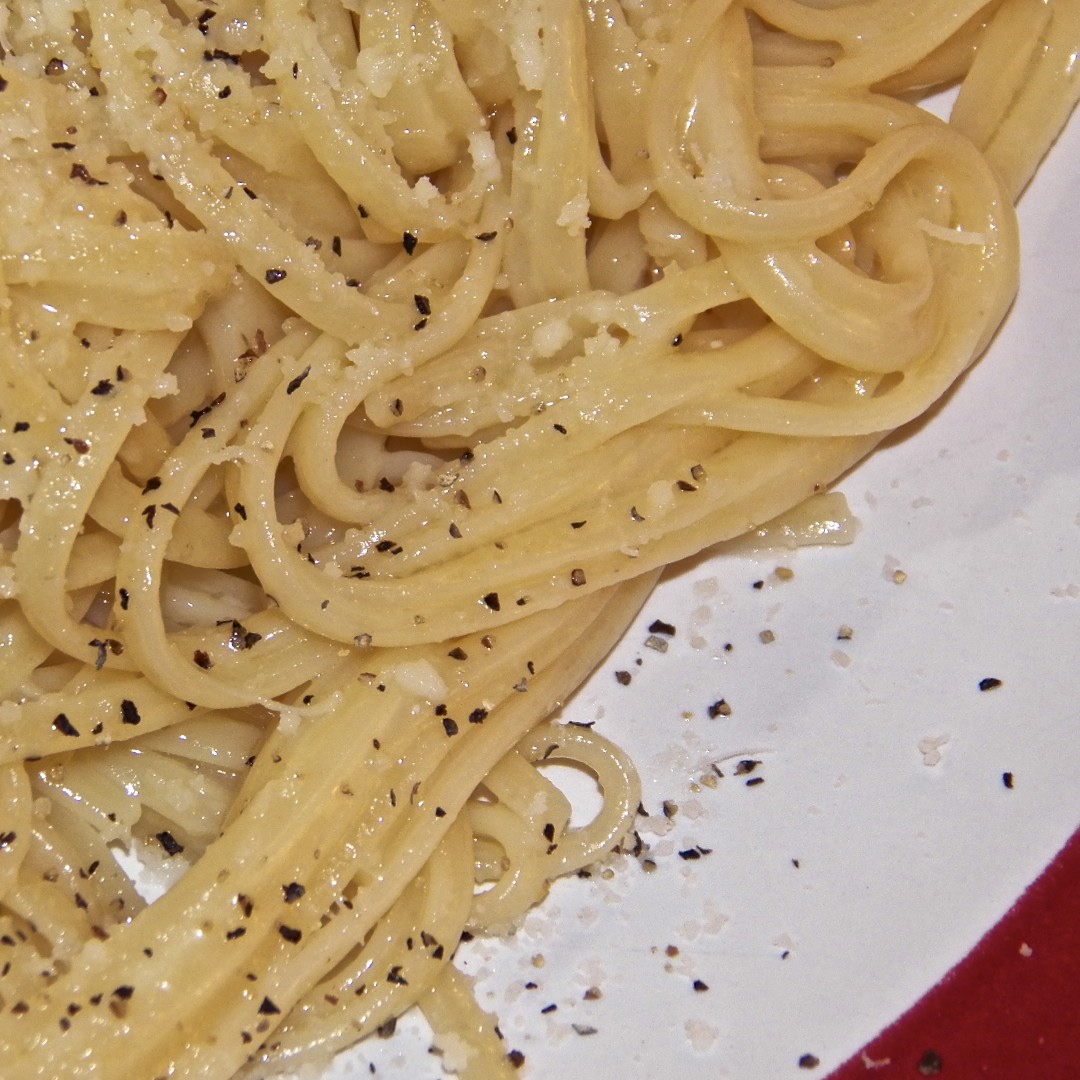
Pasta in bianco, also called pasta bianco, is about as simple a pasta dish as one can make. When I was a boy, Mom would serve this to me whenever I was recuperating from some sort of stomach ailment. I always thought that this “cure” was something peculiar to our house and it wasn’t until many years later that I learned that many Italian households do the same. Luckily, one doesn’t need to be ill to enjoy this simple, yet surprisingly flavorful, dish. And, requiring so few ingredients, this can easily be your “go to” dinner if you want something to eat but don’t have the time nor desire to cook a “normal” meal.

Pasta in Bianco

There’s no need to treat the ingredient amounts as set in stone. You can add more butter and less extra virgin olive oil, for example, if that’s your preference. In fact, true pasta in bianco is made with only butter and that’s how Mom served it to me when I was a boy. Now that I’m older — OK, much older — I’ve replaced some of the butter with the much healthier extra virgin olive oil. Whatever combined amount of butter and oil that you use, the result should be pasta that is well-coated, but not so much that it is dripping. The same holds true for the Pecorino Romano cheese. Some people enjoy a light dusting of cheese; others prefer a blizzard. Me? I’m a blizzard kinda guy — complete with drifts.

*     *     *

Pasta in Bianco Recipe

serves 2

cook time: approx.  20 minutes

Ingredients

  • 1/2 lb angel hair/capellini or spaghetti or linguine
  • 2 – 4 tbsp butter
  • 4 – 6 tbsp extra virgin olive oil
  • 1/4 cup Pecorino Romano cheese
  • 1 tbsp salt
  • pepper, to taste

Directions

  1. Fill a large, 6 to 8 quart, pot with water and bring to a rolling boil. Add the salt, then the pasta, and stir to help prevent the pasta from sticking.
  2. Follow package directions and cook the pasta, stirring occasionally, until al dente. Use a strainer to drain the pasta completely. Do NOT rinse with cold water.
  3. Return pasta to pot, add oil and butter, and mix to coat evenly. Add cheese and mix well.
  4. Serve immediately. Have additional cheese handy for us “blizzard” folks, as well as freshly ground pepper for those so inclined — like me.

Variations

The only variations listed involve the type of cheese to be used.  That’s the only ingredient that can be changed realistically without altering the recipe and, therefore, losing its simplicity.

  • In place of the Pecorino Romano, try using Parmesan, fontinella, ricotta salata, or asiago cheeses. Each can be grated and will impart its own distinctive flavor to the dish.

*     *     *

Gee, that wasn’t so bad for my first attempt. Onward and upward!

*     *     *

This is going to kill me!

"The Scream"

Ever since I began toying with the idea of starting this blog, I never really thought about what it would look like or what recipes would be included within it. I can see now that I’ll never be satisfied with its design and, as for the recipes, I’ll start with  the simple ones and just hope for the best. Put another way, it doesn’t look like there will be any blogging awards coming this way anytime soon.

That was written on my first blog website. Since then, I’ve tried another 2 sites, each acclaimed and each with its own set of advantages. I’ve decided to move to WordPress. To these inexperienced eyes, it seems to be the most user-friendly with the most options — and if I ever learn HTML or CSS it will be even better.  (Don’t count on that anytime soon.) Now that I’m here, I plan on staying here for the duration. So, make yourself comfortable and let’s get started.

Oh! I do need to explain something and I might as well do it now. As much as I would love to supply exact measurements for each and every dish, that’s just not possible. Some recipes were taught to me using approximations — i.e., “a palm of this”; “some of that”; etc. Should you come across an inexact measurement, let Common Sense be your guide and be sure to taste your food repeatedly as you cook. Remember: you can always add more of a particular spice but rarely can you correct a dish when you’ve used too much. Of course, when presenting a bakery or pastry recipe, the measurements will be exact. As they say, cooking is an art; baking a science.

All right. Once I venture into the realm of platitudes, it’s time to move on …

*     *     *