Garlic Mashed Potatoes

As I’ve mentioned in my last posts, I’m on a campaign to vary Thanksgiving dinners at my place. I do realize, however, that there is only so much leeway to be had. I wouldn’t swap out the turkey for some other fowl, nor would I replace the stuffing with wild rice, and I certainly wouldn’t serve dinner without preparing mashed potatoes — although serving the potatoes has proven to be a bit problematic. Over the years, I’ve tried a number of mashed potato recipes that, although not bad, were just not good enough to be the “go to” recipe for Thanksgiving. Then, about 6 years ago, I watched Alton Brown prepare these potatoes and it was love at first sight. Now this is the only way I make mashed potatoes and my dinner guests are very pleased that I do.

Before detailing the recipe, I feel the need to explain my statement about serving potatoes being problematic. (I apologize to those who may have already read a brief recounting of this story in a previous post’s comments.) The apartment I rented before buying my home was what they called “vintage.” The building itself contained three, 3 bedroom apartments, was Victorian in style, and each contained the original unpainted, woodwork, beamed ceilings, original leather wainscoting in the dining rooms,  and the original built-in china hutch in each dining room. Yes, the living rooms and dining rooms were really quite beautiful but, walk down the hall and you entered a kitchen nightmare. Saying that they wanted to “keep it vintage” — we tenants quickly learned that the landlords were just plain cheap — none of the kitchens had any counter space whatsoever. Each had a sink like the one pictured below and that drain board was the only “counter” to be found. There were only 2 small cupboards, as well, and they were located above the sink. To be fair, there was an adjoining pantry but it was of little use when pulling something out of the oven, unloading groceries or, I dunno, just pouring a cup of coffee in the morning.

I moved into that apartment in August and by the time Thanksgiving rolled around, I’d only found one table that I liked for the kitchen. It was an old kitchen work table with a flour bin drawer and underneath was enough space for my pots & pans. Best of all, it offered a tabletop surface that I so desperately needed. That first Thanksgiving was going swimmingly. My friends had already finished their pasta and were working on their salads. I was in the kitchen getting everything assembled for the final push. While clearing the salad plates, rather uncharacteristically, I actually remembered the rolls were in the oven and, with counter space at a premium, placed the hot baking sheet full of toasty rolls atop the bowl of mashed potatoes. I served the dinner and, by all accounts, it was very well-received. In fact, near the end of the main course, one friend mentioned that he didn’t even mind not having mashed potatoes. Huh? Sure enough, my potatoes were still in the kitchen, on the table with a now empty baking sheet covering them. Laughing, I served them, more to prove that I did make them than for any other reason. To their credit, my guests all did have some, although I wouldn’t say that they were especially thrilled to see mashed potatoes served so late in the game. Cheesecake, yes. Mashed potatoes, no.

That recipe was destined to be forgotten because once I saw today’s recipe prepared, I never made any other kind. It is certainly my kind of dish, easy to make with very little room for error — so long as you don’t lose ’em in the kitchen. All you do is steep some garlic in heavy cream and combine that cream with some boiled potatoes.  Add a little cheese & butter, and the result is a dish of mashed potatoes with a delicious garlic flavor throughout. Just be aware that when you add the last of the cream, it very well may look like there’s been too much added. Never fear. Just give it a good stir and let it rest. Within minutes, the cream is absorbed and you’ll end up with a beautiful dish of creamy, garlic mashed potatoes.

*     *     *

Garlic Mashed Potatoes Recipe

Ingredients

  • 3 1/2 lbs of potatoes (Yukon Gold)
  • 2 cups heavy cream
  • 6 garlic cloves, smashed
  • 1/2 cup grated parmesan cheese
  • 4 tbsp butter
  • 2 tbsp kosher salt

Directions

  1. Peel and evenly chop potatoes, place in a saucepan, cover with cold water, bring to a boil over med-high heat, add the salt, and then lower to a simmer.
  2. Continue to simmer potatoes until fork-tender, about 20 minutes. Remove from heat, strain the potatoes, and return to the now empty saucepan to sit for 5 minutes, allowing them to dry more fully.
  3. Meanwhile, place garlic and cream in a small saucepan and heat over medium heat until simmering. Remove from heat and set aside until needed. Just before use, pour the cream mixture through a sieve to strain out and discard the garlic.
  4. Once the potatoes have been boiled, drained, and rested,  begin mashing them.  Add some of the cream to make them easier to mash. Once mashed to your liking, add the remainder of the cream and mix well before adding the cheese and butter. Mix to combine.
  5. Let the mashed potatoes rest a few minutes on your stove top while the remaining cream and butter is fully absorbed. Mix well and serve.

*     *     *

Notes

Alton likes to leave his garlic in the cream and mash it along with the potatoes. I prefer to strain it out prior to mashing. I feel that I can better control the level of garlic flavor in the final dish and, also, ensure that no one is served a chunk of garlic masquerading as a potato lump. Whether or not you strain the cream, remember that the longer you allow the garlic to steep, the more garlic flavor will be infused into the cream.

If you look at Alton’s recipe, you may notice that he doesn’t add any butter. No butter in mashed potatoes? Perish the thought! I’ve corrected his oversight in my version of the recipe.

*     *     *

This will be my last post before the Holiday, so, I’d like to wish a happy Thanksgiving to you and all whom you hold dear. And for those not celebrating the Holiday, have a great day and an even better weekend.

*     *     *
Stovetop Braised Root Vegetables

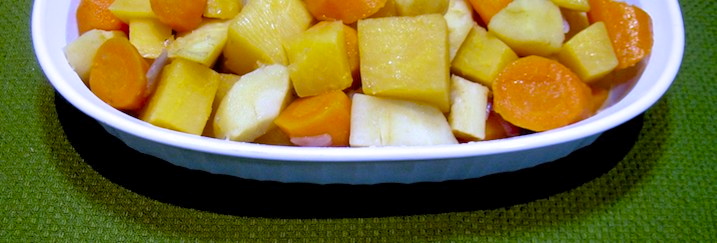
Continuing my quest to bring a little variety to my Thanksgiving dinner, the year following the introduction of creamed corn, I served a medley of root vegetables. This dish was selected because it met 2 important criteria required of any dish to be deemed worthy of a spot on my roster of  Thanksgiving side dishes.

First, and most importantly, any new addition must be tasty — and this one was surprisingly delicious. I say surprisingly because I’d never sampled rutabaga prior to my finding this recipe on the web during yet another sleepless night. I added parsnips to the dish after enjoying them for the first time at a dinner prepared by the Neighbor Lady of my Trusty Traveling Companion. While some might find that surprising, in retrospect, it’s totally understandable why rutabaga and parsnip never made an appearance upon our dining table when I was growing up. Considering the cornucopia of vegetables that graced our table, there just wasn’t any room for these 2 on the menu. Add one more vegetable and Mom may have had to cut a pasta dish out of her repertoire. Cut a pasta? I can feel my heart racing!

The second requirement is that the potential dish be easy to prepare — and special consideration is given if the dish can be cooked on the stove top.  When I’m in the final stages of getting the dinner to the table, the last thing I need is to be babysitting a couple of side dishes. I’ve got potatoes to rice/smash, gravy to make, a pasta course to serve, salads to prepare, and rolls to forget and burn in the oven. And we mustn’t forget a bird to carve and dishes to clear. Tending to some needy side dish(es) just won’t do and the time I spend trying to find room in the oven for it could be better spent trying to find the cocktail I left somewhere out among my guests. This dish is perfect in this regard. First off, you can peel and chop the vegetables well before your guests arrive. In fact, I’ll often do the prep work the night before and seal the chopped veggies in a plastic bag to be stored in the fridge. Taking but 20 minutes to cook, if that, once you get everything into the pan, you can pretty much leave it until it’s ready to be served. It doesn’t get much easier than that and you may find that you even have time to lose a 2nd cocktail.

*     *     *

*     *     *

Stovetop Braised Root Vegetables Recipe

Ingredients

  • 2 tablespoons butter
  • 1 clove garlic, minced
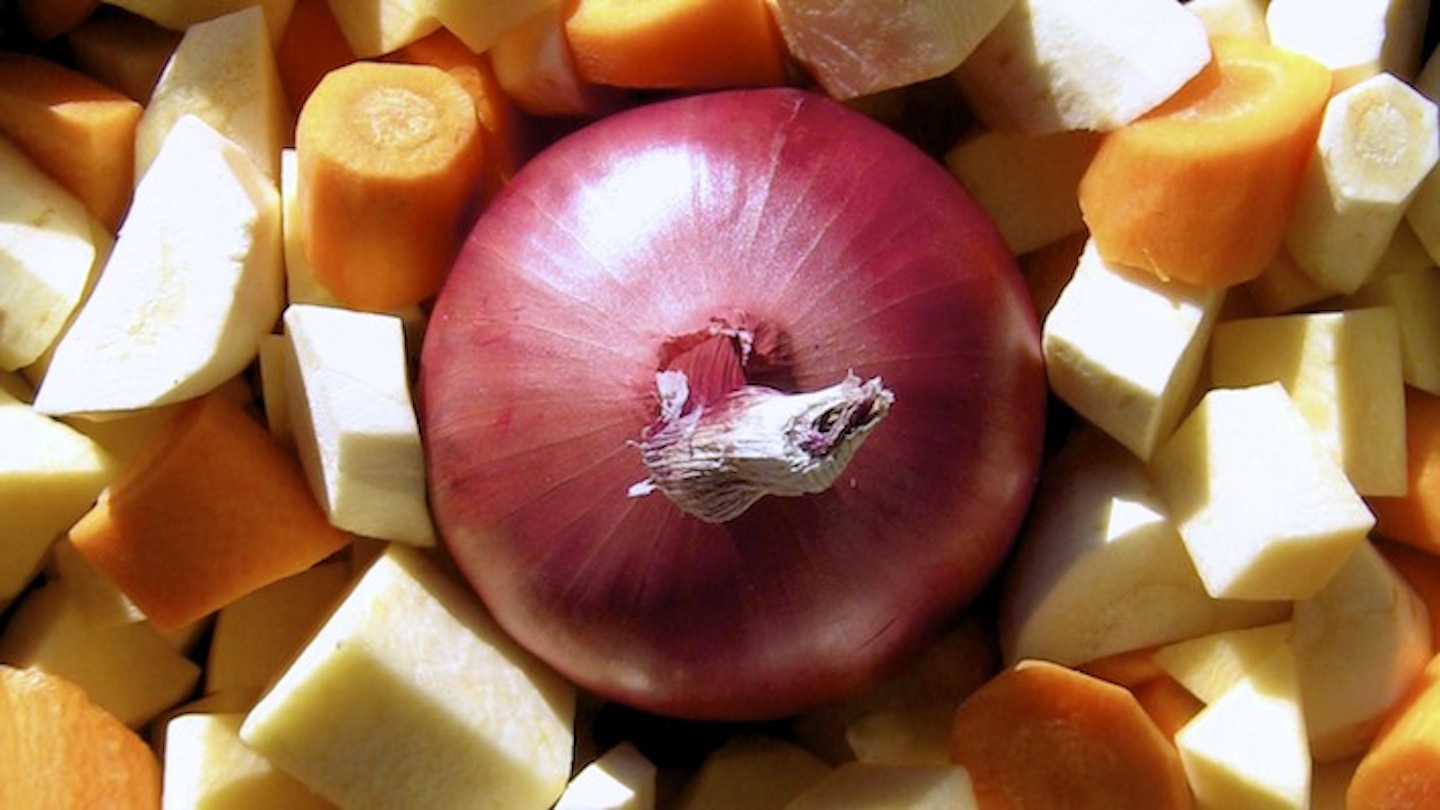
  • 1 red onion, chopped
  • 4 carrots, peeled and chopped
  • 4 parsnips, peeled and chopped
  • 1 rutabaga, peeled and chopped
  • salt & pepper, to taste
  • 2 cups low-sodium chicken stock (vegetable stock may be substituted)

Directions

  1. Melt the butter in a skillet with a cover over med-high heat.
  2. Add garlic, onion, carrots, parsnips, and rutabaga. Season with salt & pepper and sauté for 5 minutes, stirring occasionally.
  3. Add stock, bring to a boil, reduce to simmer, and cover.
  4. Cook vegetables until fork tender, about 15 minutes. Season with salt & pepper, to taste.
  5. Remove from heat and serve immediately.

*     *     *

Notes

Besides being tasty and easy to prepare, this dish is perfect for those who color coördinate their Thanksgiving dinner. By offering 4 distinct colors in one recipe (pale yellow, orange, and white, not to mention the red onion), this dish single-handedly provides you with many of the colors of the Thanksgiving palette. And if you’re worried that the parsnips will bring too much white to your table, just replace your mashed russets with a batch of Jed’s purple potatoes and you’ll be fine.

*     *     *

A Taster’s Mom’s Creamed Corn

Anyone who has cooked Thanksgiving dinner a few years in succession will understand my problem. So will anyone that dines at the same Thanksgiving table for several years. The problem is boredom, for lack of a better word. My Thanksgiving dinner’s main course and all the fixins didn’t vary from year to year. Sure, I served a different pasta for the primo piatto, I varied the salad course, desserts came and went, but the turkey & fixins remained pretty much unchanged. So, about 5 years ago, I decided to mix things up a bit. Beginning that year, and every year thereafter, I would switch out a dish for a new one.

A friend — and Bartolini kitchens taste tester — is from the South. I asked if he had a favorite dish that his Mom made at Thanksgiving. He loved her corn and I asked for the recipe. Well, as luck would have it, something came up and my friend couldn’t make it to my place for Thanksgiving dinner but his Mom’s corn sure did. It was such a hit that it has become a mainstay of my Thanksgiving dinners ever since. In fact, at one dinner I casually mentioned that I intended to switch the corn out for something else the following year. My guests politely suggested I leave well enough alone. Ironic isn’t it? I prepare a new dish in an effort to “mix things up a bit” and it is so well-received that now, 5 years later, it has become one of the dishes it was meant to replace. Anyway, even though the corn may have stayed, undaunted I’ve continued to introduce a new dish every year since, a couple of which will be shared in future posts.

*     *     *

Creamed Corn Recipe 

Ingredients

  • 1/2 red bell pepper, diced
  • 1 shalot, diced
  • 1/2 cup (1 stick) butter, halved
  • 4 cups corn kernels (fresh or frozen)
  • 1/3 cup sugar
  • 1 cup half-and-half
  • 1 1/2 tsp salt
  • 1/8 – 1/4 tsp white pepper
  • 1/4 cup all-purpose flour

*     *     *

*     *     *

Directions

  1. In a medium sauce pan or skillet over medium heat, sauté the shallot and bell pepper in half of the butter for 3 minutes.
  2. Add the half-and-half, sugar, corn, salt, and pepper. Mix well and bring to a boil.
  3. Meanwhile make a roux by combining the flour with the remaining butter over medium heat. Stir to combine and continue cooking until the roux is a pale yellow.
  4. Add the roux to the corn mixture and stir constantly until it thickens. Continue cooking and stirring for an additional minute and serve.

*     *     *

Variations

If I prepare this dish in August or September, the height of our corn season here in Illinois/Michigan, I’ll use only a 1/4 cup of sugar because the corn and its juices will be very sweet. For much of  the rest of the year, however, unless I’m certain the corn is really good, I’ll use frozen corn. Unfortunately, frozen corn has no liquids — “liquor,” if you will. To make up for the lack of liquor, I’ll take 1 to 2 cups of the corn and pulse it a few times in my food processor. This will help the final dish to look like the corn has been cut from the cob by hand. To make up for the sweetness lost, I’ll increase the sugar from 1/4 cup to 1/3 cup. The resulting dish looks and tastes like it was made from fresh corn.

Notes

I remove the corn kernels in one of two ways, depending upon the recipe. For Zia’s Corn Relish, I’ll use an electric knife to slice the kernels off of the cob. I find that the kernels remain whole with very little liquor created, just perfect for corn relish.  For this recipe, I’ll use a large chef’s knife to remove the kernels. This method is not nearly as “kind” to the ear of corn, resulting in kernels that are somewhat chopped and a good amount of that sweet corn liquor.

*     *     *

Gorgonzola and Honey Bruschette

This is probably my all-time favorite bruschetta recipe. Not only does it blend salty with sweet, it couldn’t be easier to prepare, a big plus when you’re trying to get a large holiday dinner on the table. Being so simple, I see no need to give it the “full treatment” normally accorded recipes on this blog. You’ll see what I mean soon enough.

I came across this recipe some 13 years ago, just about the time I moved into my current home. That year I prepared my first Thanksgiving dinner here for some friends and these bruschette were to be the sole appetizer. Unfortunately, and in full view of my guests who refused to leave the kitchen, I not only burned them but set them on fire under the broiler. Luckily, I’d bought 2 baguettes and, after a quick but oh, so memorable trip to the trash, I was able to make another batch with nothing harmed but my pride. After what was literally a baptism of fire, I’ve served these many times since, always to rave reviews. Just to be on the safe side, however, I make sure to clear the kitchen of guests when I remove them from the heat.

*     *     *

*     *     *

Not counting flambé, there are 2 ways to prepare these bruschette and first I’ll describe the method least likely to set off a smoke alarm or result in the fire department joining you for dinner.

Take a fresh baguette and slice it, on the diagonal, into 1/2 to 3/4 inch thick slices. Place the slices in a single layer on a baking sheet. Lightly brush each with extra virgin olive oil. and bake in a pre-heated 400˚ oven for 10 to 15 minutes or until golden brown. Remove from the oven and cover each piece with crumbled gorgonzola. Return to the oven and bake for a few minutes more until the cheese melts. Remove from oven, drizzle with honey, and serve.

As simple as that is to do, you may wish to try a different approach. When I first moved here, my stove had a separate broiler area, unlike the one I now own. Prior to my guests’ arrival, I would toast the baguette slices in my toaster, place them on a baking sheet, and cover with plastic wrap. Once my guests began to arrive, I would brush the slices with olive oil, cover with crumbled gorgonzola, and place under the broiler for 2 minutes or until the cheese melted. A drizzle of honey later and these bruschette were ready to be served.

*     *     *
*     *     *

See? Didn’t I tell you? These couldn’t be easier to make and, if you’re at all like me, the combination of salty and sweet flavors can’t be beat. And if you don’t care for gorgonzola, feel free to substitute blue cheese. You may even find that it melts better. No matter which cheese you choose, you can take the safe route and bake them in the oven or throw caution to the wind and pop these babies under the broiler. If you choose the latter, however, just make sure you’re alone in the kitchen with a clear path to a fire pail — and having a spare baguette handy may not be such a bad idea.

*     *     *

2 Brie are a Breeze

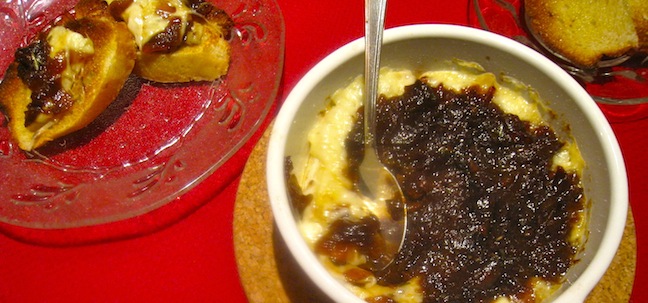
With Thanksgiving approaching fast, I thought that I’d share a few of the recipes that I’ve prepared over the years on Turkey Day. Let’s start with 2 baked brie recipes, one sweet and the other savory.

As a child, our holiday dinners always included a platter of pasta, usually ravioli. It’s a tradition that I’ve continued as an adult, always beginning special dinners for family & friends with a primo piatto of pasta. Well, with all that food to be prepared and consumed, something has to give — and it won’t be dessert, that’s for sure. So, I tend to go light with the appetizers. Besides, Max thinks that every bit of food that crosses the threshold into my his home is a potential snack. This means, in practical terms, the more appetizer dishes served, the more likely he is to “sample” one. As the graph to the right clearly shows, if 2 or fewer appetizers are served, Max will “score” a nibble less than only 30% of the time. Serve a 3rd, however, his chances more than double and he’ll snag something over 75% of the time! If 4 or more are served, you might as well put one of the appetizer trays on the floor in a corner. At least he’ll be out of the way as he noshes.

With the above in mind, I’ve found brie to be a good appetizer to serve but, rather than bake one large “wheel,” I make 2 smaller ones, a sweet and a savory. They’re easy enough to prepare, my guests can choose whichever they prefer, and, when combined, they are actually smaller than one large baked brie. That latter point will help to insure that my guests’ appetites will be saved for the actual dinner.  And, best of all, the odds are still in my favor that Max will not be joining us for appetizers. Of course, having been denied an appetizer, he will be even more hungry, as well as determined, when we move to the dining table. The question then becomes whether he will be able to scarf something from a kitchen counter or the stove top — yes, the stove top! — while I’m serving dinner. (Smart money will bet on the dog.)

*     *     *

Baked Brie with Caramelized Onions and Rosemary Recipe

Ingredients

  • an 8 oz wheel of brie
  • 2 onions, chopped
  • 2 tbsp butter
  • 1 tbsp fresh rosemary, chopped
  • olive oil
  • 1 garlic clove, minced
  • 3 oz dry white wine, divided
  • salt & pepper, to taste
  • 1 tsp fresh rosemary, chopped, for garnish (optional)

Directions

  1. Place chopped onion and butter into a saucepan over medium heat. Season with salt and pepper and sauté until translucent, about 8 minutes.
  2. Add 1 tbsp chopped rosemary and continue cooking. The onions will become golden in color by the 30 minute mark. Keep cooking, stirring frequently. Onions need to brown but not burn. Do not rush. Lower the heat if necessary.  Add a little olive oil if pan becomes too dry.
  3. Pre-heat oven to 350˚.
  4. Once deep brown in color, add garlic and sauté for no more than 2 minutes.
  5. Add about 2 ounces of white wine and sauté until completely reduced.
  6. Use remaining wine to deglaze the pan and sauté until reduced completely.
  7. Check to see if salt & pepper are needed. (At this point, caramelized onions can be refrigerated for several days, in an airtight container, until needed.)
  8. With a large knife, carefully remove the rind from the brie’s top and discard.
  9. Place cheese in an oven-proof serving dish, cut-side up. Cover the brie with an even layer of caramelized onions.
  10. Bake in a 350˚ oven until cheese is melted, about 25 to 30 minutes.
  11. Let stand for 5 minutes. Garnish with remaining rosemary and serve.

Serving Suggestions

I prefer to serve this brie with assorted crackers and freshly made crostini — thin slices of baguette that have been lightly brushed with olive oil and toasted before being “wiped” with a cut garlic clove.

*     *     *
Brie en Croute with Raspberry and Almond Recipe

Ingredients

  • an 8 oz wheel of brie
  • 3 – 4 tbsp seedless raspberry jam
  • 1/4 cup sliced almonds, toasted — separated
  • 1 puff pastry sheet
  • 1 egg + 1 tbsp water, combined

Directions

  1. Pre-heat oven to 400˚.
  2. Open & spread 1 sheet of puff pastry dough atop a lightly floured work surface. Use a rolling pin to lightly smooth out any creases that may have been created by the folds.
  3. Carefully slice the brie into 2 half-layers.

    "Do you remember Becky, the little girl who lives next door? Well, she and her Mother dropped in just as I was unwrapping the puff pastry and ... "

  4. Coat the top of the lower half with the raspberry jam. Do not spread jam to the very edge; leave about a quarter-inch border.
  5. Evenly cover the jam with the sliced almonds, reserving 1 tbsp for garnish.
  6. Return top half of brie to the lower half.
  7. Place brie, upside down, onto the center of the pastry sheet. Bring up the edges of the pastry sheet to cover and enclose the brie. Trim away and save the excess.
  8. Place the brie, seam-side down on a parchment lined baking sheet. Use your hands to smooth out the pastry and make it form-fitting.
  9. Brush the exposed surface with egg wash.
  10. If artistic, use excess pastry to decorate the top.
  11. If, like me, you are anything but artistic, do the best you can and tell your guests that you let the neighbors’ 5 year-old help you with the decorating.
  12. Once decorated, brush the decorations’ surface with egg wash.
  13. Place in  400˚ oven and bake until golden brown, about 20 to 25 minutes.
  14. Allow to stand for 20 minutes before moving to a serving tray/platter. Garnish with remaining almond slivers and serve.

Serving Suggestions

I prefer to serve this brie with slices of apple and pear, as well as an assortment of crackers.

*     *     *

Variations

For the savory:

  • Instead of caramelized onion atop your brie, try Mandy’s delicious Onion Marmalade, from her blog The Complete Cookbook.
  • Replace the rosemary with the herb(s) of your choice. Herbs des Provence or thyme come to mind.

For the sweet:

  • The raspberry jam can easily be replaced with cherry or apricot jam. Sautéed apples with walnuts or prepared cranberries with pecans could also be used. The possibilities are endless.

Notes

Hot, melted cheese, long slivers of caramelized onion, and crispy crostini or crackers are a stain waiting to happen. By chopping rather than slicing the onions prior to caramelizing, I hope to lessen the odds of a mishap. Speaking of the onions, they can be caramelized days before being needed in the recipe. Just don’t make them too far in advance as they have a tendency to “disappear” the longer they sit in the fridge.

*     *     *

Lumache alla Bartolini

This is another within the series of posts which, quite frankly, is not for everyone, not even the intrepid tourist to the left. Truth be told, snails weren’t exactly popular among members of my generation at the old two-flat either. (If you wish to exit, you may do so HERE.) I am probably the only one to have eaten lumache back then and certainly am the only one willing to go back to that well again today. Still, if I’m going to record the family’s recipes for Posterity, I’m not about to start filtering them. Besides, the look on Zia’s face when I unveiled the lumache and announced my plans for dinner was priceless. This blog delights in ways I never dreamt possible!

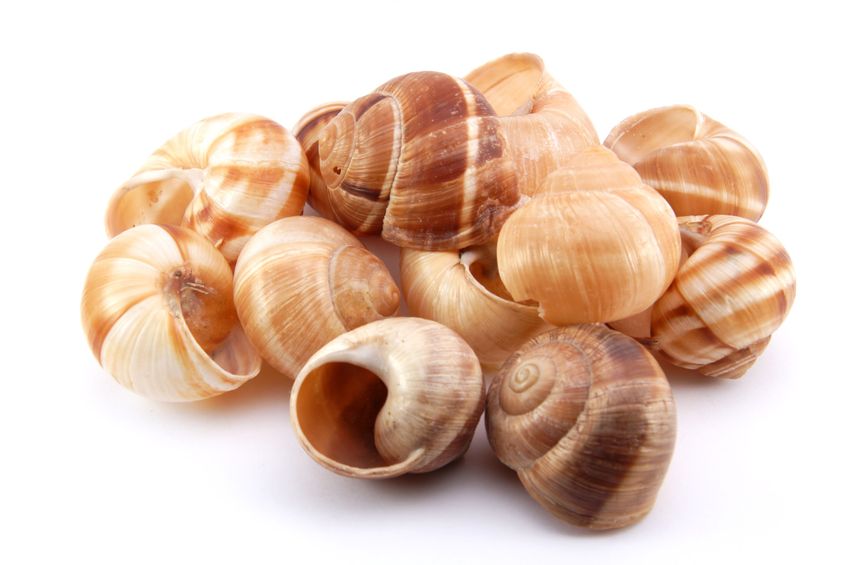
As I recall, lumache, or babbaluci as they are known in Sicily, was not at all a common dish at our dinner table nor, for that matter, at Zia’s. I only remember them being served 2, maybe 3, times. That’s probably because of the amount of work involved in preparing them for the table. They had to be soaked to rouse them from dormancy, scrubbed, boiled, scrubbed again, and either removed from their shells or left intact for further cooking. As you can imagine, this was no 1 day job. Mom would put water, vinegar, and the dormant lumache into her largest pot; place a colander atop the pot, weighted with a heavy book or pan; and, set it aside to let the lumache come out of their shells. As they came to life, they would leave the water and head up into the colander — hence the reason for the weight. Unfortunately, that weight wasn’t heavy enough to prevent me from snatching a pet when I was about 6 years old. It was, however, too heavy for me to replace properly before I returned to bed, my new pet snail in a water glass at my bedside. Mom was just a tad upset when she woke me the next morning. Her kitchen cupboards and counters were covered with lumache on the lam. Even my pet (the little tattle-trail!) was well on its way to my bedroom’s ceiling by that time. Funny thing. I don’t recall ever having a pet snail after that.

*     *     *

*     *     *

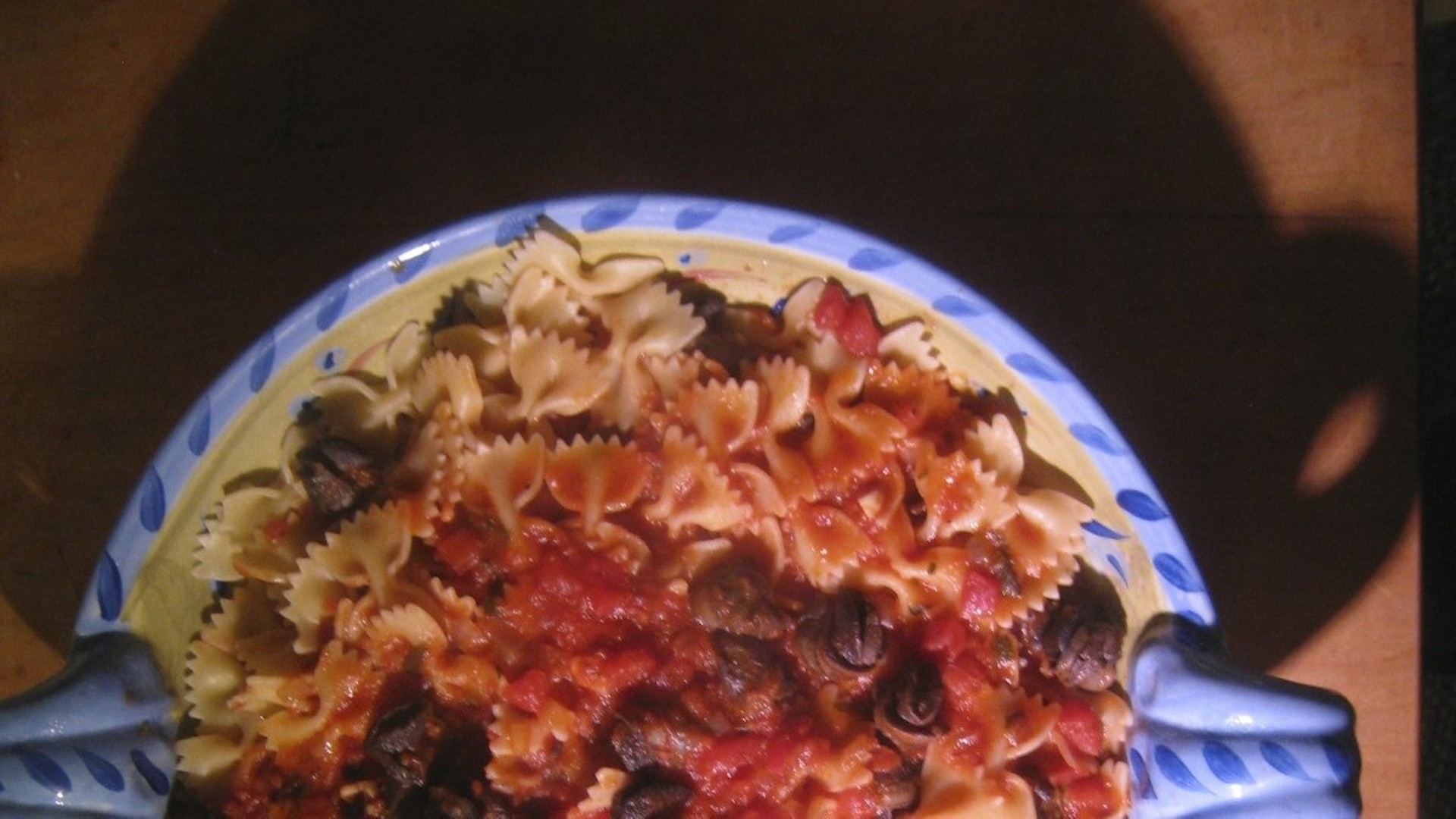
I’ve chosen to share this recipe today because of Mario Batali. On a recent rebroadcast of Molto Mario, he mentioned that lumache was one of several dishes that the people of Le Marche (the Marchigiani) prepare on All Souls Day. Well, with the Bartolinis being Marchigiani and today being All Soul’s Day, what choice do I have? So, the recipe I’m going to share is the very recipe the Bartolini Girls cooked those many years ago — with 1 exception. There was no way on Earth that I was going to start with dormant lumache. With Max in the house, that is surely a disaster waiting to happen. I can just see him running around my home, trying to lure me into a game of keep-away with some unlucky snail in his mouth, while I’m on a ladder retrieving the rest off of my kitchen’s walls. No, no, no! So, I did a little googling — and it paid off. On Amazon (of course!), I found canned lumache that were cleaned, shelled, trimmed, and ready for stewing. What was once a multi-day, very messy affair suddenly became as easy as preparing a tomato sauce. I ordered them and, once delivered, I packed them up and brought them to Zia for one most memorable dinner.

*     *     *

Lumache alla Bartolini Recipe 

Ingredients

  • 1 can (15 oz, 48 count) very large size lumache
  • 2 tbsp extra virgin olive oil
  • 1 large onion, chopped
  • 3 garlic cloves, diced
  • 1 can (14 oz) crushed tomatoes
  • 1 can (14 oz) diced tomatoes
  • 4 oz dry white wine
  • 3 tbsp parsley
  • 1 tsp marjoram
  • salt & pepper, to taste
Directions

  1. Heat olive oil in medium-sized sauce pan over med-high heat. Add onions and sauté until translucent, about 5 minutes. Season lightly with salt & pepper.
  2. Add garlic and sauté for another minute before adding the tomatoes, wine, marjoram, and parsley.
  3. Bring to a boil, reduce to a simmer, and continue cooking for about 45 minutes or until the tomatoes are cooked and the sauce has darkened.
  4. Add the lumache with the canning liquid and continue to simmer for about 30 minutes more. The sauce should be dark and thick.
  5. Season with salt & pepper, to taste, and serve.

*     *     *

Serving Suggestions

                                  *                         When she cooked lumache in their shells, Mom served them in deep soup bowls with a chunk of crusty bread on the side. When removed from their shells, lumache may, also, be served as a dressing for pasta or atop polenta.

*     *     *

Notes

Back in the days preceding Vatican Council II, when eating meat was forbidden on Fridays and other “days of abstinence,” Catholics were allowed to eat lumache because they were considered seafood. Well, in classic Italian cuisine, cheese is very rarely used in a dish featuring seafood and if the Church labels something as seafood, who are we to argue? The use of cheese, therefore, in a dish with lumache is frowned upon. On the other hand, what you serve in your own home is your own business. (Was that thunder?)

*     *     *

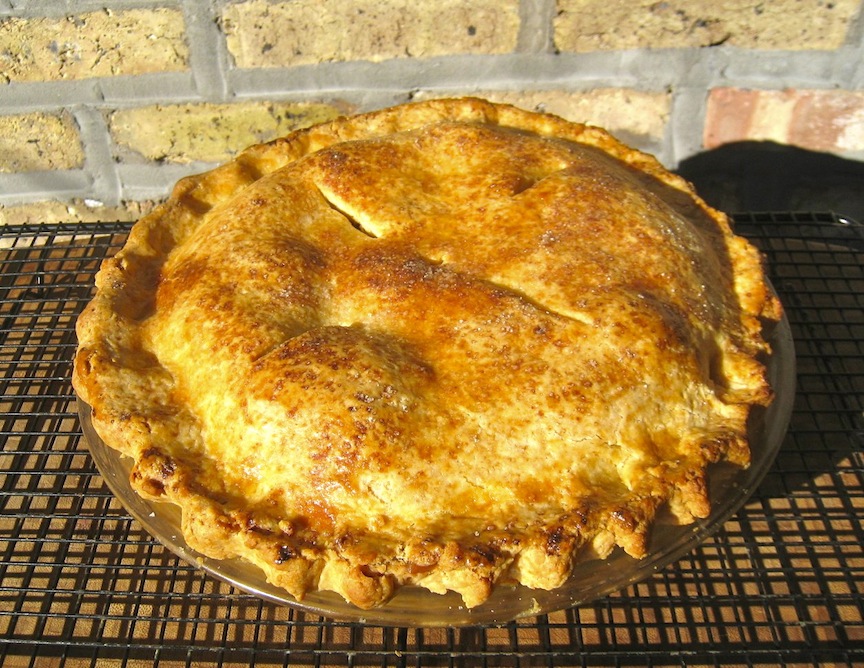
Apple Pie with a Cheddar Cheese Crust

I’ll be the first to admit that serving apple pie with a slice of cheddar cheese is not necessarily a common thing to do and it certainly wasn’t a family tradition. In fact, I was a young adult when Uncle first told me about it. Since then, I’ve enjoyed apple pie with cheddar cheese several times although, to be honest, I’ll take vanilla ice cream before cheddar cheese any day. (I am my Mother’s son, after all.) Still, I was happy with my apple pie adorned with the occasional slice of cheddar until one day a few months ago. I was busy doing whatever and, in the background, there was a Food Network program on the TV. It was one of those shows I’ve grown to dislike, with people talking about how great some dish is at this diner or that restaurant without ever telling how it’s made. Well, I watch these programs to learn new techniques, to get recipes, to see a dish prepared. If I want to hear people talk about how good a dish is, I’ll go to a diner and survey the people eating at the counter. Anyway, a restaurant was mentioned that was known for its pie and which featured an apple pie with cheddar cheese in the crust. Aside from that comment and seeing some grated cheddar dumped into a commercial mixer, the actual recipe was left a mystery. Did I mention how much I dislike these shows? Anyway, my quest began that very day …

In the weeks that followed, I baked a number of test pies. I varied the amount of grated cheddar cheese in the crust from 2 to 6 ounces per crust. I adjusted the amount of fat in the crusts and even swapped spices in the filling. And left in my wake was a trail of apple pies that stretched from the shores of Lake Michigan to those of Lake Huron, not to mention devoted taste testers in both locales. In the end, I settled on using 4 ounces of grated, sharp cheddar cheese and 7 tbsp of fat per crust while, in the pie filling, I replaced nutmeg with cardamom. The result was a pie with a crust that was manageable when raw and, when baked, was relatively light with the distinctive — but not overpowering — taste of cheddar. Success!

With the cheddar question out of the way, let’s talk filling. Just like with our Thingamajig, I use both tart and sweet apples. For the sweet, I find that Fuji work best because they, like Granny Smiths, hold up well during baking. I prefer the apples in my pie filling to be in chunks rather than thinly sliced and that way they remain somewhat firm when baked. Once the apples are peeled, cored, and chopped, I heat them in a saucepan with some butter. All I’m doing is heating them through; I take them off the heat when their juices first begin to appear in the pan. I’ve found that this helps to prevent a finished pie that has a gap of over an inch between the apple pie filling and the crust “dome” above it. It’s important, though, to pull the apples off of the heat as soon as they start to render their juices and to cool them completely before assembling the pie. Cook them too long or fill the pie while they’re still hot and your apples will not be at all crisp when the pie has finished baking.

*     *     *

No pie dome here!

*     *     *

The Apple with a Cheddar Cheese Crust Recipe

Ingredients

  • For Apple Pie Filling
    • 6 Granny Smiths (or similar, tart apples) peeled, cored, and sliced evenly
    • 2 Fuji (or similar, sweet apple) peeled, cored, and sliced evenly
    • 3 tbsp lemon juice
    • 2 tbsp butter
    • 1/4 cup raisins, soaked in hot water and drained (optional)
    • 1/2 cup sugar
    • 1/4 cup dark brown sugar
    • 1/4 cup AP flour
    • 3/4 tsp cinnamon
    • 1/4 tsp cardamom (or nutmeg)
    • 1/2 tsp salt
    • 1 egg, beaten
    • sugar
  • For Each of 2 Pie Crusts
    • 1 1/2 cups AP flour
    • 1/4 tsp salt
    • 3 tbsp vegetable shortening, cut into cubes and well-chilled
    • 4 tbsp unsalted butter, cut into cubes and well-chilled
    • 4 oz. sharp cheddar cheese, grated
    • 3 tbsp ice water, plus 1 tbsp, if needed
    • 1 tbsp cider vinegar

Directions

  • For apple pie filling
    1. In a large mixing bowl, combine the apple slices and lemon juice. Stir to coat the apples.
    2. In a sauce pan large enough to hold the apples, melt the butter over medium heat.
    3. Add the apples and sauté just until the apples begin to give up their liquid. Do not cook until the apples grow soft.
    4. Meanwhile, in a small bowl, mix together the sugar, brown sugar, flour, cinnamon, cardamom, and salt.
    5. Return heated apple pieces to large mixing bowl.
    6. Add the raisins, if using, and spice mixture to the apples and gently stir until the apples are coated evenly.
    7. Set aside to cool completely and until the pie crusts are ready.

  • For Pie Crust – Best if each crust is made individually in the food processor.
    1. Add flour, cheddar cheese, and salt to the processor. Pulse it a few times to combine the 3 ingredients.
    2. Add the very cold butter & shortening cubes.
    3. Pulse the machine 3 times, with each pulse lasting a 3-count. Your ingredients will now be lightly mixed. If need be, pulse again.
    4. With the machine running, add the vinegar and then slowly add the ice water. Do not add so much that a ball of dough forms. Remove the lid and, with your hands, test the dough to see if a ball of dough can be formed.
      1. If so, turn the dough until a very lightly floured service, form a ball, wrap it in plastic wrap, and refrigerate for 30 minutes.
      2. If a dough ball will not form, add a little more water, pulse the machine a couple of times, and test it again. When you can form a ball of dough, follow step A above.
    5. While the dough rests in the fridge, prepare the 2nd crust.
  • Assembly, to occur only after filling is cooled completely and pie crusts rested
    1. Pre-heat oven to 400.
    2. After 30 minutes, remove the dough from the fridge and roll it until large enough to completely cover the bottom of a 9 inch pie pan. Place the dough into the pan, trim any access, and return the crust and pan to the fridge until needed further.
    3. Roll out the 2nd crust, though slightly smaller, it must be large enough to cover the pie with a little excess.
    4. Retrieve the pie’s bottom crust from the fridge, fill it with the apple pie mixture, and cover it with the 2nd pie crust.
    5. Seal the pie by gently lifting the bottom crust’s edge while placing the top crust’s edge behind it. Work you way around the entire pie.
    6. Again, working your way around the pie, crimp the edge to further seal the pie.
    7. Use the egg to coat the top crust. Sprinkle with sugar. Use a sharp knife to create steam vents in the pie’s upper crust.
    8. Bake in a pre-heated 400* oven for 15 minutes. Without opening the door, lower the heat to 375* and continue baking for 40 – 45 minutes.
    9. After a total time of 30 minutes, and 15 minutes thereafter, check to see if the crust’s edge is too dark. If so, cover with aluminum foil and continue baking.
    10. When top is golden brown, remove pie from oven and place on a cooling rack. I always allow my apple pie to cool at least 2 hours before serving.

*     *     *

Fresh from the oven

*     *     *

Variations

This recipe is more concerned about the crust than it is the pie filling. So, if you prefer sweet apples, walnuts, or currants, use them. If you hate raisins, ditch them. If you don’t like or haven’t any cardamom, use nutmeg. In short, change the filling to suit your tastes. The same goes with the crust. If you find that adding cheddar to your favorite pie crust recipe makes a better pie, then please come back here and tell us about it.

*     *     *

Notes

One last thing about the crust. Add too little cheddar and you won’t taste it; too much and the pastry dough is rendered unmanageable. And even under the best of circumstances, the cheddar cheese will affect the crust’s flakiness. So, it’s basically a trade-off. The trick is to add as much cheddar cheese flavor as you can without sacrificing too many of the crust’s better qualities. My taste testers and I agree that this recipe “works.” If you try it, I hope you feel the same way.

*     *     *

Dad’s Puffballs

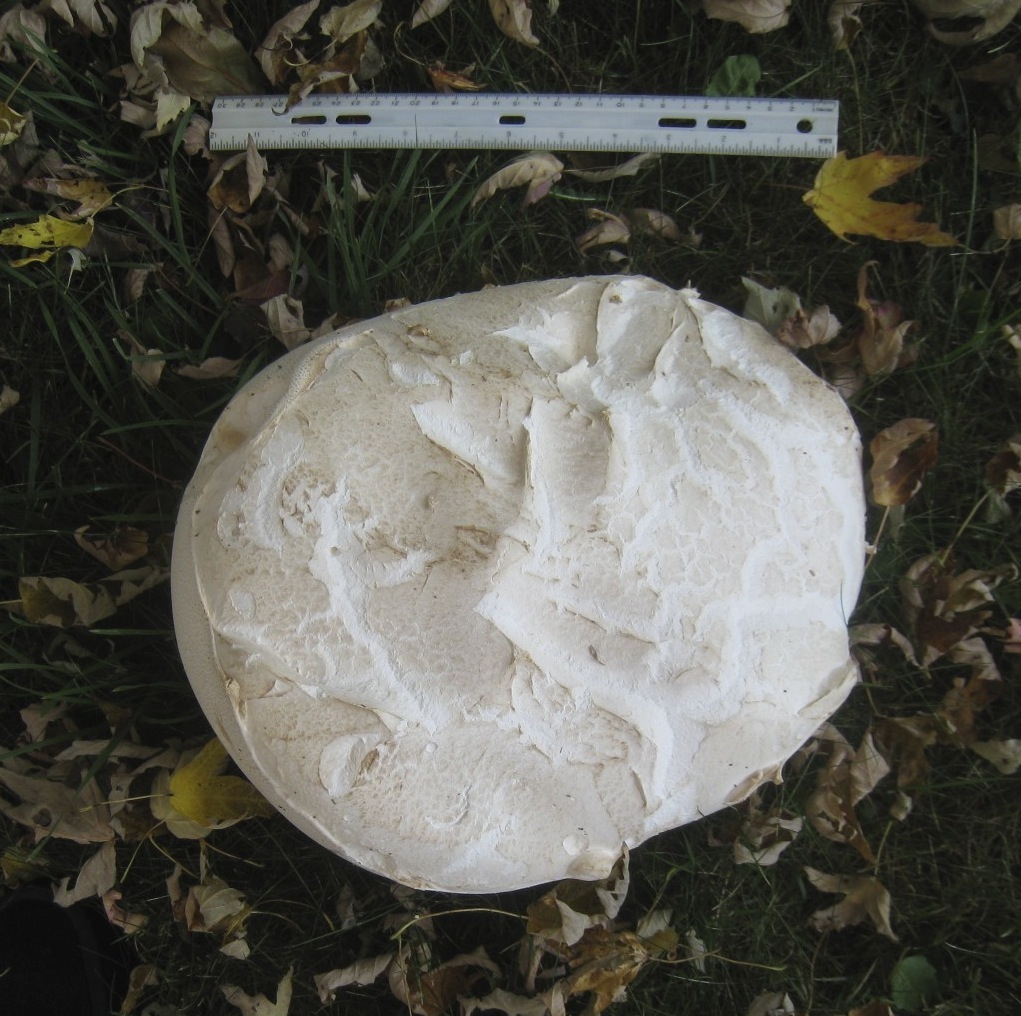
As many of you know, I was in Michigan last week, visiting Zia and my family. Luckily, my visit was timed perfectly for the annual arrival of puffballs. Pictured above, a puffball is a type of edible fungus with a mild, mushroom-like flavor. My Dad, some 25 years ago, found one growing behind Zia’s garage and we’ve enjoyed them ever since. Then again, my family has always had some sort of relationship with mushrooms. Both Mom & Zia told tales of going mushroom picking with Grandma when they were very young in as-yet undeveloped fields in Detroit. Prior to my being born, Mom & Dad lived in a house in which they grew mushrooms in a basement room that had a dirt floor. So, when Dad found a puffball and declared it edible, my family replied, “When do we eat?”

Max "picked" the smaller one about 1 week too soon. We suspect the larger was "trimmed" by a lawn mower when it was but a few days old.

Each year, usually in the first weeks of October, 1 to 3 egg-sized fungi appear in the lawn by Zia’s garage. In less than 2 weeks, these “eggs” will grow to be football-sized — and therein lies the quandary: when to pick them. Grab them too soon and you may be cheating yourself out of a few days’ growth. Picked too late and you’ll have no choice but to throw it away, hopefully back where you found it so its spores will produce next year’s crop. So, once you’ve decided it’s harvest time, what’s next? That’s easy enough. Pick them and, just before cooking, trim away the outer peel to reveal a flesh that’s relatively firm and pure white, like that of a white button mushroom cap — on steroids! If it is even the palest shade of green, yellow, or brown, discard the puffball because it has “turned.” Your best bet is to cook them as soon after harvesting as possible.

As mentioned earlier, puffballs have a very mild, mushroom-like taste and this limits the ways they can be cooked. One year, after a crop that yielded 3 huge puffballs, I brought one home and used part of it in a tomato sauce. Big mistake. Being so mild tasting, one could easily have mistaken the puffball cubes for tofu — not exactly the result I had in mind. Since then, I’ve restricted my use of them to 4 recipes. To begin with, if I cannot cook it within 2 days of picking, I’ll chop the puffball into cubes and lightly sauté them in butter. I place the partially cooked cubes on sheet pans and into my freezer. When fully frozen, I place the cubes in bags to be stored for later use in omelets.

*     *     *

Breadcrumbs (l), Flour (r)

*     *     *

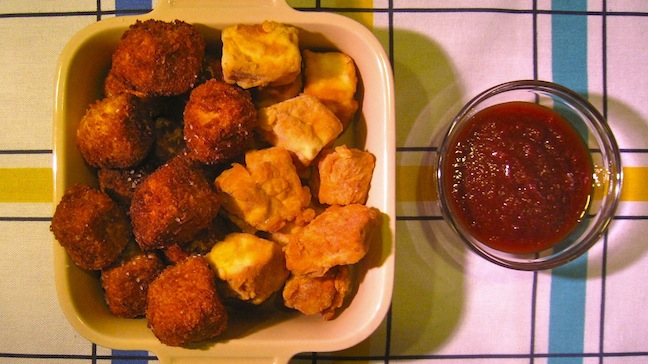
When he brought the first one home, Dad suggested that Mom cut it into cubes before breading and frying them. So, she cubed it, floured the cubes, dipped them into an egg wash, and then coated them with seasoned bread crumbs before deep frying. Pictured above, are cubes prepared in this way using Panko bread crumbs. Oddly enough, as Zia mentioned, they’ll remind you of toasted marshmallows, albeit a little mushroom-y. Also pictured are puffball cubes prepared with a 2nd coating of seasoned flour rather than bread crumbs. Although good, I much prefer the Panko-coated. By the way, the dipping sauce pictured is homemade ketchup that was inspired by Tanya’s Up The Mountain Spicy Tomato Ketchup over at her Chica Andaluza blog. Her sauce is fantastic and better, by far, than any ketchup that I’ve ever tasted.

*     *     *

Parmesan Coated

*     *     *

The 4th and final preparation is a method I found at the Mycological Society of San Francisco website. If you’ve a mushroom-related question, this is a good place to start looking for an answer. Their recipe, Parmesan Puffballs, involves coating slices of puffball with grated parmesan cheese instead of breadcrumbs or flour. Fried in a mixture of butter and olive oil, these are a tasty alternative to the other methods. Truth be told, however, the parmesan cheese is the real star of this dish; the puffball being overwhelmed by the flavor of fried cheese. Although not quite the dish one might expect, any excuse to eat fried cheese is all right in my book.

*     *     *

Notes

In the years since Dad brought home that first puffball, my family has enjoyed them many times. Never once has anyone experienced any discomfort or problem after eating them. Still, as is the case with any mushroom or fungus, if in doubt, do not eat.

*     *     *

Just One Thing More

So, you think you had a rough night?

*     *     *

No, those aren’t puffballs. The night before we (Lucy, Max, and I) left for Michigan, Lucy laid an egg, pictured above to the left of a “large” chicken egg. That was 2 weeks ago and she normally lays a clutch of 2 eggs over the course of 2 to 3 days. The trip obviously affected her delivery schedule but, the way she’s acting, I expect to find this egg’s Irish twin in the corner of her cage within the next day or 2.

*     *     *

Filling for Ravioli dei Bartolini

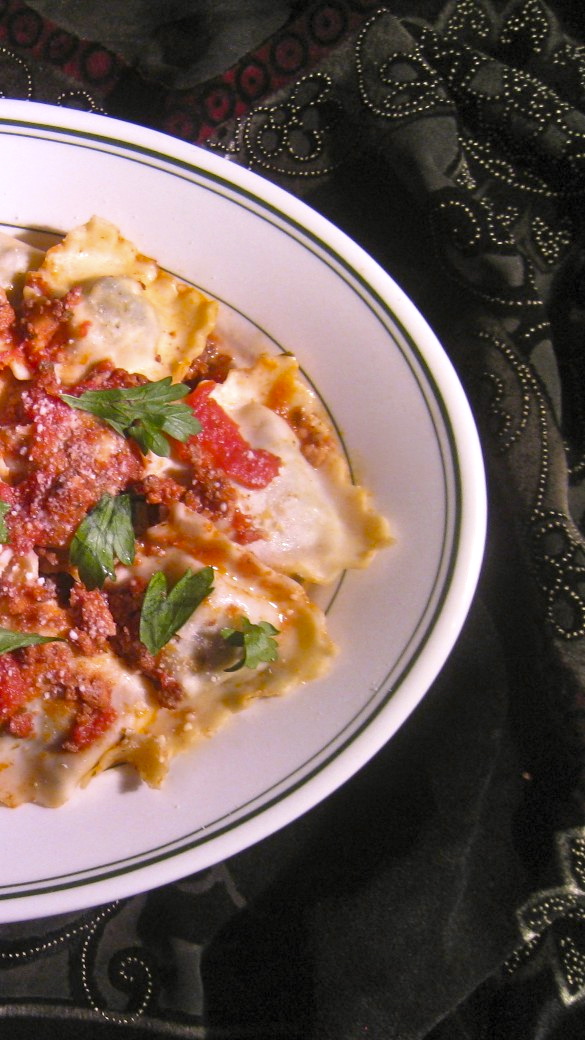
The Bartolini Girls made 2 versions of filling for their pasta. One, used in cappelletti, was served in soup while the other was for ravioli and dressed in sauce. A couple of years ago, I decided to try my hand at making sausage ravioli, using our family sausage recipe. The results were good enough to serve Zia, gain her approval, and now the Bartolini Clan has 3 ravioli fillings made with meat. Today I’m going to share the “saucy” filling; we’ll get to the “soupy” and sausage fillings in later posts.

I have 2 versions of Mom’s recipe. The original, which is little more than a few notes, and the one that’s part of a recipe book she gave to me after I moved to Chicago. Both are pictured below and, for obvious reasons, I follow the more complete version of the two. This is the same recipe that Zia follows when we have Ravioli Day. Similar to Sausage Day, once or twice a year we’ll devote a day to making ravioli so that she’ll have plenty for her family when they visit. We work well together as a team and that night’s dinner is always a good one. Never one to wait for dinner, however, Max has been known to steal a few errant ravioli that may have wandered too close to the pasta board’s edge. On one memorable Ravioli Day, he managed to inhale 35 of the pasta pillows. That was about 10% of that afternoon’s production and, not so coincidentally, the last ravioli that Max has enjoyed, to date.

*     *     *

*     *     *

When you look at the recipe, you’ll note that in the original version, Mom used nutmeg but cloves is used in the version she gave me. I’ve no idea why or when she modified the recipe, only that she gave me the book in the early ’80’s.  As is the case with any of our ravioli fillings, the meat is cooked before being ground in a meat grinder. I once tried using a food processor but did not like the results at all. The filling became a thick purée without any real texture, and I definitely prefer some texture. The recipe, also, calls for ground pork and veal but if Mom couldn’t find veal, she often substituted chicken or turkey. Living here, I’ve no problem finding any of the ingredients but it’s good to know that there are alternatives should you run into problems or be averse to using veal. The rest of the recipe is easy enough. The “fun” part will come when we make the ravioli and you can see how we do that HERE.

*     *     *

Filling Recipe for Ravioli dei Bartolini

Yield: Enough filling to be used with 8 eggs of pasta dough. Recipe found here.

Ingredients

  • 1 1/2 lbs. ground pork
  • 1 1/2 lbs. ground veal (chicken or turkey may be substituted)
  • 2 – 3 tbsp butter
  • 1 pkg (10 oz) chopped spinach (cooked and well-drained)
  • 1 pkg (8 oz) cream cheese
  • 1 cup grated romano or parmesan cheese – your choice
  • 2 or 3 eggs slightly beaten
  • dash of cloves (optional)

Directions

  1. Sauté meat in butter. Season lightly with salt.
  2. Use meat grinder to process the meats. Add all the ingredients into a mixing bowl and mix until well-combined.
  3. Cover the filling and refrigerate for a few hours or overnight.
  4. Once the filling has rested, you can begin making your ravioli.

*     *     *

*     *     *

Notes

Pictured above  is ravioli filling pre-formed into “balls.” Sometimes, while the pasta dough rests, Zia & I will use the time to create some, giving us a jump on the day’s production.

Mom and Zia used this filling exclusively for ravioli. I’ve used it in a few other dishes – i.e., stuffed shells, cannelloni, and, on occasion, a rotello. We’ll get to these recipes, too.

*     *     *

Ravioli dei Bartolini

Happy Columbus Day everyone! And what better way to celebrate the Holiday than to share one of the Bartolini Clan’s favorite holiday recipes. Say the word “ravioli” to any of the old 2-flat’s former residents and you’re sure to conjure up memories of holidays past, specifically Christmas, New Year’s, and Easter. No matter which of the 2 dinner tables you visited on those evenings, there would be a large platter of ravioli taking center stage. (It was present on Thanksgiving, too, but The Bird was the star of that show.) As a kid, my attention was pretty much focused on that platter of pasta pillows — and dessert, of course — and I think the same would have been said by everyone at the tables, save Mom and Zia. Their perspectives would have been entirely different.

One must remember that in those days, the only freezer available to most households was a small compartment above the fridge. Consequently, if you wanted to serve your family ravioli, you made it the same day it was served. Well, there was absolutely no way that Mom and Zia were going to start making ravioli on a holiday afternoon. That meant that most holiday mornings, they were up at 5:00 am making ravioli for that evening’s holiday dinner. And then there was Christmas. We were allowed to get up during the night to discover what Santa had brought us and to play with our toys. It wasn’t until years later that we learned how our parents no sooner got the gifts wrapped and under the tree when we came charging out of our bedrooms. Mom and Zia were lucky to get a couple of hours of sleep before they started making ravioli. And they weren’t making just a few ravioli. They made enough for everyone at each of the two holiday tables, which often included guests as well as each family. For Mom, that meant ravioli for as many as 12 people. To this day, I don’t know how they did it.

It really is a shame that there are no pictures of these women making pasta and ravioli, for it really was something to see. Mom would make the filling the night before and store it in the fridge. (Woe be the child caught snatching filling from the fridge!) The next day, she would make 8 eggs worth of pasta dough using the “mound” method. (Mound the flour on a large pasta board, make a crater in the center, pour the eggs into the center, and use a fork to slowly bring the flour into the egg mass, being careful not to break the flour wall and allow the eggs to spill out.) Once the dough was made, kneaded, and rested, Mom used her 3+ foot long “rolling-pin” to create thin, circular pasta sheets, 3 – 4 feet in diameter. They were laid to dry by hanging them off the edge of the dining room table, the backs of chairs, even on sheets covering a bed, if one was “open.” Once dry enough, the sheet would be hung off the pasta board’s edge, half on the board and half off. The filling balls were then laid out on the pasta half-sheet in a grid, each equidistant from its neighbors. When they were all positioned, maximizing the surface area, the bottom half of the sheet was  brought up and over, enclosing the filling-covered top half. The long handle of a spoon or spatula was used to seal the pillows. The ravioli were then cut using a pastry cutter, moved to trays, and the next pasta wheel was moved into place. This continued until all the filling was used. The remaining dough, if any, would be hand-cut to form linguine or quadretti. (More about the latter in another post.) Just about the time she was finished cutting the last of the pasta, we kids would come bounding into the kitchen. “Merry Christmas, Mom! What’s for breakfast?”

The purchase of a pasta machine changed all that. Unable to make the large pasta wheels, Mom turned to ravioli dies to make her ravioli. Pictured just below is my collection.  The 2 dies on top are used for ravioli. The one on the top-left makes ravioli that are 2 inches square. That’s just about the size The Sisters were taught to make by hand. The ravioli form on the top-right makes ravioli that are 1.25 inches square. That’s about the size The Sisters made by hand once we kids came into the picture. (Kid-friendly ravioli. Who knew?)  The remaining 3 are used for soup ravioli, which Mom called cappelletti, “little hats.” Though normally rounded, some look similar to tortellini,  the die Mom used (lower left) was .75 inches square. As a result, the word “cappelletti” in our house wasn’t used to describe the pasta’s shape but its use — and that was in soup. Mom gave me her cappelletti die years ago but it’s too small for me to use in any way. (I’ve tried several times but, being ham-fisted, I cannot make the filling “balls” small enough to fit the die.) So, I bought the die on the lower-right. It makes raviolini that are 1 inch square and I use it to make my cappelletti. In the center is a press that makes traditional-looking cappelletti, each 1.25 inches in diameter. I, also, have 2 more ravioli makers, both not shown, but they don’t work very well. One attaches to my pasta machine and the other to my stand mixer. In both cases, they require that the dough sheets be about twice as thick as I am accustomed to using. The result is ravioli that is a bit more chewy than I prefer. What can I say? Mom spoiled us. 

*     *     *

Tools of the Trade

*     *     *

When it come to the pasta dough’s final thickness, let your own palate lead the way. Our pasta machines are calibrated from 1 through 10, with 1 being the thickest setting. Zia prefers to roll her dough up to and including the number 6 setting. I will use the same setting for large ravioli but for the smaller ravioli and cappelletti, I’ll roll the dough one more time, using the number 7 setting.

Once you’ve made the filling and pasta dough, creating the ravioli is easy enough, though time-consuming. Here’s Mom’s Pasta Dough recipe and, on Wednesday, I’ll share the recipe for their ravioli filling. (Future posts will share the filling recipes for sausage ravioli and cappelletti, as well as a few others we’ve tried along the way.) The pictures that follow will guide you through the ravioli making process far better than I ever could describe. Of course, it helps that they feature that world-renowned still photo model, “Zia,” in a sequence of never seen before shots taken where she lives, along the fabulous Michigan Riviera.  Ah, the life of the octogenarian super-model!

*     *     *

How to Make Ravioli

Step One: Cut dough strips into die-sized sheets

*     *     *

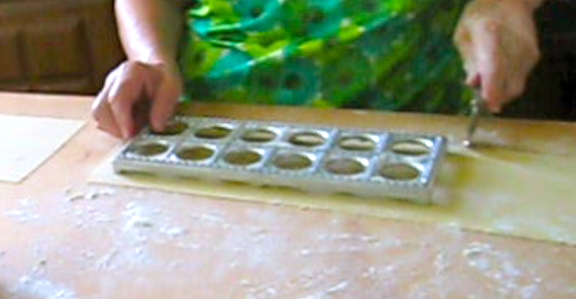
Step Two: Cover the die with a dough sheet

*     *     *

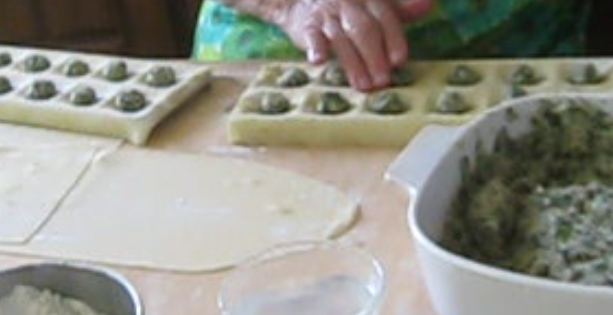
Step Three: Place filling across the die

*     *     *

Step Four: Use dampened fingers to moisten ravioli “walls.”

*     *     *

Step Five: Cover filled die with another dough sheet

*     *     *

Step Six: Use a rolling-pin to seal the ravioli

*     *     *

Step Seven: Trim the excess dough

*     *     *

Step Eight: Flip the filled die

*     *     *

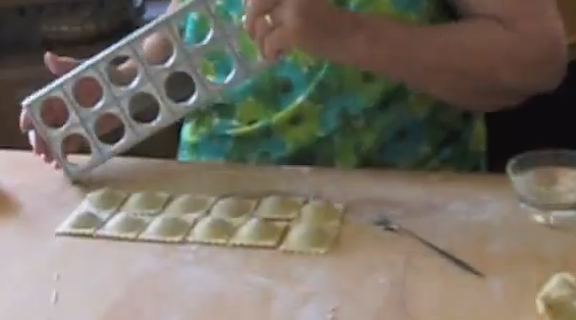
Step Nine: Unmold the ravioli

*     *     *

Step Ten: Lightly puncture the ravioli, meat-filled only

*     *     *

To Cook

  1. Bring a large pot of salted water to a rolling boil.
  2. Add the ravioli, return to boil, then reduce and simmer gently. (If boiled too hard, the ravioli may burst.)
  3. Ravioli normally take 5 – 8 minutes to cook, a couple of minutes more if frozen. Cooking times may vary depending upon the thickness of your dough, the filling, the size of the pot, etc. Taste one to insure they are done to your liking.
  4. Once the ravioli are cooked, carefully drain using a colander or sieve. You can use a Bolognese-style sauce or go meatless.

*     *     *

Variations

The method I’ve described is by no means the only way to make ravioli at home. Check out the Rufus’ Food and Spirit Guide to see Greg make ravioli completely by hand, similar to the method Mom employed but on a smaller scale. You can also see a slightly more modern approach by going to Sweet Caroline’s Cooking. With Thanksgiving just around the corner, her recipe for butternut squash ravioli couldn’t be better timed. Lastly, in an upcoming post, I’ll show you yet another method for making stuffed pasta.

Notes

You’ll note that Step Ten instructs that only meat-filled ravioli should be lightly punctured. This should be done if you intend to freeze the pasta. Doing so will allow any air sealed within each raviolo to escape during the cooking process. Too much trapped air will cause the raviolo to, in effect, balloon and it may burst before the filling can thaw and cook. We use the tines of a cocktail fork to do this but we don’t puncture cheese-filled ravioli. The cheese filling will often leak through the puncture holes. Try to fill each pillow with as much cheese filling, and as little air, as possible. This “balloon effect” should not be a problem if the ravioli are fresh (not frozen) when cooked.

Although not especially difficult, this is a time-consuming process. I’d recommend that you make enough for a couple of dinners and that you freeze what you won’t be using immediately that day. It’s easy enough. Place your freshly made ravioli in a single layer on lined baking sheets and into your freezer. 2 to 3 hours later, place the now frozen ravioli into bags or containers and return to the freezer. When needed, do not thaw before placing into boiling water, reduce to soft simmer, and cook till done to your liking, normally a few minutes longer than if freshly made.

And for heaven’s sake, keep an eye on Max at all times!

*     *     *