Bartolini Sausage

Laws are like sausages,” wrote Bismarck. “It’s better not to see them being made.” Well, I know little of the backroom dealings that are integral to our legislative process but today I intend to pull back the veil on sausage making, at least my family’s sausage making, that is. And why today? Because Zia taught me how to make sausage and today is her 89th birthday!!!

Allora, buon compleanno, Cara Zia! Cent’ anni e tanti baci!

*     *     *
You'll have no beef with this burger!

*     *     *

For as long as I can remember, the Bartolini Girls made sausage and served them at any meal. They’d cut up a few, add some beaten eggs, and we had a frittata for breakfast. As kids, many is the time we had sausages instead of hot dogs for lunch while, for supper, the sausages were either served alone, roasted with veggies & potatoes, or cooked in a tomato sauce and served with pasta instead of meatballs. Truth be told, we were much more likely to have sausage than we were to have meat balls.  Even after I moved away, Mom always made sure I had at least one container of frozen sausage patties to enjoy once I got home. And to this very day, whenever I make sausage, that first whiff of the seasoned ground pork is a trip on the Wayback Machine to my youth, watching Mom at work. Sure, there are many kinds of sausage available at the local groceries and butchers, not to mention the ethnic markets, but not a one reminds me of home. That’s reason enough for me to keep making these.

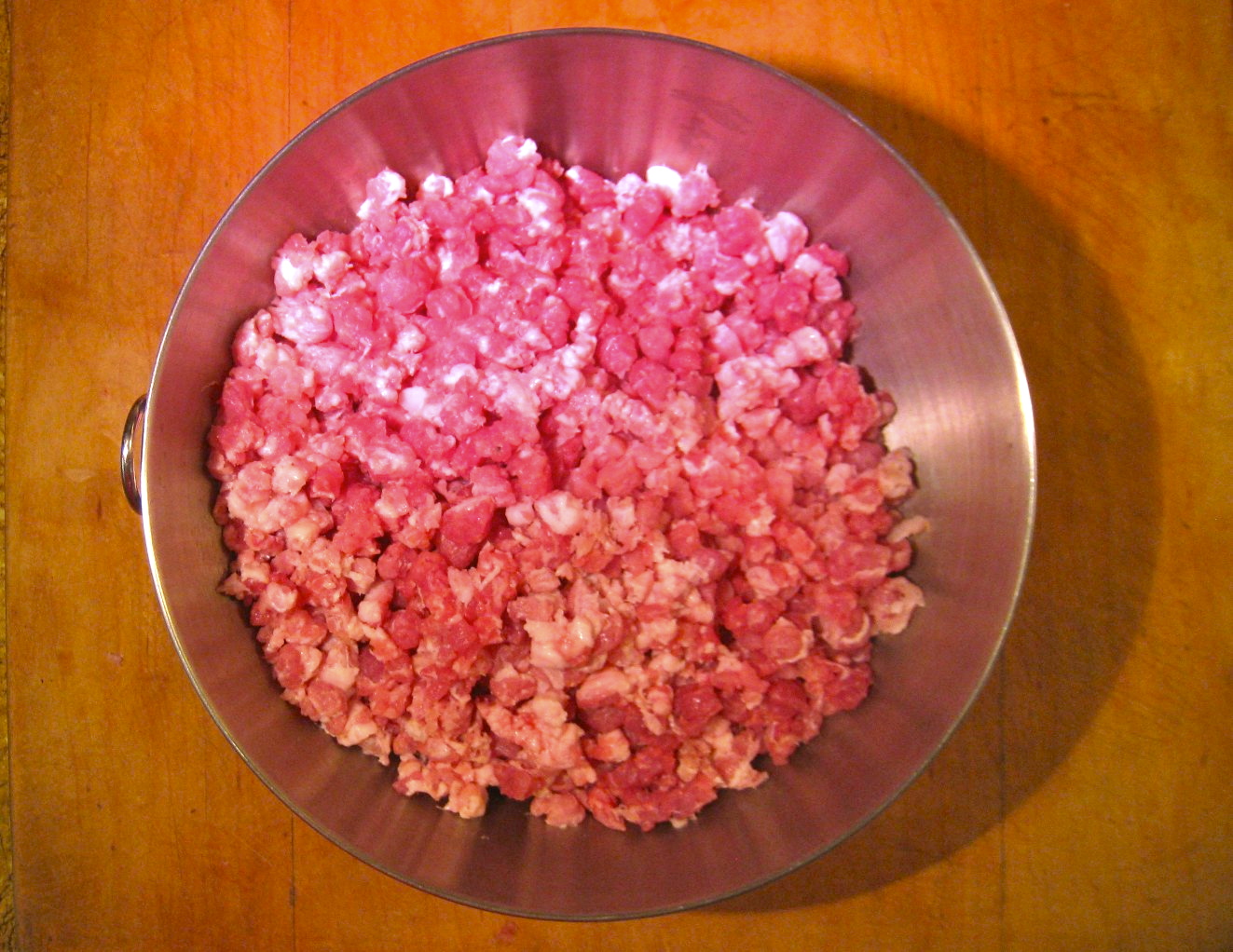
Now, for you sausage novices, there is at least 1 reason for Bismarck’s comment. You see, pork sausage requires a certain amount of fat, with some recipes calling for as much as 25% fat content. This recipe doesn’t come near that percentage but fat content is an issue. If you buy a cut of meat that’s too lean, like the pork loin I purchased early in my sausage making career, you will be very disappointed with the result. Look for a good, not too lean, pork butt roast when you make sausage. Even then, you may find that you need to add pork fat to the ground meat, although it wasn’t always this way. Years ago, pork  products had a much higher fat content and one rarely, if ever, needed to add more fat to the mix. Then, without warning to our fellow sausage makers, hog breeders began to develop a leaner, healthier product and the “Other White Meat” campaign was born. Unfortunately, getting rid of the fat got rid of a good deal of flavor, so much so that Mom and Zia quit making sausage altogether! I eventually convinced Zia to try making it again so that I could learn the recipe and, at first, I bought some extra pork belly fat to compensate for today’s leaner pork. It worked, I learned the recipe, and all was well — or should have been. One fateful day, I attempted to make sausage on my own and over-compensated with the fat. What a greasy mess! After that, I quit using additional fat and switched to pancetta. For a 4 lb. pork butt, I use about a half-pound of pancetta. Not only does it add some much-needed fat without going overboard, it brings a nice flavor to our sausage, as well. Most importantly, Zia approved the addition. In fact, the picture to the left was taken at her home and that’s pancetta on top of the pork. (See Notes below for a tip on grinding the meat.)

When you look over our recipe, you’ll quickly notice that there is a surprising lack of spices used but, because it’s so simple, it can easily be modified to suit your tastes. Mom didn’t like fennel seed in her sausage but I don’t think she’d mind if you added some to yours. She, also, didn’t like her sausage spicy but I’m sure she’d look the other way if you wanted to add some red pepper flakes or a couple shakes of cayenne pepper. And I bet Zia would find it interesting if you were to, say, add a little ground sage or marjoram to the ground meat. As for me, I’m a garlic lover and have been known to add a couple of cloves of minced garlic, in addition to the garlic-flavored wine. And if none of those suggestions hit their mark, check out Greg’s recipe at the Rufus Guide. Just remember that no matter what spices you use and how much, be sure to start with less than you think necessary and cook a small amount of pork for a taste test. You can always add more if need be.

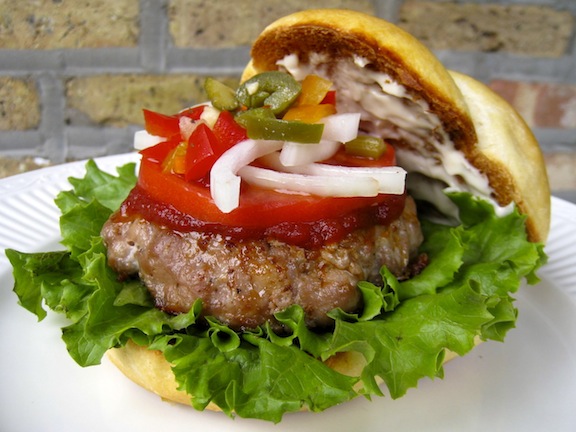
Now, one more thing probably should be mentioned. Some may be wondering where the sausages are, being this is a posting about sausage making. Well, you can blame me for that.  As I mentioned, Mom always sent me home with a container of sausage patties after I visited and I grew to prefer them. Cooked on the grill, they are a great alternative to hamburgers. Not only that, but a patty or 2 can be easily crumbled for addition to a tomato sauce, meatloaf, pizza, or some other dish. Well, during one of our Sausage Days, I convinced Zia to just make patties that afternoon and we haven’t made a sausage since. If you’re a sausage person, however, feel free to stuff those casings!
*     *     *

Bartolini Sausage Recipe

Ingredients

  • 4 lbs pork butt, coarsely ground
  • 1/2 lbs. pancetta, coarsely ground
  • 6 oz dry white wine
  • 3 cloves garlic, smashed
  • 1 1/2 tbsp salt, more or less to taste
  • 2 tsp ground black pepper, more or less to taste

Directions

  1. At least 2 hours before beginning, place garlic and wine into a glass and set aside.
  2. Once garlic and wine have “married,” combine ground meats and spread in an even layer, about 2 inches thick, on a work surface.
  3. Season the meat with salt and pepper. Use your fingertips to create dimples in the meat’s surface.
  4. Strain the garlic from the wine and discard. Sprinkle the now flavored wine evenly across the meat. Begin mixing the meat until the seasoning and wine are evenly distributed. Recreate the meat layer and let rest for at least 30 minutes so that the flavors meld. (Caution should be taken if you are doing this on a hot Summer’s day or in a very warm room.)
  5. Once rested, make a mini-patty and cook it in a small frying pan. After tasting, you may need to adjust your seasoning. If you do add seasoning, let it rest 15 minutes before tasting again.
  6. Once the sausage meat has passed your taste tests, begin making patties. Place them in single layers on baking sheets and into the freezer. Once frozen, you can bag them or place them into containers until needed.

*     *     *

Notes

Our preference is to grind the pork using the plate with the largest holes. This will create a coarse grind. When grinding meat for ravioli or cappelletti, use a smaller holed plate for a finer grind. No matter what size the end-result, you’ll find that your grinder, whether machine run or hand-cranked, will perform better and produce a more consistent result if the meat is cut into strips and partly frozen before you begin. Cut the pork butt into strips, layer them on baking sheets, and place them into the freezer for 30 to 45 minutes. Do not let them freeze solid or you will have to thaw them somewhat before grinding.

In a way, this recipe represents a milestone in the long and storied history of Bartolini sausage making. Never before were the wine, salt, and pepper measured so that they could be recorded in a recipe. It was always, “Grab some salt. Grab a little pepper. Put some wine in a glass. No, that’s too much. … ” To write this recipe, Zia worked her magic using wine and seasoning that I had pre-measured and placed in containers on her counter. When a mini-sausage patty passed her palate’s inspection, I simply measured the salt, pepper, and wine that remained. Still, as I cautioned earlier, start out with less spice than you think you’ll need. Be especially careful with the salt if you add pancetta to the ground pork, for its salt content can vary.

Just One Thing More

You didn’t think I would end this post without at least 1 picture of sausages, did you? This one is from the Bartolini Sausage Archives.

*     *     *

*     *     *

Brodetto

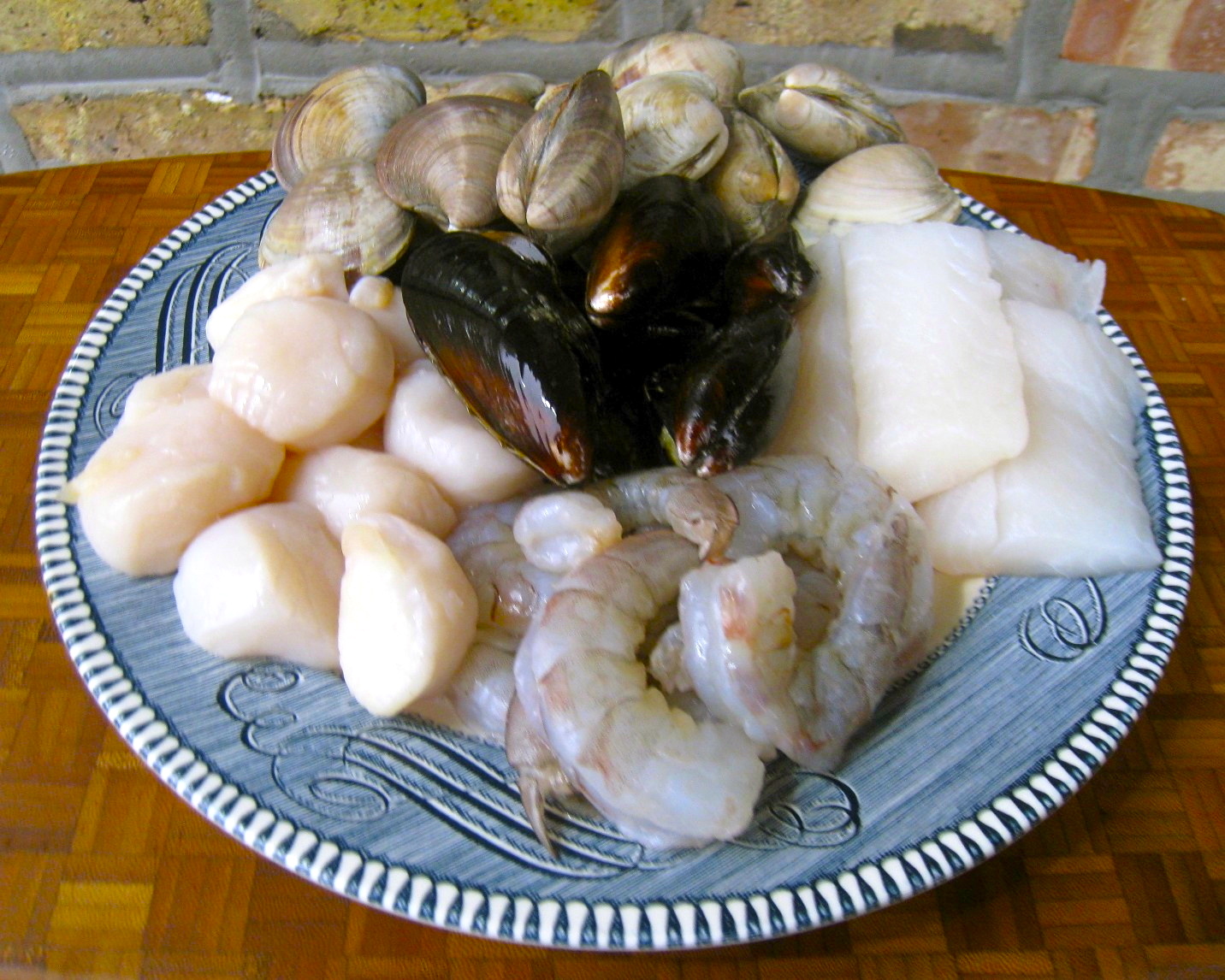
doubt there’s a European fishing community that doesn’t have its own version of fishermen’s stew. The Italians call it brodetto, the French bouillabaisse, and the Portuguese refer to it as caldeirada. Even in the this country, San Francisco is well-known for its cioppino — the real “San Fransisco treat,” in my book. Although some of the ingredients may vary by country and region within each country, the dish’s origins are often the same. The village fishermen would gather together at the end of a very long day and into a large pot they would add whatever fish that hadn’t been sold, a few vegetables, some spices, and a little wine. A short while later, with some crusty bread in hand, each would sit back and enjoy a feast among friends, no doubt filling the night air with tales of the ones that got away.

Living in Chicago, we have a wide assortment of seafood available, some of which is fresh while the rest has been flash frozen for shipment here. Although I prefer fresh, I will buy frozen and usually have shrimp and a variety of fish fillets in my freezer. If I see a sale somewhere for fresh mollusks, be they little neck or manila clams, mussels, or cockles, I’ll buy some, along with some scallops, and that night’s dinner will be brodetto. The recipe I’ll follow then is the one that I’m going to share with you now. And just like the stew the old fishermen threw together, the amount and types of seafood in my brodetto may vary but the basics remain the same. Fish, mollusks, and shrimp are added to a simple tomato broth flavored with a few herbs, garlic, and wine. Serve it in a bowl with some crusty bread, like ciabatta, and you’ll have a spectacular dinner, as well as a new-found respect for those fishermen of old.

*     *     *

Brodetto Recipe

Yield: 6 generous servings

Ingredients

  • 3 tbsp olive oil
  • 1/4 to 1/2 tsp red pepper flakes
  • 1 medium onion, chopped
  • 3 cloves garlic, minced
  • 3 tbsp fresh parsley, chopped
  • 1 cup stock (fish, clam, vegetable, or chicken)
  • 1 cup dry white wine
  • 1  large can (28 oz) whole or large dice tomatoes. (or 8 to 10 fresh plum tomatoes, peeled, seeded, and chopped into large pieces)
  • 3 or 4 stems of fresh thyme
  • 1/2 tsp Italian seasoning
  • 18 little neck or 24 manila clams or cockles
  • 1 doz mussels
  • 3/4 lb large shrimp
  • 1 doz scallops
  • 1 – 1 1/2 lbs fish fillets, cut into large, equal sized pieces (cod, haddock, halibut, striped bass, pollock, red snapper, or any combination may be used)
  • salt and pepper
  • 2 tbsp fresh basil, chopped, for garnish
  • extra virgin olive oil, for garnish

Directions

  1. At least an hour before you start cooking, scrub all the mollusks with a brush and soak the clams and cockles in cold water. Change the water at least once in the next hour. If using mussels, before scrubbing, grab hold of the “beard” and pull to remove. Keep cold until ready to cook.
  2. Once the mollusks have been sufficiently soaked and cleaned, heat olive oil in a large saucepan over med-high heat. Add red pepper flakes and cook for 1 minute.
  3. Add onion and sauté until translucent, about 5 minutes. Season lightly with salt and pepper.
  4. Add garlic and parsley and continue sautéing for another minute or so.
  5. Add stock and wine, using the liquids to deglaze the pan.
  6. Add the tomatoes. If using canned whole tomatoes, use your hands to tear the tomatoes before placing the chunks into the pan. This is a stew, not a sauce. Large chunks are preferable.
  7. Add thyme and Italian seasoning. Season lightly with salt & pepper.
  8. Bring pot to the boil, reduce heat to med-low, and simmer for 30 to 40 minutes. If stew becomes too dry, add water or stock.
  9. Increase heat to med-high, add clams and/or cockles and cover the pan.
  10. After about 3 minutes, add the mussels and cover.
  11. About 3 minutes later, place the shrimp atop the mollusks and return the cover to the pan.
  12. 2 minutes later, add the scallops and cover the pan.
  13. About a minute later, add the fish to the top of the stew, cover the pan, and cook until all is done, about 3 or 4 minutes.
  14. Serve immediately in large bowls, garnished with a sprinkling of good quality extra virgin olive oil and freshly chopped basil. Be sure to have plenty of good, crusty bread available.

Notes

The recipe I’ve just shared is by no means set in stone. I imagine that the fishermen of long ago weren’t too strict about their ingredients. I think their only concerns were that the seafood was fresh and the wine plentiful. The rest took care of itself. Today, recipes abound and it’s not just the seafood that varies from one recipe to the next. Oftentimes vegetables will be added to the stew, with bell peppers, fennel, and potatoes frequently mentioned. Some cooks will start the recipe by creating and sautéing a soffritto of chopped onion, celery, and carrot. What does all this mean for you? Well, do you have a preference for, say, crab claws? Then add them to the mix. Don’t like mussels? Don’t use them. Want more of a vegetable base for your stew? Then start with a soffritto and add whatever veggies you like. In short, indulge your palate and make the recipe your own.

*     *     *

Chicken Parmesan

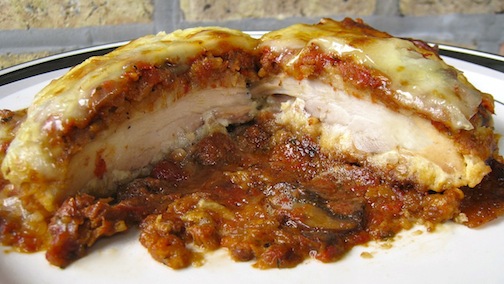
As is the case within most families, birthdays were special events in our household and Mom would fix whatever dish the birthday child desired. For me, that choice was always veal parmesan. Mom served it with home-made pasta and I was one happy boy. Nowadays, I tend to avoid veal but I can’t avoid this dish nor the memories it evokes. So, instead of  veal, I use chicken. It may not be the same but it’s close enough — and certainly good enough — for me.

*     *     *

*     *     *

To begin, I start with boneless, skinless chicken thighs, which are fried after being floured and breaded. They are then placed into a baking dish, smothered in marinara sauce, and topped with sliced mozzarella & grated parmesan cheese before being baked in the oven. Yes, this recipe can make a mess of your kitchen but the pay-off is well worth the effort. The only advice in this area that I might offer is to clean as you go. When the marinara sauce is simmering, clean the work area and utensils. The same goes with the breading station as the chicken is being fried. When the final dish is in the oven, put the rest of the mess into the dishwasher (I hope you have a dishwasher) and start it running. Take it from one who’s been there, your kitchen will resemble a disaster area if you put off the cleaning until after you’ve eaten dinner.

*     *     *

Chicken Parmesan Recipe

Ingredients

  • 1 quart Marinara Sauce
  • 1 pkg boneless, skinless chicken thighs (5 or 6 thighs)
  • 1/2 cup all-purpose flour
  • 1 – 1 1/2 cups bread crumbs
  • 3 tbsp fresh parsley, chopped
  • 1/2 tsp garlic powder
  • 1/2 tsp onion powder
  • 2 eggs
  • 2 tbsp milk
  • 3 tbsp olive oil, more as needed for frying
  • 1 large ball of fresh mozzarella, sliced thinly to provide a slice for each thigh
  • 1/2 cup freshly grated parmesan cheese
  • salt & pepper

Directions

  1. Set up a breading station. Place the flour in one dish; combine the eggs & milk and place into the center dish; and in the third dish mix the bread crumbs, garlic powder, onion powder and parsley. Season each thigh with salt & pepper. Use the standard breading technique and begin by coating each thigh with the flour, one at a time. Shake off the excess flour before coating the thigh with the egg mixture. Allow the excess to drain a bit and dredge the thigh in the bread crumbs.  Set the breaded thigh aside and repeat with the remaining chicken pieces.
  2. Place oil in a large frying pan and heat over med-high heat. Working in batches, fry the breaded thighs until each side is golden brown, about 5 minutes per side. If necessary, replenish the oil between batches.
  3. Pre-heat oven to 375*.
  4. Liberally butter or use a cooking spray to coat a 9 x 13″ baking dish.
  5. Coat the bottom of the dish with a few ladles of the marinara sauce.
  6. Place the fried chicken pieces into the dish and use the rest of the tomato sauce to cover them all.
  7. Evenly sprinkle the dish with the parmesan cheese and then position one slice of mozzarella on top of each chicken piece.
  8. Cover with aluminum foil and bake in a pre-heated oven for 20 minutes. Remove the foil and continue baking for another 20 minutes.
  9. Remove from oven and allow to rest 10 minutes before serving.

Variations

Originally, Mom shallow-fried the veal in about 1/4 inch of vegetable oil. Initially, I did the same with the chicken pieces but, over the years, eventually cut out most of the oil in favor of a few tbsp of olive oil. Use whichever method you prefer, so long as the breaded pieces are golden brown when you’re done.

Mom never baked her veal parmesan and you needn’t bake this dish either. In a large, deep frying pan with a lid, add enough sauce to generously coat the pan’s surface, add the coated, fried chicken pieces, and cover with more sauce before sprinkling with grated parmesan cheese and topping with mozzarella slices. Cover the pan and cook over medium heat until the chicken is fully cooked, about 30 minutes. Use an instant read thermometer when in doubt.

I use chicken thighs but chicken breasts, tenders, or whatever chicken parts you prefer can be substituted. You may find, however, that boneless pieces work best. No matter what part(s) of the chicken you use, just be aware that the cooking times may vary, so, again, use an instant read thermometer to ensure the meat is thoroughly cooked.

Notes

The dish, as shown, was prepared “family style” and I wouldn’t necessarily serve it this way for guests.  Here, the chicken pieces are pretty much blanketed by a coating of cheese. If I were serving guests, I would be more careful with the cheese placement, using less cheese and restricting it to the individual chicken pieces. For “family,” however, I’ll go with the cheese blanket and I haven’t had any complaints yet.

*     *     *

Steak Pizzaiola

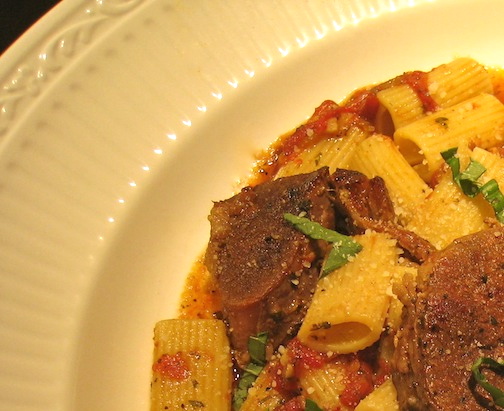
This is not one of my family’s recipes and I only started cooking it a relatively short time ago. Sure, I’d heard of steak pizzaiola but, for some reason, I always assumed that it was too complicated for me to attempt. Then, one night I saw a rerun of an “Everybody Loves Raymond” episode in which the recipe was a point of contention between Debra & Marie. After the show, I searched the web for the recipe and was surprised to learn just how easy the dish is to prepare. Basically, it’s a steak and marinara sauce served over pasta. Well, I decided to give it a try and I’ve continued to make steak pizzaiola ever since. It is one of those recipes where a minimum of effort results in a great dinner — and it’s a bargain to prepare, as well.

Exhibit A

Searching the web, I soon learned that, as easy as it is, there’s no one way to make steak pizzaiola. It’s as if there’s a different recipe for every cut of meat, especially since the better the cut, the less time needed to cook it. As a result, some recipes feature a steak that’s braised slowly in the sauce while, in others, the steak and sauce are cooked separately, to be combined just prior to serving. Although there’s something to be said for the “fast approach,” I very much prefer a slow and steady method of cooking for this dish. So, I look for a cheaper cut of meat, preferably “bone-in” for added flavor, and let it braise for a couple of hours in the oven. The sauce itself is uncomplicated and there’s no need for a lot of herbs and spices. The braising will do the work for you and infuse the sauce with a rich beef flavor. Now, my family uses very little oregano in its dishes but so many of the web recipes call for it that I’ve listed it here, among the ingredients. Use it instead of, or in combination with, the Italian seasoning, if you like. In fact, if oregano is a favorite of yours, you may want to increase the amount listed in the recipe below. As for the type of pasta to use, I prefer serving it with rigatoni, penne, or cavatappi but feel free to use whatever works for you and your family.

Exhibit B

*     *     *

Steak Pizzaiola Recipe

total time: about 2 1/2 hours.

yield: about 8 servings.

Ingredients

  • 2 – 3 pounds chuck steak, bone-in
  • 3 tbsp olive oil
  • 1/8 – 1/4 tsp red pepper flakes, depending upon taste
  • 1  medium yellow onion, chopped
  • 3 cloves of garlic, chopped fine
  • 2 – 3 tbsp tomato paste
  • 1 large can (28 oz.) tomatoes (I prefer diced or crushed)
  • 1 tbsp Italian seasoning or dried oregano or any combination of the two
  • 3 tbsp chopped fresh parsley
  • 2 tbsp chopped fresh basil
  • salt & pepper
  • 1 lb pasta, cooked al dente per package instructions, reserve 1 cup of pasta water
  • grated Pecorino Romano cheese

Exhibit C

Directions

  1. Pre-heat oven to 325*
  2. Heat oil in large, oven-proof, frying pan with a tight-fitting lid, over med-high heat.
  3. Season meat liberally with salt & pepper and sear in frying pan, about 4 minutes each side.
  4. Remove meat to a platter and add red pepper flakes to the pan. Cook for about  2 minutes.
  5. Add onions to the pan, season with salt & pepper, and sauté until translucent, about 6 – 8 minutes
  6. Add garlic and continue cooking for 2 minutes.
  7. Add tomato paste and continue cooking for 1 – 2 minutes.
  8. Add tomatoes, parsley, Italian seasoning and/or optional oregano, and stir to combine with pan’s contents. Season with salt and pepper.
  9. Return meat to the pan, cover the meat with sauce, cover tightly with lid, and place in center of oven.
  10. Braise meat for 2 hours, checking it every 30 minutes or so. Either flip the meat over or spoon more sauce over it.
  11. After 2 hours, begin heating water for the pasta and remove the lid from the pan in the oven. This will allow the sauce to thicken while the pasta cooks. When the pasta is al dente, reserve a cup of pasta water, drain the pasta, and check your sauce. If your sauce is too dry, use the pasta water to compensate.
  12. Place drained pasta in a large bowl. Take sauce out of the oven, remove any loose bones, and combine with cooked pasta. Garnish with basil and grated Pecorino Roman cheese.
  13. Serve immediately.

Exhibit D

Variations

As was mentioned earlier, some recipes call for using better cuts of meat than a chuck steak. Normally, those recipes do not need a long braise like the one that I’ve shared; the cut of meat is far more tender already. I very much prefer the long braise method, however, for it not only renders the meat fork-tender but the sauce’s flavors are more developed.

Notes

At one time or another, we all have some left-over pasta sitting in our fridge. Re-heating it can be a problem, unless you use Mom & Zia’s method. Rather than use the microwave, place about a tablespoon of butter and about 1/4 cup of water into a frying pan over med-high heat. Add the left-over pasta and sauté until heated through. Add a little more water if the pasta is too dry. Serve immediately, garnished with Pecorino Roman cheese. Understand that the pasta cannot possibly be al dente — that ship sailed the minute you put the left-overs into the fridge. This will, however, re-invigorate the sauce in ways that a microwave never could. As they say, “Try it. You’ll like it.”

*     *     *

Mom’s Chicken (that’s not really) Cacciatore

I Dig It Mom's Way

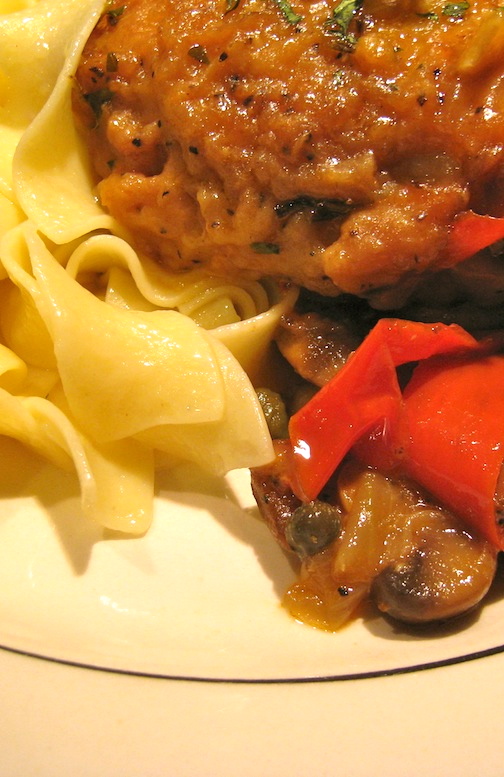
Traditionally, pollo alla cacciatore (hunter-style chicken) features chicken, pan-braised in a tomato sauce with mushrooms, served over pasta, very often spaghetti. I say “traditionally” because this is not the cacciatore Mom made. Her recipe did not result in a tomato sauce and Mom never served this dish over pasta. Although I will agree with the purists who’ll be quick to point out that this is not a true cacciatore, I very much prefer it Mom’s way if, for no other reason, than that I already make a number of tomato-based sauces. Making another one with chicken holds little interest for me. All of this doesn’t mean that tomatoes aren’t used in this recipe. I’ll add a diced tomato or about a tbsp of tomato paste “for color,” as Mom would say. Additionally, this recipe uses chicken thighs with the skin-on and bone-in because the combination adds so much flavor to the final dish. Of course, you may use whatever chicken parts you wish, with or without skin or bones, but your choices may affect cooking times. Use an instant read thermometer when in doubt. If you do not wish to use wine, one cup of chicken broth/stock may be substituted.

*     *     *

Mom’s Chicken (that’s not really) Cacciatore Recipe

total time: about 75 minutes.

yield: 5 or 6 servings

Ingredients

  • 1 pkg chicken thighs (5 or 6 thighs), with bone-in and skin-on
  • 2 tbsp extra virgin olive oil
  • 3 slices of bacon (or 1/4 lb. of pancetta),  chopped
  • 1/3 cup all-purpose flour
  • 1 large yellow or sweet onion, halved and sliced
  • 3 cloves garlic, sliced
  • 1 bell pepper, cut into strips
  • 8 oz. crimini or button mushrooms, sliced
  • 1 tomato, diced, or 1 tbsp tomato paste
  • 2 – 3 tbsp fresh rosemary, chopped
  • 1 cup white wine (or low-sodium chicken stock/broth)
  • 3 tbsp capers (optional)
  • 3 tbsp fresh parsley, chopped, for garnish
  • salt & pepper, to taste

Directions

  1. Heat olive oil in a large frying pan with lid over medium heat. Add bacon/pancetta and cook until crisp and the fat is rendered. Remove meat from pan and drain over paper towels.
  2. Meanwhile, season chicken with salt & pepper. Place flour in a plastic bag, place 2 chicken pieces in bag, and shake to coat. Remove chicken to a plate and repeat until all the chicken is coated with flour.
  3. Once the bacon/pancetta has been removed from the frying pan, increase the heat to medium-high and add the chicken pieces, skin-side down. Sauté until chicken is lightly browned, about 5 – 6 minutes, turn the chicken pieces over, and sauté until they, too, are lightly browned — another 5 minutes or so. Remove chicken to a plate.
  4. Remove all but about 3 tbsp of oil from the frying pan. Add the onion and begin sautéing. Lightly season with salt & pepper. Use a wooden spoon to clean the pan’s bottom of the brown bits. (These are where the flavor is.)
  5. After about 5 minutes, add the garlic & bell peppers and continue sautéing.
  6. After 5 minutes more, add the mushrooms.
  7. 5 minutes later, add the tomato/paste and sauté for 2 – 3 minutes. Season lightly with salt & pepper.
  8. Return the bacon/pancetta to the pan, season with the rosemary, return the chicken to the pan, and add the wine.
  9. Bring the pan to a boil before covering and reducing heat to medium-low.
  10. Continue cooking for 45 minutes or until chicken is fully cooked. (Use an instant read thermometer if in doubt.) Periodically, throughout the cooking, slightly shift the chicken pieces to prevent their sticking/burning. If the pan looks too dry, add a little water/chicken broth.  A few minutes before serving, sprinkle the capers over the pan’s contents. Taste the sauce to see if salt or pepper is needed.
  11. When finished cooking, remove to a serving platter and garnish with parsley.

Variations

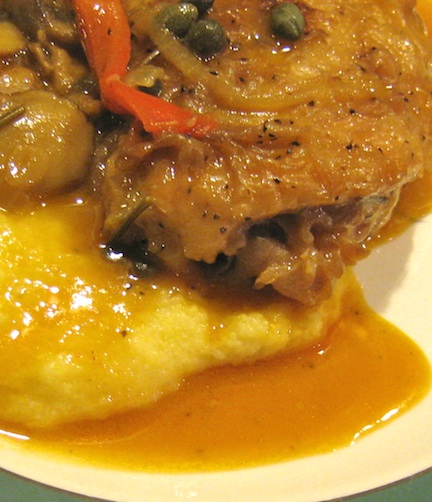
Strictly speaking, I do not have any variations for this recipe. It’s pretty much the same recipe that Mom used. Where we part ways is in the serving. As was mentioned earlier, Mom never served her cacciatore over pasta.  On the other hand, I’m a pasta fanatic and I’m always on the look-out for ways to include pasta in a meal. For me, this recipe is delicious when served over wide noodles that have been buttered and lightly sprinkled with freshly chopped parsley. And on those extremely rare occasions when I’m not in a pasta mood, I’ll serve it atop polenta. Either way is aces in my book.

*     *     *

Slow Cooker Beef Stew

Yes, you read that correctly: beef stew is next on the agenda. We’ll get to that but first I’ve got some ‘splaining to do. One of Chicago’s grocery chains has closed selected stores around town, renovated them, and is now re-opening each in grand style. One such re-opening occurred recently in my neighborhood and, of course, I attended and brought a friend. While there, he took advantage of one of the sales, buying a 4 lb bottom round beef roast. As you may already know, this cut of beef is not particularly well-marbled and isn’t the most tender of cuts. As such, it responds well to stewing or braising and is perfect for slow cooker stew. My friend asked if I had a recipe and I sent him this one in an email. Since I have the recipe handy, I might as well include it here now rather than later.

Before I share the recipe, however, we should probably look at a few of the ingredients. First off, I tend to avoid the grocery’s beef that’s pre-cut into chunks and labeled “beef for stew”. When I make stew, I prefer pieces that are 2 – 3 inches in size and those that are pre-cut are usually about half that size. So, I buy a 2 – 3 lb chuck, top round, or, as already mentioned, a bottom round roast. Once I get home, I cut the roast into chunks the size of my choosing. Of course, if you prefer smaller pieces, by all means go for it.

Zia and six-month-old Max.

Next, let’s look at the vegetables. If you’re considering making stew in a slow cooker, chances are you’ll be setting it up before leaving for work. Unless you have a sous chef, the last thing you’ll want to do is spend time chopping and cleaning your veggies. That’s why I recommend a small bag of new red or Yukon gold potatoes,  frozen pearl onions, and organic baby carrots. Only the potatoes need washing and everything can be thrown into the slow cooker as-is. If you prefer, feel free to use any type of carrot, potato, and onion that’s available. Just be sure to cut them into approximately equal-sized pieces so that they cook evenly.

Last to be mentioned is the wine. Although I use a few ounces of wine in this recipe, it’s not necessary and can be skipped, if you like. This isn’t boeuf bourguignon, after all. If you live alone, like I do, opening a bottle of wine just to use a few ounces in a recipe isn’t practical. I certainly don’t want to drink the rest with my dinner and watching it degrade on a counter or in the fridge is not the answer. I’ve found that the mini bottles of wine — about 5.5 ounces each — are the perfect solution. Our supermarkets sell them in sets of four and offer a variety of grapes. I buy one set of red and another of white. If a recipe calls for wine, I can use one of these bottles and have little, if anything, left over. Granted, these wines aren’t going to be of the same quality as those found in my wine rack but, then again, I’m not about to open an expensive bottle of wine just so that I can pour a few ounces into a stew. I’ll leave it for you to decide whether to use wine and, if you do, which one to choose. A general rule of thumb, however, states that if a wine isn’t good enough to drink, one shouldn’t cook with it. So, avoid the “cooking wines” at your grocery.

*     *     *

Slow Cooker Beef Stew Recipe

yield: 6 – 8 servings

prep time: approx.  30 minutes

cook time: 8 – 9 hours

Ingredients

  • One  2 – 3 lb beef roast, cut into 2 – 3 inch chunks (less expensive cuts of meat are fine for this recipe)
  • 3 tbsp all-purpose flour
  • 3 tbsp olive oil
  • 1 small package of new red or Yukon gold potatoes.
  • 1/2 small bag of organic baby carrots
  • 1 package frozen pearl onions
  • 1/2 package (about 4 oz) button or crimini mushrooms, quartered (more/less may be used according to your preference)
  • 1 small bottle (5..5 oz) red wine
  • 2 bay leaves
  • 3 – 4 sprigs of thyme
  • One 32 oz. box low-salt, fat-free beef stock
  • salt & pepper, to taste

Directions

  1. Spray the inside of the slow cooker with your favorite cooking spray.
  2. Place olive oil in a frying pan and heat over medium-high heat.
  3. Meanwhile, use paper towels to pat dry the beef chunks, season them with salt & pepper, and place them into the now hot frying pan. DO NOT CROWD. The pieces should not touch each other or they will steam and not brown. You may need to do this in batches. Do not disturb the meat. After 3 minutes, gently lift one piece to see if it has browned. If not, return the piece as it was and wait another few minutes before checking again. Once it is browned, turn it over, as well as all the other chunks in the pan, Repeat this process until all the meat is browned on all sides. Remove the meat and place in the slow cooker. If needed, add a little more olive oil to the frying pan before browning the 2nd, or 3rd, batch of meat.
  4. Remove the frying pan from the heat, add the wine, and return to medium heat. Use a wooden spoon to scrape off any residue from the pan’s bottom. Once the pan is “clean,” reduce heat to low.
  5. Sprinkle the flour on top of the meat in the slow cooker. Add the bay leaves and thyme sprigs.
  6. Add potatoes, carrots, onions, and mushrooms, in that order, to the slow cooker.
  7. Season with 1/2 tsp salt & 1/8 tsp pepper (more/less if you prefer).
  8. Pour the now-heated wine over the slow cooker’s contents.
  9. Add enough beef stock to cover the beef chunks. It’s OK if some of the mushrooms or carrots are above the liquid.
  10. Set slow cooker on “high” for one hour and then “low” for another 7 hours. Alternately, you can set your cooker on “low” and cook for 9 hours.
  11. Remove bay leaves & thyme sprigs before serving.

Variations

Although not really a variation, I have made this recipe but without the potatoes. I then serve it over a bed of plain rice or one of buttered, wide egg noodles. Before doing so, I check to see if the gravy is thick enough for serving this way. If not, I use a slotted spoon to remove most of the cooker’s content’s to a platter, leaving the liquid behind. Turn the cooker to “high” and while the gravy heats, mix a couple tbsp of corn starch into about a 1/4 cup water. Add to the slow cooker, stir thoroughly, and heat on “high” for 10  minutes before returning the stew meat & veggies to the cooker. By the time everything is heated through, another 5 – 10 minutes, the gravy should be thick and ready to serve.

*     *     *