Pasta with Clams (“White Sauce”)

Pasta con VongoleWhenever I’m lucky enough to visit Italy, I make a point of ordering pasta with clams at least once while I’m there. Using varieties of clams I’ve never seen stateside, my pasta is served chock full of tiny, incredibly sweet bivalves no bigger than my thumbnail. What a treat! Back here at home, when I’m in an adventurous mood, I’ll make a run to the Asian markets to try some of the varieties of clams that they have on hand. More often than not, however, I’ll just head to one of the better groceries and pick up some littleneck or manila clams. When I do, I know that night’s dinner will be something special.

With no tomato sauce to simmer, this is an amazingly simple recipe that results in a very flavorful dish. Just toss a few ingredients into a frying pan while your pasta cooks and, in about 10 minutes, you’ll be sitting down to dinner. It really is as simple to make as it is delicious to eat.

*     *     *

Pasta with Clams (“White Sauce”) Recipe

total time: approx.  90 minutes (75 minutes for prep, 15 minutes cooking)

Ingredients

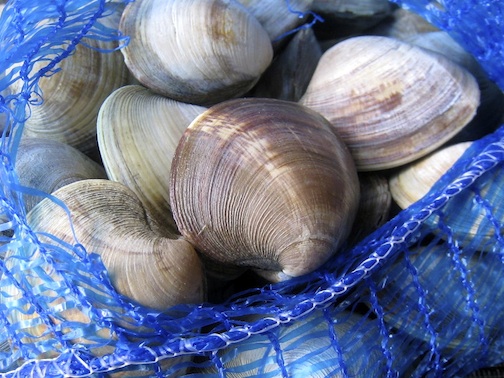
  • at least 2 doz. little neck or manila clams
  • 3 tbsp olive oil
  • 1 to 2 cloves of garlic, minced
  • 3 tbsp fresh parsley, chopped
  • 1/4 cup white wine or water
  • salt & pepper, to taste
  • 1 lb pasta
  • chopped parsley for garnish

Linguine with Clams

Directions

  1. At least an hour before dinner, use a brush to individually scrub each clam before  rinsing and placing it in a large bowl of cold freshwater. Rinse them a second time just before proceeding with the recipe.
  2. Bring a 6 quart pot of salted water to boil.
  3. Add oil to a large frying pan with a lid. Add the garlic, parsley and the wine or water.
  4. Add the pasta to the pot of salted boiling water. The pasta, if dried, should take 9 or 10 minutes to cook. If fresh, less time will be needed. Time it so that its completion coincides with that of the clams.
  5. Just when the frying pan’s liquid begins to show signs of boiling, add the clams and cover tightly,
  6. In about 5 to 8 minutes, the clams should be open & steamed. Discard any unopened clams. Replace cover and remove from heat.
  7. Reserve 1 cup of the pasta water, drain the pasta, and combine the clams & pan juices with the drained pasta. If too dry, add some of the reserved pasta water.
  8. Serve immediately, garnished with chopped parsley.

Variations

This dish is totally reliant upon timing. If you’re off, the pasta will not be piping hot or, worse yet, the clams will be over-cooked and chewy. Just heed the pasta package’s instructions and keep in mind that the clams will open about 5 minutes after they hit the hot pan. Very often, if my clams are ready and my pasta still needs another minute or two, I’ll use the time to remove some of the clam meat from the shells. I won’t remove all of the meat from the shells because I prefer to see a few shells in each serving. It’s all about the presentation.

Notes

When in Italy, one is far more likely to see this dish than you would pasta with clams in a tomato (“red”) sauce. The latter dish, however, is more popular here in the States.  Truth be told, I usually prepare today’s recipe and only “go red” about 25% of the time. The choice is yours to make and here’s my recipe for Pasta with Clams – (Red Sauce) for those who prefer their clams in a tomato sauce.

*     *     *
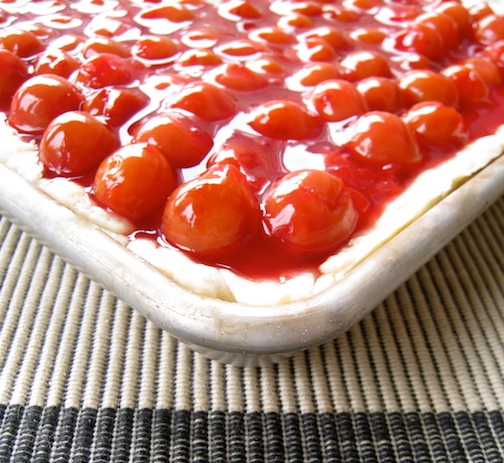
Cherry Cheesecake Pizza

Since Easter is only a few days away, I thought it the perfect time for something sweet. Mom got this recipe from one of our two-flat’s neighbors, Johnnie, a wonderful woman whose daughter and my sister remain very close friends to this day. Easy to make, this is a perfect dessert for any party, potluck, or family dinner. If you wish, you can use canned pie filling and ready-made pie crusts — I told you it was easy. On the other hand, if you’ve got the time, you can make your own pastry dough and/or topping from fresh or frozen fruit. Either way, you’ll end up with a great little dessert.

*     *     *

Cherry Cheesecake Pizza Recipe

Ingredients

  • 2 pie crusts, ready-made or equivalent amount of pastry dough — not puff pastry
  • two 8 oz packages of cream cheese, at room temperature
  • 1/2 cup sugar
  • 2 eggs
  • 1/3 cup walnuts, rough chopped
  • 1 tsp salt
  • two 14.5 oz cans of pie filling (or use 2 cans/bottles of tart cherries and follow the maker’s recipe on the container to make a filling)
  • Whipped cream for serving – optional

Directions

  1. Pre-heat oven to 350*.
  2. Roll pastry dough until large enough to cover the pan, as well as to create a ridge along the edge of the pan. Transfer to pan, prick with fork several times, and bake on center rack of oven for 15 minutes. Remove from oven and cool completely.
  3. Using a hand or stand mixer, beat together cream cheese and sugar.
  4. Add eggs, one at a time, and beat until well-blended. Add vanilla and mix well.
  5. Add the walnuts and mix using a spoon or spatula.
  6. Once the crust is thoroughly cooled, pour the cream cheese mixture over the crust and use an offset spatula to make it smooth.
  7. Bake in pre-heated 350* oven until set, about 15 to 20 minutes. Remove from oven and cool completely before proceeding.
  8. Carefully pour and spread fruit topping to cover the cheesecake. Refrigerate until well-chilled, at least 2 hours.
  9. Serve with whipped cream, if desired.

*     *     *

*     *     *

Variations

The original recipe called for one ready-made pie crust and one 8 oz package of cream cheese. Mom always doubled the amount of cream cheese and used both pie crusts, as well. This cheesecake was originally made on a 14″ or 16″ round pizza pan but, lacking one, I use a 12″ x 9″ sheet pan instead. Lastly, the original recipe used cherries for the topping. You can easily substitute blueberries, strawberries, or whatever fruit you prefer.

*     *     *

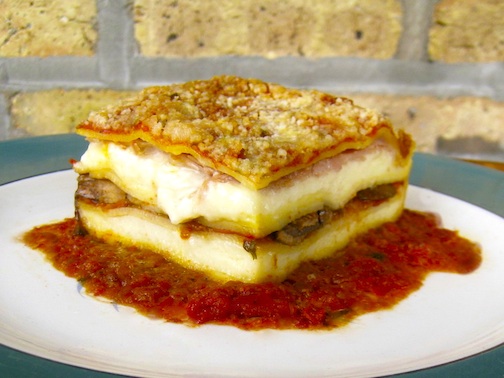
Lasagna – Not at all like what Mom used to make

To many, lasagna is a multi-layered pasta dish with ricotta cheese between the layers, all of which are bathed in a rich tomato sauce and topped with melted mozzarella cheese. Any number of cheeses can be added, along with spices and herbs, to the ricotta, depending upon the cook’s preference. As has been mentioned, my family’s recipe doesn’t use ricotta at all, as you’ll see in some future post. This post, however, is devoted to a 3rd lasagna, a recipe that I saw on some PBS cooking show about 20 years ago. It is, by far, the lightest of the 3 lasagne, with a unique blend of flavors.

*     *     *

*     *     *

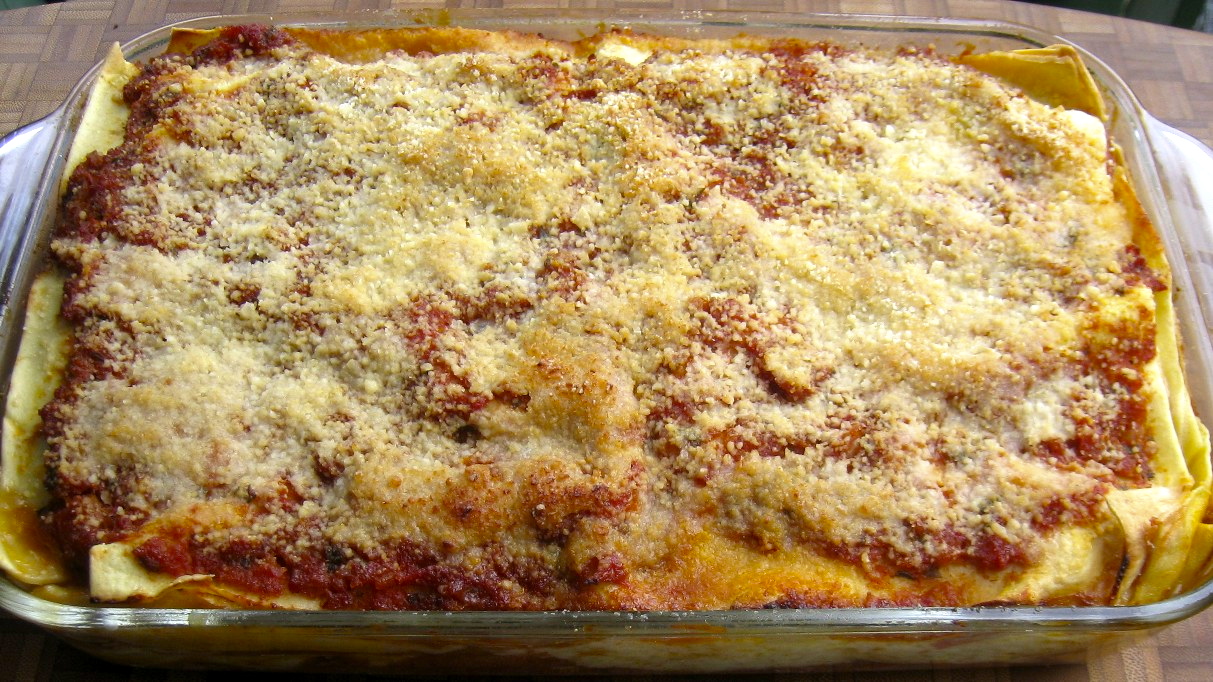
Today’s recipe consists of layers of pasta, each topped with either a marinara or a parmesan-flavored white sauce (besciamella), with mushrooms and prosciutto thrown in for good measure. No, it’s not at all like most lasagna recipes but still a good one, nevertheless. If, however, it’s not lasagna unless you see ricotta and mozzarella, then this dish probably isn’t for you. That leaves all the more for the rest of us.

*     *     *

Not My Mom’s Lasagna Recipe

total time: approx.  1:45

Ingredients

Red Sauce

White Sauce

  • 6 tbsp butter
  • 1/4 cup corn starch
  • 2 cups milk, divided
  • 1 egg, slightly beaten
  • 3/4 cup parmesan cheese — more if you like

Lasagna

  • 1/4 lb prosciutto, sliced thin
  • 1/2  – 3/4 lb mushrooms, sliced
  • 1/4 cup parmesan cheese — at least
  • Enough cooked lasagna noodles (or “No Boil”) to make 4 pasta layers

*     *     *

*     *     *

Directions

Make the White Sauce

  1. Melt butter over a low flame. Add corn starch and whisk until smooth.
  2. Add 1 cup of the milk and whisk until milk begins to thicken. Add the rest of the milk and whisk until it, too, thickens.
  3. Add the egg and stir vigorously to insure that egg is blended before it cooks.
  4. Add parmesan cheese, stir to combine, and remove from heat.

Assemble the Lasagna

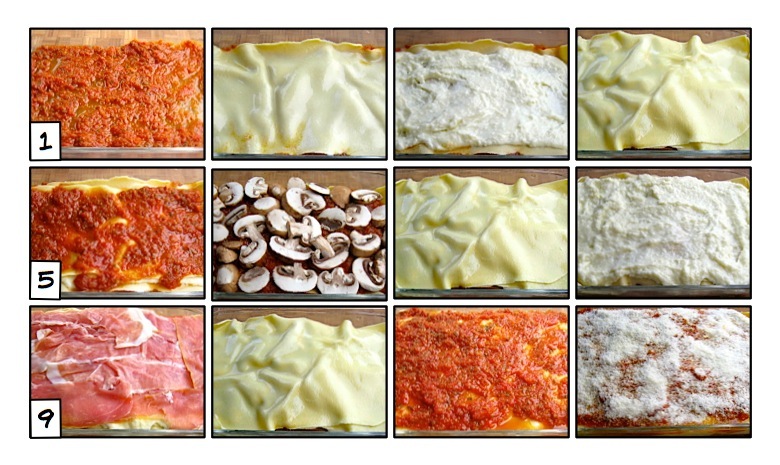
  1. Pre-heat oven to 350*.
  2. Generously butter a 9 x 13″ baking dish or pan. Coat the bottom of the dish with red sauce.
  3. Add 1 layer of noodles and then coat them with 1/2 of the white sauce made above.
  4. Add a 2nd layer of noodles and then a coating of red sauce. Add the mushrooms in an even layer atop the sauce.
  5. Add the 3rd layer of noodles, covering them with the rest of the white sauce. Cover this layer with all the prosciutto.
  6. Add the 4th and final layer of noodles, cover liberally with red sauce, and sprinkle the top with as much parmesan cheese as you like.
  7. Place in pre-heated oven and bake until heated through, 40 – 45 minutes. Let rest 10 minutes before serving.

*     *     *

*     *     *

Variations

I’ve not toyed with this recipe at all, since seeing it prepared many years ago. For my tastes, it’s fine the way it is. Should you add a little something to improve the dish, however, drop me a line. I’d love to give it a try.

*     *     *

Fried Calamari

One of the most ubiquitous of appetizers, fried calamari can be found on most of America’s restaurant menus and, as one would expect, recipes abound for creating the dish. Some of these recipes marinate the squid first, while others only flour them before frying. Still others rely on a batter to coat the squid, and those batters may use any one of a number of liquids, from water to milk to beer. Absent a family recipe, what’s a blogger to do?

Well, this blogger ran some tests. Armed with frozen squid, vegetable oil, and a dream, I set out to learn which recipe resulted in the best fried calamari. I took 2 calamari and did nothing but flour them before frying. Six other calamari were given a buttermilk soak for over an hour. Of those, 2 were floured and fried, 2 were dipped in a beer batter before frying, and the last 2 were coated with a water-based batter before frying. My objective was to determine which frying method was the best, so, I only used salt & pepper for seasoning. I didn’t want the results clouded by too many variables.

So, then, how did they do? Well, all 4 preparations fried easily and the results were crisp, although some more so than others. Perhaps my least favorite was the beer batter-fried (lower – left). Although I’d like to try that batter again with chicken, shrimp, or onion rings, it was just too thick for the calamari. These tentacles were the worst of the bunch, a sorry mass of fried batter. Next would have to be the calamari that were fried after only being dipped in flour (l – r). Although they were crispy and the tentacles were the best of all four, they were the least flavorful. As is the case with chicken, soaking the squid in buttermilk made a difference. Next were the calamari that were dipped in a water-based batter (top – left). They were good but not good enough to overtake my favorite, the calamari that were soaked in buttermilk before being floured and fried (t-r). They benefited from the buttermilk and got extra points for ease of preparation and of frying — there was no messy batter to deal with. This, then, is the recipe I’ll be sharing today.

*     *     *

The Winner!

*     *     *

Fried Calamari Recipe

yield: 2 servings

Ingredients

  • 1 lb. squid (about 16 medium-sized), cleaned & cut into 1/2 inch rings (Frozen, raw rings may be substituted. Thaw before using.)
  • 2 cups buttermilk
  • 1 cup all-purpose flour
  • 1 tbsp garlic powder
  • 1/2 tsp coarse kosher or sea salt
  • 1 tsp cayenne pepper – more or less to taste
  • 1/4 tsp pepper
  • Oil for frying — NOT olive oil

Directions

  1. Place buttermilk, calamari rings, and tentacles into a bowl and set aside for one hour. If longer, refrigerate until you’re ready.
  2. Heat oil in a large sauce pan or dutch oven over med-high heat.
  3. Place dry ingredients into a bowl and whisk to combine.
  4. Line a sheet pan with paper towels and pre-heat oven to 200*.
  5. When oil reaches 360*, remove some pieces of calamari from the buttermilk and allow excess liquid to run off before dredging them in the flour mixture. Place pieces, one at a time, into the hot oil. Work in batches. Do not overcrowd.
  6. Remove calamari when golden brown, about 90 seconds to 2 minutes, and place on paper-lined sheet pan. Sprinkle with salt and place in warmed oven.
  7. Repeat steps 5 and 6 until all calamari are fried.
  8. Serve immediately with lemon wedges and your favorite dipping sauce.

Variations

The ingredient amounts listed-above are not set in stone. They are what I use and, as you can see, they bring a little heat to the dish. You can just as easily use more of one spice and less of another or, for that matter, skip one altogether in favor of some other. The point is no matter what spices you use, be sure to soak the calamari in buttermilk for optimum flavor. Do that and you won’t be disappointed.

What if, after all of this, you decide you’d rather not fry your calamari? You can always try my Mom’s Calamari Salad recipe. Follow her directions and  you’ll be rewarded with calamari rings that are tender but never rubbery and a salad that looks as fresh as it tastes.

Note

When I ran these tests, I put some thought into the testing but completely forgot about serving the calamari. I was mid-way through the frying when I realized I didn’t have any sauce for an accompaniment. I made a quick dipping sauce using 2 parts mayo, 1 part sour cream, the juice of a half-lemon, 1 grated garlic clove, and a little salt & pepper. It worked just fine although, if you have a low tolerance for garlic, you may wish to use 1/2 clove or none at all.

*     *     *