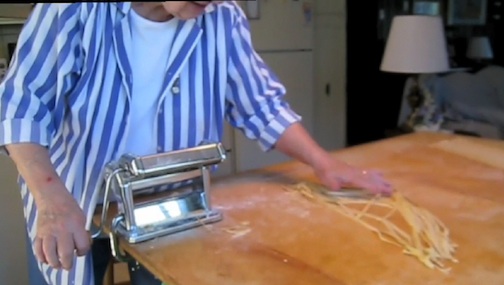
Ravioli dei Bartolini

Happy Columbus Day everyone! And what better way to celebrate the Holiday than to share one of the Bartolini Clan’s favorite holiday recipes. Say the word “ravioli” to any of the old 2-flat’s former residents and you’re sure to conjure up memories of holidays past, specifically Christmas, New Year’s, and Easter. No matter which of the 2 dinner tables you visited on those evenings, there would be a large platter of ravioli taking center stage. (It was present on Thanksgiving, too, but The Bird was the star of that show.) As a kid, my attention was pretty much focused on that platter of pasta pillows — and dessert, of course — and I think the same would have been said by everyone at the tables, save Mom and Zia. Their perspectives would have been entirely different.

One must remember that in those days, the only freezer available to most households was a small compartment above the fridge. Consequently, if you wanted to serve your family ravioli, you made it the same day it was served. Well, there was absolutely no way that Mom and Zia were going to start making ravioli on a holiday afternoon. That meant that most holiday mornings, they were up at 5:00 am making ravioli for that evening’s holiday dinner. And then there was Christmas. We were allowed to get up during the night to discover what Santa had brought us and to play with our toys. It wasn’t until years later that we learned how our parents no sooner got the gifts wrapped and under the tree when we came charging out of our bedrooms. Mom and Zia were lucky to get a couple of hours of sleep before they started making ravioli. And they weren’t making just a few ravioli. They made enough for everyone at each of the two holiday tables, which often included guests as well as each family. For Mom, that meant ravioli for as many as 12 people. To this day, I don’t know how they did it.

It really is a shame that there are no pictures of these women making pasta and ravioli, for it really was something to see. Mom would make the filling the night before and store it in the fridge. (Woe be the child caught snatching filling from the fridge!) The next day, she would make 8 eggs worth of pasta dough using the “mound” method. (Mound the flour on a large pasta board, make a crater in the center, pour the eggs into the center, and use a fork to slowly bring the flour into the egg mass, being careful not to break the flour wall and allow the eggs to spill out.) Once the dough was made, kneaded, and rested, Mom used her 3+ foot long “rolling-pin” to create thin, circular pasta sheets, 3 – 4 feet in diameter. They were laid to dry by hanging them off the edge of the dining room table, the backs of chairs, even on sheets covering a bed, if one was “open.” Once dry enough, the sheet would be hung off the pasta board’s edge, half on the board and half off. The filling balls were then laid out on the pasta half-sheet in a grid, each equidistant from its neighbors. When they were all positioned, maximizing the surface area, the bottom half of the sheet was  brought up and over, enclosing the filling-covered top half. The long handle of a spoon or spatula was used to seal the pillows. The ravioli were then cut using a pastry cutter, moved to trays, and the next pasta wheel was moved into place. This continued until all the filling was used. The remaining dough, if any, would be hand-cut to form linguine or quadretti. (More about the latter in another post.) Just about the time she was finished cutting the last of the pasta, we kids would come bounding into the kitchen. “Merry Christmas, Mom! What’s for breakfast?”
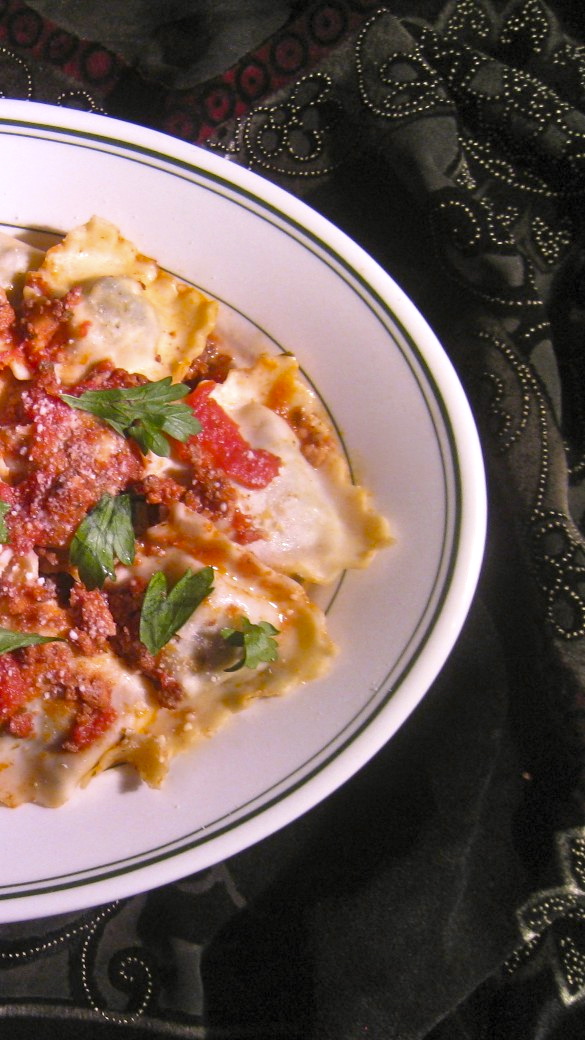
The purchase of a pasta machine changed all that. Unable to make the large pasta wheels, Mom turned to ravioli dies to make her ravioli. Pictured just below is my collection.  The 2 dies on top are used for ravioli. The one on the top-left makes ravioli that are 2 inches square. That’s just about the size The Sisters were taught to make by hand. The ravioli form on the top-right makes ravioli that are 1.25 inches square. That’s about the size The Sisters made by hand once we kids came into the picture. (Kid-friendly ravioli. Who knew?)  The remaining 3 are used for soup ravioli, which Mom called cappelletti, “little hats.” Though normally rounded, some look similar to tortellini,  the die Mom used (lower left) was .75 inches square. As a result, the word “cappelletti” in our house wasn’t used to describe the pasta’s shape but its use — and that was in soup. Mom gave me her cappelletti die years ago but it’s too small for me to use in any way. (I’ve tried several times but, being ham-fisted, I cannot make the filling “balls” small enough to fit the die.) So, I bought the die on the lower-right. It makes raviolini that are 1 inch square and I use it to make my cappelletti. In the center is a press that makes traditional-looking cappelletti, each 1.25 inches in diameter. I, also, have 2 more ravioli makers, both not shown, but they don’t work very well. One attaches to my pasta machine and the other to my stand mixer. In both cases, they require that the dough sheets be about twice as thick as I am accustomed to using. The result is ravioli that is a bit more chewy than I prefer. What can I say? Mom spoiled us. 

*     *     *

Tools of the Trade

*     *     *

When it come to the pasta dough’s final thickness, let your own palate lead the way. Our pasta machines are calibrated from 1 through 10, with 1 being the thickest setting. Zia prefers to roll her dough up to and including the number 6 setting. I will use the same setting for large ravioli but for the smaller ravioli and cappelletti, I’ll roll the dough one more time, using the number 7 setting.

Once you’ve made the filling and pasta dough, creating the ravioli is easy enough, though time-consuming. Here’s Mom’s Pasta Dough recipe and, on Wednesday, I’ll share the recipe for their ravioli filling. (Future posts will share the filling recipes for sausage ravioli and cappelletti, as well as a few others we’ve tried along the way.) The pictures that follow will guide you through the ravioli making process far better than I ever could describe. Of course, it helps that they feature that world-renowned still photo model, “Zia,” in a sequence of never seen before shots taken where she lives, along the fabulous Michigan Riviera.  Ah, the life of the octogenarian super-model!

*     *     *

How to Make Ravioli
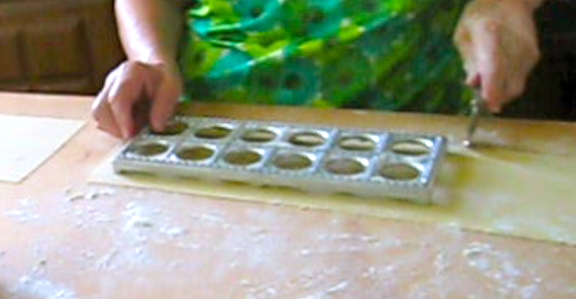
Step One: Cut dough strips into die-sized sheets

*     *     *

Step Two: Cover the die with a dough sheet

*     *     *

Step Three: Place filling across the die

*     *     *
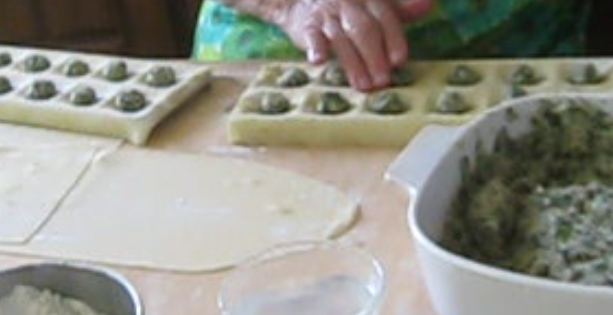
Step Four: Use dampened fingers to moisten ravioli “walls.”

*     *     *

Step Five: Cover filled die with another dough sheet

*     *     *

Step Six: Use a rolling-pin to seal the ravioli

*     *     *

Step Seven: Trim the excess dough

*     *     *

Step Eight: Flip the filled die

*     *     *
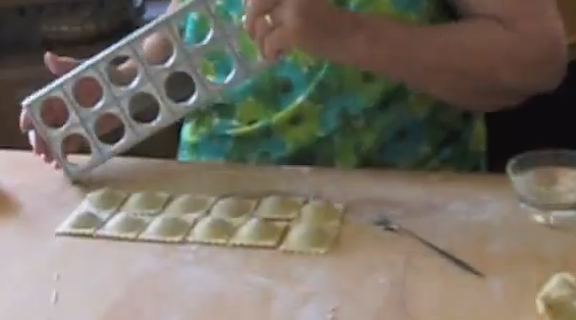
Step Nine: Unmold the ravioli

*     *     *

Step Ten: Lightly puncture the ravioli, meat-filled only

*     *     *

To Cook

  1. Bring a large pot of salted water to a rolling boil.
  2. Add the ravioli, return to boil, then reduce and simmer gently. (If boiled too hard, the ravioli may burst.)
  3. Ravioli normally take 5 – 8 minutes to cook, a couple of minutes more if frozen. Cooking times may vary depending upon the thickness of your dough, the filling, the size of the pot, etc. Taste one to insure they are done to your liking.
  4. Once the ravioli are cooked, carefully drain using a colander or sieve. You can use a Bolognese-style sauce or go meatless.

*     *     *

Variations

The method I’ve described is by no means the only way to make ravioli at home. Check out the Rufus’ Food and Spirit Guide to see Greg make ravioli completely by hand, similar to the method Mom employed but on a smaller scale. You can also see a slightly more modern approach by going to Sweet Caroline’s Cooking. With Thanksgiving just around the corner, her recipe for butternut squash ravioli couldn’t be better timed. Lastly, in an upcoming post, I’ll show you yet another method for making stuffed pasta.

Notes

You’ll note that Step Ten instructs that only meat-filled ravioli should be lightly punctured. This should be done if you intend to freeze the pasta. Doing so will allow any air sealed within each raviolo to escape during the cooking process. Too much trapped air will cause the raviolo to, in effect, balloon and it may burst before the filling can thaw and cook. We use the tines of a cocktail fork to do this but we don’t puncture cheese-filled ravioli. The cheese filling will often leak through the puncture holes. Try to fill each pillow with as much cheese filling, and as little air, as possible. This “balloon effect” should not be a problem if the ravioli are fresh (not frozen) when cooked.

Although not especially difficult, this is a time-consuming process. I’d recommend that you make enough for a couple of dinners and that you freeze what you won’t be using immediately that day. It’s easy enough. Place your freshly made ravioli in a single layer on lined baking sheets and into your freezer. 2 to 3 hours later, place the now frozen ravioli into bags or containers and return to the freezer. When needed, do not thaw before placing into boiling water, reduce to soft simmer, and cook till done to your liking, normally a few minutes longer than if freshly made.

And for heaven’s sake, keep an eye on Max at all times!

*     *     *

Fazzoletti Pasta

It’s been said that the Inuit have 100 words for “snow.” I’ve no idea whether that’s true but I bet the Italians with their pasta can come close, matching them pasta shape for snow term. You see, as many pasta shapes and sizes that you may find in your local market, they are but a small fraction of the pasta varieties available, particularly if you’re lucky enough to visit Italy. It’s as if every restaurant there features a couple pastas that you’ve never heard of, each of which comes with some story behind it. Fazzoletti, today’s recipe, is one of those pastas. Derived from the Italian word for handkerchiefs, Zia and I were served this pasta for lunch one day in a small restaurant not far from the Coliseum of Rome. Today, I usually make fazzoletti with the dough scraps left when I’ve made some other pasta. Definitely the easiest of pastas to make, they are simply squares that can be anywhere from 3 to 6 inches long, per side. Personally, I tend to make mine around the 3 inch mark but two or three 6 inch fazzoletti, lightly dressed, make a perfect primo piatto. Whether you serve them large or small, you’ll amaze your dinner companions with your knowledge of Italian cuisine’s more obscure pastas. It works every time.

*     *     *

Fazzoletti Pasta Recipe

total time: approx.  45 minutes (includes resting time)

Ingredients

  • 1/2 lb. fresh dough, (about 1/3 of Mom’s Pasta Dough recipe or use dough left over from some other preparation)
  • extra all-purpose flour for dusting the work surface and pasta sheets
  • To serve: your favorite tomato sauce (marinara or meat-based) or your favorite pesto (traditional or Trapanese).

Directions

  1. Steps 2 though 7 are a partial reprint of the directions found here Home-Made Fettucine, Linguine, Capellini
  2. Be sure the dough has been allowed to rest at least 15 minutes before starting to roll it.
  3. Using a knife or dough scraper, separate a ball of dough, roughly the size of a very large egg. With your hands, flatten the dough somewhat, making a square. Set your machine’s rollers to the widest setting and dust the rollers with flour.
  4. Place one edge of the dough between the rollers and turn the crank, causing the dough to grow thinner as it passes through the rollers. Lightly flour the dough, fold it in half upon itself, and pass it through the rollers again. Repeat this, without adjusting the rollers, a few times.
  5. Repeat steps 3 & 4. In fact, work with as many dough “eggs” as you are comfortable handling. Just remember to keep the remaining dough covered while you work with the “eggs.”
  6. Once you have rolled a few “eggs”, adjust the rollers to the next setting and pass each dough sheet through the rollers. If the dough is at all sticky, dust the sheets with flour. When all the sheets have been rolled, fold each in half and send through the rollers again.
  7. Adjust the rollers and repeat Step 6, again and again, until the strips are the desired thinness. You should no longer need to flour the strips between passes through the rollers.
  8. Lay a dough strip on the work surface. Use a pastry cutter to cut the strip into equally sized squares. Remove the fazzoletti and place in a single layer on a floured surface or lined sheet pan.
  9. Cook ASAP. Storing dried fazzoletti is problematic and some breakage is all but assured.
  10. Fresh fazzoletti will take minutes to cook in a pot of salted boiling water. Once cooked al dente, reserve some of the pasta water and either pour the pot’s contents into a colander or use a “spider” skimmer to remove the pasta from the water.
  11. Drain, lightly dress with either sauce or pesto, using some of the reserved pasta water if necessary. Serve immediately. If you prefer large fazzoletti, use tongs to carefully place and fold, in a seemingly careless manner,  the dressed pasta on each serving plate. (Remember: it’s all about presentation. You do not want a large fazzeletto laying flat upon the plate, nor is it desirable to serve several smaller fazzoletti stacked like pancakes.)

*     *     *

*     *     *

Notes

As I’ve mentioned, I normally make fazzoletti out of pasta dough remnants, most often after making  a tray of lasagna for friends. I usually have enough pasta dough and sauce left over that I can quickly make myself a nice dinner of fazzoletti. If, heaven forbid, I don’t have any sauce, I can either serve it in bianco or grab some pesto out of the freezer. No matter how it’s dressed, you can be sure that I’ll be enjoying a dish of freshly made fazzoletti that evening while reminiscing about Italy, as will Zia when she reads this recipe.

*     *     *

Home-Made Fettuccine, Linguine, Capellini

This is more an informational page than a recipe. As such, it only involves making the pasta noodles. Should you wish to see the pasta dough recipe, please refer to Mom’s Pasta Dough recipe.

Fettuccine

As was mentioned in the pasta dough entry, Mom cut the sfoglia by hand for much of my youth. Occasionally, I’ll do it myself although, to be honest, the width of my noodles aren’t nearly as consistent as were Mom’s. Whereas hers were perfect trenette, mine are more a collection of the various noodle sizes known to Man. Either way, thick or thin cut, you just can’t beat the taste of home-made pasta.

Although I follow Mom’s recipe for making the dough, I roll it into sheets using an attachment for my Kitchen Aid stand mixer, before using a hand-cranked machine to cut the noodles. Mom, as has been mentioned, used a machine with a hand-crank to roll out her dough and cut it into noodles. Both types of rolling devices work under the same principle. The dough is passed between 2 rollers, which are manually set at varying widths. Using the Kitchen Aid attachment as a guide, the no. 1 setting is where the rollers are at their widest, producing a very thick sheet of dough; no. 10 setting will produce an extremely thin dough strip. The relative thickness of the dough strips will depend upon their eventual use. When needed for lasagna, I stop after they’ve passed through the no. 5 setting. For noodles, I stop after setting no. 6. I use the same setting for large ravioli but will use no. 7 for small ravioli, where there isn’t so much filling. Zia, on the other hand, prefers to use no. 5 for her lasagna and noodles, with no. 6 being used for all of her ravioli. Again, let your own palate be your guide.

*     *     *

Home-Made Fettuccine, Linguine, Capellini

total time: approx.  45 minutes (includes drying time)

Ingredients

  • 1 1/2 lbs. fresh dough, made using Mom’s Pasta Dough recipe
  • extra all-purpose flour for dusting the work surface and pasta sheets

Directions

  1. Be sure the dough has been allowed to rest at least 15 minutes before starting to roll it.
  2. Using a knife or dough scraper, separate a ball of dough, roughly the size of a very large egg. With your hands, flatten the dough somewhat, making a square. Set your machine’s rollers to the widest setting and dust the rollers with flour.
  3. Place one edge of the dough between the rollers and turn the crank, causing the dough to grow thinner as it passes through the rollers. Lightly flour the dough, fold it in half upon itself, and pass it through the rollers again. Repeat this, without adjusting the rollers, a few times.
  4. Get another dough “egg” and repeat steps 2 & 3. In fact, get as many dough “eggs” as you are comfortable handling. Just remember to keep the remaining dough covered while you work with the “eggs.”
  5. Once you have rolled a few “eggs”, adjust the rollers to the next setting and pass each dough sheet through the rollers. If the dough is at all sticky, dust the sheets with flour. When all the sheets have been rolled, fold each in half and send through the rollers again.
  6. Adjust the rollers and repeat Step 5, again and again, until the strips are the desired thinness. You shouldn’t need to flour the strips between passes through the rollers.
  7. At this point, the dough strips will need to dry a bit before cutting. This could take anywhere from 5 to 20 minutes, or so. Much depends on your home’s temperature and humidity. If the strips aren’t dry enough, the freshly cut pasta will stick together and you’ll need to separate the noodles by hand. Just as strips that are too moist are a problem, so are strips that are too dry. In the latter case, the dough will crack & break during the cutting process. The dough strips need to be pliable.
  8. Once the sheets are suitably dried, pass them through the cutting rollers on your machine. Work the crank with one hand as you catch the noodles with the other. The freshly cut pasta may be lightly formed into bird’s nests or spread out on baking sheets, table tops, or floured towels. The pasta may be cooked immediately or allowed to dry completely, which should occur relatively quickly. If heat and humidity are a problem, freeze the freshly cut pasta to prevent mold from developing. Your pasta will store for weeks, whether dried or frozen, but the sooner used the better.

Variations

The steps outlined above use a machine to cut the fresh noodles. You can, if you like, try cutting them by hand. Take a strip of dough and fold it in half, thereby reducing its length by half. Fold it again in half, then again, and again, and again. The result should be a multi-layered dough strip about 2 – 3 inches wide. This is called sfoglia. Starting at one end and using a sharp knife, cut strips as thin as you like. Once the entire sfoglia has been cut this way, unfold the thin strips and these are your noodles.

*     *     *

Mom’s Pasta Dough

Hand-Rolling the Dough

Making pasta at home sure has changed a lot, just during my lifetime. For centuries, Italian women took a mound of flour, made a volcano-like cavity in its center, added a few eggs or some water, and slowly started combining the 2 ingredients. Eventually, a ball of dough would be formed, which they would knead before setting it aside to rest. (Let’s be clear: it’s the dough that rested.) Then, using long rolling pins, they rolled out the dough into huge sheets, 3 to 4 feet in diameter, and as thick as that day’s pasta required. The sheets would be laid somewhere to dry a bit before being folded repeatedly upon themselves to make sfoglia, which was then cut by hand with a sharp knife. It was the width of the noodle that determined the pasta — i.e., extremely thin: capellini (angel hair); somewhat thicker: spaghetti; a little thicker: trenette; a shade thicker: linguine; thicker still: fettuccine; etc. I think you get the idea. For generations, this is how pasta was made and our house was no different.  I have fond memories of the women of the house wielding their rolling pins; of wheels of dough drying on floured sheets covering tabletops, beds, and even the backs of chairs; of the family dog being banished while the dough dried; and, of the sound of Mom’s knife quickly cutting perfectly sized linguine, while holding a conversation with one of us or whomever entered her kitchen — and it was her kitchen. Then, about the time I entered high school, everything changed. Our family’s first pasta machine was purchased.

Sfoglia

Although relatively commonplace now, I’ve no idea how widespread their use was in the late 1960’s. I do know that Mom got her machine first and that things changed from that day forward. Mom’s long rolling-pin was all but retired. (She gave it to me a few years before she died.) Instead of round wheels of dough drying around the house, there were now strips of dough — and far fewer of them. You see, if you didn’t have to hand-roll the dough, you could do it more often and make less when you did. More change was to come when my sister and I bought Mom a food processor. Gone were the flour mounds and volcanoes, replaced by a 30 second whirl in this beauty built by Cuisinart.

Pasta Machine

Against this backdrop of technological advancement stood my Dad, a bit of a “pasta purist.” He insisted that he could tell the difference between pasta that was hand-rolled and that which was rolled by machine. As my sister lovingly recalls, if Dad noticed Mom preparing to make pasta that morning, he’d remind her of the benefits of rolling the dough by hand and ask that she do so. Mom would agree and a satisfied Dad would leave for work. Dad’s car was barely down the street when Mom went to the cupboard and pulled out the machine. (As I mentioned, it was her kitchen.) Later, at dinner, the hint of a wry smile would grace Mom’s face as Dad praised her “hand-rolled pasta.”

Pasta dough recipes abound on the internet. Just google “pasta dough recipe” and you’ll see what I mean. The one constant that all of the recipes share is that there is nothing exact about making pasta dough. For starters, not all “Grade A Large” eggs are created equal; some are larger than others. As for the flour, not only do you have to contend with differences between the kinds of flour, things like humidity and how you measure it will affect your dough, as well. These things may seem minor but you have to remember that as little as a tablespoon of liquid can make your dough too wet or, if it’s lacking, too dry.

Double Batch

Dough at Rest

This recipe was given to Mom by long-time family friend, Emilia, who had converted a few recipes for preparation using a food processor. (“Milia” and her husband were my brother’s god-parents.)  I follow this recipe because it uses a specific amount of liquid, thereby removing any variance resulting from eggs of differing sizes. Though flour-related variables may remain, at least we’re using a constant amount of liquid. Beyond that, one thing is certain: when making pasta dough, experience is the most important ingredient.

This post will only cover making pasta dough. Future posts will detail its uses.

*     *     *

Pasta Dough Recipe

makes about 1.5 lbs

total time: approx. 45 minutes (includes 30 minutes rest)

Ingredients

  • 2 3/4 to 3 cups all-purpose flour
  • 4 whole large eggs + enough water to equal 1 cup of liquid. Egg should be allowed to sit on a counter for about 30 minutes before use.

Directions

  1. Place all ingredients in food processor and mix until a ball of dough forms, about 30 seconds. Place dough on floured work surface.
  2. Dough should not be stick to your fingers but should be moist enough to form a cohesive ball.
  3. Begin kneading the dough, adding flour or water, in small amounts, as required. Knead until a smooth dough is achieved, at least 5 minutes. The longer you knead the dough, the better the pasta’s texture will be.
  4. Cover with plastic wrap and set aside for at least 15 minutes or up to an hour. If dough is to be rested longer than an hour, place it in the refrigerator. When removed from the refrigerator, temper the dough by leaving it on a counter for 30 minutes before using.

Variations

  • I prefer to add a pinch of salt and a dash (about 1/8 tsp) of olive oil to my pasta dough.
  • For green (verde) noodles, mix a couple of tablespoons of finely chopped spinach with the flour before adding the egg liquid to the food processor. Zia recalls that, years ago, they used spinach baby food when making pasta verde. 

*     *     *