
The Italians love eggplant and no place is it better celebrated than in Sicily. For proof of that, one need look no further than today’s recipe, Pasta alla Norma. Named in honor of Bellini’s masterwork “Norma,” eggplant takes center stage in this recipe and the resulting dish, like its operatic inspiration, is sublime.
* * *

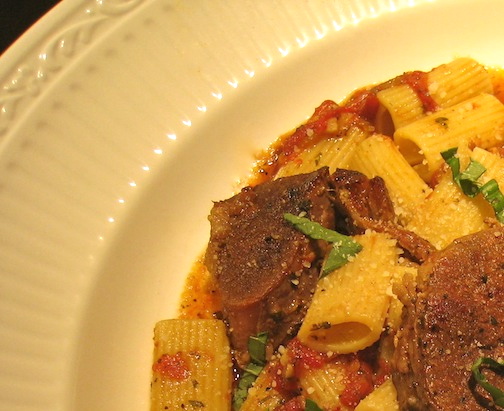
Campanelle alla Norma
* * *
Eggplant was no stranger to our table growing up. Mom often served them halved, topped with bread crumbs, and baked. Sometimes she cut them into discs before breading and frying them. Still other times, she cut them lengthwise to make planks, layering them with cheese and sauce to make a lasagna-like dish. Of course, like most Italian households, she also used eggplant to make her caponata. Comparing the two, caponata is actually more complicated than Pasta alla Norma. Whereas caponata consists of chopped eggplant and a variety of vegetables, Pasta alla Norma’s sauce is a product of just eggplant and marinara sauce. It’s hardly a difficult recipe to follow but it sure is a delicious way to dress a dish of pasta. And with our vegetable stands and markets just beginning to display this season’s bounty, there’s no better time to try this little taste o’ Sicily.
The recipe calls for 1 to 1 1/2 lbs. of eggplant. Rather than buy one large eggplant, I’ll buy 2 or 3 medium-sized ones. The larger the eggplant, the more seeds it will have and the more bitter it will be. The recipe, also, states that the eggplant should be cut into 1/2 cubes before being salted. You may find it easier to cut the eggplants into 1/2 inch slices and, after salting and rinsing, cut the slices into cubes. If you use small or “baby” eggplants, you needn’t cut them into cubes at all, but leave the slices as-is. The choice is yours.
* * *
Pasta alla Norma Recipe
Ingredients

Norma's Notes
- 2 tbsp olive oil, more as needed
- 2 – 3 small/medium eggplants (1 – 1 1/2 lb total), cut into 1/2 inch cubes
- 2 – 3 tsp kosher salt
- 1/4 to 1/2 tsp red pepper flakes, more to taste (optional)
- 1 medium onion, chopped
- 3 cloves garlic, minced
- 2 – 3 tbsp tomato paste
- 1 large (28 oz.) can tomatoes, whole or diced
- 2 tbsp fresh parsley, chopped.
- 2 – 3 tsp Italian seasoning
- 2 tbsp fresh basil, chopped
- salt & pepper, to taste
- 1 lb pasta, i.e., rigatoni, penne, campanelle
- reserved pasta water
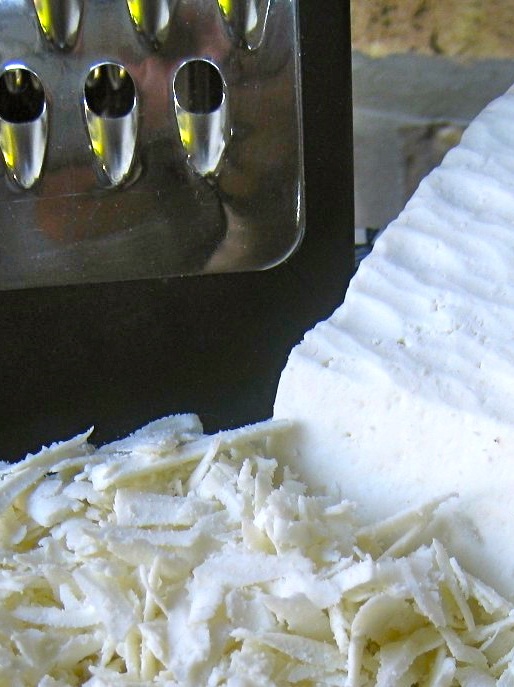
- 1/2 cup grated ricotta salata, reserving 2 – 3 tbsp
Directions
- Cut each eggplant into 1/2 inch cubes. Place 1/3 of the cubes in a colander and sprinkle with 1/3 of the salt. Add another third of the eggplant and sprinkle with another third of salt. Place the remaining 1/3 of the eggplant cubes in the colander and sprinkle with the last of the salt before carefully mixing the colander’s contents. Allow excess water to drain for 15 – 30 minutes. Give the colander & eggplant a quick rinse of tap water. Dump the rinsed eggplant onto a paper towel-lined baking sheet and use more paper towels to pat dry.
- Heat oil in a large, deep skillet over med-high heat.
- Begin sautéing the eggplant cubes. Do not overcrowd and work in batches, if necessary. Continue cooking until all cubes are lightly colored, adding more olive oil as needed. Remove cooked cubes and reserve for later.

Grate Cheese
- If needed, add 2 tbsp olive oil and heat. If using the pepper flakes, add them now and cook for one minute.
- Add onion and sauté until soft, about 5 minutes.
- Season lightly with salt & pepper, add the garlic, and continue sautéing for another minute.
- Add tomato paste, stir well, and continue cooking for a minute or so.
- Add tomatoes. If using whole tomatoes, tear them into pieces before adding to the pan.
- Add the Italian seasoning & parsley, return the eggplant to the pan, and stir to combine everything. Once the sauce begins to boil, reduce the reduce heat to a simmer.
- The sauce will cook for 30 minutes. Check the pasta’s package directions and time its cooking so that the pasta is about 2 minutes shy of being al dente when the sauce is ready.
- Reserve some of the pasta water before adding the basil and the not quite al dente pasta to the frying pan. Mix well and continue cooking until the pasta is done to your liking. Add some of the reserved pasta water to the pan if the pasta becomes dry during this last step of the cooking process.
- Just before serving, add most of the ricotta salata and mix well. Check for seasoning and add salt & pepper, if needed.
- Serve immediately, garnished with the reserved 2 – 3 tbsp ricotta salata.
Variations
Like I said, it’s is a simple dish with relatively few ingredients and, as such, there’s little room for variations other than the pasta selection and the cheese. For the pasta, I prefer to serve this sauce with pastas like penne, rigatoni, or campanelle (little bells) and not any of the ribbon-like pastas. As for the cheese, if I have ricotta salata, that’s great. If I don’t have any, I’ll substitute some crumbled feta or, if all else fails, some grated parmesan cheese. I’ve even used some grated fresh mozzarella, so, I wouldn’t let the absence of ricotta salata prevent you from enjoying this dish.
* * *










 from the Bartolini kitchens