Eggplant Lasagna

eggplant-lasagna-5

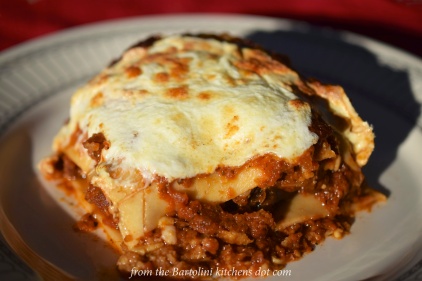
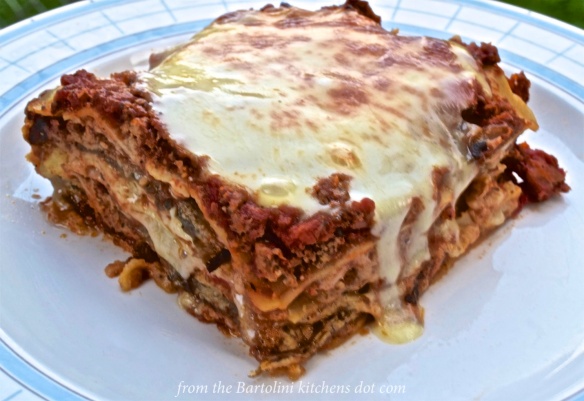
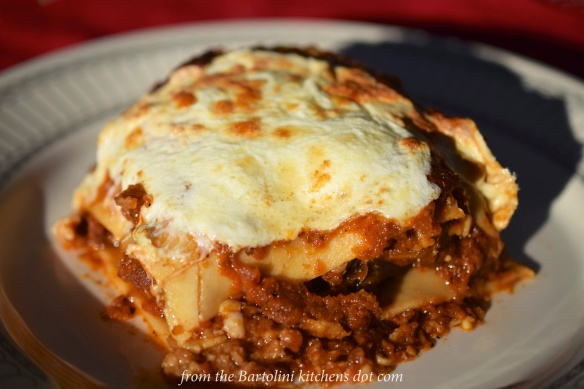
This post was actually written and the lasagna prepared last summer, when I was at the height of the Great Eggplant Glut of 2017. At the time, I promised that I’d post the recipe. Well. my birthday is coming next week and I was in need of something to prepare in celebration. Unfortunately, despite recent attempts to stretch the parameters, I’m still rather restricted to soft foods. Just as I’ve done, i could make a soup, or pasta, or soup with pasta but I wanted something a bit more special. Enter eggplant lasagna. Lucky for me, there’s a tray waiting for me in the freezer. Oh, boy!

Now, to be clear, this dish contains my homemade pasta and, therefore, is not gluten-free (GF). If the noodles are to be omitted, I’d rather make eggplant parmesan, this lasagna’s GF cousin. Well, it is my birthday and sometimes I just want a nice plate of good old-fashioned gluten. Sue me but at least send a birthday card before you do.

The recipe is easy enough. You can use any kind of lasagna noodle that you wish. Follow the directions on the package for store-bought noodles. If using “no-bake” noodles, I give them a quick rinse in hot tap water before placing in the tray. That helps to ensure that each noodle gets enough moisture to cook properly. If at all possible, use freshly made pasta noodles, They only require about a two-minute blanch in boiling water before use but the difference in taste is remarkable. Do it once and you’ll be sold.

*     *     *

ETA: For a slightly different take, one more true to the dish’s Sicilian roots, take a look at Bea’s recipe on her delicious Viaggiando con Bea, Travels with Bea. One can never have too many lasagna recipes.

*     *     *
eggplant-lasagna-preview

*     *     *

Eggplant Lasagna Recipe

Ingredients

  • medium-sized eggplants (see Notes)
  • cooking spray
  • about 1 quart tomato sauce (Vegetarians use meatless)
  • butter to grease the baking dish
  • pasta sheets to create 3 layers
  • 4 oz mozzarella cheese, grated
  • 4 oz  Asiago cheese, grated
  • 4 oz Pecorino Romano cheese, grated
  • fresh mozzarella, cut into rounds
  • Pecorino Romano cheese, grated, for serving

*     *     *

This slideshow requires JavaScript.

*     *     *

Directions

  1. Preheat oven to 450˚ F (230˚ C). Liberally butter baking dish/pan.
  2. Prepare the eggplant(s):
    • Trim off ends of eggplants and slice into 1/2 inch rounds. (See Notes)
    • Place rounds in a single layer on a rack resting upon a baking sheet.
    • Lightly spray each side and sprinkle with salt.
    • Bake for 15 minutes,
    • Remove from oven and reserve.
  3. Reduce oven to 350˚ F (175˚ C).
  4. Meanwhile, cook lasagna noodles per package instructions,
  5. If using fresh noodles, par-boil for about 2 minutes before rinsing is cold water.
  6. Assemble the lasagna:
    • Lightly coat the bottom of the baking dish/pan with tomato sauce.
    • Place enough pasta sheets to create a single layer.
    • Add a single layer of eggplant rounds.
    • Cover with a layer of sauce.
    • Sprinkle half of the grated cheese mixture.
    • Sprinkle with 1/3 of the grated Pecorino Romano.
    • Add another layer of noodles, eggplant rounds, sauce, and cheeses.
    • Add the final layer of noodles and enough tomato sauce to cover.
    • Evenly distribute the mozzarella rings and sprinkle the rest of the Pecorino Romano cheese on top.
    • Cover with aluminum foil. (See Notes)
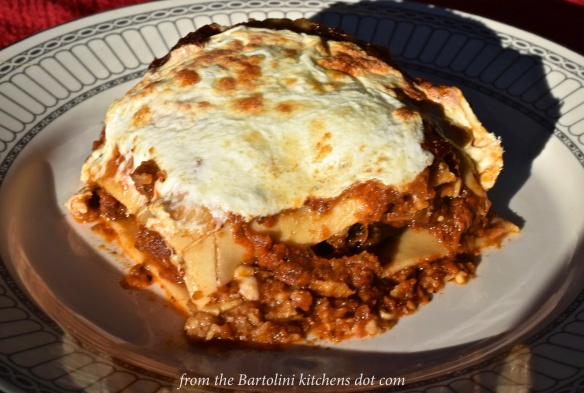
  7. Bake for 20 minutes, uncover, raise the oven temperature to 450˚F (230˚ C), and bake until lightly browned, about 20 minutes more.
  8. Allow to rest for at least 15 minutes before serving. Be sure to have grated Pecorino Romano available at the table. (See Notes)

*     *     *
eggplant-lasagna-10*     *     *

Notes

You will need enough eggplant rings to create 2 layers in whatever size baking dish/pan you’re going to use.

When preparing eggplant parmesan, I do not peel the eggplant, the peel adding structure to the dish. In lasagna, the noodles add some structure, so, strips of the eggplant’s peel are removed.

Lightly coating the inside of the aluminum foil with cooking spray will help prevent it sticking to the mozzarella should the 2 come in contact while baking.

Once baking is complete, be sure to give the lasagna ample time to rest and set. It will be easier to serve and will retain its shape far better than if sliced immediately upon removal from the oven.

This past summer, I made a couple extra trays of lasagna and froze them. Once fully cooked and cooled, wrap the trays in plastic wrap before wrapping with aluminum foil. The night before you intend to serve the lasagna, place the tray in the fridge for defrosting. The next day, unwrap and remove the plastic wrap, and place the tray, recovered with foil, into a preheated 350˚ F (175˚ C) oven. Serve when heated through.

*     *     *

It’s déjà vu all over again …
cherry-pie

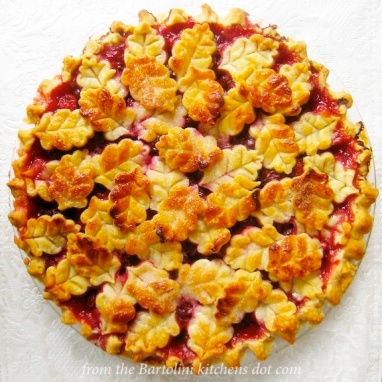
It’s that time of year again. Every January, I go to the freezer in my basement and retrieve a bag of frozen tart cherries. The current January Thaw notwithstanding, a mid-winter cherry pie reminds me of the previous summer when the cherries were bought and put away, out of sight. Now, while I prepare, bake, and enjoy a cherry pie, I cannot help but dream of the summer to come. Old Man Winter may still claim the outdoors but here, in my kitchen, summer rules once again. And if this doesn’t work? No problem. There’s another bag in that freezer, though it’s contents will be used to prepare cherry muffins. One way or another, summer is coming. (Take that, Jon Snow!)  You can see the cherry pie recipe HERE and the cherry muffin recipe HERE.

*     *     *

Coming soon to a monitor near you …
meatloaf-preview

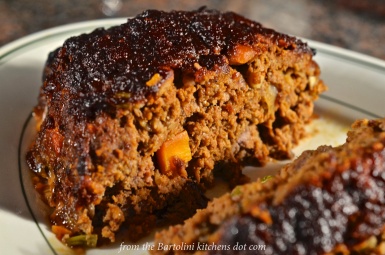
Meatloaf

*     *     *

Panettone Pain Perdu and Bread Pudding

Panettone

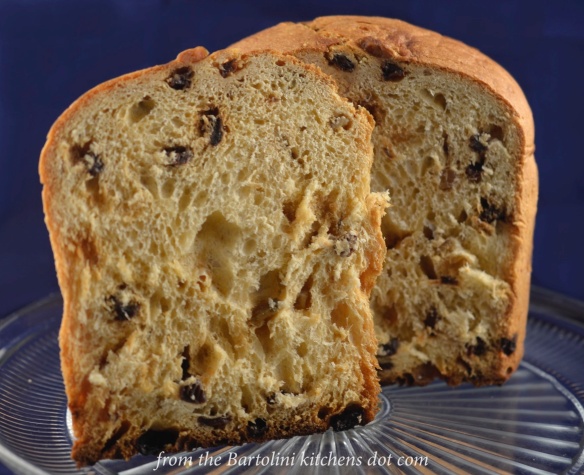
Panettone is a sweetened bread from the Milan area that Italians enjoy throughout the holidays. Containing candied citrus and raisins/sultanas, a piece of panettone served with un caffè makes a great afternoon snack. Later, a slice of panettone with a glass of prosecco – or limoncello – is the perfect ending to any meal during this festive season. That’s not the only way to serve this tasty bread, however.

Over the years, I’ve used day-old panettone to make bread pudding and pain perdu (aka French toast, aka eggy bread). In fact, very often I’ll buy a couple of the loaves and place them directly into the freezer. Weeks later, I’ll retrieve one and treat myself to pain perdu on one morning, with some bread pudding on the next. I’m not much of a breakfast person but I really do enjoy “Panettone Week”. What’s not to love? Anyway, since I so often prepare the dishes back-to-back, and the pain perdu recipe is really quite simple, I’m going to share both in one post. I’ll start with Panettone Pain Perdu — for no other reason than I’m a sucker for recipes with an alliterative title.

*     *     *

Panettone Pain Perdu

This recipe is pretty straight forward. I would caution you, however, from just slicing a panettone and diving in. Always cut and taste a slice before using it as the base for another recipe. First off, it’s delicious, so, why not? Secondly, not all panettone are created equal. Best to learn what flavors you’re dealing with before adding seasonings of any kind.

We’ve all made variations of this dish, so, there’s really no need to give it the “full recipe treatment.”  This dish is very much dependent upon your own taste.

Pre-heat your oven to 200˚ F (95˚ C).

First off, get your egg mixture together. I usually plan 1 large egg per slice of panettone. To that, I’ll add a couple of tablespoons of sour cream or Greek yogurt or cream or milk. Too Pain Perdu on the Griddlecomplicated? Grab that container of left-over eggnog and use it in place of some or all the egg mixture just described. Next, spice it up a bit. I like to grate a little nutmeg into the eggs/nog but have been known to add a little cinnamon, as well. Just be sure to taste the eggnog before adding any more spices. Depending upon how sweet your panettone is, you may want to add a little sugar to the mix, too. Now, give it a good whisk and set aside.

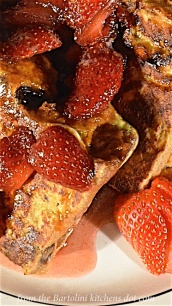
Place equal amounts of sliced strawberries – I’ve also used blueberries but any berry will do – and maple syrup in a small pan and heat over a medium heat. Once it begins to boil, reduce heat to a soft simmer and cook for about 5 minutes before turning the heat to very low to keep warm.

Now, for the panettone. You want thick slices, at least an inch-and-a-half (4 cm) thick. Panettone is filled with bits of candied fruit and they may cause thinner slices to fall apart during or after soaking.

PPP_ServedWhile you heat the griddle, frying or cast iron pan, or whatever cooking surface you intend to use, dip each piece of panettone into the eggs/nog. Be sure to evenly coat each side of every slice.  Melt a bit of butter on the cooking surface and reduce heat to medium before placing the now egg-soaked panettone into the pan. Cook until golden brown — about 5 to 8 minutes — before flipping to cook the other side. Cook for about 5 minutes more. Place on a platter and keep warm in the pre-heated oven while you cook the rest.

Serve garnished with powdered sugar (optional) and accompanied by a gravy boat filled with the warmed berry-laden syrup.

*     *     *

For a different take on Panettone Pain Perdu, check out the recipes presented by blogging buddies BAM, of Bam’s Kitchen, and/or David, of Cocoa and Lavender. If you can, take a few minutes to check out each of these 2 wonderful blogs — but eat before you do. You’re gonna be mighty hungry if you don’t.

*     *     *

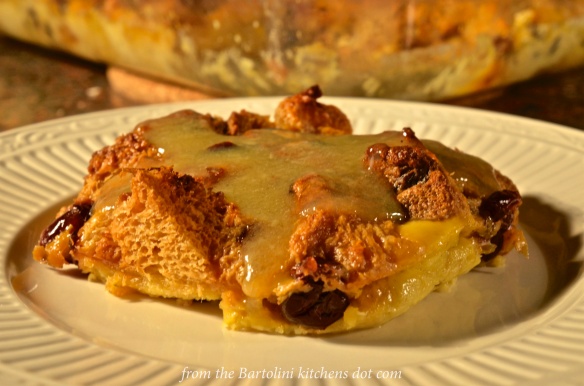
Panettone Bread Pudding

Panettone Bread Pudding Preview

*     *     *

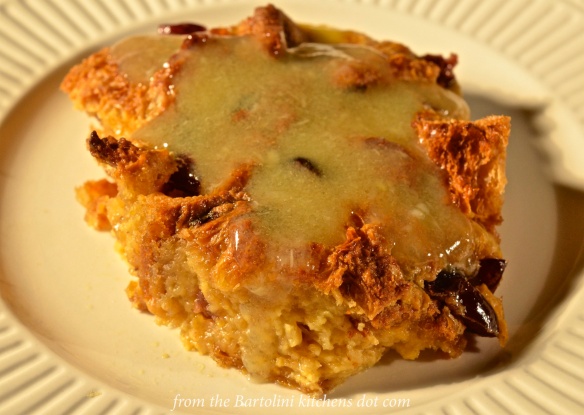
Admittedly, this dish is a little more involved to prepare but don’t let that stop you, Panettone makes a wonderful bread pudding and who doesn’t love to start the day with a bit arancello-flavored sauce?

Ingredients

for the bread pudding

  • 16 oz (450 g) panettone, cut into 1 inch (2.5 cm) cubes
  • ½ c (100 g) dried cranberries
  • ½ c arancello + 1 additional tbsp — Grand Marnier may be substituted
  • 4 whole eggs
  • 3 egg yolks
  • ⅓ cup sugar
  • 2 cups heavy cream
  • 1 cup half-and-half
  • pinch of salt
  • ¼ tsp nutmeg
  • zest of 1 orange
  • butter cut into chunks

for the orange sauce

  • 1 stick (½ cup, 113 g) butter
  • ⅓ c sugar
  • arancello reserved after soaking the dried cranberries in Step 1 — ¼ to ⅓ cup
  • juice of 1 orange
  • ⅛ tsp salt
  • 1 egg, beaten

*     *     *

panettone bread pudding pics

*     *     *

Directions

  1. At least 30 minutes before you begin, combine the dried cranberries in a bowl with 1/2 cup of arancello. Once fully soaked and needed in the recipe, drain and be sure to reserve the excess arancello for use in the orange sauce – Step 15.
  2. Liberally butter a 9 X 13″ (23 X 33 cm) baking dish.
  3. In a large mixing bowl, add 1 tbsp arancello, the eggs, and sugar. Whisk to dissolve the sugar.
  4. To the same bowl, add the heavy cream, half-and-half, salt, nutmeg, and orange zest. Mix until fully combined.
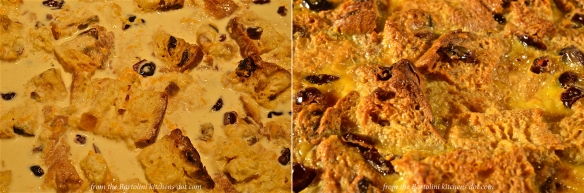
  5. Spread an even layer of the cubed panettone into the prepared banking dish.
  6. Drain the cranberries, reserving the liquid for use in the orange sauce. Sprinkle the cranberries over the top of the bread cubes in the baking dish.
  7. Give the custard mixture one last whisking before pouring it over the contents of the baking dish.
  8. Cover the dish with foil and refrigerate for at least a couple of hours or overnight.
  9. Once the dish has rested, pre-heat the oven to 350˚ F (175˚ C).
  10. Remove the foil cover and place the baking dish in an even larger pan on the oven’s center rack.
  11. Pour hot water into the larger pan until it reaches halfway up the side of the baking dish. Do not allow any water to get into the baking dish.
  12. Tent the larger pan with foil. Cut a few holes in the foil to vent any steam that may develop.
  13. After 30 minutes, remove the foil tent.
  14. Continue to bake the pudding until the custard is set and the top is browned — about 30 to 45 minutes.
  15. Pull from the oven, remove from the water bath, cover with foil, and allow to rest for 15 minutes.
  16. While the pudding rests, prepare the orange sauce.
    1. In a small sauce pan over medium heat, add the butter, sugar, arancello, orange juice, and salt. Stir and heat until the sugar is melted and the sauce fully heated.
    2. In the bowl containing the beaten egg, stir the egg as a few tablespoons of the heated sauce is added. (This will temper the egg.)
    3. Once tempered, add the eggy mixture to the sauce, whisking all the while to prevent the egg becoming scrambled.
    4. Once fully incorporated, continue to whisk the sauce until it thickens — 2 to 3 minutes. Do not allow to boil.
  17. Bring the bread pudding to the table and drizzle a little of the orange sauce atop each serving.

*     *     *

Panettone Bread Pudding 4

*     *     *

Notes

As mentioned earlier, no need to make a batch of arancello. Grand Marnier, an orange-flavored liqueur, may be substituted. For those with children or avoiding alcohol, substitute fresh orange juice for the liquor.

Add 1/4 tsp almond extract if using dried cherries instead of the cranberries

Cooking times may vary depending upon the depth and overall size of the baking dish.

*     *     *

It’s déjà vu all over again …

Eggs in Purgatory X

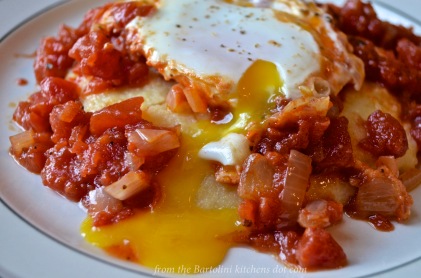
If you liked today’s eggy dishes, how about another? Although we call it Eggs in Purgatory, Uova in Purgatorio, a number of nationalities have their own version and name for the dish. In its simplest form, eggs are cooked in tomato sauce and served. Sound easy? That’s because it is. You can read all about it when you click HERE.

*     *     *

Coming soon to a monitor near you …

Eggplant Lasagna - Preview

This Year’s Birthday Dinner: Eggplant Lasagna

*     *     *