 There’s no way around it. Today’s recipe is tripe, another within the series of posts which many will find less than appealing, to put it mildly. And, once again, the overwhelming majority of my generation of the Bartolini Clan would agree. I, myself, being the only exception. Yet, tripe is an ingredient found in most of the World’s cuisines and, when cooked properly, is really quite tasty. Still, many of you may be looking for the nearest exit and, if that’s the case, you may depart HERE. All right then …

Nonna
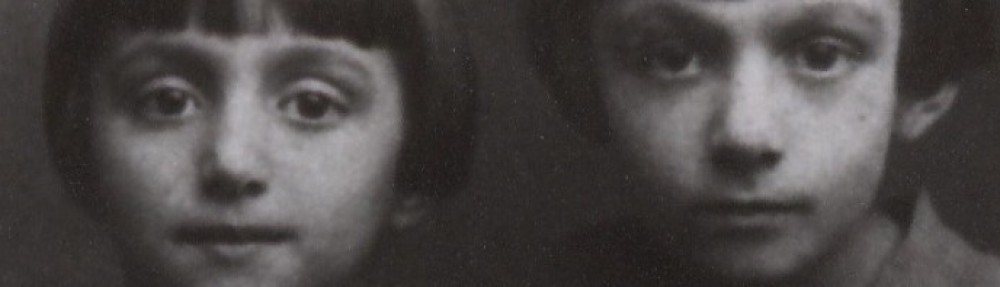
Trippa wasn’t something Mom ever prepared while I was growing up but it was a dish that the “People Upstairs” made and one that I absolutely loved. Even then, since Zia’s boys would have nothing to do with it, I believe it was usually Grandpa who requested trippa be on that day’s menu. Being that Zia had her own family’s dinner to prepare, the trippa was often made by her Mother-in-law, a woman we kids all called “Nonna” and whose name was Stefanina. She was a sweet woman and, for my siblings and I, the only Nonna we would ever really know. Since tomorrow would have been her birthday, and yesterday was mine, what better way to celebrate both than by sharing this special recipe? And it is special, as you’ll soon see.
Now, before going further, we need to revisit the 2 flat’s floor plans. You may recall that a stairwell separated my bedroom from our kitchen and the rest of our home. Directly above my room, was my cousins’ bedroom and the stairwell, also, separated their room from Zia’s kitchen and the rest of their home. So, forgetting the stairwell for a moment, my bed was about a 10 feet, in a straight line, from Mom’s stovetop and certainly less than 20 feet away from Zia’s. (Remind me again. Why did I move away from home?)
On those occasions when Grandpa prevailed upon Nonna to make a batch of trippa, the aroma of some as yet unknown delicacy, wafting down the stairs, was my siren call. A quick run up the stairs and a stealth bomber-like cruise through their kitchen was all I needed to check things out. Trippa was on the menu! I returned home via the “front stairs” and  the wait began in my room. After what seemed like an eternity, I would hear Nonna’s voice calling, “Johnny! Johnny, are you there? I’ve got surprise for you.” My feet couldn’t get me up those stairs fast enough. When I burst into the kitchen, she’d be standing there, smiling broadly, holding a dinner plate. “Would you like some polenta?” Trying not to appear too eager, I’d reply with something like, “Sure.” And so the lesson began. “This is how you make polenta, Johnny.” Holding the plate in one hand, she would use the other hand’s fingers to dot the plate’s surface with dabs of butter. Then she would sprinkle the plate with freshly ground Pecorino Romano cheese. Next, using a large spoon, Nonna would slowly and carefully cover the plate with a nice layer of freshly made polenta. By now, I was about ready to drool. “Pazienza, Johnny,” and she would dot the surface of the polenta with more butter, to be followed with another sprinkle of grated cheese. And then came the trippa. Da Vinci didn’t take such care painting the Mona Lisa as did this dear woman when she layered the trippa upon that polenta. Then came another sprinkle of cheese. And every time, when she was done, with a twinkle in her eye, she would hand me the plate and say, “This is how you make polenta with trippa.”
Many years later, I cooked a polenta dinner for Mom and Zia. They were dumbstruck when I prepared their plates just as Nonna had showed me all those years before. Although both were fully aware that she often made me a plate when she cooked trippa for Grandpa, they’d no idea how that plate was created. And today, some 40+ years after my last serving of Nonna’s cooking, I cannot prepare a dish of polenta with trippa without hearing her say, “Pazienza,” and, minutes later, when my plate is ready to eat, I just have to echo, “This is how you make polenta with trippa.”
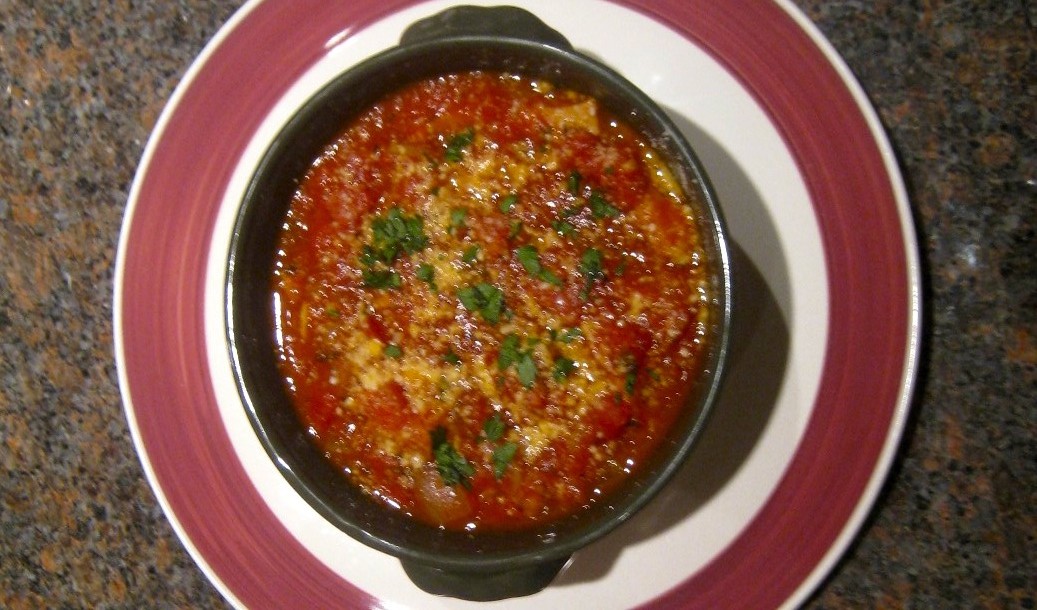
The preparation and serving of trippa that I am about to present is in the style of Le Marche (alla Marchigiani). (For tripe prepared with a distinctly Spanish flair, check out Tanya’s fantastic Chica Andaluza blog.) Today’s recipe is pretty much the same as Nonna prepared, save 2 exceptions. The first, and easiest to explain, is that I use instant polenta and I don’t know if the product was even available when Nonna was fixing me a plate. I first brought instant polenta to Mom and Zia some 20 years ago and they never served me “regular” polenta again. In fact, during his last visit to Italy in the early ’60s, Grandpa brought back a copper “polenta pot.” Each time Nonna prepared my plate, she served me polenta that she had spent 45 minutes stirring in that very pot. With the arrival of instant polenta, there was no real need for it any longer and I was given the pot several years ago. And, as “payment,” when I return home for a visit, I always bring a container or 2 of instant polenta.
* * *

* * *
The second exception has to deal with a basic of Italian cooking. Most, if not all, of the Mediterranean countries begin many of their sauces, stews, and, well, just about anything, with a mixture of diced green pepper, celery, and onion. In Italy, this is called a soffrito and it is sautéed in olive oil at the very start of many dishes, just as is done in France (mirepoix) or in Spain, Latin America, and the Caribbean (sofrito) where the ingredients may vary a bit. Even New Orléans has its “holy trinity” of onion, carrot, and green bell pepper. My family often began dishes with a different kind of soffrito called “battuto.” To make a good “battut,” you need fine quality salt pork, onion, garlic, and parsley. Exact quantities are nearly impossible to gauge. This is something that must be learned by doing. I can say that the onion makes up the majority of a battuto and a small to medium size onion will do. You will, also, need 2 to 3 oz of salt pork sliced about 1/4 inch thick, 2 to 3 garlic cloves, and about 4 tbsp of fresh parsley. That should give you about 1 to 1 1/4 cups of battut, just perfect for today’s recipe. Begin by heating your knife’s blade over a stove’s burner. Once hot, use it to roughly chop the salt pork. Next, in no specific order, roughly chop the garlic, parsley, and onion. Combine the 3 ingredients on top of the salt pork and continue to chop them all. Do not create a paste but continue chopping until the ingredients are of uniform size and well-blended. Once chopped, sauté the battut in a sauce pan with olive oil over medium heat until it develops a little color. Do not rush it nor let it burn. Once done to your satisfaction, go ahead with your recipe. For today’s recipe, if you’d started with a battut, there would be no need for the pancetta, onion, nor garlic, and the only parsley required would be added at the very end of cooking. You’ll be amazed at the flavor this simple mixture brings to a dish and your kitchen will be filled with an aroma that is just too good to be true.
My family used battuto as the base for sauces, braises, risotto, some soups, and even some vegetables. During the worst of the Great Depression, dinner often consisted of a large amount of polenta served on a large “polenta board” that had been placed in the middle of the dining table. At its very center, Grandma placed a little battuto and you had to eat your way through the polenta to get to it. Grandma, also, used battuto to dress pasta, her own version of aglio e olio. Mom and Zia stopped making battuto a number of years ago, about the time they stopped making sausage. They just couldn’t find good quality salt pork anymore. In its place, like in today’s recipe, they made a soffrito, of sorts. Not willing to give up, I keep searching for salt pork that will pass Zia’s inspection. To that end, I’ve recently learned of a Polish butcher on the West Side that reportedly has the best salt pork in town. We’ll see soon enough.
* * *
Trippa alla Stefanina Recipe
Ingredients
- 5 lbs honeycomb tripe
- 3 tbsp extra virgin olive oil
- 1/4 lb pancetta, chopped
- 1 large onion, chopped
- 4 tbsp fresh parsley, chopped, separated
- 4 garlic cloves, diced
- 1/2 cup dry white wine
- 3 tbsp tomato paste
- 1 large can (28 oz) crushed tomatoes
- 1 large can (28 oz) diced tomatoes
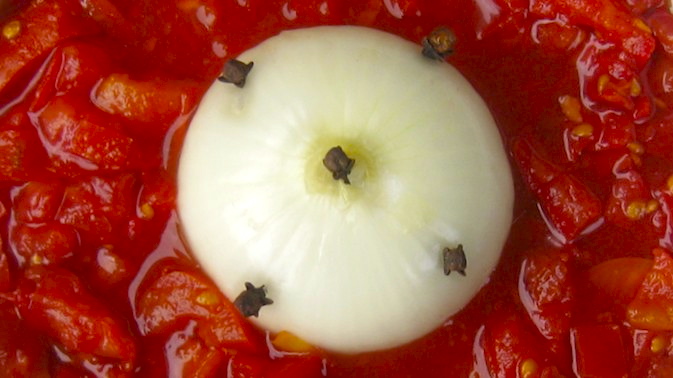
- 1 small onion, whole & studded with 5 – 6 whole cloves
- 1 tbsp marjoram
- salt & pepper, to taste
- grated Pecorino Romano cheese for serving
* * *
* * *
Directions
- Rinse trippa under cold water and trim off unusable parts. Place in a large pot, cover with water, and bring to a boil. Reduce heat and simmer, uncovered, for 1 hour.
- Remove trippa from water and, when cool enough to handle, cut into strips 1 to 2 inches in length and 1/4 to 1/3 inch wide.
- While the trippa cools, heat olive oil in medium-sized sauce pan over med-high heat. Add pancetta and sauté until cooked but not crisp, about 8 minutes.
- Add the chopped onion, half of the parsley, and sauté until onion is translucent, about 5 minutes. Season lightly with salt & pepper.
- Add garlic and sauté for another minute before adding the wine. Continue cooking until the wine is reduced and almost gone.
- Add the tomato paste and continue to sauté for 2 minutes before adding the tomatoes, marjoram, and trippa. Season with salt & pepper, stir well, and then add the clove-studded onion.
- Bring to a boil, reduce to a soft simmer, and continue cooking for at least 2 hours. Sauce should be dark and thick; the trippa should be quite tender.
- Remove studded onion and discard. Add most of the remaining parsley to the pot, taste to see if additional salt or pepper is needed, and stir well.
- Serve immediately, garnished with the remaining parsley and a sprinkling of cheese. Be sure to have grated cheese available at the table.
* * *
Serving Suggestions
Traditionally, trippa is served in deep soup bowls with a healthy chunk of crusty bread on the side. As mentioned above, our family usually served it atop polenta. Pasta fanatic that I am, I’ve even used it to dress pastas like farfalle or rotini.
Notes
Making instant polenta is quite an easy process. So much so that there’s little need to devote an entire post to it, especially since my family’s recipe is so simple. Following package directions (most require, per serving, 4 tbsp of polenta for each cup of water), bring the water to boil, add a pinch of salt, and pour the polenta into the water, whisking all the while until fully blended. Over a medium to med-low heat, stirring frequently, cook the polenta for 5 minutes. At the end, add a tablespoon of butter and grated cheese to taste. (The latter would depend upon the dish(es) that will accompany the polenta.) Mix well and serve. It couldn’t be more simple. Of course, if you want to serve polenta like Nonna, dabs of butter and all, then go for it. You won’t be disappointed.
* * *
About the Matter of Provenance
I’ve been asked, more than once, if these are really my family’s recipes. Certainly, not all of them are but, I can assure you, those that I say came from Mom, Zia, Nonna, etc., are, in fact, theirs. As further proof, below is an image of the Zia’s “polanta” recipe that can be found in the recipe book that she gave me.
* * *

* * *
Where’s Flat Ruthie Now?

Any guesses? Stay tuned …
* * *
 from the Bartolini kitchens