Fiocchetti

Fiocchetti

I was trying to find a recipe when I ran across one that I hadn’t thought about or tasted in decades. Fiocchetti are a sweet treat that Mom would make for us kids on occasion and I’ve just learned that they’re a popular item throughout Italy during Carnivale. (Who knew?) Depending upon where you are in Italy, fiocchetti  may be called: “chiacchiere”, “manzòle”, “bugie”, or “risole”. No matter what you call them, basically, they’re all the same: thin strips of sweetened dough that are deep-fried and coated with sugar. After reading that description, you can probably guess why Mom only made them for us “on occasion” and no more often than that.

“Fiocchi”

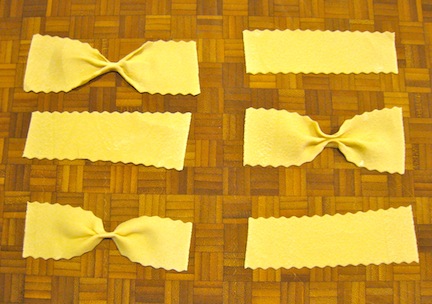
The word fiocchetti is derived from the word fioccho (pl. fiocchi) or ribbon(s). The strips, if left alone before frying, do indeed look like pieces of ribbon. Mom, however, would pinch each strip in its center, making them look like over-sized farfalle. She referred to them as either angel wings or bow ties. I can remember eating one, alone in my room, that I had stolen from the stove top while Mom was distracted. (Yeah, like a six-year-old would be able to pull off anything in that kitchen with Mom standing right there.) It was a recurring theme in our house. Mom would be cooking some treat and we three juveniles would be falling over each other trying to steal away a sample or two. It’s a wonder that any of them ever made it to the table.

*     *     *

Fiocchetti Recipe

total time: about 90 minutes, includes 60 minutes for dough to rest.

Ingredients

  • 2 cups all-purpose flour, plus as much as 1/4 cup more
  • 2 whole eggs
  • 2 egg yolks
  • 2 tbsp rum
  • 1 tbsp confectioners sugar
  • 1/8 tsp salt
  • oil for frying
  • additional confectioners sugar

Directions

  1. Mix together all ingredients and combine as if making pasta. Form a large ball.
  2. Put 1/4 c flour on work surface and knead dough, using as much of the flour as necessary to create a smooth and shiny dough. This should take about 10 minutes
  3. Cover in plastic wrap and refrigerate for at least one hour.
  4. Roll out dough until very thin and cut into strips about 6 inches long and from 1 to  3  inches wide, depending on your preference. If you like, pinch the center of each strip to create a bow-like shape.
  5. Deep fry in hot oil that has reached 350*. It should only take a minute or two for them to turn golden brown. Remove and drain on paper towels.
  6. Sprinkle with confectioners sugar before serving.

*     *     *

Home-Made Ricotta Cheese

One night in the Fall of 2009, I was having trouble sleeping so I did what I always do: I surfed the web. Eventually, I came across a cheese-making site, then another, and another. At the time, I had no idea that so many varieties of cheese could be made at home. While some – gorgonzola, cheddar, parmesan, etc. — are a bit too involved for me to attempt, I have made mozzarella, cream cheese, ricotta, mascarpone, and goat cheese, not to mention butter and herbed yogurt cheese. Although I’ve no intention of blogging about my cheesy exploits, earlier today I followed a recipe from a cooking show that produced a great batch of ricotta. Because of its simplicity and delicious results, I thought I’d devote today’s entry to the making of ricotta. For those interested in making cheese at home, I’ve listed below a few websites that I’ve used as sources for both information and supplies.

Yum!

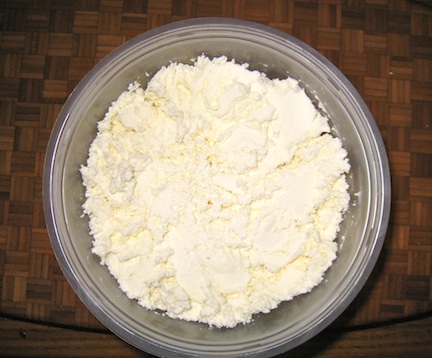
Recently, I watched a program hosted by Boston’s Brass Sisters. They planned to make their special lasagna for the firemen of a nearby firehouse and needed to buy ricotta. They went to Capone Foods, where the owner, Albert Capone, not only sold them what they needed, he shared his recipe for making ricotta. I made some earlier today and it ranks among the best ricotta that I’ve ever tasted and is certainly the easiest to make.  Looks to me like it will be stuffed shells for dinner tomorrow night.

Before attempting to make this cheese or any within my recipe collection, please refer to my Cheesy Stuff page. Chock full of cheesy details, it provides information about ingredients, cleaning/sterilizing equipment, spices & seasonings, a few tips, and sources for supplies and information.

*     *     *

Albert Capone’s Homemade Ricotta Recipe

total time: 30 minutes to prepare, at least 2 hours to drain.

yield: about 2 lbs. – recipe may be halved easily

Ingredients

  • 1 gallon whole milk
  • 1 pint heavy cream
  • 1 tbsp table salt
  • 1/2 cup white distilled vinegar

Directions

  1. Combine milk, cream, and salt in a large non-reactive pot over medium heat.
  2. Stir often to prevent scorching as you bring the temperature up to 185*.
  3. Add the vinegar, stir for 15 seconds, and heat for two more minutes before removing from heat.
  4. 15 – 20 minutes later, use a small sieve or slotted spoon to remove the floating curds and place them in a cheesecloth-lined colander to drain.  Place colander over a bowl in refrigerator and drain for at least a couple of hours or overnight.  The longer you allow it to drain, the more firm the results.
  5. Remove the ricotta from the cheesecloth, place in airtight containers, and refrigerate. Ricotta will last up to 2 weeks.

Note: Always be careful if you add fresh herbs to your newly made cheese. Although fine if served relatively soon, the fresh herbs may be a source of contamination and cause your cheese to spoil prematurely. Of course, if the freshly herbed cheese is then cooked, the “threat” is reduced.

*     *     *

Cheesy Stuff

*     *     *

Home-Made Fettuccine, Linguine, Capellini

This is more an informational page than a recipe. As such, it only involves making the pasta noodles. Should you wish to see the pasta dough recipe, please refer to Mom’s Pasta Dough recipe.

Fettuccine

As was mentioned in the pasta dough entry, Mom cut the sfoglia by hand for much of my youth. Occasionally, I’ll do it myself although, to be honest, the width of my noodles aren’t nearly as consistent as were Mom’s. Whereas hers were perfect trenette, mine are more a collection of the various noodle sizes known to Man. Either way, thick or thin cut, you just can’t beat the taste of home-made pasta.

Although I follow Mom’s recipe for making the dough, I roll it into sheets using an attachment for my Kitchen Aid stand mixer, before using a hand-cranked machine to cut the noodles. Mom, as has been mentioned, used a machine with a hand-crank to roll out her dough and cut it into noodles. Both types of rolling devices work under the same principle. The dough is passed between 2 rollers, which are manually set at varying widths. Using the Kitchen Aid attachment as a guide, the no. 1 setting is where the rollers are at their widest, producing a very thick sheet of dough; no. 10 setting will produce an extremely thin dough strip. The relative thickness of the dough strips will depend upon their eventual use. When needed for lasagna, I stop after they’ve passed through the no. 5 setting. For noodles, I stop after setting no. 6. I use the same setting for large ravioli but will use no. 7 for small ravioli, where there isn’t so much filling. Zia, on the other hand, prefers to use no. 5 for her lasagna and noodles, with no. 6 being used for all of her ravioli. Again, let your own palate be your guide.

*     *     *

Home-Made Fettuccine, Linguine, Capellini

total time: approx.  45 minutes (includes drying time)

Ingredients

  • 1 1/2 lbs. fresh dough, made using Mom’s Pasta Dough recipe
  • extra all-purpose flour for dusting the work surface and pasta sheets

Directions

  1. Be sure the dough has been allowed to rest at least 15 minutes before starting to roll it.
  2. Using a knife or dough scraper, separate a ball of dough, roughly the size of a very large egg. With your hands, flatten the dough somewhat, making a square. Set your machine’s rollers to the widest setting and dust the rollers with flour.
  3. Place one edge of the dough between the rollers and turn the crank, causing the dough to grow thinner as it passes through the rollers. Lightly flour the dough, fold it in half upon itself, and pass it through the rollers again. Repeat this, without adjusting the rollers, a few times.
  4. Get another dough “egg” and repeat steps 2 & 3. In fact, get as many dough “eggs” as you are comfortable handling. Just remember to keep the remaining dough covered while you work with the “eggs.”
  5. Once you have rolled a few “eggs”, adjust the rollers to the next setting and pass each dough sheet through the rollers. If the dough is at all sticky, dust the sheets with flour. When all the sheets have been rolled, fold each in half and send through the rollers again.
  6. Adjust the rollers and repeat Step 5, again and again, until the strips are the desired thinness. You shouldn’t need to flour the strips between passes through the rollers.
  7. At this point, the dough strips will need to dry a bit before cutting. This could take anywhere from 5 to 20 minutes, or so. Much depends on your home’s temperature and humidity. If the strips aren’t dry enough, the freshly cut pasta will stick together and you’ll need to separate the noodles by hand. Just as strips that are too moist are a problem, so are strips that are too dry. In the latter case, the dough will crack & break during the cutting process. The dough strips need to be pliable.
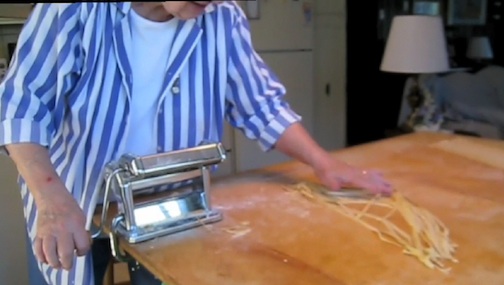
  8. Once the sheets are suitably dried, pass them through the cutting rollers on your machine. Work the crank with one hand as you catch the noodles with the other. The freshly cut pasta may be lightly formed into bird’s nests or spread out on baking sheets, table tops, or floured towels. The pasta may be cooked immediately or allowed to dry completely, which should occur relatively quickly. If heat and humidity are a problem, freeze the freshly cut pasta to prevent mold from developing. Your pasta will store for weeks, whether dried or frozen, but the sooner used the better.

Variations

The steps outlined above use a machine to cut the fresh noodles. You can, if you like, try cutting them by hand. Take a strip of dough and fold it in half, thereby reducing its length by half. Fold it again in half, then again, and again, and again. The result should be a multi-layered dough strip about 2 – 3 inches wide. This is called sfoglia. Starting at one end and using a sharp knife, cut strips as thin as you like. Once the entire sfoglia has been cut this way, unfold the thin strips and these are your noodles.

*     *     *

Mom’s Pasta Dough

Hand-Rolling the Dough

Making pasta at home sure has changed a lot, just during my lifetime. For centuries, Italian women took a mound of flour, made a volcano-like cavity in its center, added a few eggs or some water, and slowly started combining the 2 ingredients. Eventually, a ball of dough would be formed, which they would knead before setting it aside to rest. (Let’s be clear: it’s the dough that rested.) Then, using long rolling pins, they rolled out the dough into huge sheets, 3 to 4 feet in diameter, and as thick as that day’s pasta required. The sheets would be laid somewhere to dry a bit before being folded repeatedly upon themselves to make sfoglia, which was then cut by hand with a sharp knife. It was the width of the noodle that determined the pasta — i.e., extremely thin: capellini (angel hair); somewhat thicker: spaghetti; a little thicker: trenette; a shade thicker: linguine; thicker still: fettuccine; etc. I think you get the idea. For generations, this is how pasta was made and our house was no different.  I have fond memories of the women of the house wielding their rolling pins; of wheels of dough drying on floured sheets covering tabletops, beds, and even the backs of chairs; of the family dog being banished while the dough dried; and, of the sound of Mom’s knife quickly cutting perfectly sized linguine, while holding a conversation with one of us or whomever entered her kitchen — and it was her kitchen. Then, about the time I entered high school, everything changed. Our family’s first pasta machine was purchased.

Sfoglia

Although relatively commonplace now, I’ve no idea how widespread their use was in the late 1960’s. I do know that Mom got her machine first and that things changed from that day forward. Mom’s long rolling-pin was all but retired. (She gave it to me a few years before she died.) Instead of round wheels of dough drying around the house, there were now strips of dough — and far fewer of them. You see, if you didn’t have to hand-roll the dough, you could do it more often and make less when you did. More change was to come when my sister and I bought Mom a food processor. Gone were the flour mounds and volcanoes, replaced by a 30 second whirl in this beauty built by Cuisinart.
Pasta Machine

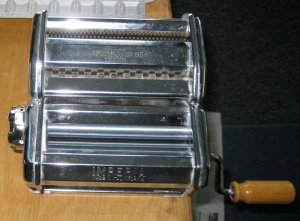
Against this backdrop of technological advancement stood my Dad, a bit of a “pasta purist.” He insisted that he could tell the difference between pasta that was hand-rolled and that which was rolled by machine. As my sister lovingly recalls, if Dad noticed Mom preparing to make pasta that morning, he’d remind her of the benefits of rolling the dough by hand and ask that she do so. Mom would agree and a satisfied Dad would leave for work. Dad’s car was barely down the street when Mom went to the cupboard and pulled out the machine. (As I mentioned, it was her kitchen.) Later, at dinner, the hint of a wry smile would grace Mom’s face as Dad praised her “hand-rolled pasta.”

Pasta dough recipes abound on the internet. Just google “pasta dough recipe” and you’ll see what I mean. The one constant that all of the recipes share is that there is nothing exact about making pasta dough. For starters, not all “Grade A Large” eggs are created equal; some are larger than others. As for the flour, not only do you have to contend with differences between the kinds of flour, things like humidity and how you measure it will affect your dough, as well. These things may seem minor but you have to remember that as little as a tablespoon of liquid can make your dough too wet or, if it’s lacking, too dry.
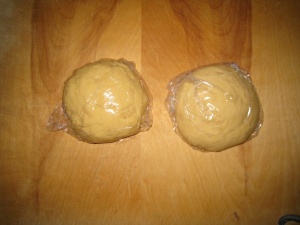
Double Batch

Dough at Rest

This recipe was given to Mom by long-time family friend, Emilia, who had converted a few recipes for preparation using a food processor. (“Milia” and her husband were my brother’s god-parents.)  I follow this recipe because it uses a specific amount of liquid, thereby removing any variance resulting from eggs of differing sizes. Though flour-related variables may remain, at least we’re using a constant amount of liquid. Beyond that, one thing is certain: when making pasta dough, experience is the most important ingredient.

This post will only cover making pasta dough. Future posts will detail its uses.

*     *     *

Pasta Dough Recipe

makes about 1.5 lbs

total time: approx. 45 minutes (includes 30 minutes rest)

Ingredients

  • 2 3/4 to 3 cups all-purpose flour
  • 4 whole large eggs + enough water to equal 1 cup of liquid. Egg should be allowed to sit on a counter for about 30 minutes before use.

Directions

  1. Place all ingredients in food processor and mix until a ball of dough forms, about 30 seconds. Place dough on floured work surface.
  2. Dough should not be stick to your fingers but should be moist enough to form a cohesive ball.
  3. Begin kneading the dough, adding flour or water, in small amounts, as required. Knead until a smooth dough is achieved, at least 5 minutes. The longer you knead the dough, the better the pasta’s texture will be.
  4. Cover with plastic wrap and set aside for at least 15 minutes or up to an hour. If dough is to be rested longer than an hour, place it in the refrigerator. When removed from the refrigerator, temper the dough by leaving it on a counter for 30 minutes before using.

Variations

  • I prefer to add a pinch of salt and a dash (about 1/8 tsp) of olive oil to my pasta dough.
  • For green (verde) noodles, mix a couple of tablespoons of finely chopped spinach with the flour before adding the egg liquid to the food processor. Zia recalls that, years ago, they used spinach baby food when making pasta verde. 

*     *     *