

Although I had planned today’s post weeks ago, it really could not have come at a better time. When that virus most vile invaded my world just before New Year’s, I was about as prepared for it as could be. In my freezer were quarts of turkey stock that had been made after Thanksgiving, as well as a nice supply of Mom’s broth, brodo, that I’d prepared for this post. As soon as I detected the contemptible contagion’s presence, I was off to the store for a few odds & ends, returning home where I would remain for the duration. The bastardly bacillus had chosen the wrong host, for the brodo that had served me so well as a child would now be called upon to see me through the dark days that loomed ahead.
I’ve mentioned in the past that we lived on the same block as the parish church which was across the street from our grammar school. Living so close to the school, we were expected to go home for lunch, for the school was relatively small and there was no cafeteria. Children who stayed for lunch sat at their desks and ate. We, on the other hand, raced home where Mom had lunch ready for us. To be sure, at the start of the school year, our lunches often consisted of sandwiches, an occasional burger or hot dog, and fish sticks, tuna salad, or some other meatless delight on Fridays. As the year progressed and the weather grew colder, soup would come to play a larger role in our noontime meals. It was no coincidence that, just as the temperatures began to dip, Mom’s old stockpot would make its first appearance on a Sunday morning, having spent weeks in hiding someplace out of sight.

Sunday was the only day that Dad didn’t work at the restaurant. That morning, Sis and I often accompanied Dad on his morning rounds, returning home just in time to sit down for lunch. Once the weather turned cold, that stock pot was atop Mom’s stove virtually every Sunday morning until Spring. Some days, our Sunday lunch was just soup, with the boiled meats served on the side. (See Notes.) Other times sandwiches accompanied our soup and, of course, there were other Sundays where soup wasn’t served at all. Still, no matter how much, or how little, was used on Sunday, Mom had plans for that brodo.
On the coldest of school days, we could count on a bowl of steaming soup waiting for us at lunchtime. With Dad home for supper on Wednesdays, Mom often used her brodo to prepare risotto for us that night. And throughout the week, if a recipe required a cup of broth, Mom need look no further than the refrigerator. Beyond that, she always kept a quart of brodo in the freezer should one of us be visited by an ancestor of the beastly bacterium that recently called upon me. If Doctor Mom surmised that the malevolent microbe was not going anywhere for a few days, her stockpot was called back into duty so that when the quart of frozen brodo was gone, she’d be ready with a full pot of brodo to continue the battle.
Before detailing Mom’s recipe, a few points need mentioning. None of the soups I’ve mentioned was chicken noodle soup. To be sure, she prepared that for us but it certainly wasn’t very often. We were much more likely to be fed her brodo plain or with quadretti or acini de pepe pastas when ill and, maybe, with capelli d’angelo pasta when we were feeling better. And her brodo wasn’t made with chicken only. Like most Italian broths, 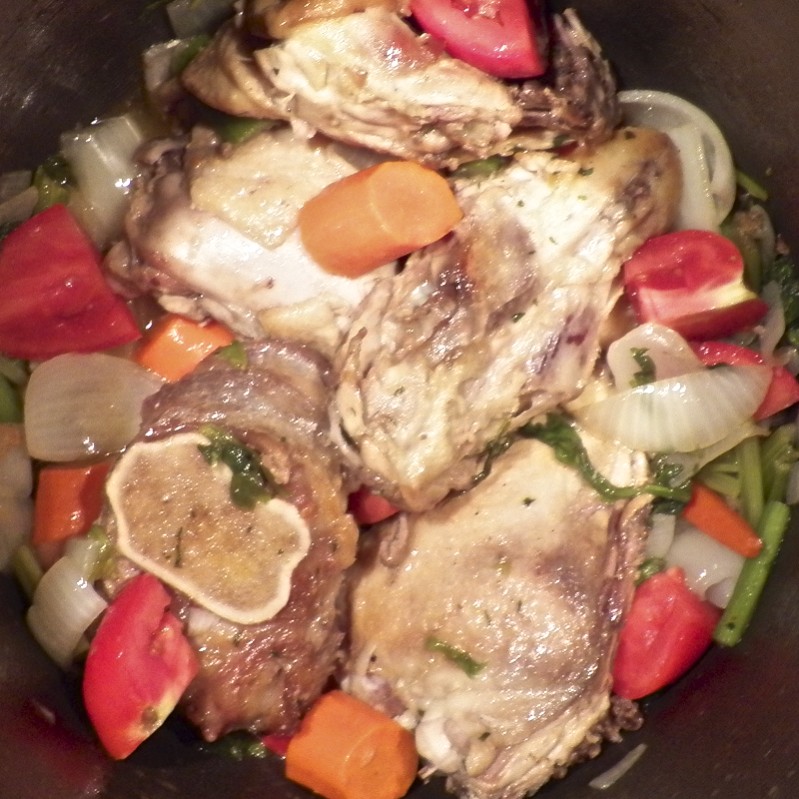 chicken and beef were used to create them. This isn’t to say Mom never made a purely chicken broth. It was, however, fairly rare for her to do so. Lastly, many cooks today will brown the chicken and vegetables before adding water to the pot. This will result in a flavorful broth, which some call “brown” chicken stock. I’ll make either one, depending upon how the broth will be used. If I intend to use the brodo to make risotto or chicken noodle soup, I’ll brown the meats (like Mom, I’ll include a piece of beef) and vegetables first. If, however, I’m going to use the brodo for cappelletti, stracciatella, or passatini, I’ll follow Mom’s lead and not brown anything. The meats, vegetables, herbs, and spices are put into a pot of cold water and then the heat is turned on. This results in a cleaner, less complex-tasting broth, one that will let the flavor of the pasta shine. (You’ll note that the photos accompanying this post are from the making of a pot of “brown” chicken stock for interest’s sake. Photos of Mom’s brodo being prepared would be nothing more than beef, chicken, and vegetables floating in water.)
* * *
Mom’s Broth Recipe
total time: approx. 3.5 hours
Ingredients
- 1 or 2 chicken thighs, with skin and bones
- 1 or 2 chicken backs
or
- 2 or 3 chicken thighs, with skin and bones
—————-
- 1 medium-sized slice of beef shank or beef “soup bone” with meat attached.
- (2 – 3 tbsp extra virgin olive oil, if browning meat and vegetables)
- 1 large onion, cut into large chunks – or – 2 medium, cut into chunks
- 2 carrots, cut into chunks
- 2 celery stalks, leaves included, cut into chunks
- 2 – 4 garlic cloves, smashed
- 1 tomato, rough chopped
- 4 – 6 parsley sprigs
- (salt & pepper, if making soup and not broth)
- 4 to 7 quarts of water, depending upon amount of meat used
Directions
- For true “brown” chicken stock, purists will omit the beef.
- Heat the olive oil in a large stock pot over medium-high heat. Add the onions, carrots, and celery. Stir occasionally while sautéing until the vegetables are lightly carmelized, about 10 minutes. Remove from pan and reserve.
- In the same pan, sear the meats. You may have to work in batches.
- When the last of the meat has been browned, return the vegetables to the pot, add the garlic, tomato, parsley, and enough water to cover all the pan’s contents by 3 inches, at least.
- For Mom’s brodo:

- Add all the ingredients to a large stock pot, and add enough water to cover all the pan’s contents by 3 inches, at least.
- Bring the ingredients to a boil, then reduce to a soft simmer. Periodically skim the film off of the surface.
- For a pot this large, I will continue simmering the broth for 2.5 to 3 hours. Your cook-times may vary depending upon how much brodo you’re making.
- When finished simmering, take the brodo off of the heat to cool somewhat. Remove the meats and reserve. Pour the broth through a fine mesh strainer, discarding the cooked vegetables and herbs. Depending upon its intended use, you can pour the broth through a clean kitchen towel, resulting in a clearer brodo. Refrigerate once strained.
- Once the broth is well-chilled, the fat will have risen to the top and can be removed relatively easily with a large spoon. Once the fat has been removed, store the brodo in air-tight containers in the refrigerator for a few days, or, in the freezer for several weeks.
* * *
Notes
More than anything, the amount of meat used will determine how much broth to make. I have a 10 quart stockpot and usually make 5 to 6 quarts of brodo. The ingredients listed reflect this and will ensure that I’ve plenty of broth my soups, risotto, or for sipping when a malicious malady attempts an invasion of my pulmonary system. Lacking a large stock pot, you should scale back the amount of meat you put into the pot. The same would hold true, for example, should you only intend to make enough brodo for that night’s risotto or soup.
You’ll note that I do not use salt and pepper in my broth unless I’m sure it will be used for soup and nothing else. Even then, I prefer not to salt it. I can always add salt to my brodo as I use it but I can do nothing, for example, to fix a risotto that’s over-salted and nothing ruins a bowl of cappelletti like a salty brodo.
Sticking with the tradition of nothing going to waste in the kitchen, Mom rescued and served whatever meat she could from the stockpot. Granted, if only chicken backs and a beef soup bone were used that morning, there’d be nothing to save. On the other hand, if there was a nice piece of beef or chicken to be found, she would shred each separately, add some of the boiled onion, and dress with a bit of olive oil and vinegar, salt & pepper. These two “salads” would be served at room temperature along with the tureen of soup.
Today, although I, too, will often make a salad with any beef that’s present, I’ll use the chicken meat in another way. After chopping the meat, I’ll sauté it in a bit of butter, seasoning it with some herb (rosemary, tarragon or thyme) and salt & pepper. In the meantime I’ll assemble the rest of the ingredients needed for a chicken salad. When the chicken is ready, my salad gets prepared, and I’ll enjoy a chicken salad sandwich with my bowl of soup.
* * *
So, you’ve made brodo. Now what?
Well, you could make chicken noodle soup but, as I said, that would not have been Mom’s first choice. I’ve already shared a few of her options and all are listed below. (Click on the photo’s caption to see its recipe.) In the future, I’ll share her recipes for soup ravioli (cappelletti) and Bartolini risotto .
* * *

* * *

Acini de Pepe with Little Meatballs
* * *

* * *

* * *
It’s déjà vu all over again …
 When I wrote earlier that I needed some odds & ends, one of those was flour. Thinking ahead, I knew that at some point I would want a little something more to eat along with my soup. Bread came to mind. Spianata, to be more specific. Made with 3 of my favorite things — garlic, onion, and rosemary — this focaccia-like bread is easy to prepare and a welcome addition to any meal — like a bowl of soup. Best of all, it will fill your kitchen with a heavenly aroma like only freshly baked bread with rosemary can. You can see the recipe by clicking HERE.
* * *
 from the Bartolini kitchens
I love homemade broth. I’ve been making a lot of those with roast chicken carcasses lately.
LikeLike
It is very rare that I roast an entire chicken these days. That’s a lot of bird for one person. If I do, however, I, too, put the carcass in the stock pot. That’s too much flavor to throw away.
Thanks for commenting, Anne.
LikeLike
My husband and I can finish a whole chicken (about 3-4 pound chicken) ourselves. Of course it took a couple of days. 😉
One time I was dining out with my family and we ordered a whole roast duck. They carved it and de-fat the duck and it was just wonderful. Afterwards, my Mom asked for the carcass of the duck. She took it home and made soup. It was just absolutely delicious. Never would have thought of it but she did. Ever since I’ve been making broth that way.
You’re welcome John.
LikeLike
Thank you so much for sharing this recipe I have been trying to find it for along time it’s not in any cook books, it’s was a favourite of ours that my aunt use to make, and now I can do it too many thanks x
LikeLiked by 1 person
And thank you for taking the time to comment, Carol. You’re not the first to write and tell me how much this recipe means to you. It makes me happy to hear this and I’m sure that Mom is smiling somewhere. 🙂
LikeLike
What a wonderful way to live and grow up. How fabulous that you could leave your school to come home for lunch – what a treat and I bet it was so hard to head back to school after such a fabulous, warming lunch. We should all be like you and your mother and turn what we normally discard or allow to ‘turn’ into nourishing and tasty stocks like this brodo. No wonder you recovered so quickly from your setback and you treated yourself with nourishment rather than drugs – excellent! xx
LikeLike
Thanks, Charlie. Funny thing. We felt like we were missing out by not being able to stay at school for lunch. That all changed after we actually did stay for lunch one day and learned there was nothing special about eating a sandwich at your desk. Our first lesson of how the grass is always greener … 🙂
LikeLike
I was excited about the broth then found the bread recipe! Great choices! I’m so sorry you got the dreaded “bug” and hope it didn’t last too long. It’s making the rounds, I hear! I love a good soup and think your Mom had the right idea making her broth on Sunday and having enough for both “then” and “later.” I never thought about mixing the chicken with the beef bones, but I can say that it looks really good. Thanks so much for the review of soup recipes. It is definitely soup weather! Stay well now. 🙂
LikeLike
Thanks, Debra, I’m doing better now. I never really did think much of Mom’s putting beef into the stockpot until I began reading recipes and really started to cook. I thought, at first, that it was something just Mom & Zia did but have come to learn that it is fairly common in Italy. It really does make a full-bodied broth. Mom always knows best. 🙂
LikeLike
How I love home-made soups during the colder months. Your Mum’s brodo sounds just the ticket to see off any dastardly bacillus!
LikeLike
It certainly works for me, Marianne. A cup of hot broth and a blanket and I was all set for the night.
LikeLike
I hope you are over the bug? I have a question, what are chicken backs? I love the options you give of your mother’s dishes with the brodo, especially the Acini di Pepe, I shall be trying that, it sounds like real comfort food.
LikeLike
I’m doing better, Maria, thank you. In our markets, you can buy whole chickens or chicken cut up into parts. When it is cut into parts, a cut is made on each side of the backbone so that it can be removed. These “backs” are sold for about 50 cents apiece and a couple of them are perfect for making broth. The best thing about the Acini di Pepe soup is the meatballs. Be sure to make extra and freeze them for later. You won’t be sorry. 🙂
LikeLike
This is what I need to reinvigorate the inner man:)
LikeLike
I know, Roger. I’m sure you could have used some of this a few days.ago. I hope you”ve turned the corner. I have finally. Whew!
LikeLike
I use chicken carcases [as we call them here] + wings for the feathery broth : is that against your ‘religion’ of cooking a brodo? Beef bones + meat I make separately into a clear beef stock . . . love having the ‘security’ of the ‘trinity’, including a vegetable one in the fridge/freezer. Haven’t thought of mixing chicken and beef: interesting!
LikeLike
Mom would save all of the chickens parts for her broths. I rarely buy whole chickens so I rarely have a carcass to add to the pot, or even wing tips, for that matter. I don’t recall Mom ever making a purely beef stock. I have and really enjoy it. Do give beef & chicken a try in your next pot of stock. I think you’ll like it.
LikeLike
Surely shall try to enjoy the flavour! We can buy ‘carcases’ at the supermarket for ‘brodo’ at about a couple of dollars [Oz is an expensive country!] each. Wings cost about 1/3 of all the other cut-up parts – less than $5/Kg!! Coming from Northern Europe beef stock was the main one we made . . . so this is a welcome learning experience!
LikeLike
Just today, I made a quick trip to the grocers and they had a number of packages of chicken backs. Normally, I would buy them all but, this time, I’ve had my fill of broth this past week. I can do without for a while. If you do try beef and chicken in the same stockpot, please come back to let me know what you think. I would love to hear your opinion — good or bad. 🙂
LikeLike
When you have homemade broth, you don’t want to make just any old soup. You want to make a soup that will shine a light on that broth. After all, you took the time to make it from scratch. The broth I had made was a classic Italian meat broth, brodo di carne, as it is known. It is, in essence, chicken broth enriched by the addition of beef marrow bones. It is a shade lighter in flavor than beef broth, but a little more robust than plain chicken broth. Italians use brodo di carne in all sorts of ways beyond soup—for simmering stews and moistening roasts, for cooking risotto, and for adding depth to pasta sauces and to sautéed vegetables.
LikeLike
I couldn’t agree more. Thanks for commenting.
LikeLike
A winter warmer for sure John. I enjoy your sharing of your memories, you really do take us back with you and it’s always a delight to do so ! Right I’m off to read your bread recipe – the ingredients have me hooked!
LikeLike
Thanks, Claire. It helps the storyteller when the audience is as kind as you always are..
LikeLike
I know you’ll understand my sadness when I tell you I’d made heaps of stock and froze much of it and then John’s elderly parents left the freezer door open and I lost it all, plus all the food in there. I will use your Mamma’s brodo recipe this weekend! It looks rich and delicious.
LikeLike
So sorry, Maureen. I read your comment and thought how badly I’d feel if I came home to find my freezer in similar shape. I think I’d cry. In fact, I know I would. I’m sure John’s parents felt terrible about it, too.
If you do make Mom’s brodo, I hope you enjoy it like we all do.
LikeLike
Fortune smiles – the Dreaded Virus has yet to appear on our doorstep – although it’s in the state in epidemic numbers already…This is the second time in a week that I’ve heard someone extolling the curative powers of broth.
I’m sold. Will make some tomorrow to have on-hand!
LikeLike
A cup of broth and a nice blanket, Marie, and I can ride out any illness. Well, mustn’t forget Max. That first night he would not leave my side. I knew I was doing all right when he relaxed a bit. 🙂
LikeLike
Your memories bring back memories of my own, We use to go home for lunch as well. I remember my mother also making homemade soup. This recipe is right on time for what they are calling a bad flu season. Hope you are feeling better. I am sure I will put this recipe to good use.
BE ENCOURAGED! BE BLESSED!
LikeLike
We were very lucky, Francine, to have a hot lunch ready for us. Who knew back then how rare that would become?
I am feeling better, Francine, thank you.
LikeLike
As I was reading about the brood and the types of soups your mom made I started to say to myself “I hope he includes links to those soups” …and of course you didn’t disappoint. I actually have never tried the browning method for making stock (brodo) but it really makes sense! I can’t wait to try this technique and your soup recipes!
LikeLike
Thank you. I think you’ll find that browning everything gives your soup a a deeper flavor. I really like to use that broth with risotto. It adds so much flavor to the rice. If and when you do try this technique, I hope you enjoy it as much as I do.
LikeLike
The Brodo sounds so good. Nothing like home made stock as a foundation for recipes. While I love the recipe and the remembrances, the thing that came to mind is, I didn’t know your father worked at a restaurant! Sorry you got the bug, glad it seems you are on the mend.
LikeLike
Thanks, David. I’m doing better now. Dad worked just about every job there was in the restaurant, save chef. He even owned one for a while. And you’re right about a good stock being the foundation of so many dishes. There are some pretty good mass-produced stocks on the market but none are as good as homemade.
LikeLike
I know I am ring my own bell here but I am a good soup maker…all kinds too. I love soup in the winter simmering on the stove, it just makes the home , well, so homey. the smell to me is intoxicating…I love this post John and I hope you are feeling better…m
LikeLike
Thanks, Maria, I am doing better now. I have Mom’s old strainer and one of the cloths she used to strain her brodo. I rarely use the cloth but, when I do, the sight of it in that strainer and smell of the brodo really does take me back in time to those Sundays many years ago.
LikeLike
John, I certainly hope you are feeling better. I thoroughly enjoyed this post and find the addition of beef to the brodo brilliant. I had never thought of adding beef and it does sound extra flavorful. Thanks for the tip on not adding salt to the brodo unless using as-is. This post definitely has me craving a bowl of soup…especially the Acini de Pepe.
LikeLike
Thanks, Geni. This bug has just about run its course and I’m doing better now.
I didn’t realize how rare it was to put beef into a stockpot with chicken until I started to cook. For a while, I didn’t add it, but I must admit, I like the flavor it lends to the broth. Now I keep a beef bone or shank slice in the freezer just for soup. You never know when you’re going to need a cup of broth — or a couple quarts.
LikeLike
A right on time broth! Feel better soon…the creeping crud is highly virulent this season according to the news.
LikeLike
Thanks, Teri. It’s just about ready to leave me now. Bar the door. This is one visitor you don’t want to let into your home.
LikeLike
I make my broth your Mom’s way except I use pork bones instead of beef, scallion instead of onion and add a few slices of fresh ginger.
I do brown my bones if using beef.
Sorry the unwelcome “bug” is hanging around, hope it departs soon..
LikeLike
Thanks, Norma, for your well wishes. I have some pork bones in my freezer that I was going to add to my next pot of tomato sauce. I think I may use them in soup now. I’d never would of thought of that, Norma, if you hadn’t mentioned it. That’s a great idea, one that I’m sure to try. Thanks again.
LikeLike
John this brought back memories for me! I have so many memories of my own moms brothy soups. No matter what I do, my soups do not tastes like hers! They are usually very simple, maybe some pastina and some carrots. But they warm me up like nothing else!
LikeLike
There’s nothing like Mom’s soup, Tanya. I can almost hear mine asking if I feel well enough to try a cup of soup. Even today, I find a cup of soup/broth is a miracle cure. ANd I bet your soups are delicious. You’re comparing them to your Mom’s and you’ll never win that comparison. I know I won’t and don’t even try. 🙂
LikeLike
I trailed off to check out your spianata recipe. Would love to bake it to go with my homemade vegetable soup. Glad I’ve discovered your blog with its memories and recipes. Hope you are feeling better now.
LikeLike
Thanks, Kathleen. Yes, I’m doing better now. I do hope you enjoy the spianata. It’a family favorite.
LikeLike
John–This sounds excellent, and pretty close to the recipe we use, but I’ve never heard of using both chicken and a beef soup bone together. Do you have any sense of whether this is a southern Italian practice, an immigrant Italian one, or maybe exclusively a Bartolini family tradition? Beef was a relatively rare commodity in southern Italy, which is why I’m struck by it. Thanks. Ken
LikeLike
You’re right, Ken. The use of beef in dishes lessens as one travels south in the Italian peninsula, as does butter. I’m not sure how widespread the combination of both beef and chicken in broth is across Italy. My Mom’s family is from Le Marche and they all added the 2 meats and the same holds true for Dad’s family from San Marino. Not very long ago, Mario Batali, on one of his shows, made broth using both beef and chicken. I think his family is from Abruzzo. I’ll mention this to Zia when we next talk. Maybe she can shed some light on it for us.
Thanks for dropping by, Ken, and taking the time to comment.
Bb-p0
LikeLike
So sorry to hear you caught that nasty bug! And good thing you had homemade broth on hand! I as well keep some in the freezer and frig for using all week. You never know when a bowl of soup is needed. And I’m finding more so in this cold weather! Your memory of going home for lunch immeditaely flashed me back to my childhood. I walked home for lunch and recall hot bowls of soup waiting for me once I discarded all my winter wrappings! My mom did as yours, whole pieces of chicken were served on the side. You always bring back the best memories, John, and heart touching recipes! Stay healthy and warm!
LikeLike
Thanks, Linda, I’m doing better now. Isn’t it a shame that kids today are missing that lunchtime experience? I realize that times are different and too many homes are dual income now, making a trip home at midday nearly impossible. Still, it was very nice to get a break from school and go home for a spell. And if you’d had a bad morning, Mom was there to tell you everything would be allright in the afternoon. 🙂
LikeLike
Very nice, John. As you know I am a big proponent of homemade stock/broth. Homemade stock/broth is sooo much better than the commercially sold stuff. Even though Baby Lady & I can’t eat a whole roasted chicken by ourselves, we will routinely roast a couple of chickens at a time. We eat whatever we want for dinner and then debone the birds. We freeze the meat and make stock with the carcasses. Typically, we get 6 qts of rich stock which also goes in the freezer. Whenever we want soups or need broth, it’s always available. The frozen chicken meat comes in handy for soups, salads, sandwiches, etc. It sure makes weeknight meals a lot easier/quicker to have these things on hand. Like others, however, I have never added beef bones to my stock although I have been known to combine beef and chicken stock for various uses. The addition of the beef bones and meat should provide an incredible depth of flavor and make a much hardier brother. I need to give this a try. Thanks for sharing. 🙂
LikeLike
Thanks, Richard, for leaving such a great comment. I do know how you guys are about your stock and I hope you try Mom’s combination of beef with chicken. The beef does add much to the broth’s overall taste. I really should follow your lead and roast more whole chickens, freezing leftovers for later. I don’t know why it never occurred to me to try this. I freeze just about anything else I make. Go figure! 🙂
LikeLike
It’s funny that you posted this on the exact day I’m planning to make some chicken noodle soup. Thanks John! I have a recipe for the broth, but this one, though similar, is my choice for this soup. As usual, I trust you more. Over the past year that I’ve been here, you haven’t led us astray even one time. I’m excited to get started, so, I’m off to broth! 🙂 Have a wonderful day John, and thanks for keeping us well-fed! xo
LikeLike
“Off to broth” January isn’t even half over and we have the year’s next catch phrase. 🙂
I hope you like this broth, Sarah, It certainly has served me well. When I showed Zia the recipe she remarked how it was just “like the old days.” That’s about the best compliment she can give me with these recipes. Good luck and have a great week!
LikeLike
Home made broth sounds wonderful right now as my silly cold is either still lingering or somehow I’ve acquired a new bucketful of ‘contemptible contagions’. Next stop dr’s office for some dreaded antibiotics. But first I’d absolutely love a giant bowl of this home-made goodness. Hope you’re feeling better soon.
LikeLike
I am feeling better, Eva. Sorry to hear that your “bug” is being so obstinate. This “thing” is certainly making the rounds. I just hope that we’re now done with cold/flu for the rest of 2013. We’ve certainly paid our dues!
Having so much broth in the freezer was heaven-sent these past 2 weeks. And it taught me a lesson. Every Fall I’m making a big pot of broth for the freezer. If nothing else, I’ll make a lot of risotto in January! 🙂
I hope you needn’t go to the Dr’s but, if you must, don’t delay. You’ve fabulous parties to plan and fine restaurants to review. You can’t do either if you’re not well. Feel better soon. 🙂
LikeLike
Thank you for your kind words, John. I’ve booked a dr.’s appointment for Monday! I am glad that you are feeling better.
LikeLike
Great looking recipe! I love a good Italian brodo — combining both poultry and beef makes such a tasty stock. By coincidence, last night I was rereading the brodo & sugo chapter of Paul Bertolli’s Cooking by Hand (a terrific read; if you haven’t read it, check it out at the library), and thinking it’s been way too long since I’ve made this. And now your post — it has to be a sign, don’t you think? 😉 Anyway, wonderful post and story, as always. Thank you.
LikeLike
Thanks, John, for the great comment and for the tip about Bertolli’s book. I found it on Amazon and wish-listed it — for now. And yes, it is a sign. You need to break out the stockpot! You’re right, too, that beef and chicken make a great stock. When I’m not sipping it by the mugful, I find it is perfect for risotto. Brings a ton of flavor to the rice.
LikeLike
“bastardly bacillus” — ha! This made me laugh, thinking it would be a perfect name for a super villain in the next Marvel comics movie. 🙂 Homemade stock is like gold, nothing in the store can compare to its goodness.
LikeLike
I’m glad you enjoyed my naming convention, Judy. After spending days under the weather, calling this “thing” the flu or a cold just didn’t seem to do it justice. “Bastardly bacillus”, however, hit just the right tone for me. 🙂
LikeLike
I caught that darn cold as well. I could really use some of this broth right now–sounds so comforting and delicious! Hope you feel better soon.
LikeLike
I am feeling better, Caroline, thank you. I hope you have someone to bring you some broth. Get a big mug of broth, a warm blanket, and find a good movie on cable. You’ll feel better soon. 🙂
LikeLike
What fantastic medicine 🙂
LikeLike
Moms always know best. (Mums, too!)
LikeLike
It is very cold here today. It has been raining for days and today there is snow everywhere and it is expected to go as low as -2 C tonight. I wish I had some of your mum’s broth in the freezer but at least now I have the recipe and I will try it very very soon because with this cold weather those horrible bacteria are sure to stop by for a visit soon
LikeLike
Cold and wet weather can be miserable, perfect for making little ones ill. I hope you and your family can avoid this, Sawsan. As I mentioned in the post, I was very lucky to have so much broth on hand. It made all the difference in the world, knowing I didn’t have to worry about cooking anything for a couple days. I certainly do hope this bug passes you by but, if it does pay a visit, I hope you’ve had time to store away some broth. Good luck! 🙂
LikeLike
Oh lovely 🙂 Nothing like homemade broth. I made some stock after Thanksgiving, need to do a post. I love the flavours you chose for this.
LikeLike
Thank you. I do hope you post your post-Thanksgiving broth recipe. I bet it’s delicious!
LikeLike
It’s on my list of things to post! 🙂 I usually do chicken, turkey, and duck stocks.
LikeLike
I always have a broth on the fridge or on the stove, everything (even potato peelings and apple cores) are collected in a bag in the freezer for when i make my stock for the broth. This is a great recipe, i shall start collecting and next time i shall make it your way.. it sounds delicious! Thank you john. And i am glad you are feeling better.. c
LikeLike
Thank you so much, Celi. I am feeling better, finally. I never would have thought to add apple cores to my stock but it makes perfect sense and could add a nice element to it. Still, it would depend on the broth’s use. For some of those soups I’ve listed, the pasta, not the broth, is the star. A couple of them use lemon zest and a simple broth lets that flavor shine better. I’ll get you to make the brodo first. Next time around I’ll get you to make the pasta. 🙂
LikeLike
I am making pasta (well I will again when I can get three eggs at a time!!) and getting better at it. There is a real feel for the dough that I am discovering that can only be discovered by doing it again and again. If i freeze my broths I label the ingredients, some are for thai soups, some for vege soups, sometimes i add cider vinegar to the vege ones but the lemon zest does sound good for a zing.. rain today? hope so. c
LikeLike
You’re right, Celi. The dough gets an elasticity that you feel and you know it when you get it. I wish you could have watched Mom roll out some dough back in the day. It was really something to see. The cappelletti also has lemon zest in the filling. It’s one ravioli you don’t mind if it opens. The filling gives the broth a wonderful flavor. Yes, rain is definitely heading this was from the South. You’ll see it before we do. 🙂
LikeLike
Hope so! c
LikeLike
Such a fantastic post – I think folk like us were bought up on brodo and it was the cure for all ills (pastina in brodo was a favourite in our house with a beaten egg alla straciatella if we needed building up!). And I love how you use all the meat afterwards. Isn´t it wonderful how these traditions that came from Italy are still alive and strong and being loved as much as they always were?! Glad you are recovering from the lurgy…
LikeLike
Thank you, Tanya. There was nothing quite like Mom appearing at bedside with a bowl of soup in her hand. That was more powerful than the strongest antibiotics. And I agree that it is nice to revisit and pass along some of these “old country” methods and traditions. They won’t die out so long as people continue to try them.
LikeLike
Beautiful post, I could visualize it all just perfectly! I like the idea of using beef and chicken to make a broth, I’ve never done that, but I be it is wonderful!
take care of yourself…
LikeLike
Thanks, Sally. Tr using both beef and chicken in the same stock. I’m sure you’ll love the broth. 🙂
LikeLike
I hope that brodo has banished the evil virus! We are in need of an infusion here — there is a lot of coughing in our house and the weather is awfully nippy. I’ve never used beef bones along with chicken bones. I guess it’s time to try!
LikeLike
Sorry to hear that this cursed virus has found its way to your home. I hope it’s a mild version and that you stay clear of it. Doctor Mom needs her strength. Take care.
LikeLike
Love this, John, and am intrigued by the addition of beef! I’ll have to try that next time. I hope you’re well and truly on the mend! x
LikeLike
Thanks, Celia, I’ve turned the corner and am doing better now. Do give beef and chicken a try. I bet you’ll like it! 🙂
LikeLike
This is such a great post from beginning to end! What an amazing childhood you had and such wonderful memories of family and food. I’ve never made a true Brodo, but my mouth waters at how delicious and flavorful your mom’s must be using both chicken and beef, and caramelizing the veggies first. I really want to try this method, as well as some of your ways to use it. I remember these terrific looking pasta soups from before and am now wanting to try one or more…with some of that Spianata, too, please!
LikeLike
THanks, Betsy, and I do hope you give this a try. Placing a piece of beef in with the chicken gives the broth a nice flavor boost. And, as for the spianata, you’re in for a real treat. The olive oil makes it pretty moist while the rosemary gives it a great flavor. I really do enjoy it and every time I make some, I wonder why I don’t do so more often. You’ll see. 🙂
LikeLike
Thanks for the memory. Sick soup was the best!!
Love Dee P.S. My kids know sick soup as well. But not as good as mom’s.
LikeLike
The soup was wonderful, no doubt about it, but I think it was more about the care with which it was served. I’m sure your kids will say the same, too. XOX John
LikeLike
John, I hope you are feeling better and thank you for taking the time with this outstanding broth. I grew up with homemade broth and acini de pepe with no meatballs. Just homemade chicken broth and the teeny pasta! Yours looks fabulous and I am going to try it very soon!! Looks delicious and thank you for the beautiful memories with your lovely story.
LikeLike
I am doing better now, Judy. Thank you. That acini di pepe sure did make the rounds, didn’t it? 🙂
I do hope you make the little meat balls. They’ve a touch of lemon zest that really does brighten a bowl of soup. Best of all, you can make a large batch and freeze what you don’t need. After you try them the first time, you’ll be happy you’ve stashed some away for a second time. 🙂
LikeLike
A terrible way to start the year by not feeling well but it sounds like your brodo served you well. I hope that you have fully recovered and are replenishing your brodo for your freezer.
LikeLike
Thanks, Karen. I am doing better now and that brodo was a big help, as you can well imagine. I’m ready for more substantial fare now, like that bean, kale, and potato soup you just posted. Now that is one good bowl of soup!
LikeLike
I’m happy to hear you are better. I’m glad you liked the soup recipe…it is good.
LikeLike
🙂
LikeLike
Wonderful post, John. I get a bit twitchy when we don’t have any good broth in the ‘fridge (or at least in the freezer). It makes all the difference in just about everything, doesn’t it?
LikeLike
Yes it does, Michelle. The quality of store-bought stock has improved but they still cannot compare with homemade. Having a couple quarts in the freezer is a very good thing. 🙂
LikeLike
My mom taught me how to make a great stock as well. I remember days when the stock pot was cooking on the stovetop several hours. Your moms recipe looks exactly like my mom’s except for the tomato. Looks SO good! I’m really looking forward to the ravioli and risotto! Great post!
LikeLike
Thanks, MJ. Mom put a tomato in her soup and in a few other dishes, as well. “For color,” she would always say. I do it, too, now and can almost here her repeating those words. 🙂
LikeLike
Your post and story remind me of my going home for lunch from school and my mother having lunch made for me, too. What a different world. I am sorry you were sick but this brodo sounds like it worked magic and provided comfort for sure.
How you were able to post your year in photos and all is astounding.
The recipes arrival in my inbox are well timed as soup season is in full swing in my kitchen. I feel good just reading your post. It was a cup of homemade broth that brought me back to wellness after a Christmas week bug, made lovingly by Erika’s mother in Ohio. Thanks for all your wonderful comments on my blog , John.
LikeLike
It is a different world, Ruth, and I feel fortunate to have experienced it. Sorry to hear you were under the weather but glad that broth helped to get you back on your feet. Never underestimate the power of a mug of steaming broth. 🙂
I really do enjoy your blog, Ruth. Your family photos are the best and it’s my pleasure to leave a comment there.
LikeLike
Are you still being haunted by that ruthless virus? Take care of yourslef and make a huge kettle of your mom’s broth. My little Italian mom used to live right across the school when she was growing up as well and went home every day for grandma Egla to make lunch. they owned a grocery store and mom used to tell stories about she used to come home with 10 of her closest friends for lunch and grandma would just put an extra potato or 2 in the pot and there was always enough. I guess not that I think of it my mom also just drops the whole chicken into the pot, no browning first. Your broth looks so very flavorful and I love those little “star shaped noodles” in such a rich broth. What do you call that shape of noodle again? Take care, BAM
LikeLike
Thanks, BAM, for your concern. I’m doing much better. I’ve just a touch of congestion left and it will be gone in a day.
Mom sometimes stuck a whole chicken in the pot, too. Back then you got “stewing” chickens for soup. These were hens that were no longer laying eggs. Mom had a way of stretching meals, too, if we brought a friend home for dinner. Suddenly, the meal would include a dish of pasta of some sort. What teenager is going to pass up a dish of homemade pasta? 🙂
Although they aren’t pictured, pasta made in the shape of little stars are called “stelline” . We were usually served quadretti, which Mom made from scraps of dough left when making other pastas. She always had a container of quadretti around in case one of us was ill.
LikeLike
Thanks John for the little background on this little pasta. My mom used to make it for me all the time. Maybe thats is exactly what I need to make for you today and by tomorrow you would be on recovery! Take Care, BAM
LikeLike
A very timely post since I think every area is getting hit with the bastardly bacillus – the mayor of Boston just declared a health emergency. Know that you have motivated me to start making AND saving broth. I just never think to do it until someone gets sick & I’d like to make a good soup for them. Another benefit to homemade stock is that you don’t have any additives like MSG or tons of sodium.
LikeLike
I agree on all counts, Diane. Having that broth in my freezer was heaven-sent and I’ll be sure to have some at the start of next flu season, too. Besides, adding homemade stock to a recipe is infinitely better than using store bought and for the reasons you stated: no MSG and far less sodium. Best of all, it tastes better!
LikeLike
Very nice John. You have a real talent for storytelling and for broth making. We used to have a big pot that sat on the side of the old Rayburn cooker. It would have an evolving soup in it. There always was plenty and it changed from day to day as different things were added and the simmering did it’s work. Your story brought all that back.
Thanks and best,
Conor
LikeLike
Thanks, Conor. That sounds like quite a soup. I can just imagine how it “evolved” as the week progressed. We had nothing like that, though we never went soup-less. Glad you like the post and that it brought back some good memories for you. 🙂
LikeLike
I always turn are leftover bones into broth and have gotten so good at it that Liz informs me that I’ve reached perfection with the broth becoming gelatinous. Gelatinous, gluttonous, or whatever…I just make the stuff. 🙂 I’ll be sure to incorporate some of your family’s ideas in my next batch though. Many thanks my friend!
LikeLike
I really do enjoy grabbing my broth from the fridge and seeing it jiggle instead of splash. Success!
It sounds like your broths need no help from mine. If it ain’t broke …
Nevertheless, thank you, Jed, for the compliment.
LikeLike
The other day I made turkey soup from the Christmas turkey bones, and the smell of it simmering all day DROVE ME CRAZY. However, I really like idea of the beef in the recipe you`ve posted here. That would be really good. I`m gonna try it the next time I`m making soup.
LikeLike
I LOVE turkey broth made after Thanksgiving. The broth is so flavorful by itself but it also makes a great soup. Better still, you can make a great tasting risotto with it. For me, it is truly one of the best things about roasting a turkey.
I hope you do try adding some beef to your chicken stock and enjoy it as much as we all do.
LikeLike
Ah, John! I wish I had this recipe back in December… Thanks for sharing. It sounds delicious and heartwarming 🙂
Cheers,
G
LikeLike
Oh, sorry, Giovanna. I was just happy to have some on-hand when I became ill. Glad you all are better and hope that your 2013 will now be cold & flu-free. 🙂
LikeLike
Pingback: Mom’s Broth - Il Brodo della Mamma | Le Marche and Food | Scoop.it
Well, you already know what a broth fan I am, so I hardly need to say that this is pretty as a picture and I’ll be looking at the various ways you’ve used it too!
LikeLike
I originally intended this post to be the basis for a couple future recipes. And then, Kathryn, I got sick. This brodo came in handy these past couple weeks. I hope you do try placing a piece of beef in with your chicken stock. The result’s a very tasty broth.
LikeLike
Pingback: Mom’s Broth - Il Brodo della Mamma | La Cucina Italiana - De Italiaanse Keuken - The Italian Kitchen | Scoop.it
Pingback: Mom’s Broth – Il Brodo della Mamma « goodthingsfromitaly
Pingback: Mom’s Broth - Il Brodo della Mamma | Savor the Flavor | Scoop.it
What a beautiful, clear stock (excuse me, brodo) and one with medicinal powers to boot! I got quite the kick out of your colourful vocabulary regarding your illness … contagion indeed, but clearly no match for for the powers of the brodo! Glad you’re feeling better.
LikeLike
THanks, Mar. Yes, I am doing better and I owe it all to Doctor Mom! She taught me well. 🙂
LikeLike
Pingback: Mom’s Broth - Il Brodo della Mamma | BEAUTY ART | Scoop.it
This is one I want to make sometime. Thanks for posting it.
LikeLike
It’s easy enough to do, Chris, and you’ll love the soup.
LikeLike
There is a feeling so – nostalgic, so far deep-down comforting – that settles when one reads your “growing up” posts John. You manage to create such a mood and such a vitality that i literally “smell” the kitchen of your childhood. I so love reading your stories John. Though I’ll not be making your momma’s brodo it’s not from any lack on your part but only dietary restrictions on mine. That in no way diminishes the pleasure I take in reading ANY post you EVER write! This was another beautiful one. Thank you!
LikeLike
Thank you, Spree, for you gracious comment. Some of these memories are so closely associated with the recipes that I cannot write one without detailing the other. Memories of Mom’s stockpot, her strainer, the container of brodo in the fridge, and the aroma come flooding back whenever I start to make a pot of stock. As I wrote the recipe, when I got to the tomato, I can hear her say, “For color.” She was always adding a tomato to some recipe for color. With memories so fresh, it’s easy to put them to paper, especially when the audience is as generous as you and my WP buddies.
As I’m sure you’re well aware, you can skip the meat & bones and still make a hearty vegetable stock. It’s every bit as tasty and makes a very good risotto, to boot. 🙂
LikeLike
Hi John, Looking at this brodo’s ingredients, I am having my own déjà vu: my grandmother, my mother, and now I cook it about the same way. The only difference is that I cook it for about 5-6 hours simmering very-very slow. I need to make some more tomorrow: we used it all up. All I have left in the freezer is brown broth/brodo and mushroom broth. Now, you made me hungry! 🙂
I hope you have recovered from that nasty cold…
LikeLike
Hi, Marina! Sometimes it’s almost like our families share the same recipe book. After simmering for 5 – 6 hours, your broth must be very flavorful! I really should try that sometime. I really don’t like being without stock. It is so much better to use in recipes than store-bought and, as I just proved, it can come in very handy when cold/flu strikes.
I’m doing much better, thank you. Time to make up for lost time! 🙂
LikeLike
It does seems that way to me too. I am with you: I don’t like store bought broth either. I don’t like any processed food in general. I made some brodo yesterday, just poured in in the jars and put in the freezer. I am glad you are better, don’t get sick anymore: we miss you here! 🙂
LikeLike
That’s very kind of you to say, Marina, Thank you.
LikeLike
I loved this post….nothing like homemade chicken broth.
The thing I liked most about this post was that you could go home for lunch from school……the way it has become with schools today, our children possibly will never be able to see such a school, or even such carefree days.
LikeLike
“What price progress?” The days of kids running home for lunch are long gone, I’m afraid. Two income households are the norm and no one is home at noon to greet them. Even so, kids today have advantages that just didn’t exist back then. It’s a trade-off, to be sure. I hope theirs is a better way because there is no going back.
Thanks for stopping by and taking the time to comment.
LikeLike
Hi John! I love the post on the brodo – we don’t have the habit of making our own brodo in my house, but in the future I will definitely want to get a huge stock pot and cook up some good brodo and your recipe is definitely the first I will go to. Thank you for all the tips!
LikeLike
Hey, Jasline! You’re such a fine cook that I’m surprised that you don’t make your own broth. As you can see, it’s very easy and you really cannot go wrong. In fact, Mom’s is a pretty basic recipe, mostly because the pastas used with it were the stars. I hope you do give it a try and make it your own. I’d love to read your post on how you made your own brodo.
LikeLike
I totally could have used this today. If only I had ready this post earlier. I made a French onion soup tonight and it would have been much better with a good homemade broth. I’ve never made one before, but I’m thinking for as much as we use it, it’s probably something I should start looking into and seriously consider. I hope you’re feeling better John. That nasty bug is sure making its rounds!
LikeLike
I am doing better, Kristy, thank you. French onion soup is soo good. I bet yours was just fine! What’s this about your not having made broth before? You’re kidding, right? You and Mike make such a great cooking team and you’ve not tried to make broth!?!?! This you must do. You will love the aroma in your kitchen and the taste! The taste is so much better than store-bought. If you have the time to bake some rolls at the same time, you guys will be eating mighty fine that night! 🙂
LikeLike
Nothing beats a homemade broth, hands-down. I bet your Mama’s was the best. Hope you are feeling better!
LikeLike
A Mom’s broth is always the best! Just ask your kids in a few years. 🙂
I’m feeling much better, Courtney. I certainly hope you’re feeling better, too.
LikeLike
I loved your story of your Mom’s broth! I usually make the browned version but maybe next time I should try your Mother’s version. I often will set aside a few cups of broth from my CrockPot when making game meats, chicken, beef or pork and freeze it. Then when I need a shot of flavor in a dish I always have some on hand!
LikeLike
Your methods sound much like Mom’s. She rarely if ever used store-bought broth, always preferring to use her own. You’ll find that soup made without browning the meat first is lighter in color and taste. For some of the pastas used, a more simple tasting soup would allow the pasta to shine. Either way it’s made, though, you just cannot beat a good bowl of soup on a cold Winter’s day.
LikeLike
Pingback: 10 Soul Warming Soups For A Cold Winter’s Day « Profiteroles & Ponytails
I can’t believe I’ve been away so long.. This soup reminds me of my mother-in-laws “brodu” (I’m not sure I’ve spelled it right, she’s from Malta). She cooks this up similar to yours, but leaves the vegetables in and told me that sometimes her mom would take the meat out and serve it separately as you’ve described. What heaven to have run home to a steam bowl of your mom’s soup… and to be served this when sick, I can imagine you were better within days!
LikeLike
The Maltese share many customs with the Italians. Serving the soup meats was just another way of eliminating waste in the kitchen. Besides, it made a great little salad.
Yes, we were very fortunate to come home everyday for lunch throughout our grammar school years. What a shame that it isn’t even a possibility for kids today. And though Mom’s brodo was a wonderful cure-all, it really wasn’t the broth as much as it was the care-giver that pulled us through. You’re a Mom, Barb. You know this to be true and if your kids haven’t said so, don’t worry. They will. 🙂
LikeLike
Great post! Homemade brodo is an important ingredient and I love reading about the family history. Your mom’s recipe is quite similar to the brodo I made for Christmas tortellini. The biggest difference is the garlic.
LikeLike
Thank you, Stefan, for leaving such a nice compliment. I recognized the similarities when I read your tortellini post. Once you get in the habit of making your own brodo, store-bought just doesn’t compare. I don’t know how they are in The Netherlands but here, many have a high salt content. As you well know, that can ruin a risotta or bowl of soup.
LikeLike
Some of the more expensive brands are pretty decent and not salty, but over $2 per cup…
LikeLike
Your eloquent posts always make me feel nostalgic 🙂 I find that soup not only warms your heart (and tummy) but also helps replenish all those lost fluids from fevers and making copious amounts of phlegm & snot 😉 Dr. Mom definitely knows best.
LikeLike
You are so right about Dr Mom. Even today, if I’ve a pot of soup on the stove because I’m not well, just a whiff of its aroma and I start to feel better. As a child, having Mom serve it to us, well, the font at Lourdes couldn’t be nearly as effective. 🙂
Thanks for leaving such a nice compliment.
LikeLike
Pingback: Go to sleep in the fireplace, you’ll sleep like a log. – Ellen Degeneres and Tortellini en Brodo (in broth) « Susartandfood's Blog
Pingback: CBBH Photo Challenge: VIEW FROM AN AIRCRAFT « East of Málaga
I’m sorry you were feeling poorly. I initially read this post a week or so ago… but time being what it has been… anyway. It’s been on my mind. It’s warmish & summer-y here now but you can feel in the early mornings the season moving. Your Mom’s Broth Recipe will be coming into the cooler months with me. Sitting at an office desk as much as I do, sometimes I just want warmth and taste and homey but not bulk. The brodo will be perfect to sip, and of course I can also use it for those lovely winter soups and stews.
LikeLike
THanks, EllaDee. I guess I was just in the first wave of our current flu epidemic. I’m much better now.
You and I are of the same mind. On a cold Winter’s night, I really enjoy a cup of broth like others would like tea or cocoa. I don’t do it often; I don’t want it to lose that specialness. It remains a comforting treat. 🙂
LikeLike
Pingback: Cappelletti in Brodo, The Super Bowl of the Bartolini | from the Bartolini kitchens
Great recipe John! This is how it’s done! Those 2 1/2 to 3 hours are necessary for the broth to taste as it should! In northen Italy, the meat you use for making the broth is called “bollito” and it is paired with what they call mostarde, made with fruits and spices. Good Job!
LikeLike
Thank you, Ambrosiana, for you kind words and being so encouraging.
It’s wonderful to see you around again. I realize the Little One will keep you busy and I hope you and your blossoming family are all well. I know this is a little late but I hope 2013 is a very good year for you!
LikeLike
Nothing more comforting, filling and deliciously satisfying than our mother’s homemade broth. Thanks for sharing your mom’s recipe. Just looking at the pictures, I can tell that every sip and bite is pure delight. I used to go home too during school breaks since home and school was a short distance. I was full of energy then.
LikeLike
We took so much for granted back then but, looking back, it sure was wonderful to have a hit bowl of soup waiting for us. And what I wouldn’t give to have that metabolism again! 😉
LikeLike
Pingback: The Bartolini Family Risotto | from the Bartolini kitchens
Pingback: The S&C Annual, “These Are a Few of My Favorite Posts” | Sweet And Crumby
Hi john. I just wanted to say a big thank you for sharing your memories & your post on your mothers brodo! My beautiful Nonna (from Trieste) has been making this brodo for me all my life (35 years..& beyond!) and I have always taken it for granted that should would be able to make it for me always, when ever I wanted it. Recently she has become ill & unable to cook her delicious meals, nor has she been able to remember the steps to making the brodo to be able to teach me. So I began my search online & came across so many…..But when I found yours I knew this was the one, the one that is made from tradition & good for the soul. It is perfect, just as my nonna would make. Even she agrees:) So thank you once again for sharing your memories. They can mean a lot more to someone else than you could even imagine 🙂 kind regards xRachelX
LikeLike
Oh, Rachel. I’m so glad that these recipes will help you, for I know exactly the situation you find yourself in. When Mom passed away, I realized that our family recipes were in danger of being lost. With my Zia’s help, what began as a repository for our family recipes became this blog. She and I both love it when someone comes looking for a lost family recipe and finds its substitute here.
Rachel, you’ve made my night and you’ll make Zia’s morning tomorrow. Feel free to contact me at any time with whatever questions you may have.
Please tell your dear Nonna that I wish her well and I hope that one day soon she’ll feel strong enough to sit in your kitchen and supervise your cooking. 🙂
LikeLike
Pingback: There’s a storm-a-comin’! Grab the … lentils? | from the Bartolini kitchens
Oh, yum. And not being a purist, I would keep in the beef. My butcher sells chicken carcases for soups. I’d be adding those as well.
LikeLiked by 1 person
I’m rather a hoarder when it comes to chicken and beef bones. I buy them whenever and wherever I see them. Stored in my freezer, I can make a pot of stock anytime I need it. Mom’s recipe is a good one. It wasn’t Sunday morning ifher stockpot wasn’t on the stove, filled with her brodo. 🙂
LikeLike
How random it is today to receive notifications on this brodo…as I have a pot on the stove cooking at the moment 🙂 and how delicious it is with your little ‘meatballs’ you include with it. (I came across that recipe once before & luckily I have saved it!) I just can’t remember what it’s called. Thank you for all your wonderful knowledge! X
LikeLiked by 1 person
Thank you, Rachel! I am so glad that you enjoy the recipes. Mom would be thrilled. The soup with meatball recipe you’re referring to was my Sister’s favorite, and you can see it here: https://fromthebartolinikitchens.com/2012/02/15/siss-soup-with-little-meatballs-minestra-con-polpettine/
Thank you for coming back to tell me how much you enjoy Mom’s recipe. It means a lot to me.
LikeLike
Pingback: Bone Marrow Risotto with Morel & Porcini Mushrooms | from the Bartolini kitchens